Messing about in boats since 1975. Online Since 1997.
Home | Intro | Our Design Process | Stock Design Info | Motor Yacht Designs | Sailing Yacht Designs | Prototype Designs
Plans List | Articles | Our CAD Design Stream | Maxsurf | SITE MAP..! | Site Search | Design Team | Contact Us
Please see the AVAILABLE BOAT PLANS web page
Nomadic Watercraft
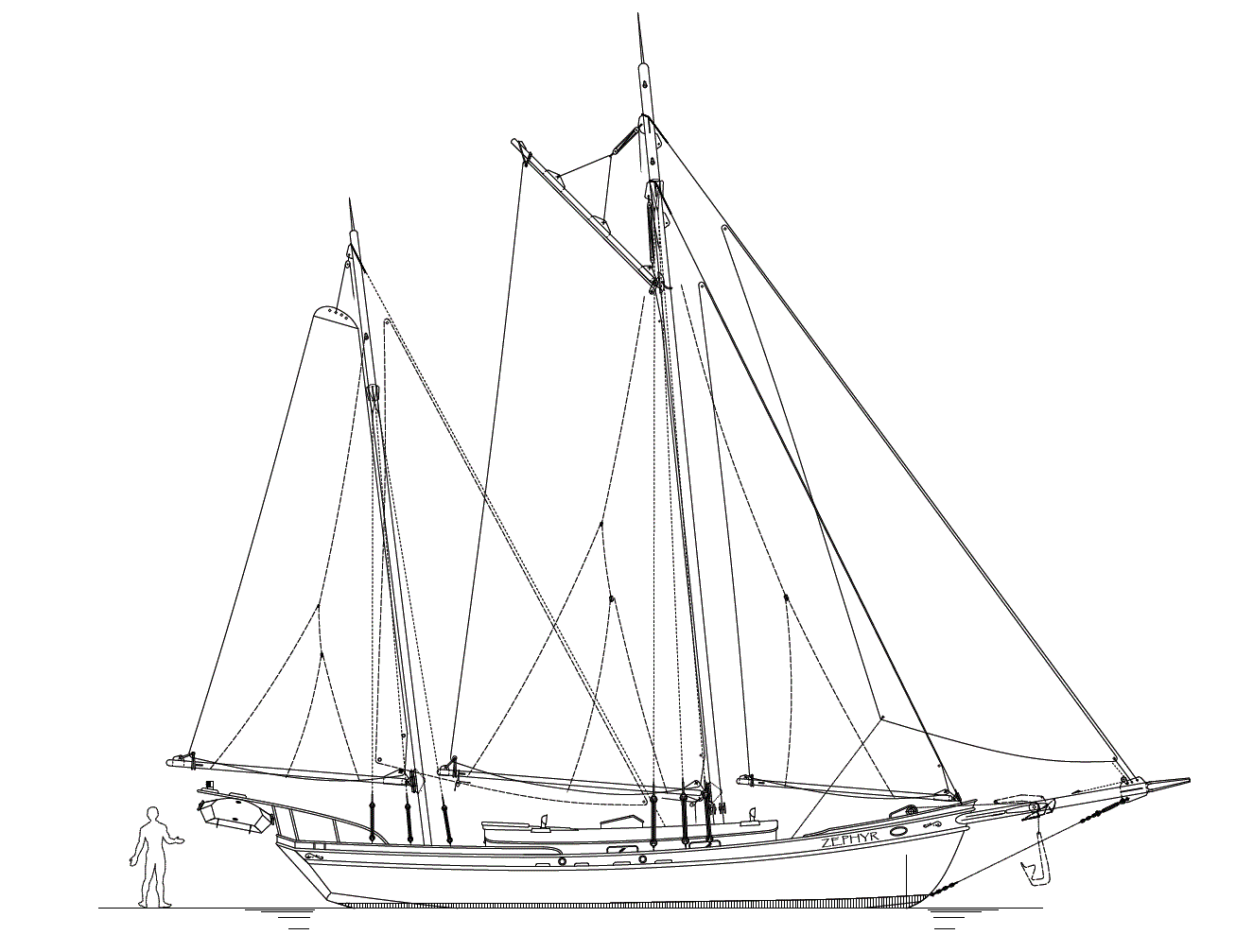
42' Ketch Zephyr
Copyright 2011 - 2022 Michael Kasten
Updated 20 February 2022
Sustaining a Design Philosophy
A recurring question -- one that I continue to ask is: "What makes my boat designs different from those in the main stream...?" Although there are many distinguishing features among them that one might identify, at the core of my approach to boat design has always been the wish to create what I call Nomadic Watercraft.
What exactly does this mean...?
Nomadic peoples are defined as being those who move from one place to another rather than settling permanently in one location, usually for the purpose of hunting, herding, or to offer skills in trade. The word "pelagic" comes from the Greek pélagos, which means "open sea." Pelagic birds and fish are those that live on the open sea and in coastal waters, often having a seasonal migration pattern. Examples of such pelagic creatures are petrels, albatross, tuna and salmon.
We can apply these terms to humans who choose to live on the water, but not necessarily in one place, and refer to them as "pelagic nomads." Taking a step further, we can define their vessels as "nomadic watercraft." By this I mean truly pelagic blue-water boats capable of being used for ocean voyaging, whether it be under power or under sail.
For this purpose, a certain degree of autonomy is required of the vessel itself. Autonomy in this context refers to a measure of independence from shore-based support.
From the Greek autonomia, the word autonomy literally means "self-law" or the capacity of a rational individual to make an informed un-coerced decision. This is not to imply anarchy, but rather a self-imposed order and sovereignty, as opposed to an externally imposed order or rule.
We refer here to an independence of function with regard to self-determination, as opposed to there being an overabundance of external support or control. In other words, the requirement for our 'Nomadic Watercraft' is that it be as independent as possible from shore-based support, as well as from externally imposed red-tape.
Essential Characteristics
Our basic needs are to have sufficient food and water, and to have adequate shelter. A core function of any nomadic watercraft is to provide a home, as well as mobility on the water. In order to create a more or less autonomous nomadic watercraft several essential characteristics must be inherent in the design:
- A sense of the familiar and the feeling of being 'at home' while onboard.
- Simplicity for the sake of ease of construction and economy of ownership.
- Ruggedness and strength in keeping with a simple structure.
- Seaworthiness and safety as well as seakindliness and comfort.
- Performance, stability and an economical means of propulsion.
- Ease of handling and excellent course keeping ability.
- Simplicity for the sake of economical maintenance and repair worldwide.
Rather than viewing a boat as merely a machine for transport and a roof over one's head, I view a cruising vessel as being one's habitat. If the vessel has been successfully designed, one will feel very much 'at home' while onboard. A voyaging watercraft of any kind after all is one's home - within which one should feel at ease, and which should always invoke good feelings. In other words, you will want to be onboard such a vessel because you like being there.
Design Examples
Among my sailing designs and prototypes there are several examples that embody the above essential characteristics, including the all-important concept of being 'at home.'
SAILING YACHT DESIGNS
The Ocean Voyaging Yacht, VALHALLA 44
AVAILABLE DESIGNS - SAIL: PROTOTYPE DESIGNS - SAIL:
- 33' Pelagic Cutter Freyja
- 36' Ketch Grace
- 36' Cutter Fantom
- 40' Schooner Benrogin
- 42' Ketch Zephyr (above)
- 42' Ketch Lucille
- 43' Ketch White Buffalo
- 44' Schooner Redpath
- 44' Pelagic Yacht Valhalla (above)
- 49' Schooner Jasmine
- 50' Schooner Lucille (below)
- 57' Brigantine Flores Privateer
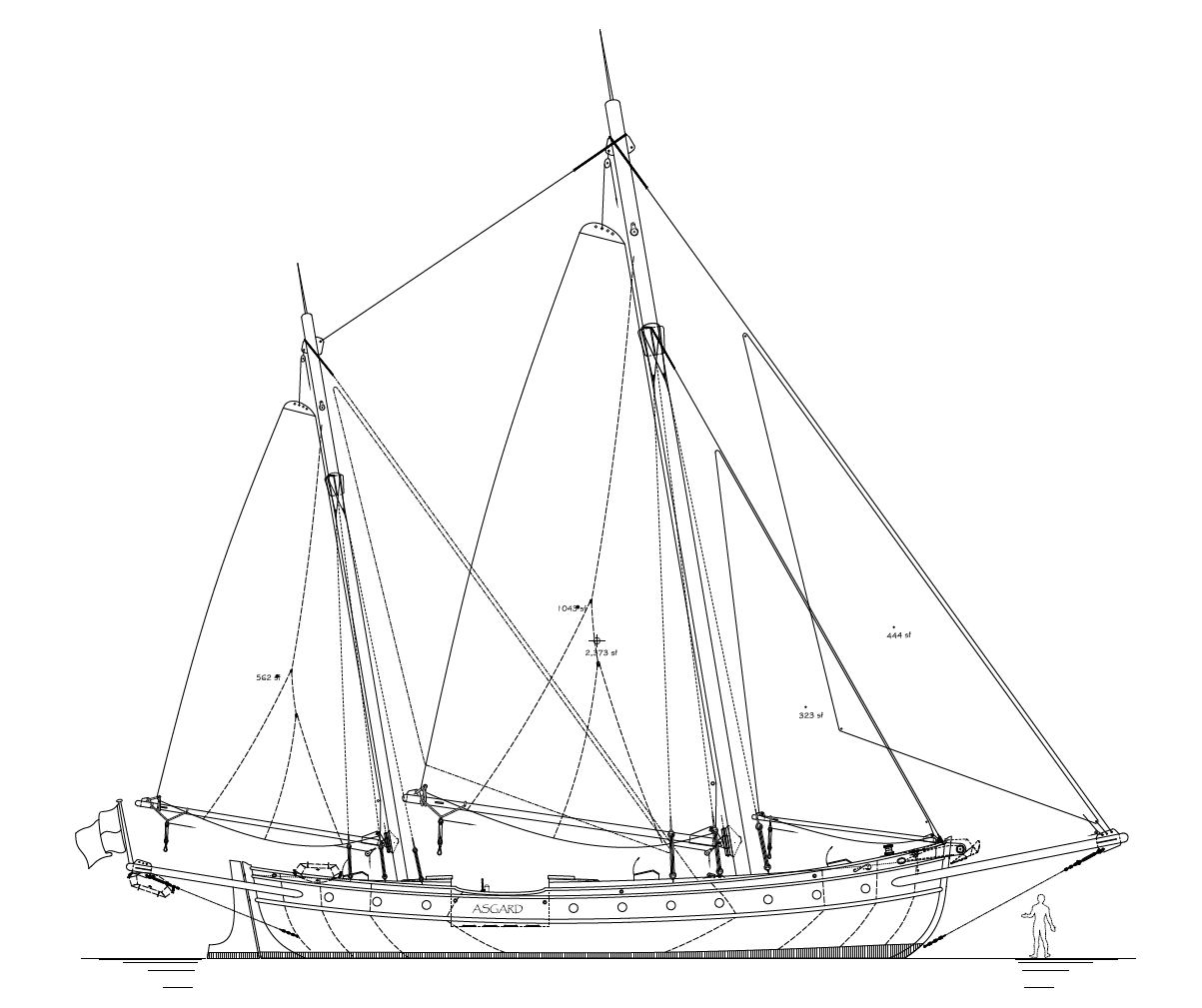
- 66' Pelagic Ketch Asgard (below)
- 66' Brigantine Sulawesi Privateer
- 28' Cutter Ernest Shackelton
- 28' Cutter Bedouin
- 28' Junk China Cat
- 38' Cutter China Cat
- 48' Ketch Awahnee III
- 48' Yawl Spray
- 50' Schooner Abshire
- 54' Schooner Wylepathaway
- 55' Schooner Josephine
- 64' Tern Schooner Amethyst
- 70' Schooner Skipjack
- 78' Schooner Pathaway
- 78' Schooner Odin
- 100' Skipjack Bermuda
The designs listed above as 'Prototype Designs' are offered in way of inspiration...
They are at present 'concept designs' that await a client for their completion.
MOTOR YACHT DESIGNS
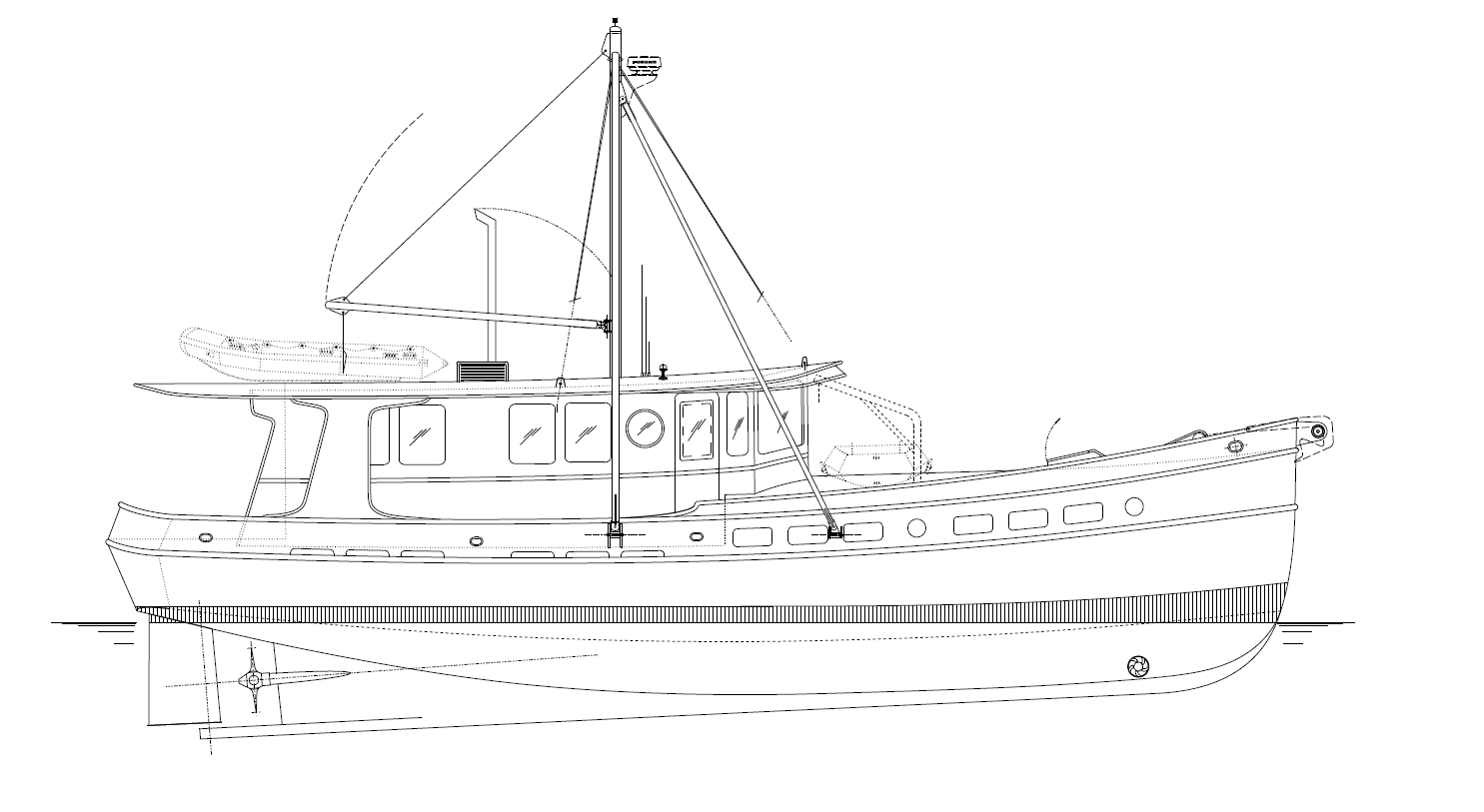
50' Trawler Yacht VAGABOND
ALL OCEAN PELAGIC COASTWISE PELAGIC
- 25' Tug Yacht Boojum
- 30' Trawler Yacht Buster
- 32' Tug Yacht Terrier
- 32' Tug Yacht Talisker **
- 38' Tug Yacht Nidaros
- 36' Motor Yacht Greatheart
- 40' Motor Yacht Coaster
- 40' Motor Yacht Far Horizon **
- 42' Motor Yacht Gulliver
- 43' Motor Yacht Roberta Jean
- 45' Motor Yacht Nomad **
- 46' Motor Yacht Far Horizon
- 49' Motor Yacht Vagrant
- 50' Motor Yacht Vagabond (above)
- 54' Motor Yacht Greatheart
- 60' Motor Yacht Swallows Nest
- 43' Dream Yacht Moxie
- 50' Dream Yacht Renegade
- 62' Dream Yacht Peregrine 62 **
- 70' Rum Runner Express **
- 82' Dream Yacht Peregrine 82 **
MULTI-HULL
- 60' Power Tri Pennywise **
A double asterisk (**) indicates a design that is a Prototype (a concept design).
A HOUSEBOAT..?
There is even a house boat intended for inland waterways....! Though not 'pelagic' in the sense of being capable on the ocean, for inland waters the house boat still embodies the essence of allowing a more or less nomadic life on the water...
- 36' Drifter
The above examples were selected primarily on the basis of their relative simplicity and their consequent economy of ownership. Naturally the word 'economy' means different things to different people, however in this context I am referring to a vessel that the owner considers to be affordable and which is easy to care for. In that sense, if I had the the means to choose among them, any of the above designs are boats that I would personally consider owning, depending though on what I could afford at the time. Just now, it would not be very big...!
Simple in this sense does not at all imply 'crude' in any way. Simplicity in this context implies an economy of structure and an elegance of form - a kind of grace on the water. I have chosen relatively more traditional types as a design paradigm - where the elements of beauty and grace are inherent. After study and observation of the working craft of the past, eventually a kind of 'boat sense' comes to the fore and you 'just know' when it is right.
This is not to imply that "style" supersedes function... However it is very much to say this: "In the sense that a vessel will be one's habitat, the creation of a certain kind of lifestyle very much *is* its function." Such lifestyle implying that the vessel be affordable, that it be easy to keep, comfortable, safe, friendly, etc. These are the feelings we usually wish to invoke when we use the term, "home."
Except for the immutable necessities imposed by physics, there are no hard and fast rules when creating a new boat design. A designer's first task is to listen to the owner's wishes. And when those wishes have been fully understood, to then begin to translate those concepts into a viable enclosure having the essential characteristics articulated above.
All design choices come down to being a matter one's own preferences. One vessel or rig type is not inherently "wrong" or another inherently "right." Instead they simply represent differing expressions of one individual's preferred style. Therefore there really can be no argument with regard to what a design has become: it always amounts to being an expression of the owner's preferences.
Most of the vessels listed above are metal boats, however two wooden sailing vessels are included. Among the metal boats, they have intentionally been given an easily built shape, i.e. a single chine hull form, so that they can be built without fuss by any amateur or professional boatbuilder. Given a simple design to start with, boatbuilding is not at all difficult, though it does require perseverance...
MODERN YACHT DESIGNS
Naturally there are many more modern vessel types that also evoke the essential sense of being 'at home' to their owners. Although the majority of my boat designs echo traditional aesthetics, we have created many designs having modern styling, and which ordinarily place greater emphasis on performance. The following are a few examples:
SAIL
POWER MULTI-HULL
- 90' Tunnel CAT (twin diesel) **
- 80' Power Tri (single diesel) **
- 50' Fast CAT (twin diesel)**
A double asterisk (**) indicates a design that is a Prototype (a concept design). Though not a hard and fast rule, it tends to be the case that with a more modern styling paradigm, the resulting vessel becomes considerably less simple. For example, on a motor yacht there is often the pursuit of higher speed, therefore the use of more powerful engines. On a sailing vessel, a more extreme high aspect rig and keel configuration are usually specified. Along with this tendency toward maximum speed, the on-board equipment and rigging ordinarily become more elaborate and complex. This need not always be the case, but it most often is. The inevitable consequence is that the boat often becomes more expensive.
This is not to deprecate these more modern and relatively more complex craft in any way - it is merely to point out the root causes of their tendency toward higher cost, both to build and to maintain. Certainly if cost is not an important factor then there is no impediment..!
But I think we digress... The overall point of this article is to point toward simplicity.
The Classic
The tendency toward complexity need not involve modern or futuristic styling. After all, one can just as easily complicate a traditional design...! I only want to point out that in general, a more traditionally styled vessel seems more in keeping with the concept of simplicity.
As a result, at least in my view, it is most often the more traditionally styled craft that seem the most inspiring, especially when given the benefit of modern materials and construction techniques. This notion should be evident upon perusal of our various Design Examples above. Among them, the more traditionally inspired craft tend to be far simpler and therefore more friendly in their overall aspect. Thus they are significantly more economical to build and far less costly to keep than their ultra modern brethren. That there is an element of our age-old maritime heritage evident in their design is a particular delight.
The Modern Classic
These days, we are able to intelligently select which elements of tradition we should leave un-changed, and freely choose others that can be improved upon in a way that is compatible with the aesthetics and functionality of the type - a favorable combination I think - one that I call Modern Classic.
The Ocean Voyaging Yacht, ASGARD 66
Focus
Whether 'modern' or 'classic' in terms of styling, if attention has been paid to the essential characteristics outlined above, even if the vessel is small and simple, we will end up with a stronger, safer, more comfortable, and even more elegant habitat on the briny deep...
We might think of these Nomadic Watercraft as being relatively affordable, portable habitat for humans during our very troubled times... a unique habitat that doesn't involve real estate, brokers, agents, banks, or overbearing bureaucratic meddling.
Creating a successful Nomadic Watercraft does not require a great deal of wealth; it does however require a certain amount of determination and resourcefulness..!
Wot to do,
An how to do it,
An if so,
Wy..?
- Krazy Kat, 1930's
Why..?
Why..? This is the essential question... In order to answer it we must begin by re-stating our original goal, which is:
"To achieve a certain degree of autonomy - a self-imposed order and sovereignty - wherein there lies potential for a true wealth of being."
It will possibly be instructive to examine the concept of Autarchy, which perhaps should be spelled Autarky for greater clarity. We will use Autarchy here, with the original definition...
The word Autarchy is derived from the Greek word "autarchia" which literally means "the state of self rule." In other words rule by oneself, the very essence of autonomy.
As a defining concept, it should be noted that Autarchy is the opposite of Anarchy... which means rule by no-one, eventuating in or implying chaos. Autarchy is also the opposite of Autocracy... which means rule by one and is synonymous with Monarchy or Dictatorship...
By contrast, Autarchy implies that each person assumes full responsibility for himself; exercises authority over himself; controls himself; supports himself; takes initiative on his own; joins with others - or not - as he so pleases; does not in any way seek to impose his will by force upon any other person; and seeks to remain unmolested by any external agent of coercion. Autarchy means that each person rules himself, and no other.
"The man of virtuous soul commands not, nor obeys."
- Percy Bysshe ShelleyAutarchy does not imply that one can live without help from others. In other words, "to voluntarily unite with others in a common objective is not a violation of freedom, but an illustration of it."
Thus, to the question, "Why?" we must answer:
"Why not...?"
How?
The next question becomes: How shall we create our own unique and autonomous habitat...?
It starts with finding or creating a good design - one that will satisfy our unique requirements. In order to address the most basic wishes of the prospective boater, I have offered the 32' Tug Yacht Terrier and the 36' Ketch Grace at substantially reduced prices. You will find them on the Plans List web page along with other designs of possible interest.
If an existing design is not found, then a new design can be created. To further explore that notion I have provided an outline of the process in my article on Custom Yacht Design.
When we create a new design, we use modern tools for modeling, analysis and construction. Our work-flow is described in an article on our CAD Design Stream. When it comes to building the vessel, a few potentially effective strategies are described within my articles on Affordable Boatbuilding and Building Offshore.
If you would like to discuss these concepts further, please inquire.
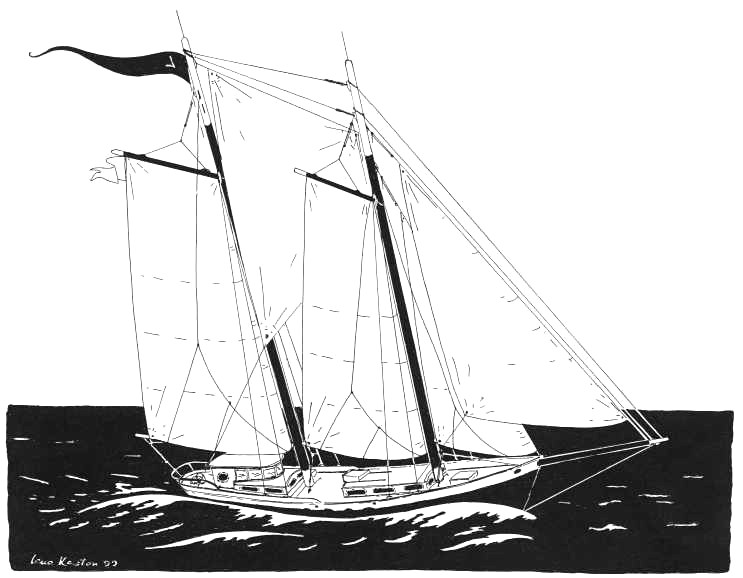
The 50' Schooner Lucille
Professional Memberships Past and Present

Royal Institution
of Naval ArchitectsSociety of Naval Architects
and Marine EngineersSociety of Boat
and Yacht DesignersMetal Boat
SocietyAmerican Boat
and Yacht Council
Please see the AVAILABLE BOAT PLANS web page.
Home | Intro | Our Design Process | Stock Design Info | Motor Yacht Designs | Sailing Yacht Designs | Prototype Designs
Plans List | Articles | Our CAD Design Stream | Maxsurf | SITE MAP..! | Site Search | Design Team | Contact Us