Messing about in boats since 1975. Online Since 1997.
Home | Intro | Our Design Process | Stock Design Info | Motor Yacht Designs | Sailing Yacht Designs | Prototype Designs
Plans List | Articles | Our CAD Design Stream | Maxsurf | News..! | SITE MAP..! | Site Search | Design Team | Contact Us
Please see the AVAILABLE BOAT PLANS web page
The 43' Classic Trawler-Yacht
"Roberta Jean"
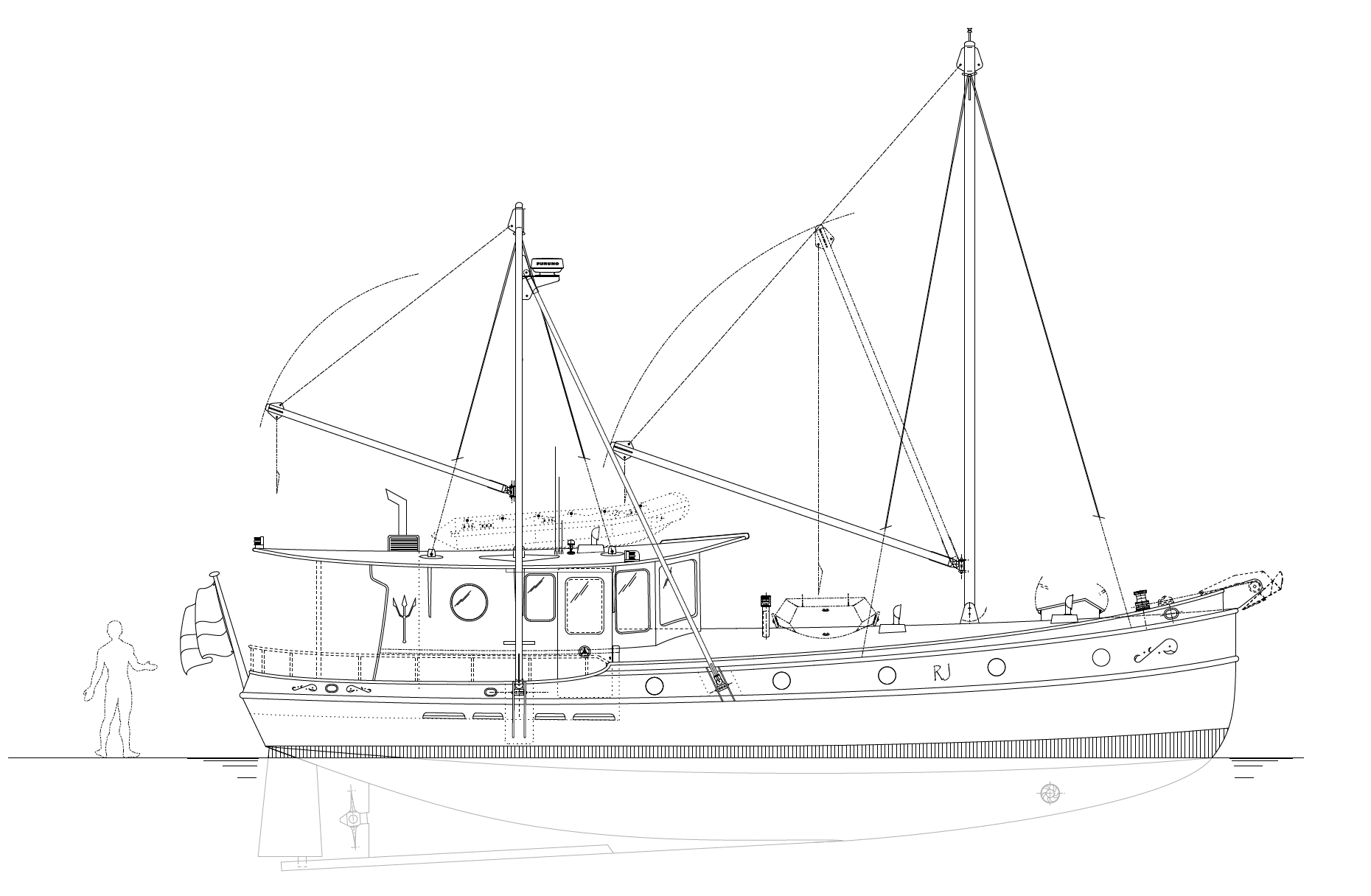
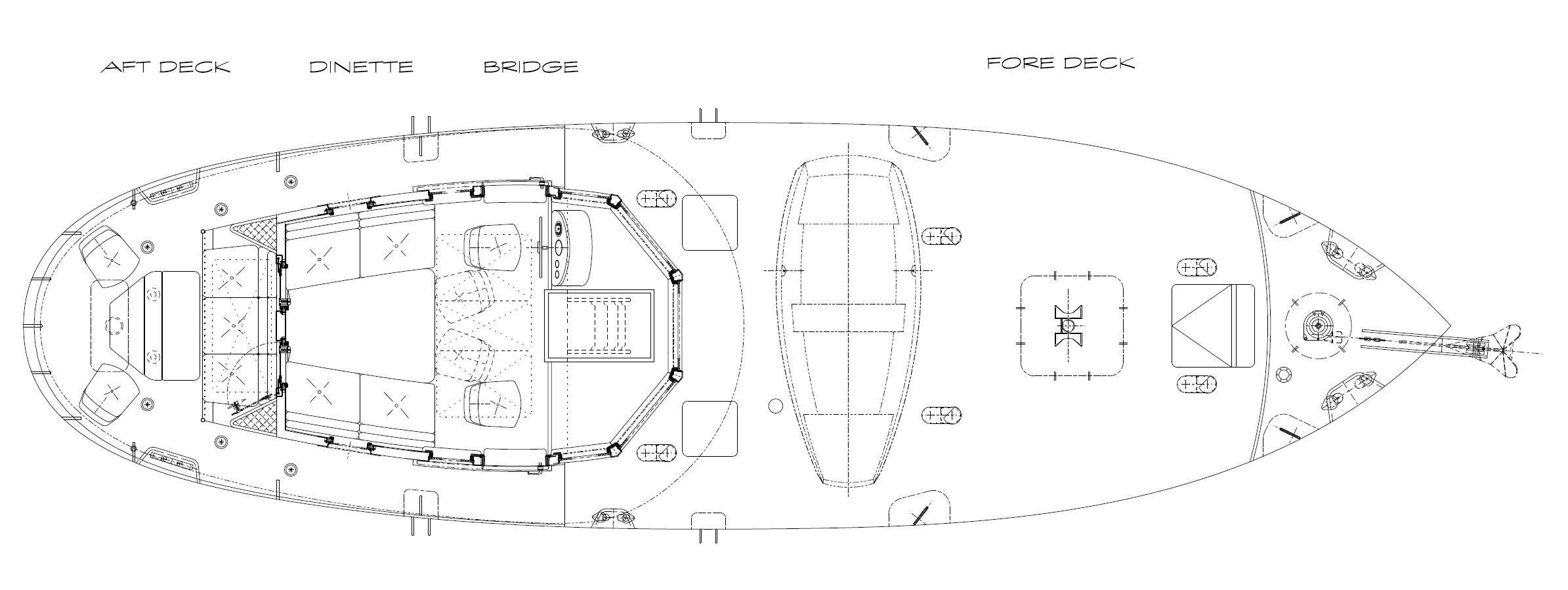
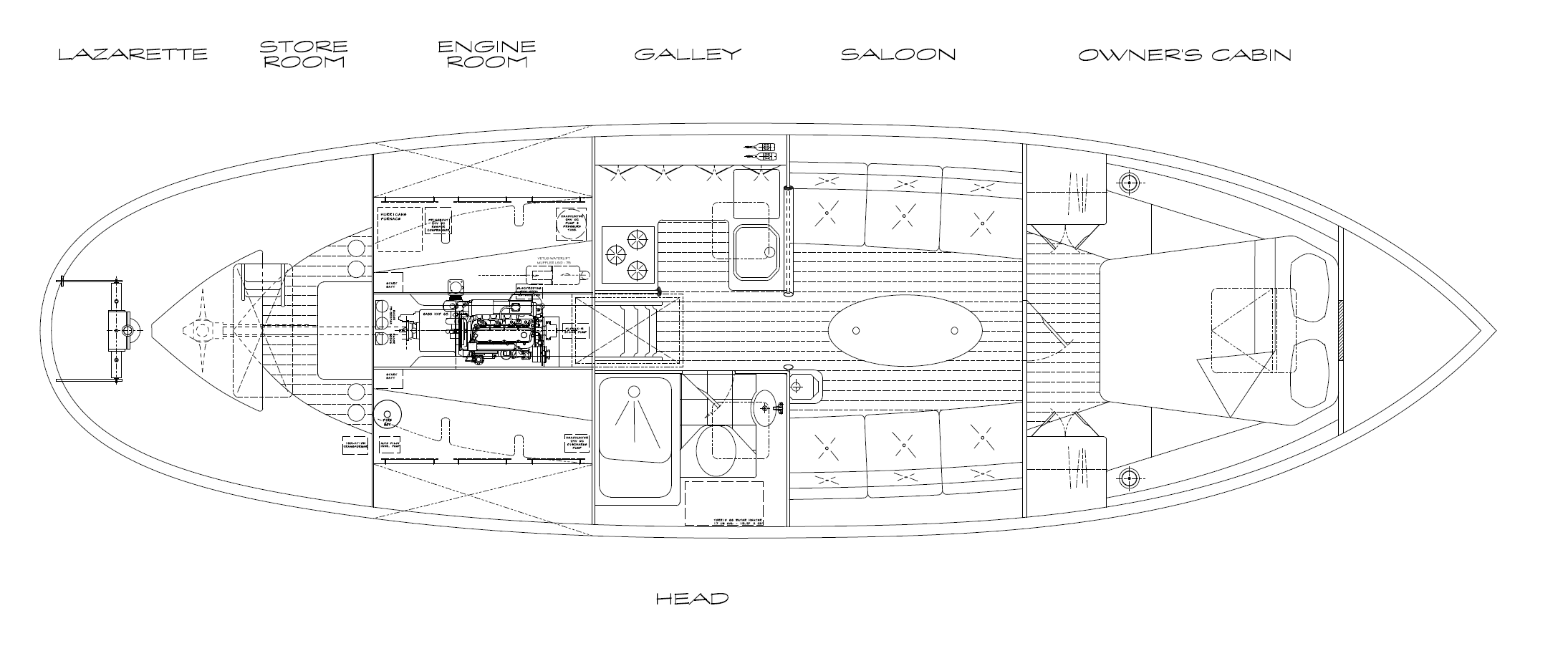
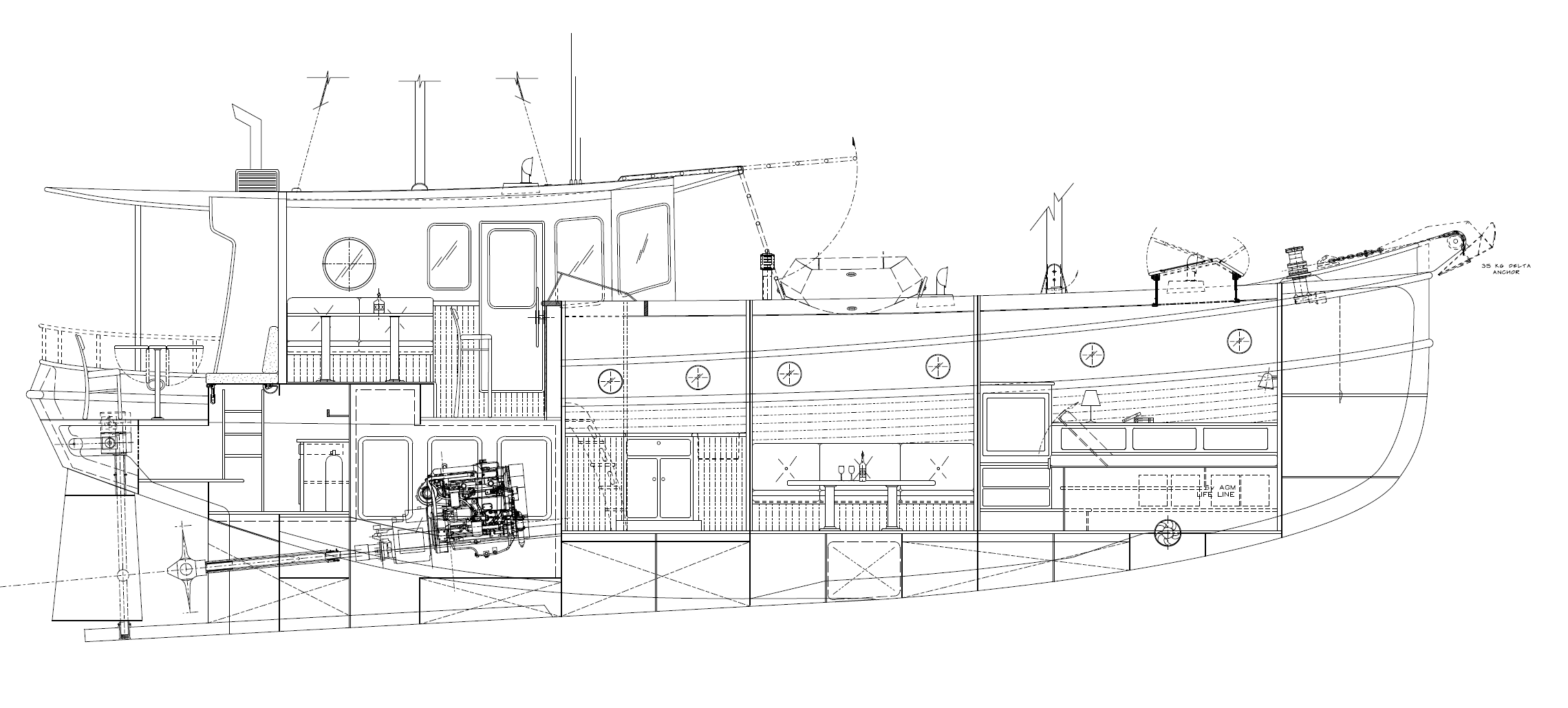
Larger Exterior Profile | Deck Plan | Interior Profile | Interior Plan
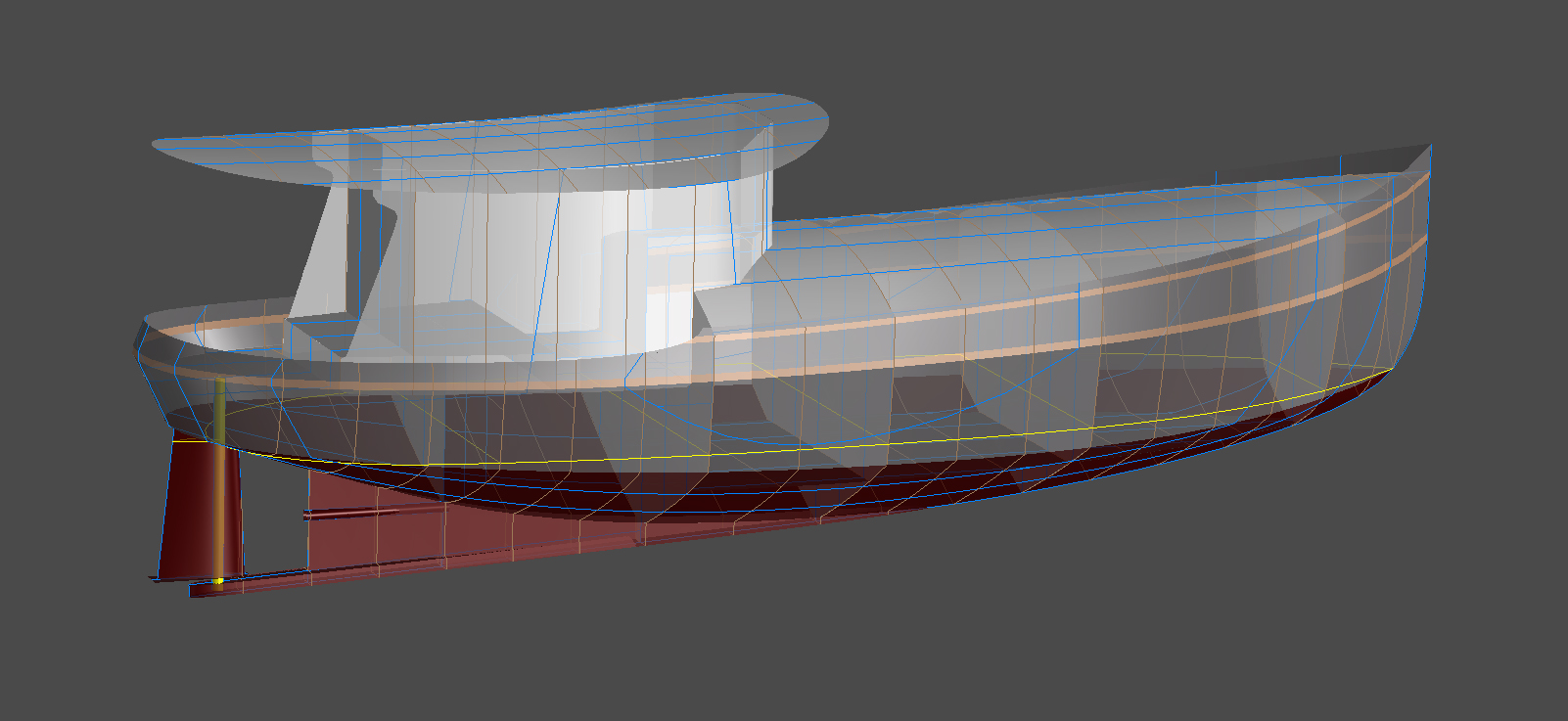
Perspective Forward | Perspective AftCopyright 2008 - 2016 Michael Kasten
General Concept
The 43' Roberta Jean is a modification of the 43' Roberta design. The 43' Roberta Jean has more room in the forward accommodations to allow for a true owner's cabin forward. That space was gained by moving the pilot house and engine room slightly farther aft. In all, quite an excellent improvement. The most recent addition to this family is the 43' White Buffalo, which retains the RJ-43 hull form and interior layout, but includes a fully capable sailing rig and a sailing keel...
These vessels have a layout that is to a large extent shared across a family of our motor yacht designs, starting with the 43' Moxie and, extending up to her bigger sisters, the 49' Quinn, the 50' Renegade, and the 60' Peregrine. Specifically, they share in common a plumb stem, a long raised fore deck, an aft-located pilot house, and a fantail stern that is reminiscent of the Lake Union Dream Boats built during the '20s and '30s in Seattle, thus the monniker I have given them: "Dream Yachts." Each of those designs represent examples of my own ideal Motor Yacht type.
For the 43' Roberta Jean we wanted to create a design with an interior layout similar to the 43' Moxie, but with a heavier displacement hull form in order to provide more elbow room throughout. I chose a hull form based on my lineage of Tug-Yachts: the Boojum, Buster, Nidaros, and Boomer designs. Those designs have a relatively much deeper body for the sake of maximum carrying capacity and sea-going comfort. Still, they share the beautiful fantail stern - a natural and classic end for a metal yacht - balanced nicely with a plumb stem.
Layout
The RJ-43 shown here has a covered aft deck for part-time outdoor living, which can be screened in or enclosed by a canvas / vinyl dodger in cooler weather. A large open fore deck allows plenty of space for sun tanning and for stowing gear. A 10' sailing pram will fit nicely on the fore deck, and a 10' RIB can be stowed on the house top, nested in between the legs of an "A-Frame" mast.
Inside, the layout is designed to provide comfort for a couple and occasional guests. There is a large owner's cabin forward, with an 'island' berth and ample storage in lockers and a pair of good sized wardrobe cabinets. Aft of the owner's cabin, the saloon has two full length settee berths with a coffee table in between. The port side settee can be extended inboard to form a double berth. The pilot house dinette can also be made into a double berth. Combined with the aft-facing seat on the aft deck, conceivably there is sleeping space for seven. If the aft deck table were able to be lowered to berth-height to create a double, there would be room for eight...! Of course that's pushing the limits of what would be reasonable, but it is possible...
The galley is "U" shaped, occupying the port side aft. There is a large head / shower opposite the galley complete with its own bath tub...! Good ventilation is assured via a Herreshoff style hatch in the owner's cabin, an opening hatch in the galley and another in the head, plus a pair of opening windows in the aft end of the pilot house. The pilot house has sliding doors on both sides, which can be secured in any position.
Click for Larger Images
The pilot house dinette is raised up so that when seated you are at eye level with someone standing at the wheel. The raised seating allows greater headroom in the aft part of the engine room, as well as in the lazarette aft. The lazarette is designed to accommodate dive gear, to provide ample stowage, and to function as a small workshop.
Construction
The choice of aluminum for the structure was made in order to make the vessel as rugged as possible. If built to the same strength as a steel vessel, a bare aluminum hull "as fabricated" will weigh roughly 1/3 less than an equivalent steel hull. However, if designed to the same weight budget for structure, the lighter weight of aluminum allows a given hull form to be built with much greater strength than would be possible in steel. In other words, by increasing the scantlings the aluminum structure is able to achieve a much greater strength than the same design in steel. The benefits of more robust scantlings are many. Among them are that the added plate thickness will preserve hull fairness to a much greater degree; the internal stringers and frames can be spaced farther apart, also contributing to fairness and simplifying construction.
As an example, it would be typical to build a vessel of this size in steel using 5/32 to 3/16 inch (4 to 5mm) mild steel plate, and if built in aluminum it would be typical to use 1/4 inch (6mm) alloy plate in order to achieve an equivalent overall strength. However, given the same weight budget as the steel vessel, it is possible to use 5/16 to 3/8 inch (8 to 10mm) aluminum plate without any weight penalty – and that is precisely the approach taken with the scantlings throughout the Roberta Jean 43. Rather than having only sufficient thickness for an equivalent strength, the alloy plating thickness is double that of the steel vessel, achieving a roughly equivalent weight, and a structure that is approximately twice the strength.
For the RJ-43, all parts are intended to be NC cut by plasma, water-jet or router. The NC cutting process leverages the work that has already been done to create the computerized design model. In other words, structure can be easily developed directly from the surface model of the hull and superstructure. The resulting "boat kit" makes for fast and accurate assembly. Once the parts have been pre-cut and delivered, the frames and other internal structures are quickly erected, the stringers placed, and the plating applied.
This not only saves considerable labor during fabrication, it also vastly improves the accuracy of the fit-up. The result is consistently accurate plate seams and considerably less distortion during the weld-up, yielding a much more fair hull. The reward is that the hull is unlikely to need fairing, and for that matter in aluminum it does not even need paint...!
Stabilization
Although steadying sails could certainly be used, the RJ 43 is designed to make use of low-drag aluminum paravanes for stabilization. These low-drag paravanes are a series of proprietary designs that I developed based on US Navy research as regards their geometry, balance and size matched to various boat sizes. These low-drag paravanes make use of NACA foil shaped surfaces combined with a weighted NACA foil shaped bulb. They are designed to be machined out of marine grade aluminum plate and rod. The paravanes are balanced and are adjustable for different speeds. For more information on this, please see our article on Roll Attenuation.
Power And Range
As with the other vessels in my “tug-yacht” and “dream yacht” series, the RJ 43 has aimed for a maximum WL length within a given boat length, thus the plumb stem and relatively short overhang aft. The longer WL provides more accommodation space, as well as the most boat speed for a given overall boat length.
The propulsion equipment specified is a 120 hp John Deere 4045 TFM (M-2 Rating) mated to a Sabb HVP 65-E controllable pitch gear (at 3.82:1 reduction ratio) driving a Helseth (or Nogva) self-contained shaft system with a three blade 32 inch controllable pitch propeller – the ideal for fuel efficient travel at any boat speed and at any loading. With that engine, top speed will be around 9.6 knots. If one were to prefer a naturally aspirated engine, the 80 hp John Deere 4045 DFM will provide a top speed of around 8.4 knots.
For the sake of ocean voyaging, the RJ-43 has been given a generous fuel capacity of 805 US gallons (3,047 liters). Per the Beebe algorithm for calculating range, that should allow a range of around 4,000 NM at 7 knots, assuming 12% of the fuel is held in reserve.
Particulars
Overall height with the masts lowered is under 3.5 meters in order to allow cruising the canals of Europe.
Roberta Jean's particulars are:
- 43' - 0" Length on Deck
- 12' - 3" Moulded Beam
- 39 -8" DWL Length
- 4' - 11" Draft at DWL
- 39,000 Lb Light
- 43,000 Lb at DWL
- 47,000 Lb Loaded
In Summary
For a couple seeking a comfortable life afloat, the 43' Roberta Jean offers a spacious and uncrowded interior for two. In terms of achieving the best interior layout for a personal motor yacht, the Moxie - Roberta - Roberta Jean - Quinn - Renegade - Peregrine designs are my own first choice.
Guests can be accommodated by various means, none of which require there being a separate dedicated guest cabin. The covered aft deck offers outdoor living with protection from sun and rain. A gourmet size galley and big saloon provide an arrangement suited to entertaining onboard, and the pilot house dinette with a view allows for fine dining afloat... Combine that with simple construction and economical powering... we think it is a winning combination....!
For more information on these vessels, please inquire...
Similar Designs and Prototypes in this Tug / Trawler Yacht Series
Tug Types
Boojum 22 | Boojum 25 | Boojum 30
Terrier 32 | Talisker 32 | Nidaros 38
Trawler Types
Sweet Okole 30 | Buster 30 | Boojum 43
43' White Buffalo | Roberta 43 | Roberta Jean 43 | Roberta Jean 47
Far Horizon 40 | Far Horizon 43 | Far Horizon 46 | Far Horizon 50 | Far Horizon 54
Direct Quote from an aluminum boat owner... As an owner since 5 years of an aluminum boat I could not agree more with your preference for this material. She is a great boat and requires very little in the way of maintenance. I do a lot more reef snorkeling than the paint, polish, varnish and wax guys!
--Peter Kminek
Please see the AVAILABLE BOAT PLANS web page.
Home | Intro | Our Design Process | Stock Design Info | Motor Yacht Designs | Sailing Yacht Designs | Prototype Designs
Plans List | Articles | Our CAD Design Stream | Maxsurf | News..! | SITE MAP..! | Site Search | Design Team | Contact Us