Messing about in boats since 1975. Online Since 1997.
Home | Intro | Our Design Process | Stock Design Info | Motor Yacht Designs | Sailing Yacht Designs | Prototype Designs
Plans List | Articles | Our CAD Design Stream | Maxsurf | SITE MAP..! | Site Search | Design Team | Contact Us
Please see the AVAILABLE BOAT PLANS web page
The 61' Motor Yacht
PEREGRINE
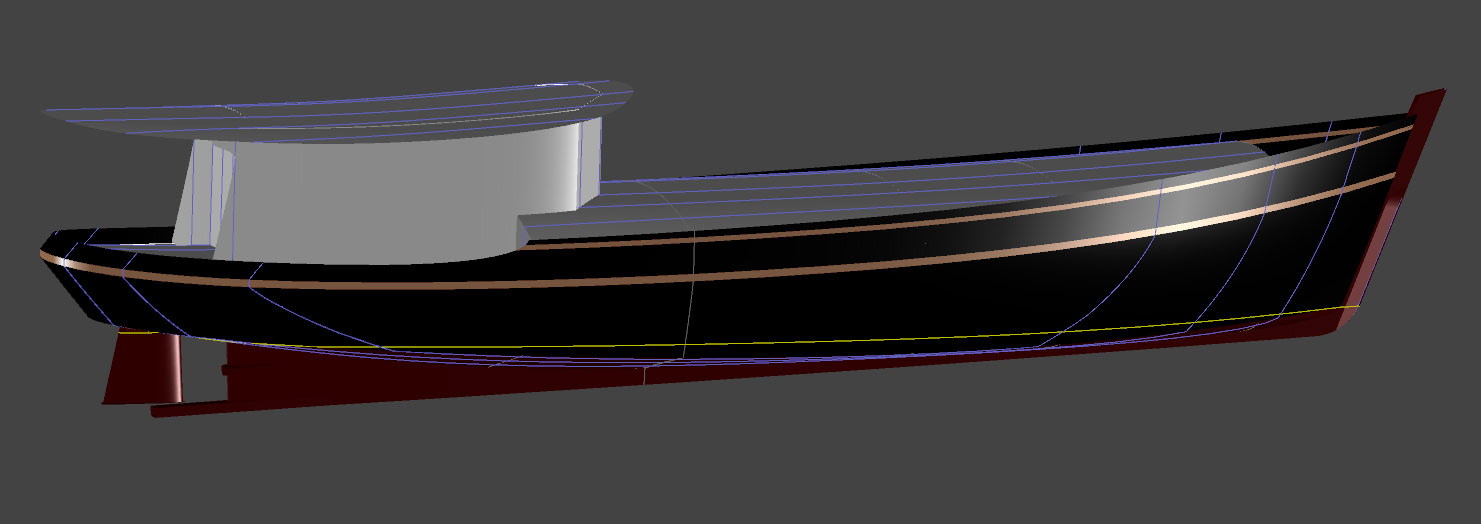
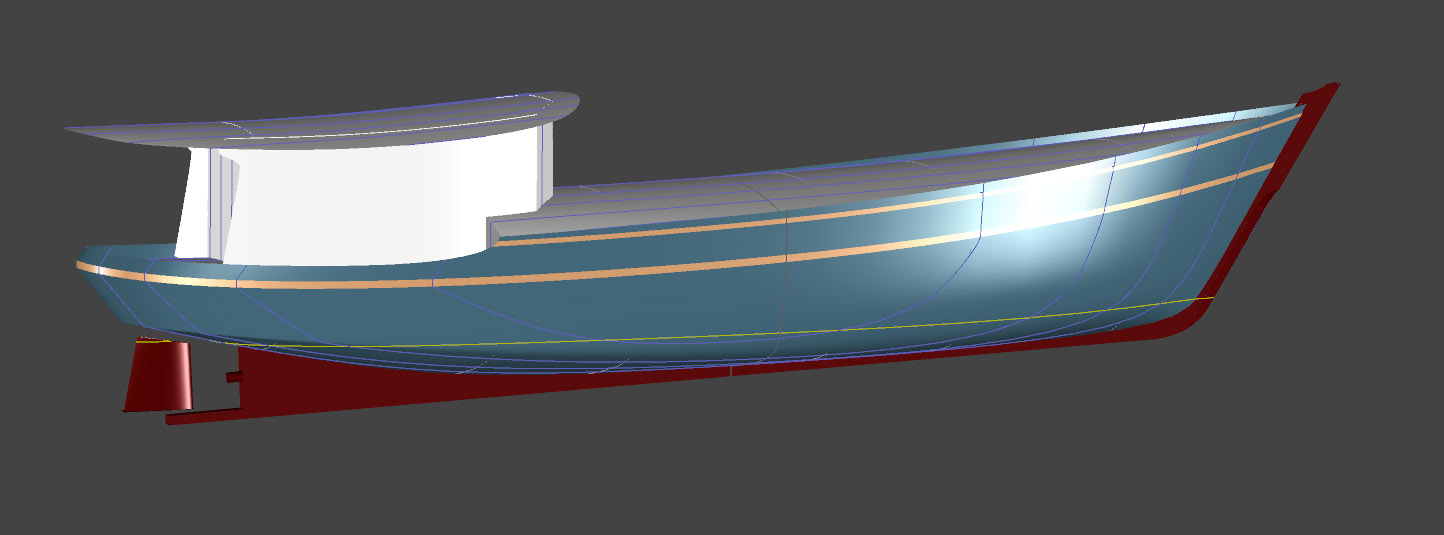
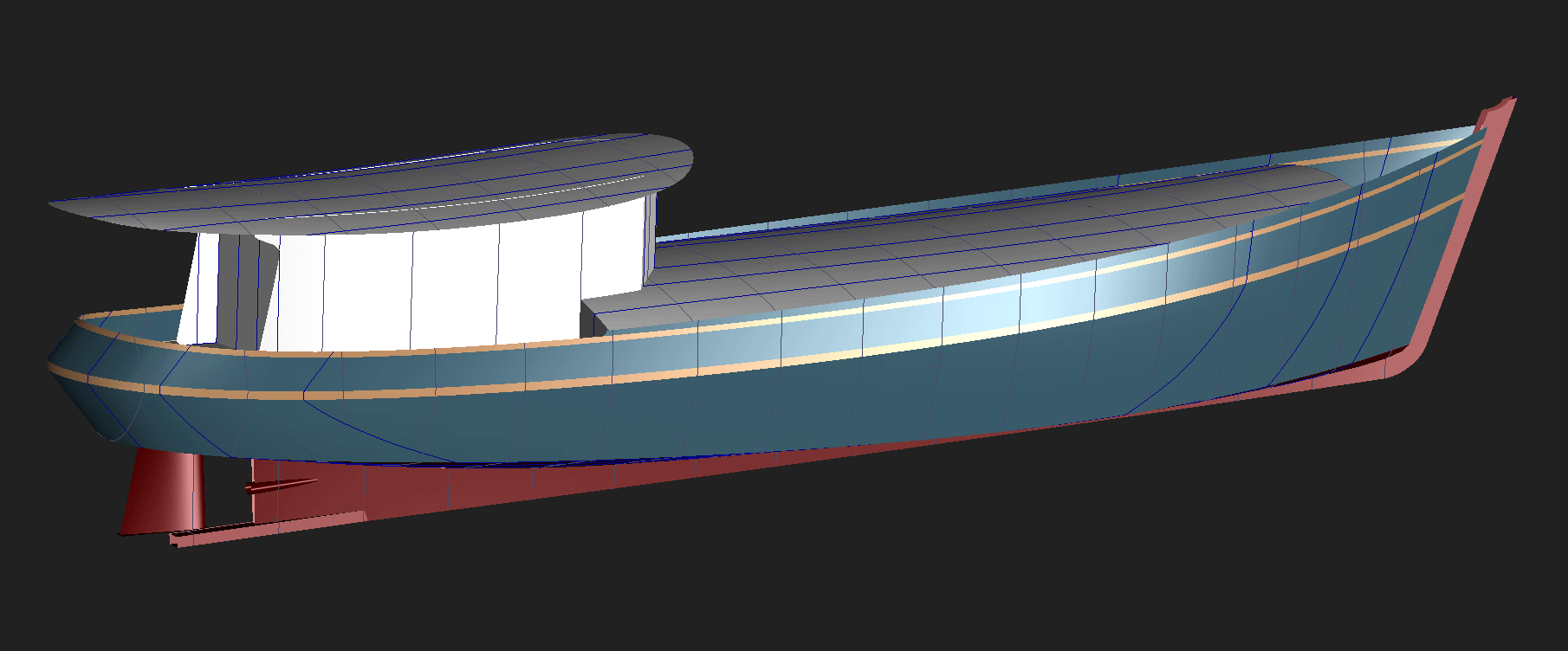
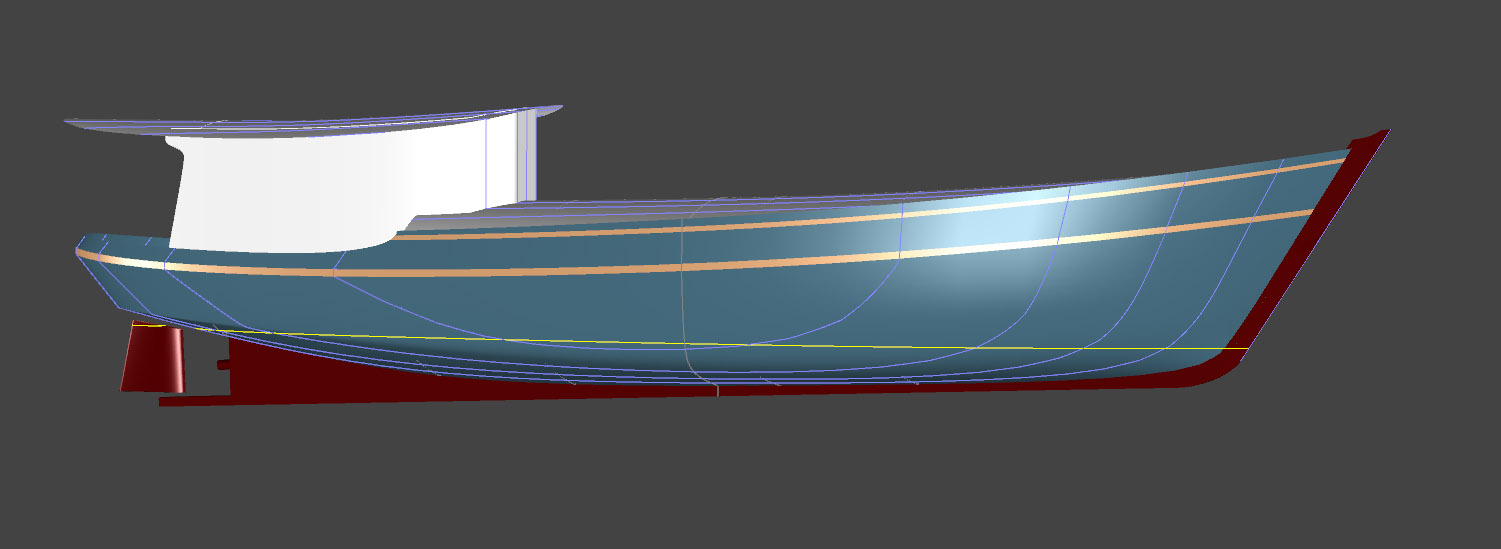
Aft View - Black Hull | Aft View - Blue Hull | Forward View
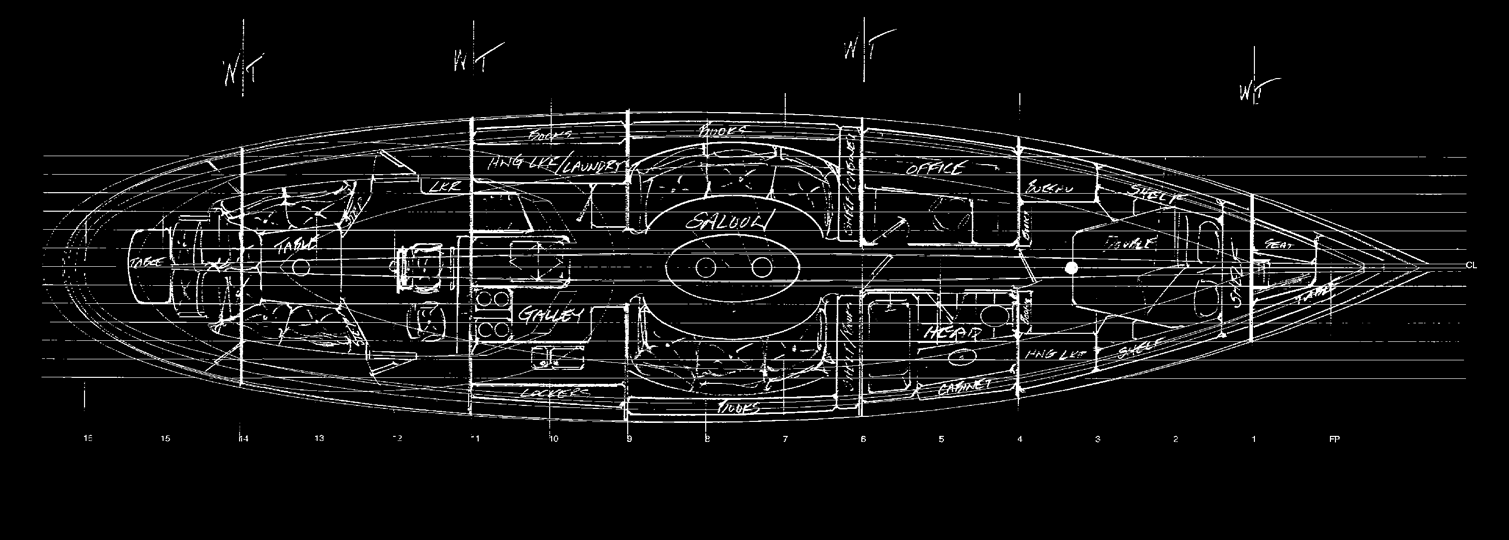
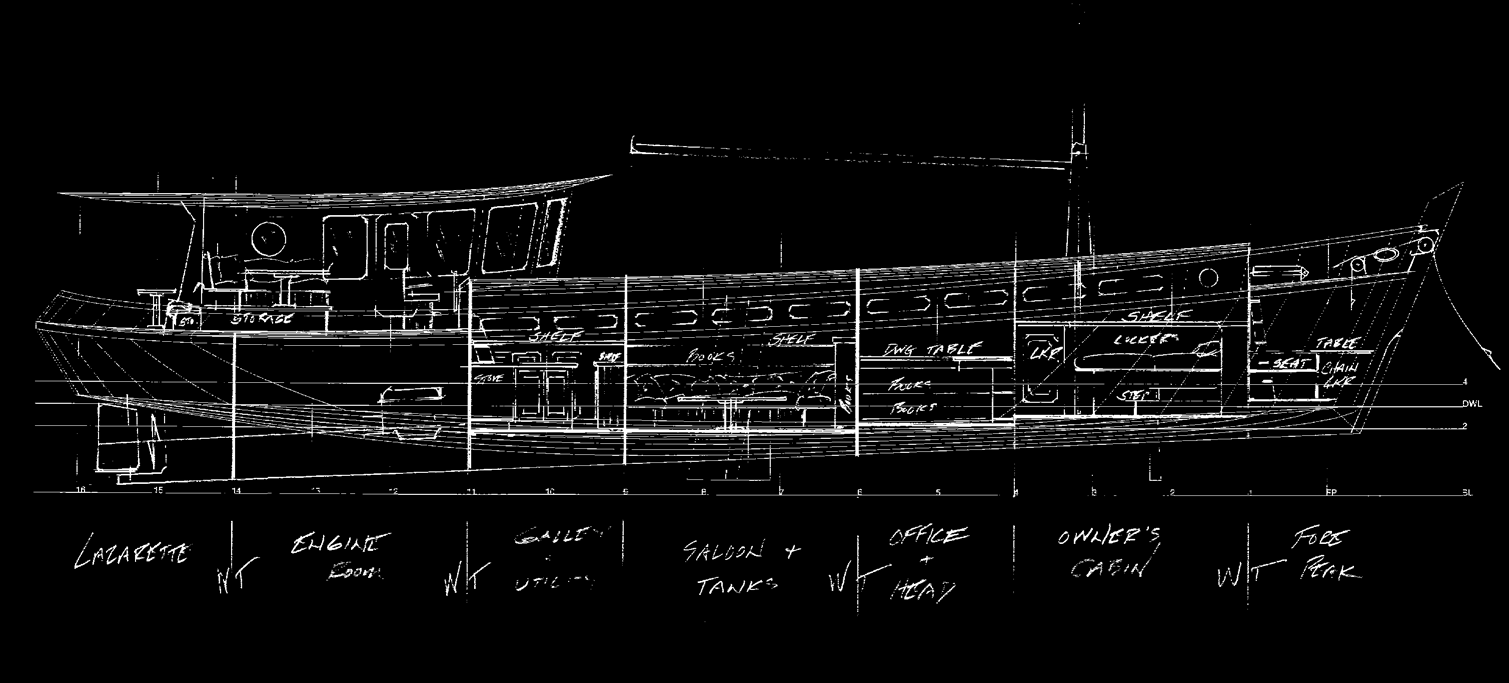
Interior Plan | Interior Profile
Rounded Hull - Larger: 66' Peregrine Fwd | 66' Peregrine Aft
Rounded Wooden Hull - Larger: 68' Nusa Tenggara Fwd | 68' Nusa Tenggara Aft
Copyright 2000 - 2008 Michael Kasten
The Concept
The assignment in this case has been to create an aesthetically pleasing "traditional looking" power vessel that would have a chance of fitting in well in any working Asian port, or among other trawlers and fishing vessels in a working Western port. In other words, it is intended to blend in, rather than having the immediate aspect of being a "yacht" to the casual observer. An additional requirement was to provide a height low enough to allow navigating the canals of Europe. Further, the goal was to achieve an extreme economy of construction and a vessel that would be very efficient under way.
These requirements have encouraged a long and low interior accommodation forward, with an aft pilot house. The result is quite a neat little ship, so far called "Peregrine." The links above show renderings of the preliminary model created within Maxsurf. The hull is a long and slender type that is easily driven with a minimum of power - very much as with our other designs in the Peregrine family: the 43' Moxie, the 49' Quinn and the 50' Renegade.
Hull Form
The hull is a single chine type, in order to provide flexibility in choice of construction materials. The general shape is a V-bottom reminiscent of the US east coast skipjacks. The fantail stern is from the traditional US sharpies and the early steam yachts of the 20th century. It is the perfect shape for the stern of a metal boat. The prominent bow has a Southeast Asian look... Thailand; Indonesia...
Dimensions are:
- 64' LOA
- 61' LOD
- 55' DWL
- 13.5' Beam
- 3.5' Draft
- 36,000 lb. DWL Displacement
- 45,000 lb. Loaded Displacement
Structure
Interestingly, this vessel is large enough to take advantage of steel for the hull, deck, and house structures and still have a low enough center of gravity for 100% positive stability.
This kind of hull has a generous water-plane. This provides sufficient reserve capacity to carry fuel for long range under power. Overall though, systems must be kept as light as possible. Therefore, we should presume there will be no separate generator, and instead a very adequate 24v DC system; that tank capacities will be kept to the minimum required; and that construction materials will be chosen for lightness.
One should also tend toward light weight interior structures, such as the use of honeycomb panels for the joinery flats wherever practical. One such material is Nida-Core, possibly the most cost effective among the HC panels. Nida-Core is easily laminated to thin plywood skins, producing very stiff and light interior joinery panels.
Power
The average WL length for Peregrine is around 54.7 feet. Typically, that would translate into around 10 knots hull speed, for which around 90 hp would be required. Since Peregrine is extremely long and slender, a maximum hull speed of around 14 knots is possible, which would require nearly 240 hp...!
That last knot or two costs quite a lot, so ideally power will be provided by a more modest engine such as the John Deere 6068-TFM 6 cylinder diesel having around 155 hp @ 1800 rpm, continuously rated. Taking this engine to its maximum intermittent rating of 225 hp @ 2600 rpm would achieve close to the full hull speed potential. By simply backing off to twelve knots, the power required would be around 140 hp, well within the continuous rating of the engine.
The Reduction Gear intended for this design is the Sabb HVP-80, a new offering from Sabb. This gear is supplied complete with a Helseth 3H-70 three blade controllable pitch propeller & shaft assembly. How does this compare in terms of performance and price with fixed pitch propeller installations? Check out the article on the advantages of the Controllable Pitch Propeller.
With 750 US gallons of fuel, range will be around 3,000 miles assuming a typical "voyaging" speed of around 8.5 knots. At 8.5 knots, only around 45 hp are being used...! The advantage of a controllable pitch propeller becomes evident here... one can still fully load the diesel engine.
Sail...?
If very long range were a requirement, then emphasis would ideally be placed on the vessel's inherent sailing ability, for which purpose the Chinese Junk rig would be an ideal choice. After all, the hull form is derived from two well known sailing types... To fit a sail rig would be quite easy, and there is very adequate stability to carry the rig if it is kept low.
For an example of this type of rig, have a peek at the optional cat ketch rig drawn for the 50' Renegade. For get-home sailing, one may possibly arrange tandem centerboards in a way that would not interfere with the accommodations.
Accommodations Below & On Deck
It is often said that there is no substitute for length when it comes to creating a generous living space. I believe this to be true. You can see the Peregrine layout in our Interior Plan and Interior Profile sketches, and follow along with the accommodation description as follows...
The Pilot House provides a sitting room with a view. In the case of Peregrine, a settee will face forward all along the aft bulkhead of the house and will also wrap around a table, allowing meals to be taken there for a good view of the harbor. The Pilot House doors exit the pilot house on each side, just aft of the step down in the long fore-deck.
The companionway leads below from the Pilot House on the port side. To port of the companionway below is a long bureau, housing a laundry and hanging locker. To starb'd of that is a large U-shaped galley.
A large saloon is located forward of the galley. Two long curved seats along each side have a low "coffee table" between. At the aft end of the saloon seats is a cabinet / book case / sideboard.
Forward of the saloon to starb'd is a large head compartment, complete with a combination shower / bathtub... a very welcome device for living aboard! To port of the head is a guest cabin / ship-board office. It can be arranged to serve both functions, using a "berth-in-a-box" scheme, where the mattress hides in a large box, more or less the same height as a desk drawer. The desk-top is then arranged to fold up to reveal the bed inside the desk...
Forward of the head and office / guest cabin is a door leading to the master suite. Within the master stateroom are a pair of bureaus, one to each side, which also contain a pair of hanging lockers. Between the bureau lockers is a generous dressing area. A big double "island" berth is right forward, with the head of the berth forward. Another shelf / locker space extends across the ship just forward of the berth.
A bulkhead is at the forward end of the master stateroom, forward of which is a large fore peak for anchor rode, dock lines, fenders, etc. A hatch leads into the fore peak from the well-deck forward.
The interior described here is for long term living aboard for a couple. Guest sleeping is accommodated on the settees, within the pilot house, and if so arranged, within the convertible office.
On the aft deck a wrap around seat could be arranged at the stern and / or an aft facing seat along the aft end of the Pilot House. The covered aft deck would be ideal regardless of climate, providing shade in the tropics and shelter from the weather elsewhere. The aft deck could easily be enclosed by a series of canvas and vinyl weather cloths, or by canvas and screen, allowing its use in a variety of weathers.
The well-deck forward provides a good anchor handling spot. In between, there is an enormous foredeck area for sun bathing, where a simple awning over the fore-boom would provide a bit of shade or shelter from a tropical downpour.
For a look at a similar interior, although much narrower and with the galley re-located please have a look at accommodation plan of the Power Trimaran, "Penny Wise." Each space aboard Peregrine, while somewhat similar, has considerably greater width - and this has allowed the galley to be positioned aft.
Summary
So far Peregrine is a prototype design - one more in a series of designs that I've created as an example of my own ideal blue water / coastwise motor yacht types. In other words, for these designs I have been my own customer...! Links to the other designs in this series are below.
The adventure with these boats has been to nail down a style that gives each of them a timeless classic aesthetic; generous interior accommodations without crowding; a low profile for canal cruising; a hull type that lends itself to economical construction; an easily driven hull form; and an overall presentation that would "fit-in" regardless of where the yacht may be found, whether that may be in the South China Sea, or the South of France.
Designed / imagined as my own ideal motor yacht type, Peregrine is a vessel type that I believe has considerable merit for permanent living aboard, intimate charters, and long range cruising...!
66' Rounded Hull Version - Click for Larger ImageRounded Hull - Larger: 66' Peregrine Fwd | 66' Peregrine Aft
Rounded Wooden Hull - Larger: 68' Nusa Tenggara Fwd | 68' Nusa Tenggara Aft
Other designs in the "Peregrine / Renegade / Moxie" Family:
36' Molly | 43' Moxie | 49' Quinn | 50' Renegade
61' Peregrine | 82' Peregrine | 100' Amazon | 164' Peregrine
60' Pennywise Trimaran | 70' Peregrine-on-Thames
Please see the AVAILABLE BOAT PLANS web page.
Home | Intro | Our Design Process | Stock Design Info | Motor Yacht Designs | Sailing Yacht Designs | Prototype Designs
Plans List | Articles | Our CAD Design Stream | Maxsurf | SITE MAP..! | Site Search | Design Team | Contact Us