Messing about in boats since 1975. Online Since 1997.
Home | Intro | Our Design Process | Stock Design Info | Motor Yacht Designs | Sailing Yacht Designs | Prototype Designs
Plans List | Articles | Our CAD Design Stream | Maxsurf | SITE MAP..! | Site Search | Design Team | Contact Us
Please see the AVAILABLE BOAT PLANS web page
The 60' Power Trimaran
'Penny Wise'
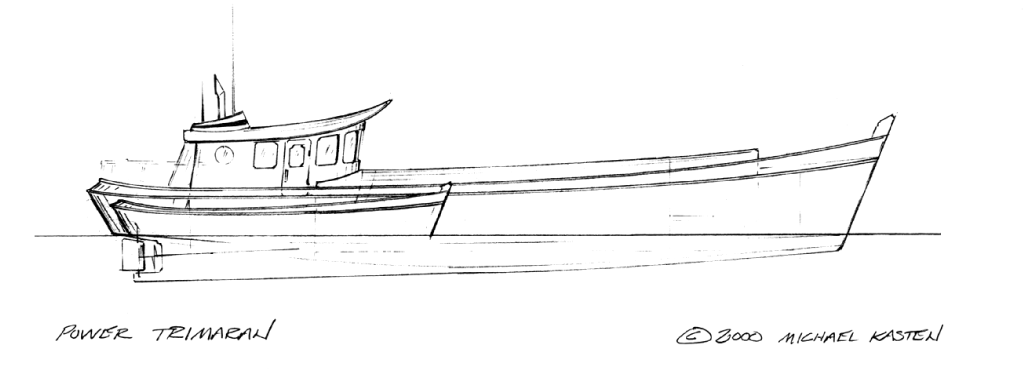
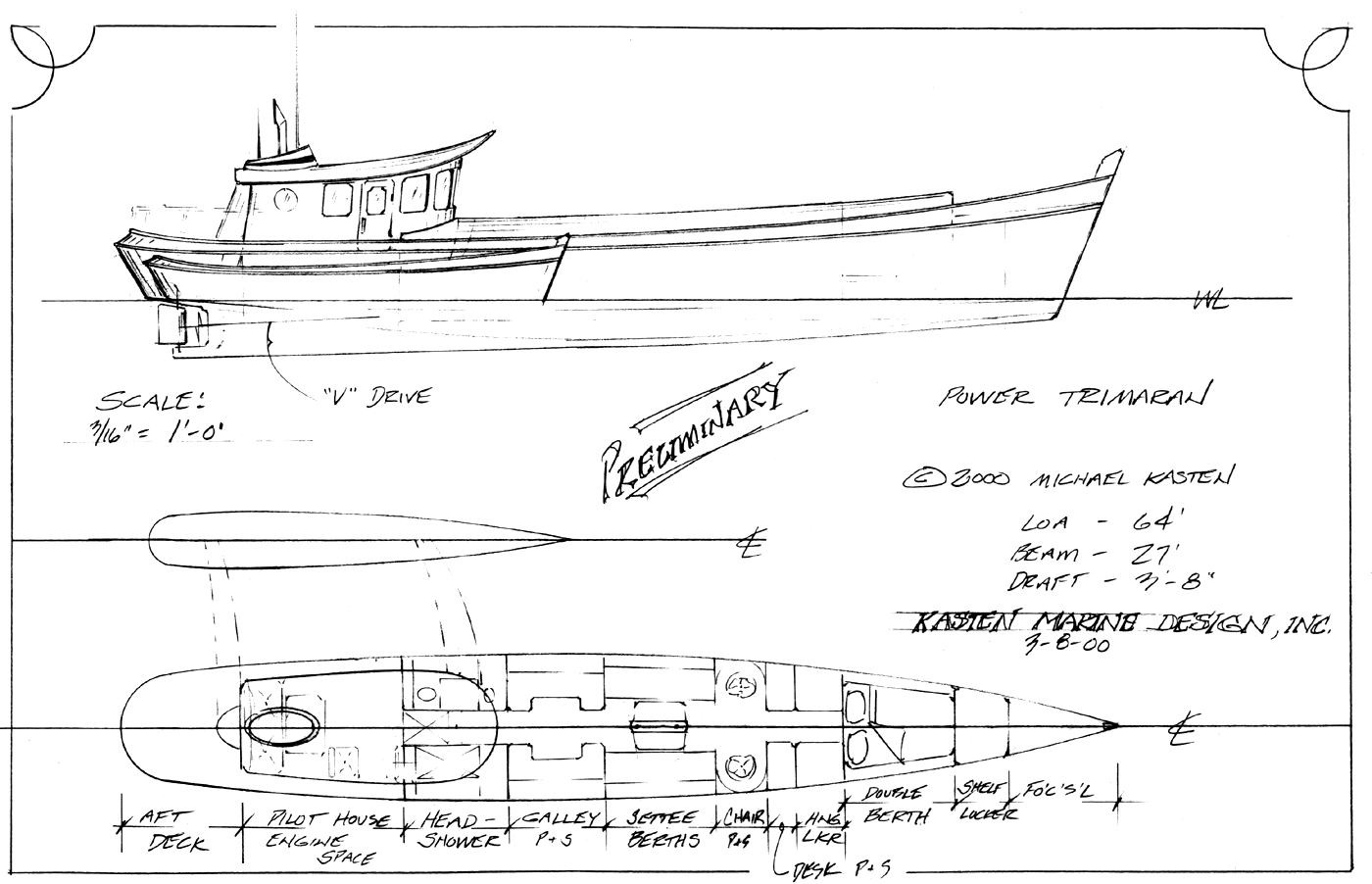
Larger Profile | Deck Plan & Interior Sketch
Larger Perspective Aft | Larger Perspective FwdCopyright 2000 - 2006 Michael Kasten
The Concept
The client stated the following:
"I seek a marine mobile home primarily for long-term island/harbor hopping in the Western Pacific and the rivers of China, but capable of occasional long ocean passages.
My wife has three requirements:
- A lounge / house with a view
- Galley with a view
- Emergency sailing capability
Layout: I have few pre-conceived notions about layout but I have done a lot of sketching. The trimaran configuration is so narrow that there are really not all that many options for layout unless it has a wide topside blister or the length exceeds 60 feet, and 60 feet is already a hard boat to manage in port. Too much beam hanging out above the waterline looks funny, and may preclude trucking. I am open to all suggestions including a catamaran that does not break the budget.
The galley should be large enough for everyday living, the head (one is enough) should have a separate shower, not a grate below the toilet. My list includes lots of storage, a well equipped shop, and an office/computer/study area. It would be good if settees were long enough to serve as guest berths in port.
Appearance: I actually like 'spaceships' that look like the ILAN Voyager and Cable & Wireless, but for this vessel I prefer a more traditional looking boat in order to find better acceptance in third world ports. Except for the local fishing boats however, it is not clear what "traditional looking" will actually be for such a craft as this, given that the concept is most certainly not traditional...!"
Sails: There is no need to think too hard about an emergency sail. Indonesian trimarans routinely use rectangular sails on near-vertical yards hung from short masts. They could be awnings with the necessary fittings added. I prefer simple mechanical systems that I can fix myself, except for communications and navigation gear.
Materials: I like unpainted aluminum a la Northwest fishing boats, but given that construction will be in the Philippines, I think materials are confined by cost to sheathed strip planking and/or ply. At a minimum, the boat should be designed to accept routine bashing about in rough ports.
The Result
On the face of it, a somewhat bizarre request; a tough assignment, at best: Come up with a "traditional looking" trimaran...?
Well, the result is certainly that. It would fit in well in any Asian port, and also would not be out of place among trawler yachts in a Western port. It is perhaps somewhat in the Wharram "tradition" though the hull form is quite different from those craft, and is combined with a pilot house that any trawler would be proud of.
Is the result strange? I think not -- it is instead quite a neat little ship!
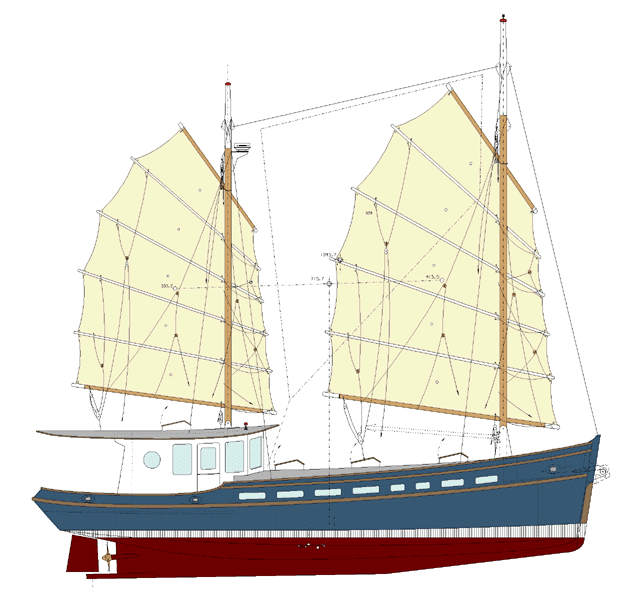
To fit a sail rig would be quite easy, and if primarily used as an "emergency" get-home affair, it could easily be a Chinese Junk type of schooner to keep the rig low.
For 'get-home' sailing, one might want to have dagger-boards or centerboards arranged to not interfere with the accommodations. Mast placement is always problematic to the interior of a vessel, so in this case, they would probably be deck stepped, and in that way could be made to easily be lowered.
The "Sitting room with a view" is accomplished in the Pilot House, with a wide settee facing forward. A table forward of the settee allows meals to be taken there for a good view of the harbor. Another larger settee and table arrangement below provides privacy for evening dining as well.
The requirement for "a galley with a view" is well met in my view, since the galley is located centrally below the fore deck, and is of a generous size. As for the view, it would be quite good. The galley is forward of the amas, so they would not be an interference. The fore-deck spans the full width of the ship, extending from bulwark to bulwark athwartships, and from the pilot house, all the way forward until the anchor well is reached at the bow. With generous ports within the bulwark outboard of the galley, plus several good sky lights, all requirements are met.
An alternate location for the galley would of course be to lengthen the pilot house, and place the galley within it. In spite of the excellent view from there, this arrangement has multiple disadvantages. It would raise the center of gravity of the main hull due to the longer pilot house; it would locate more weight aft (already pushing the limits); it would place a lot of activity in the piloting area, always a disadvantage; and it would make food preparation underway during the night watch somewhat of a risk to the helmsman's night vision. For a true voyaging vessel, the piloting area is best reserved for just that, and for comfortable lounging while at sea or in harbor.
Below, forward of the settee are a pair of office-like desks with swivel chairs. Below aft, there is a generous shower to starb'd, and a large head to port. Right forward is a very spacious double berth with a big shelf / locker forward of that. Farther forward yet is the fo'c's'l locker to house the anchor rode.
In order to achieve any sort of meaningful 'shop-space' the vessel would either have to become longer, or one of the interior spaces would have to serve multiple purposes. For example, if it could be tolerated to locate the shower within the head compartment to port, one could then dedicate the starb'd compartment to being a shop-space, or possibly an office, or even an extra guest cabin...
Naturally, in such a long and narrow living space, the width of sole is very restricted. One can raise up the sole in the outboard areas if it is needed, and then arrange for comfortable seating for whatever task is contemplated, whether this be a shop area, shower, office, or what have you.
On the Exterior, one could arrange a nice wrap around seat at the stern and maybe a BBQ / bar on the aft face of the pilot house on either side of the 'stack.' There is plenty of foredeck area for sun bathing, and with a mast and boom there, one can easily arrange an awning for a bit of shade...
Though not illustrated in the above-linked drawings, there could be a 'trampoline' net arranged between the main hull and the amas, extending from the forward beam to the aft beam... a great place to hang out under way...
The amas themselves are quite small, and should be kept water tight with a secure hatch. Each could become a small 'kid's cabin' and they would have their own 'private vessel' to command... Alternately, though it is best to keep them as light as possible, they could be used for light weight storage, say for fenders, lines, sails, etc.
Materials of Construction
Given the type of vessel in question we can definitively say a few things about the materials of construction:
- Building a vessel of this type in steel would be completely out of the question.
- Aluminum alloy would be an excellent choice for the hulls, the decks, the pilot house structures, and for the cross beams. If built in aluminum and NC cut, the building of the hulls would be very quickly achieved.
- Plywood is certainly a quick method of construction, and if covered using a composite resin / laminate, there would be very good strength, lightness of structure, and ease of general maintenance.
- Cored FRP construction does offer several advantages, among them strength, longevity and freedom from general maintenance. Naturally, FRP construction of any type will be much more costly in terms of materials than any other type, particularly if construction were to be in a remote part of the world.
- In order to achieve the best laminate quality, we prefer vinyl ester resin or epoxy resin. With these, the logical fabric would be Kevlar or another high strength fiber such as E-glass or S-glass. There is little point with a cruising vessel to use high-cost exotic fibers however such as carbon fiber. While light and stiff, carbon fiber is quite expensive, thus it is ordinarily ruled out for this kind of boat.
A very light weight interior would be quite important as well. For this, we specify the use of honeycomb panels for the joinery flats wherever it is practical and easy to do so. One such material brand is Nida-Core, possibly the most cost effective among the HC panels. Nida Core panels have thin plywood skins bonded to a phenolic resin honeycomb core. This produces very stiff and light weight interior joinery with more or less the same labor cost as with standard plywood construction.
Ideally the struts / cross-beams would be laminated wood, and would be tapered. If the hulls were all plywood, construction would be very fast. In that case we could detail all the sheets for NC Cutting by a 2-axis router. For maximum construction speed and the least number of man-hours we could make use of the "stitch and glue" method of hull construction. This would allow eliminating many of the heavy carlins and chine logs common to traditional plywood construction. Each hull could be quickly built upside down until the deck is reached, then turned over.
If built in cored glass, the mould would be simple to build using flat pressed board panels, and would of course be built upright. To detail the mould for NC cutting would be quite easy... we would simply put the 'structure' of the mould on the outside of the hull surfaces rather than on the inside...! The result would be a 'mould kit' which would quickly snap together.
Hull Form
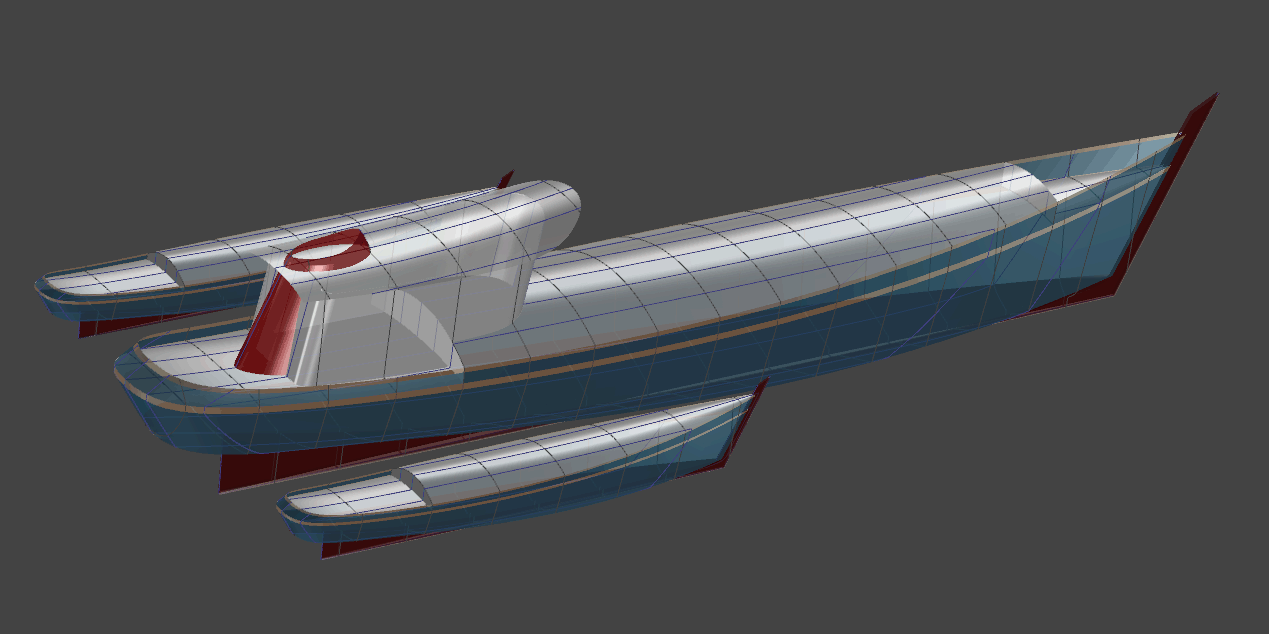
The hull is a simple single chine type in order to provide the ultimate flexibility in choice of construction materials. The general shape is a V-bottom on all hulls, using a shape somewhat reminiscent of the US east coast sharpies. The transoms are all arranged to be similar to the sharpie's fantail stern, and with a brief little "kick" upward at the stern. The prominent bow is a tribute to the possibility that this may be an Asian built vessel. With a junk rig, all the more fitting.
Of course the amas (the outer hulls) would not be deep in the water. Opinion varies quite widely on this, with some even advocating that amas be completely clear of the water with the vessel upright. In my view, the amas' hulls should just "kiss" the water when at rest with the vessel in an average load condition. This would immerse the keels on each ama, so they would never be entirely free of the water unless a sail rig were provided and the vessel were under a press of sail.
A monohull or a power catamaran can be designed to carry enormous cargo, however a trimaran cannot tolerate being overly burdened with the accretion of extra weight (most cruising vessels seem to suffer from this...!). Vigilance will therefore be required in order to preserve the inherently excellent performance that such a vessel has to offer.
Opinion is also divided on the best fore and aft location for the amas. In this case, the amas have been located quite far aft so that they can provide added buoyancy where it is needed most, due to the weight of engines and PH, etc. The aft location will help minimize any tendency to trip, and will provide the maximum in terms of tracking ability. In the aft location, the amas will also help the stern of the vessel resist squatting at speed.
Naturally, if sailing ability were to receive greater emphasis the amas would be located farther forward. The amas would not be moved beyond amidships however, as that would introduce the potential for tripping as well as possible steering anomalies.
The amas need to be as light as possible, so fuel and water can not be located there. Still, the amas need not be empty... The amas are 26' long by 3' 9" wide, so a perfectly comfortable berth could be placed into each ama with room to spare, making each one a little microcosm for young sailors... A little water tight combo house-companionway for observing the ocean... very nice indeed!
I have modeled the hull and house as drawn, and I've also modeled the house with considerably less "saddle" shape. Please see the links above for images of the hull model.
Power & Range
The trimaran allows the use of an efficient single engine and there is no need for roll attenuation devices. A long slender hull is the very ultimate in terms of efficiency.
Power would be via a diesel engine located below the Pilot House in the main hull. Overall, all systems must be kept as light as possible. Therefore, one can presume there would be a single engine of modest size to adequately drive the boat; that there would be no generator per se, and instead a very adequate 12v DC system would serve electrical needs; that tankage would be kept to the minimum; and that construction materials would be as light as possible.
If very long range were a requirement, then emphasis could be placed on the vessel's sailing ability, for which purpose as mentioned the Chinese Junk rig would be an ideal choice. If that were chosen, the rig would likely be similar to that shown on our 50' Renegade. A sail rig would offer the ultimate in terms of range, get-home power, and the fun of sailing...
For the Penny Wise, if built very lightly as intended (around 26k to 28k lb. total in the light load condition), power could be in the range of around 65 - 70 hp, and that would attain a speed of around 10 knots depending on the load condition.
However due to being very light, narrow and long the hull is capable of exceeding that speed by quite a lot. In optimum conditions 15 knots would be possible, but... that would require 165 hp...! On a more rational note, we'd prefer a maximum of around 95 - 100 hp total, sufficient for 12 knots depending on load condition.
With 400 USG and a 15% reserve, range would be around 3,000 NM at 8 knots. That's enough to reach Hawaii from any West Coast port - and then some.
Now that's what I call economy and good speed...!
Summary
The 'design-study' budget for this vessel was limited in the extreme, therefore the vessel's name (and its implied meaning). As a result, the 'Penny Wise' remains 'Pound Foolish.' In other words, the concept design presently awaits a more qualified owner to pursue the remaining drawings, design calcs, propulsion and resistance calcs, etc.
Even so, I believe the concept of the Penny Wise has excellent merit, especially for long range cruising. A few of the reasons for that opinion are as follows:
Monohull power passagemakers expend terrific expense on roll damping, which in this case would just not be an issue. Relative to active stabies, the amas would be silent and efficient. Relative to paravanes, the amas would be very simple, would require no tending, would provide extra space and extra buoyancy, and would not present nearly the amount of drag induced by paravanes.
There have been some very impressive voyages in power trimarans of late. The whole concept has engendered a completely new vessel type: the ILAN (Incredibly Long And Narrow). An internet search for ILAN will turn up quite a few interesting precedents for such a vessel, and should illustrate the practicality of the concept. With an ILAN type however, the hull materials must be light weight in the extreme, thus they require quite an extreme budget to build...!
The adventure with this particular assignment has been:
- To create the best combination of economy and efficiency
- To somehow nail down a style that gives the vessel a "traditional" aspect
- To create a type that lends itself to alternate building methods
- To provide an aesthetic that will have the best chance to "fit-in" regardless of where the vessel may be found, whether that may be in the South China Sea, or the South of France...
All of those design requests have been admirably met in the Penny Wise...
Larger Perspective Aft | Larger Perspective Fwd
Similar Designs...?
We have developed various prototype designs for multi-hull craft, including catamarans and proas. We have also developed a series of mono-hull vessels which are quite similar to the Penny Wise. They share quite a lot of design traits with the Penny Wise...
Other designs in the "Peregrine / Renegade / Moxie" Family:
36' Molly | 43' Moxie | 49' Quinn | 50' Renegade
61' Peregrine | 82' Peregrine | 100' Amazon | 164' Peregrine
60' Pennywise Trimaran | 70' Peregrine-on-Thames
Please see the AVAILABLE BOAT PLANS web page.
Home | Intro | Our Design Process | Stock Design Info | Motor Yacht Designs | Sailing Yacht Designs | Prototype Designs
Plans List | Articles | Our CAD Design Stream | Maxsurf | SITE MAP..! | Site Search | Design Team | Contact Us