Messing about in boats since 1975. Online Since 1997.
Home | Intro | Our Design Process | Stock Design Info | Motor Yacht Designs | Sailing Yacht Designs | Prototype Designs
Plans List | Articles | Our CAD Design Stream | Maxsurf | News..! | SITE MAP..! | Site Search | Design Team | Contact Us
Please see the AVAILABLE BOAT PLANS web page
Creating A New Yacht Design
Copyright 2016 Michael Kasten
Updated June 2016
The Yacht Design Process
The following article is a summary of how a new custom yacht design is imagined, sketched and drawn. In addition to the following notes, our Introduction web page provides an outline of our general approach to yacht design.
While seemingly complex, the design process is made up of a series of incremental steps, much like the building process itself. The goal of undertaking the design of any new yacht is to take a unique set of owner requirements and to turn them into the best possible solution to those requests. If the resulting design is to be what it should be, each of the steps outlined below must be addressed thoroughly.
There is first the idea, and then the bringing forth of the idea into a functioning reality. In order to get the relevant information on the table, two primary ingredients are necessary:
I. Owner's Specification: The first 'design task' is actually performed by the prospective boat owner. It is first to imagine the goal, and then to create an 'Owner's Specification' or 'mission statement' for the proposed vessel. With that information understood, we will provide a written Design Proposal to outline how we propose to meet the goals that have been set forth.
- Rather than being a detailed description of the result of the design process, the Owner's Specification is better if seen as a general guide to the intent of the design.
- Toward that end, ideally the owner's 'mission statement' will be kept fairly simple, since the details of the design will emerge as a result of the design process itself.
- The basic information needed is an outline of the intended vessel's size, layout, materials of construction, the intended use, range, speed, rig, and general aesthetic.
- The essential information should include the intended schedule for designing and building the yacht.
II. Design Proposal: My first job is to understand the preliminary Owner's Specification, then to provide the prospective client with a detailed outline for creating the new design. This is in the form of our standard written 'Design Proposal' which includes the following:
- A written outline of the design process itself.
- A list of the deliverable drawings and documents.
- An estimate for the design work required in order to create the design and to detail the plans for the vessel as described.
The following paragraphs describe our design process, and outline the deliverable drawings and documents.
Stage I - The Preliminary Design Study
After our 'Design Proposal' has been reviewed, if the prospective boat owner approves of what we have proposed, then the actual design work can begin.
A custom design starts with listening to the requirements of my clients. The objective is to create the best mutual design solution in terms of vessel type, layout, size and style. My goal is to propose an appropriate form and function to suit the vessel's intended purpose, and to follow that up with a thorough analysis of structure, stability and performance.
There will first be a series of information exchanges, possibly including clippings of similar vessels or sketched layouts provided by the client. After the owner's requirements have been articulated I will usually begin by creating a preliminary 3D CAD model of the intended vessel, which is most often created by adapting one or more of our existing designs or prototype designs to its new purpose.
The 3D model allows us to determine:
- The envelope available for the accommodations
- The overall size and hull form
- The preliminary internal structure (bulkheads and soles)
- The rig (if for a sailing vessel or motor sailor)
- The styling and features of the superstructure
- The preliminary hydrostatics
With that, I will prepare a few CAD generated drawings in order to show the proposed layout in Plan and Profile views and a perspective view of the proposed Exterior Styling. Combined with a description of the proposed dimensions and other particulars of the vessel, this is the beginning of what I refer to as 'Stage I' or the preliminary 'Design Study.'
Stage I is basically a process of ‘discovery’ wherein we mutually discover the best solution to your requests. In pursuit of that ‘discovery’ process we will review our proposed design solutions against the original specification -- or possibly the initial specification will be revised according to what we discover. This process is both flexible and adaptable.
During Stage I we will strive to establish the accommodations, styling, size, dimensions, and the target displacement. Our goal here is to provide a "proof of concept" for the design so that further changes can be kept to a minimum. When the preliminary design has been approved by the owner, Stage II can begin.
Stage II - The Estimating Plans
The goal of Stage II is to create the first few sheets of the actual Building Plans, and to generate a number of essential documents that will be required by builders so that an accurate construction estimate can be provided.
The first part of Stage II involves finalizing 'Stage I Study Drawings'. The preliminary Estimating Plans will therefore include:
- The proposed Sail Plan or Outboard Profile
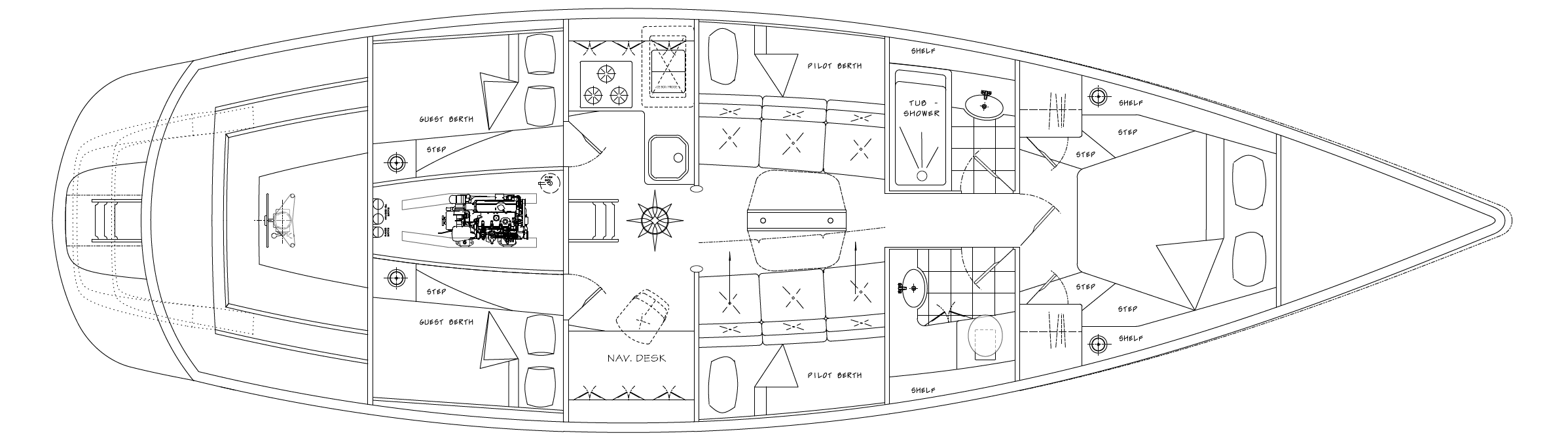
- The proposed Interior Profile and Arrangement Plan
Once those drawings have been approved, we can proceed knowing that further changes will be minimized. When completed, the Estimating Plans Package will include:
- Sail Plan / Outboard Profile
- Interior Profile and Arrangement Plan
- Structural Profile and Arrangement Plan
- Equipment List
- Vessel Specification
- Painting Specification
- Preliminary Weight Study
- Preliminary Power and Range Analysis
- Preliminary Hydrostatics Analysis
- List of Boat Builders Suited to the Project
- Designer's Cover Letter to Builders
- Sample Owner's 'Request for Quotes' Letter to Builders
For smaller vessels there will be three drawing sheets at this point. For larger vessels there may be two or more sheets in each category. The goal of Stage II is that enough information be presented in the Estimating Plans Package that firm quotes can be obtained from prospective builders for construction of the vessel.
If you would like to review an example of our design work up to this point, Estimating Plans are available for any of the designs listed on our Plans List page.
Stage III - The Building Plans
During 'Stage III' the remaining design work is completed. With additional owner and builder feedback, further decisions can be made with regard to equipment and finish as needed.
The drawings, Equipment List and Vessel Specification are refined and the remaining drawings are completed in order to create a final Building Plans package. These drawings and documents will finalize the interior and exterior details, the machinery arrangement, the deck plan, scantlings, construction sections, the boat's final dimensions and hull shape, and the as-designed displacement, range, performance, hydrostatics and stability.
The Building Plan Drawings will include:
- Outboard Profile: Sail plan or other exterior details of the hull
- Deck Plan: Cabins, hatches, fittings, mooring and anchor gear
- Interior Profile and Arrangement: The vessel's accommodations
- Sectional Views: Structure and interior joinery sections
- Inboard Profile: Structure and primary equipment
- Various Structural Details as needed
- Mechanical / Machinery Details as needed
- Rudder Details
- Spar and Rigging Plan as needed
- Hull Fitting Details
- Hatch and Deck Fitting Details
- Companionway, Door and Portlight Details
- Interior Joinery Details
- Lofting Conventions Drawing
- Lines Drawing
Several of the above drawing categories may include a number of individual sheets. Depending on vessel size and complexity, the Building Plans may include anywhere from 10 to 40 or more drawing sheets.
During Stage III the Equipment List and Vessel Specification are finalized in order to accurately describe the intent, the layout, the scantlings, the construction, the systems and the outfit of the vessel. In addition to the above listed drawings, the following Documents will be included in the Building Plans set:
- Equipment List: The complete list of equipment items.
- Vessel Specification: Details of the intent, rationale and construction.
- Painting Specification
- Scantling List
- Welding Specification for metal structure
- Fastening Schedule for wooden structure
- Laminate Schedule for GRP structure
- Offsets Table (unless the vessel will be NC cut).
- Power and Range Analysis Report
- Weight Budget Summary
- Hydrostatics Report
- Stability Compliance Report
- Cover Letter to Builder
Having finished Stage III, the Design Phase of the new yacht will be complete. Sufficient information will be contained in the drawings and documents to allow any professional or amateur builder to build the vessel as intended.
Then the Construction Phase of the project may begin.
Standards Used
Design Goals: Throughout the design process we have the following goals:
- Suitability to the owner's requirements and to the intended service.
- An interior and on-deck layout per the owner's requirements.
- A pleasing aesthetic.
- A thorough specification to assure longevity and ease of maintenance.
- Sensibility of structure for the sake of ease of construction.
- A functional and accessible machinery and equipment layout.
- A distribution of weights to provide correct trim and adequate stability.
- Performance suited to the expectations of the vessel type.
- Structure per classification society scantling rules.
- Stability per international criteria.
The general attributes of seaworthiness, seakindliness, strength and durability are considered to be requirements for each of our designs. It is interesting to note that for private yachts within the US, there are no requirements for stability or for structure. However if a US yacht is to be used commercially or Classed and built under survey, one or more of the following standards will apply. Whether or not a private yacht will be Classed, it is our position that all yachts be held to the following standards.
STRUCTURE: When creating a new design, classification society rules are the best guide for the adequacy of structure. We will confirm compliance with one of the following rules as appropriate to the vessel type, size, materials or build venue (for more information, see our article on Designing to the ABS Rule):
- ABS 2000 Motor Pleasure Yachts (applicable to motor yachts from 79' to 200' scantling length - all materials - now obsolete for yachts)
- ABS 1994 Offshore Racing Yachts (applicable to sailing yachts from 79' to 100' scantling length - all materials - now obsolete for yachts)
- ABS 2016 Steel Vessels (applicable to steel vessels up to 295' scantling length - obsolete for yachts, but still required by the CFR for commercial yachts carrying passengers)
- ABS 2016 Yacht Rule (new rule applicable to all motor and sailing yachts in all materials up to 90 meters scantling length (295 feet)
- ISO-12215 for vessels subject to the EU-RCD standards (yachts up to 78' measurement length - all materials)
- Germanischer Lloyds (wooden yachts up to 78' scantling length - under revision as GL and DNV begin to merge their rules)
- Germanischer Lloyds (plank-on-frame commercial wooden vessels up to 115' scantling length - applicable to larger vessels on approval)
- British Lloyd's Register (plank-on-frame wooden yachts up to 98' scantling length - applicable to larger yachts on approval)
STABILITY: To assess stability we use a variety of criteria depending on vessel size, use and location, as follows:
- For private yachts under 24 meters measurement length (78 feet) intended for registry in the EU, stability will be calculated according to the EU-RCD standards (ISO-12217).
- For private or commercial yachts above 24 meters measurement length, stability will be calculated according to IMO, MCA or other standards appropriate to the vessel type, size and use.
- For commercial charter yachts in the US, safety and stability will be calculated according to the US Code of Federal Regulations (CFR).
- For private or commercial yachts in the US, stability will be calculated according to the new ABS 2015 Rules for Building and Classing Yachts, which defer to the IMO or MCA standards depending on vessel type and size.
- For yachts in Canada, stability will be calculated according to criteria established by Transport Canada, which for the most part defer to to the IMO or MCA rules.
- For yachts in other locations, stability will be calculated according to locally applicable criteria - most often the IMO or MCA rules, depending on vessel type, service, and size.
When a vessel is destined for construction and use within the European Union, we also prepare documentation regarding structure and stability in order to make obtaining a CE Mark a relatively easy process for the builder.
Construction Support Services
We ordinarily recommend that plans be submitted to a few selected yards for their construction estimates. We have worked with a variety of builders in a number of places worldwide. We will try to match a project with an appropriate builder, even if that may be outside the US.
During the Construction Phase of the process, there may be various requests for additional services in support of construction. Although we don't get into project management per se, we remain available to act as the owner's representative during construction whenever we are asked to do so. In other words, although we do not get involved in managing personnel, scheduling or purchasing, we are pleased to remain involved in order to manage the flow of information and specifications for the builder.
Additional Drawings, Documents, Schematics...
Ordinarily, system schematics are developed in-house by the builder (e.g. plumbing, fuel system, etc.) or by system suppliers (e.g. electrical, hydraulic, air conditioning, etc.). On occasion the owner or builder may request that we provide basic schematics or additional drawings to illustrate specialized features or other details in support of construction in order to communicate specific owner requests to the builder.
For passenger vessels or other commercial craft there may be the requirement to provide additional drawings and reports for documentation and compliance with the relevant standards. And when a vessel is destined for use within the European Union, we can prepare documentation that makes obtaining a CE Mark relatively easy for the builder.
NC Cutting Files
One of the most valuable Construction Support Services we provide for metal boats is to develop NC Cutting Files in order to automate a portion of the vessel's construction.
What is NC...? It simply means Numerically Controlled... By this method a numerically driven plasma or water-jet cutter can be used to create frames and plates for a metal vessel. One can also use an NC driven router to cut mould frames for a wood or composite superstructure. It is even possible to carve an entire male plug or female mold out of foam for use in building a composite superstructure, directly from the computer generated surface model that was created during the design of the boat.
This leverages the work that has already been done in order to create the design and can provide a significant labor savings to the yard. It also dramatically improves accuracy of construction. With NC cutting, the labor saved during fabrication of a metal hull will usually pay for the cost of developing the NC cutting files, plus some.
In other words NC cutting is an opportunity to not only effect a true cost savings by shortening the overall build time, but to also improve the quality of the result.
The Role of the Computer
Designing the Boat: We use the Maxsurf family of software products, a series of programs for hull modeling, analysis, and construction. With Maxsurf, a preliminary hull model is quickly generated and an initial round of hydrostatics, stability, and performance calculations performed to see where the design can be improved. The computer generated model allows the design to be enhanced quickly at an early stage of design before it has become fixed, or even to be modified without too much fuss later in the process. In fact, without such an easily used computer modeling tool (as compared to manual drafting) those subtle refinements would rarely be undertaken even if given a substantial budget.
Several other benefits are also evident. For example, via the computer generated model it is easy to assure that the surfaces are developable, so building a metal or plywood hull is made simpler.
Testing the Design: With the computer generated model of the hull and superstructure having already been created, it is a simple matter to make a scaled down physical model for towing tank testing, or to verify the styling and features of the yacht in three dimensions.
Building the Boat: A substantial benefit of having generated a model of the hull on the computer is that the vessel's structure can also be computer generated and actually pre-cut via computer guided laser or plasma cutting - or in the case of a GRP vessel, the mould created using a computer guided router.
By this method, having detailed the hull plating and structure, the parts are nested onto available plate sizes. The completed plate nestings are then sent to the metal cutters - usually by email. This is extremely convenient since the cutter can receive the information immediately in order to start the work. When completed, the cutters have a "boat kit" that can be shipped wherever needed.
The Savings: When building a metal boat in a production environment, assuming one-off construction, industry feedback is generally that NC cutting will save a professional builder some 35% or so of the hull fabrication labor. The percentage of fabrication labor saved by an amateur owner-builder is dramatically greater. For example, consider that lofting is eliminated, as are templating for frame and plate patterns. For an amateur builder, this also eliminates most of the "what to do and how to do it and why" kind of worries... Other Benefits: Via NC cutting an extremely accurate fit results. For a metal hull this means there will be far less distortion during the weld-up.
For construction in other materials such as GRP, NC cutting nearly eliminates the labor required for lofting and for mold construction. An entire hull and superstructure mold can be carved by five axis NC router directly from the computer generated model, avoiding nearly all tooling labor. A builder can also pre-cut glass fiber or carbon fiber cloth, especially useful with 'pre-preg' cloth (cloth that is pre-impregnated with resin and post-cured by UV or by heat). Where the materials cost is high, the improved efficiency will quickly offset the cost of having developed the structure via computer modeling.
Design-Stream Overview
For more detail on our design and build strategy please see our CAD Design Stream article. The following flow-charts were created in order to show our design process - more or less taking the usual "design spiral" and stretching it out into a linear diagram. I have used two different ways to represent the work-flow.
- Software in Use - This is a simplified flow chart showing the software we use, and how a few basic software groups interrelate during the process of creating a new yacht design.
- Process & Deliverables - This is a workflow chart showing our Design Process arranged in terms of the "order of operations" that we follow in order to create each new yacht design. This process starts with our interaction with the client as described above, then moves into the stages of the design process wherein we produce the drawings and documents that we deliver to the client, the builder, and to the metal cutter.
Cool 3D Models
The following are two examples of how we make good use of a 3D CAD workflow in order to create a design and its structure, then to communicate the result using 3D PDF files for use by both client and builder.
- 3D Lines Drawing - This is a 3D perspective file showing the lines of one of our designs. As with all of our designs, it was created in Maxsurf, then imported to Microstation so that it could be "plotted" to a 3D PDF for customer review. Within the PDF, you can grab the 3D model, rotate it, zoom, pan, walk-through, and you can change the perspective. If you turn on the PDF menus, you can also manage the layers in the original CAD drawing, turning any of them on or off to simplify the view. This is an excellent tool for visualization of the spaces, and to see the vessel's shape from any angle.
- 3D Structure Drawing - This is a 3D perspective file showing the structure of a metal yacht design. Having been designed in Maxsurf, the vessel's structure was then created in Workshop; after which the basic structure was brought into Microstation for editing and detailing, and then "plotted" to a 3D PDF for the builder to use as a guide during assembly. It is an excellent way to view the structure using simple, free Adobe Reader software. This enables the builder and his crew to see exactly how the structure interrelates.
Why Develop A New Design...?
As you may have surmised from the above, there is a fair bit of work involved in designing a boat well, even if it is a simple one! Given the number of designs that already exist it may seem a little bit wild to commission a new yacht design. On the other hand, it is an unquestionable delight to see one's ideas turned into one's own personal yacht.
You will be surprised to discover that the cost to develop a new and unique yacht design is ordinarily less than a yacht broker's typical fee to purchase an existing yacht...!
I'll repeat that in case you missed it... Even though there is quite a lot more work involved to create a boat design, the cost to create a new custom yacht design is ordinarily less than a yacht broker's fee for the simple act of signing the purchase papers...!
As a percentage of the yacht's cost the amount expended on design is really not very much. If you also consider that a custom design will be tailored to your particular requirements rather than being an "off-the-shelf" solution, the difference in satisfaction will be well worth the effort expended. This is especially so if a custom designed yacht will better serve its intended purpose and will therefore be able to do so for a longer time, versus a vessel built to a stock design. In other words, by not having to replace the yacht quite so soon, the cost of custom design work will easily have paid for itself, in all likelihood many times over.
Is It Proven?
The question inevitably comes up: " Is it a proven design?"
The answer is an unqualified "Yes!"
The basic principles of boat design, while seemingly complex, are well established. If faithfully attended to, the success of a new vessel is assured, and the result will nearly always be an improvement on what has been done before on existing designs. Where unusual features or hull types are requested, it is prudent to involve tank testing, which can provide valuable insight as to vessel behavior; performance; stability; seakeeping; etc. What ultimately makes a boat a success is whether the vessel is safe, seaworthy, sea kindly, beautiful to behold, and above all, whether the vessel satisfies the originally stated wishes of the owner.
Establishing a Design Philosophy...
My aim is to engender superior aesthetics along with safe and comfortable boating. A distinguishing characteristic of our design work during the last few decades has been a focus on Nomadic Watercraft, in other words the design of truly pelagic blue water boats for family cruising and world voyaging.
I strive for long term owner satisfaction with the resulting vessel, using the most up to date methods and design tools, including software optimized for hull modeling, stability and performance analyses. With this approach, I am able to leverage the work done to create the design into subsequent detailing of the vessel's structure in order to provide an NC cutting file package to automate parts of the vessel's construction, a process that is outlined in our CAD Design Stream article.
My goal is to provide a complete "design service" from the point of imagining the vessel, to creating the ideal solution to those conjurings, in other words to take the concept all the way from 'napkin sketch' to building plans, and to then provide the various "construction support services" noted above.
Where To Begin?
The place to start the design process is to first create an Owner's Specification, or "mission statement." It need not be more than a few paragraphs that describe the proposed vessel, or possibly a simple list of desired features such as overall size, operational requirements, preferences with regard to rig, power, equipment, materials of construction, accommodations, budget, project timing, and so forth.
The 'mission statement' need not be elaborate, since the vessel's particulars will be generated during the design process itself... however where specific requirements exist, they should be articulated. While sketches or design examples are not necessary, if preliminary sketches or design examples are available and relevant, they should be included.
Once I've understood your requirements I will provide a written 'Design Proposal' - usually by return email. Our Design Proposal is offered at no cost, and implies no obligation; it is just good information for your planning purposes...
As for the inevitable questions regarding the cost of boat custom design, our Design Proposal will answer them definitively, however please also see our Articles On Costs involved with boat design and boat building. In order to pursue a design inquiry in greater detail, please feel free to contact me for more information or to request a Design Proposal.
Creating a new yacht design is by far the most rewarding path to long term boat ownership, and the process itself can be quite a lot of fun...!
What do our clients think...? Please review some of their Testimonials to find out...
Member
Royal Institution
of Naval Architects
Member
Society of Naval Architects
and Marine Engineers
Member
Society of Boat
and Yacht Designers
Member
American Boat
and Yacht Council
Member
Metal Boat
Society
Please see the AVAILABLE BOAT PLANS web page.
Home | Intro | Our Design Process | Stock Design Info | Motor Yacht Designs | Sailing Yacht Designs | Prototype Designs
Plans List | Articles | Our CAD Design Stream | Maxsurf | News..! | SITE MAP..! | Site Search | Design Team | Contact Us