Messing about in boats since 1975. Online Since 1997.
Home | Intro | Our Design Process | Stock Design Info | Motor Yacht Designs | Sailing Yacht Designs | Prototype Designs
Plans List | Articles | Our CAD Design Stream | Maxsurf | SITE MAP..! | Site Search | Design Team | Contact Us
Please see the AVAILABLE BOAT PLANS web page
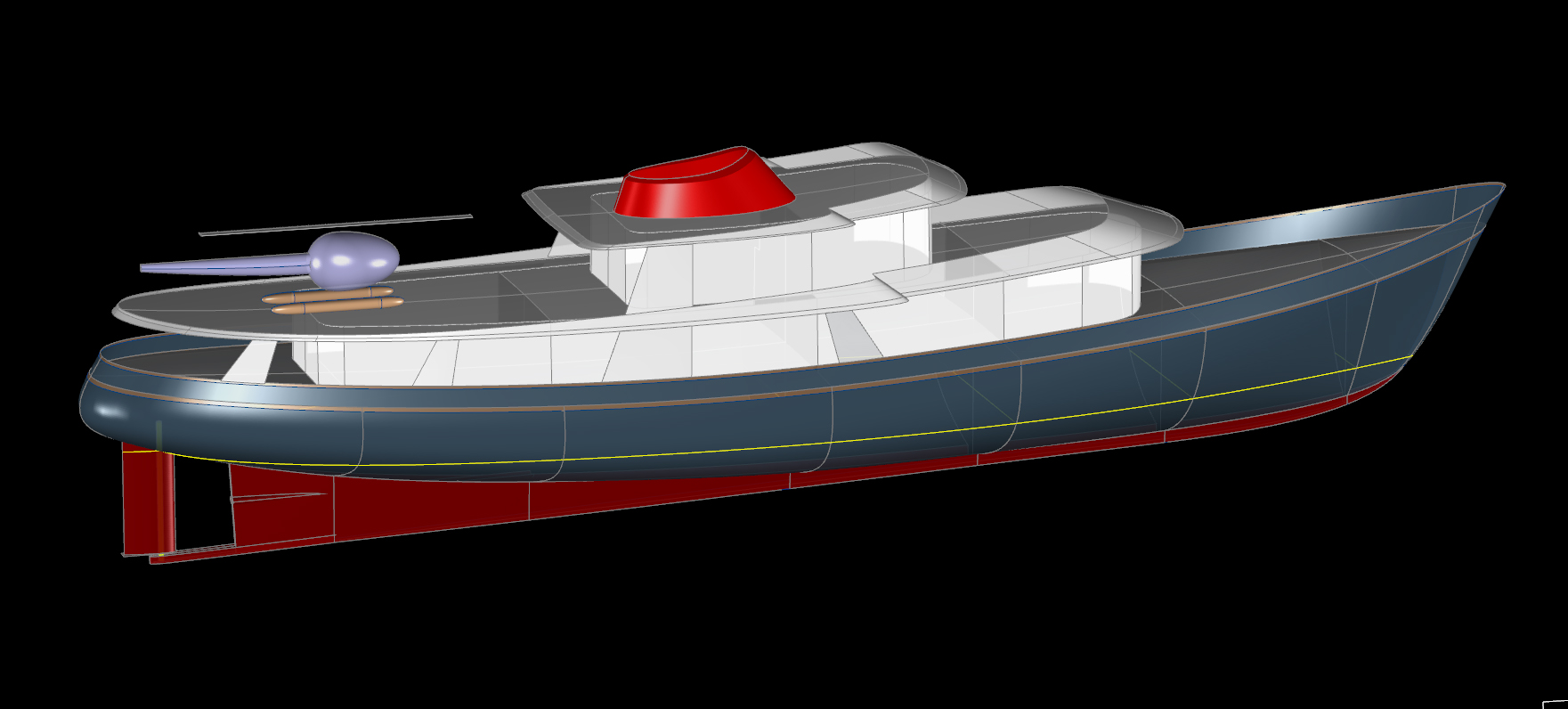
Forward Perspective | Jeanne V Web Page
Modeling
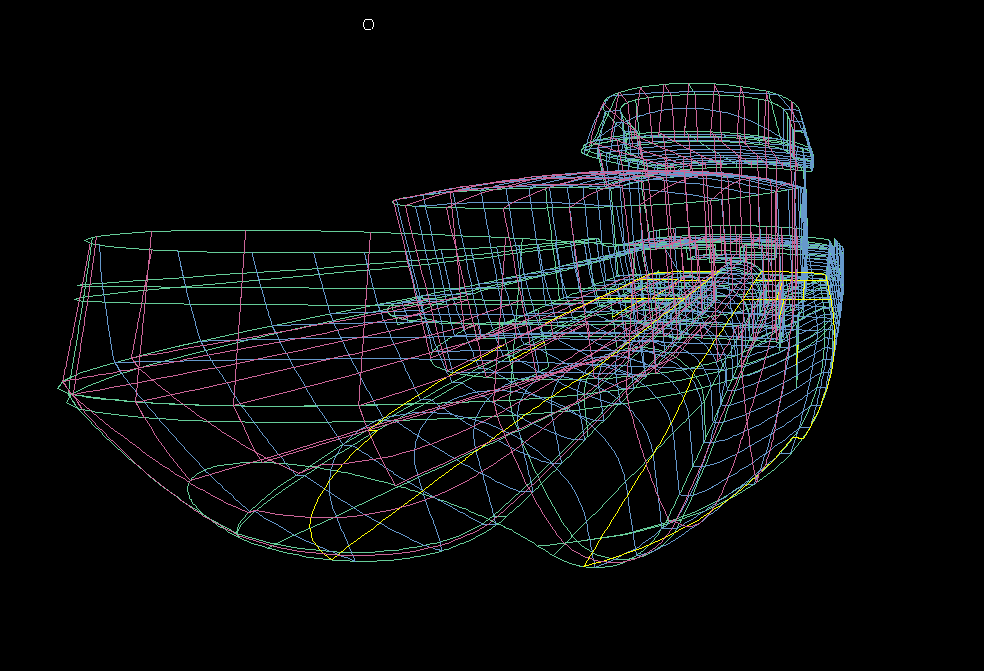
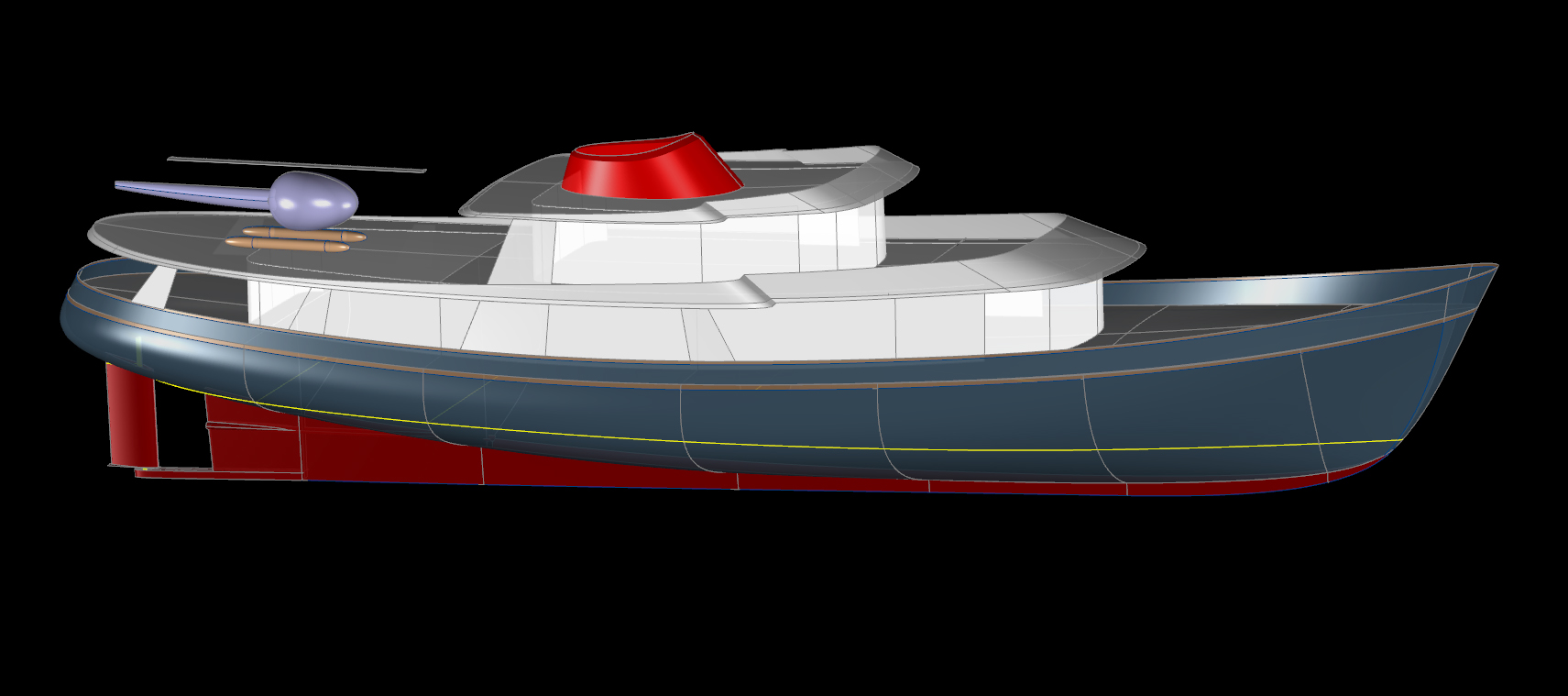
Without question, Maxsurf is the most highly developed and best integrated 3D modeling and analysis software for yacht and ship design. Using trimmed NURBS surfaces, Maxsurf is the ideal tool for creating a prototype or preliminary design of a proposed vessel. The above image shows a model of a 130 foot motor yacht, the Jeanne V. Having created and faired the 'virtual' hull and superstructure, the 3D surface model can be put to a number of uses...
- As a graphic image, the model can be rendered and background added, giving the model the appearance of being a photograph of the completed vessel. This can be a highly useful sales tool, or can simply be for the prospective owner's use.
- The virtual model can be used for numerical analysis to determine the vessel's hydrostatics, trim, stability, performance, etc. Surface areas and their centers are immediately available to the designer for use in the weight analysis, and in determining resistance, windage, etc. for the final stability analysis.
- Internal structure can be modeled for the sake of determining interior volumes or to observe the available spaces within the hull for visualization purposes. This can become quite elaborate if necessary, in order to have a virtual "walk through" should that be desired.
- The computer generated NURBS surface model's geometry can be exported to a numerically driven 5-axis router, which can be used to carve a three dimensional scale model of the vessel for the sake of knowing in advance what the exact look will be, including hull, appendages, and superstructure. It can then be painted nicely and become a showpiece physical scale model.
- For vessel of any material a real-world performance analysis can be done by having the hull and appendages router-carved to a precise scale for use in a towing tank. This is especially useful where new or experimental features have been introduced, or for testing the efficacy of a bow bulb or new keel design or to optimize various hull shapes.
- For a GRP vessel, the computer model's surface geometry can be exported directly to the same kind of numerically controlled router in order to create the actual hull mold. This is equally applicable to the superstructure, and has become the most viable approach for new GRP yacht construction. It allows the builder to eliminate the long lead-in time associated with lofting and mould making. This not only lets the builder to save considerable time, but also allows the builder to save on valuable shop space.
- For metal vessels, the computer generated model becomes the basis of generating the actual structural shapes that will be used for construction, such as frames, tank faces, engine girders, stem, stern, etc. as well as to plan and expand all the exterior hull plating. For more information on this process, please see our CAD Design Stream and Why NURBS... articles.
- The interior joinery such as wooden bulkheads, soles, and even minor joinery partitions can also be defined directly from the computer model for automated cutting by 2-axis router, providing a terrific labor savings. When used with an NC cut moulded GRP vessel or with a precision NC cut metal vessel, this will also provide an extremely accurate fit-up. An entire interior can be defined, modularized, and cut out by machine, ready for assembly and installation.
All of the above described services are readily available in North America, Europe, Australia, New Zealand and South Africa. For example in the US Pacific Northwest the following services are close at hand:
- A large 5-axis NC router is located at Janicki Machine in Sedro-Woolley, Washington, just north of Seattle.
- Another large 5-axis router is at Cadence CNC Manufacturing in Victoria, BC, on Vancouver Island.
- One of the best towing tanks is close by in Vancouver, BC, at the University of British Columbia.
- There are many services that do NC cutting for metal structure via machine driven plasma torch or water jet.
- Other services use routers to cut plywood structure, whether for sheathing a plywood hull, or to create mould frames for a GRP vessel.
One of the biggest advantages of having defined the 'parts' via computer modeling is that the resulting geometry can be sent anywhere worldwide via email. Design information can be shared instantly worldwide during the development of the design then and during the actual building of the boat.
Where labor rates are at a premium, the virtues of computerized modeling and NC cutting become readily apparent, and the machine-cut parts can save considerably in terms of production costs. In other areas where labor may not be the dominant cost component, computer modeling of the hull and superstructure will still offer advantages in terms of advance planning, project communication, accuracy of parts definition, and control over the resulting as-built geometry.
As an extreme example, we have created designs that have been built in the jungle on Borneo with design information shared by email. Our designs have been built in Canada, the US, New Zealand, Australia and Europe. In each case, we sent nested parts to the metal cutters via email, and the builder received a complete pre-cut boat kit.
Lofting
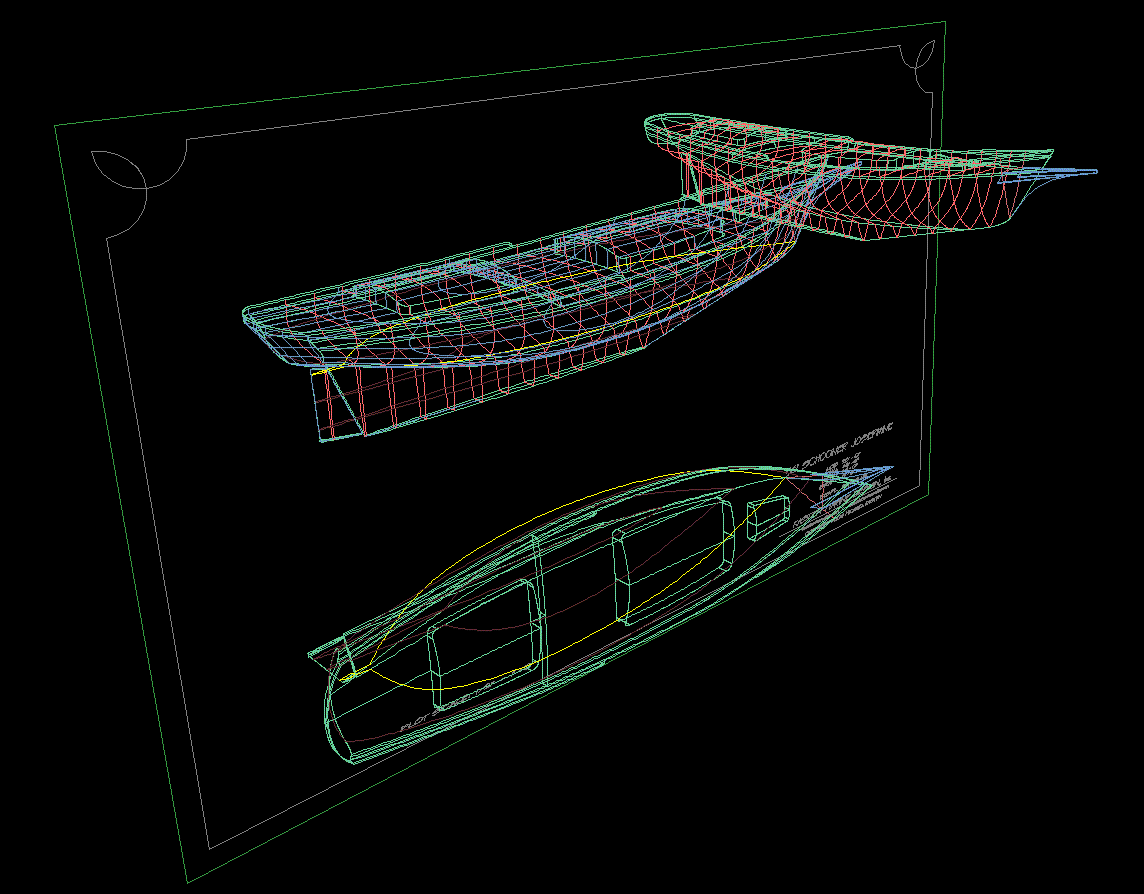
Maxsurf is a natural tool for computer based lofting and fairing. The computer-faired model can be used to export any of the typical plan, profile or body views in whatever configuration is needed to create an entire lofting - eliminating the need for any manual lofting.
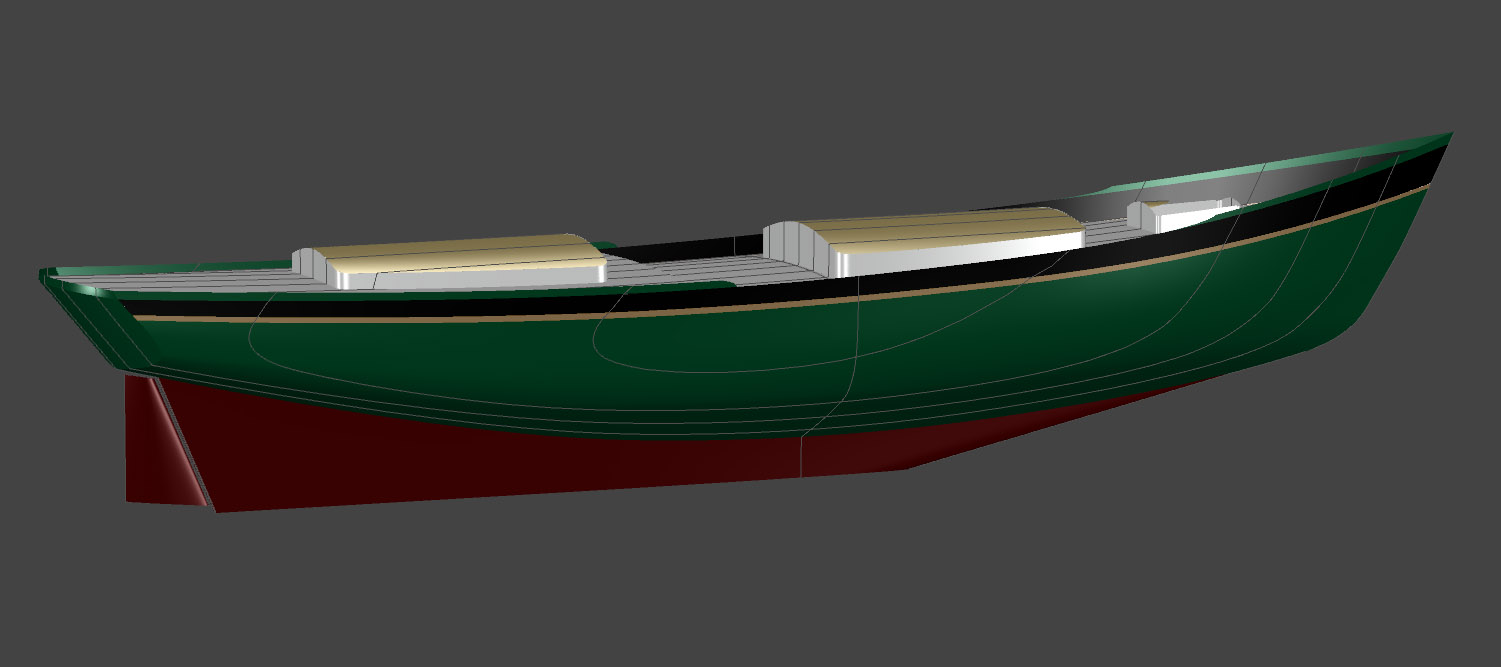
Prototype 50' Schooner Josephine
Possibly just the body view will be printed out at full size as a lofting for assembling the frames of a metal boat, or as moulds for a wooden boat, or as mould frames for a GRP boat. The body view can be sent to a numerically controlled ink-jet print head which can 'print' the body view onto metal plates for use as the actual frame-building platen. For wooden vessels or when building a mold for a GRP hull or superstructure, the body lines can be sent to a numerically controlled 2-axis router with a veining bit to cut the body lines into hard board for the same type of use.
The layout for interior bulkheads, soles, and even minor joinery partitions can also be lofted directly from the computer model.
In short, the uses for the computer generated hull and superstructure model are quite extensive, and provide a real advantage for modern computer based design, analysis, and boat building.
Computer Modeling & Analysis Links
Our CAD Design Stream | Why Use NURBS...? | Maxsurf Information
NC Prototyping | NC Parts Cutting | NC Boat Building Advantages
Please see the AVAILABLE BOAT PLANS web page.
Home | Intro | Our Design Process | Stock Design Info | Motor Yacht Designs | Sailing Yacht Designs | Prototype Designs
Plans List | Articles | Our CAD Design Stream | Maxsurf | SITE MAP..! | Site Search | Design Team | Contact Us