Messing about in boats since 1975. Online Since 1997.
Home | Intro | Our Design Process | Stock Design Info | Motor Yacht Designs | Sailing Yacht Designs | Prototype Designs
Plans List | Articles | Our CAD Design Stream | Maxsurf | SITE MAP..! | Site Search | Design Team | Contact Us
Please see the AVAILABLE BOAT PLANS web page
The 50' Aluminum or GRP Fast Trawler
'Fast Cat'
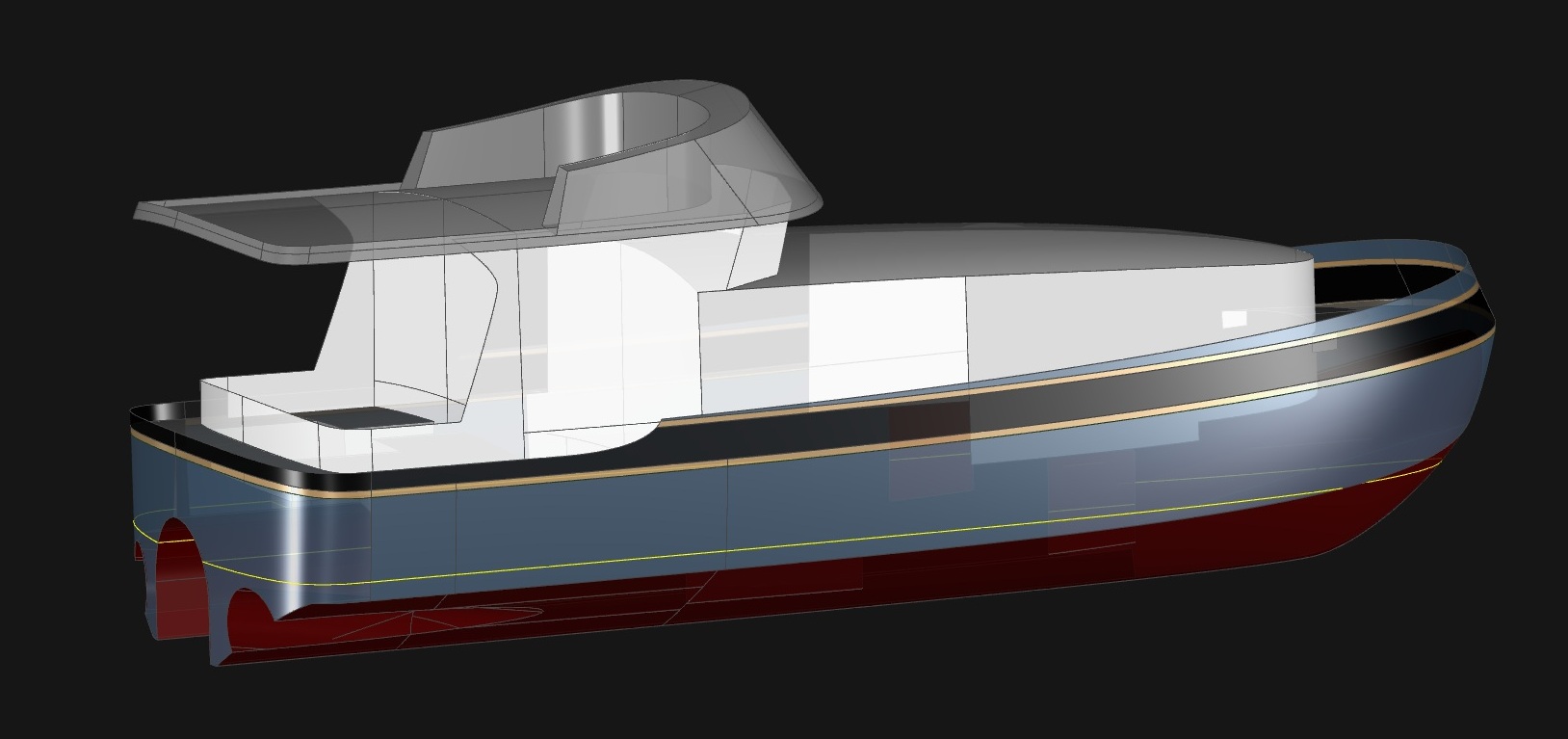
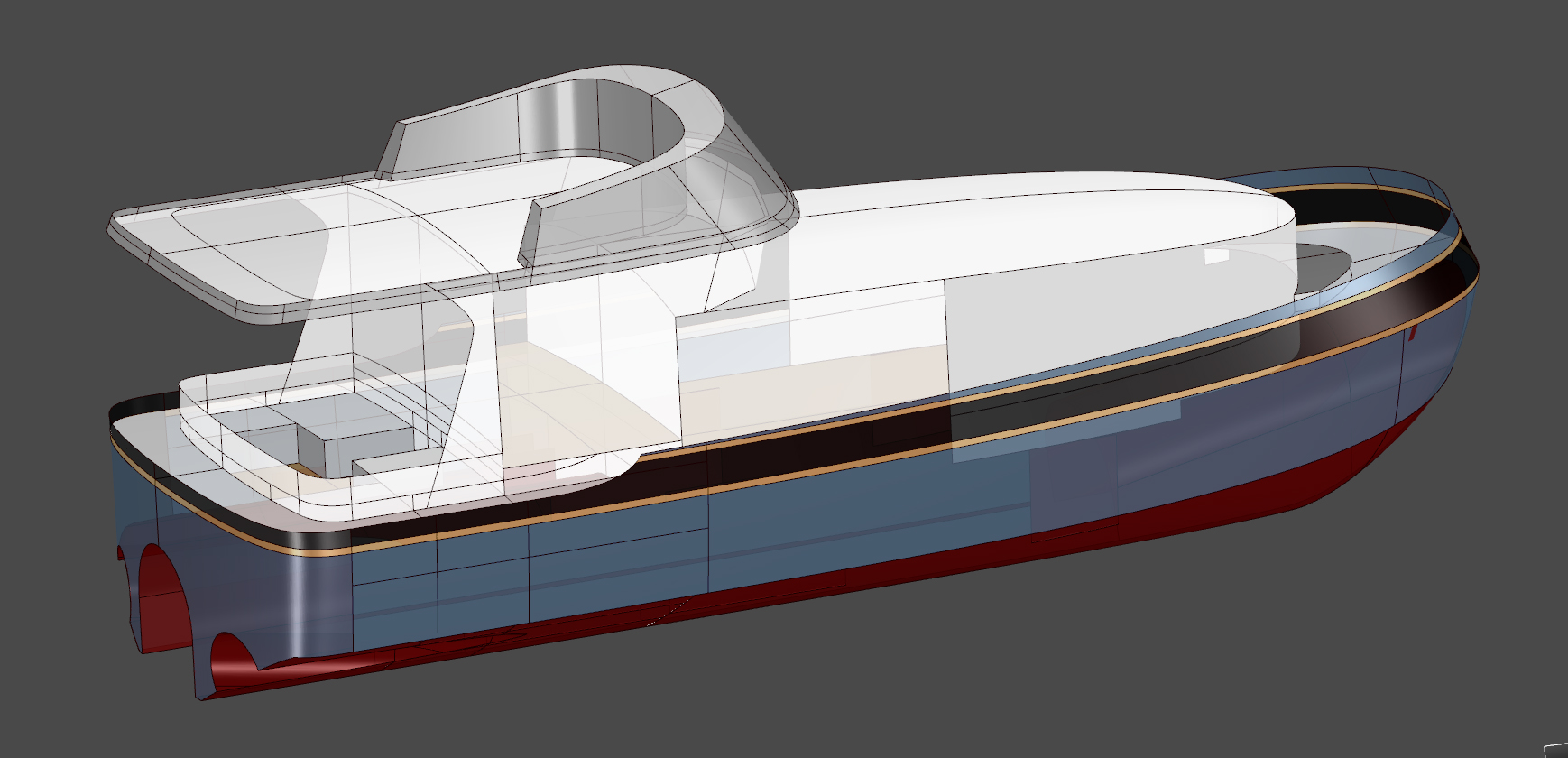
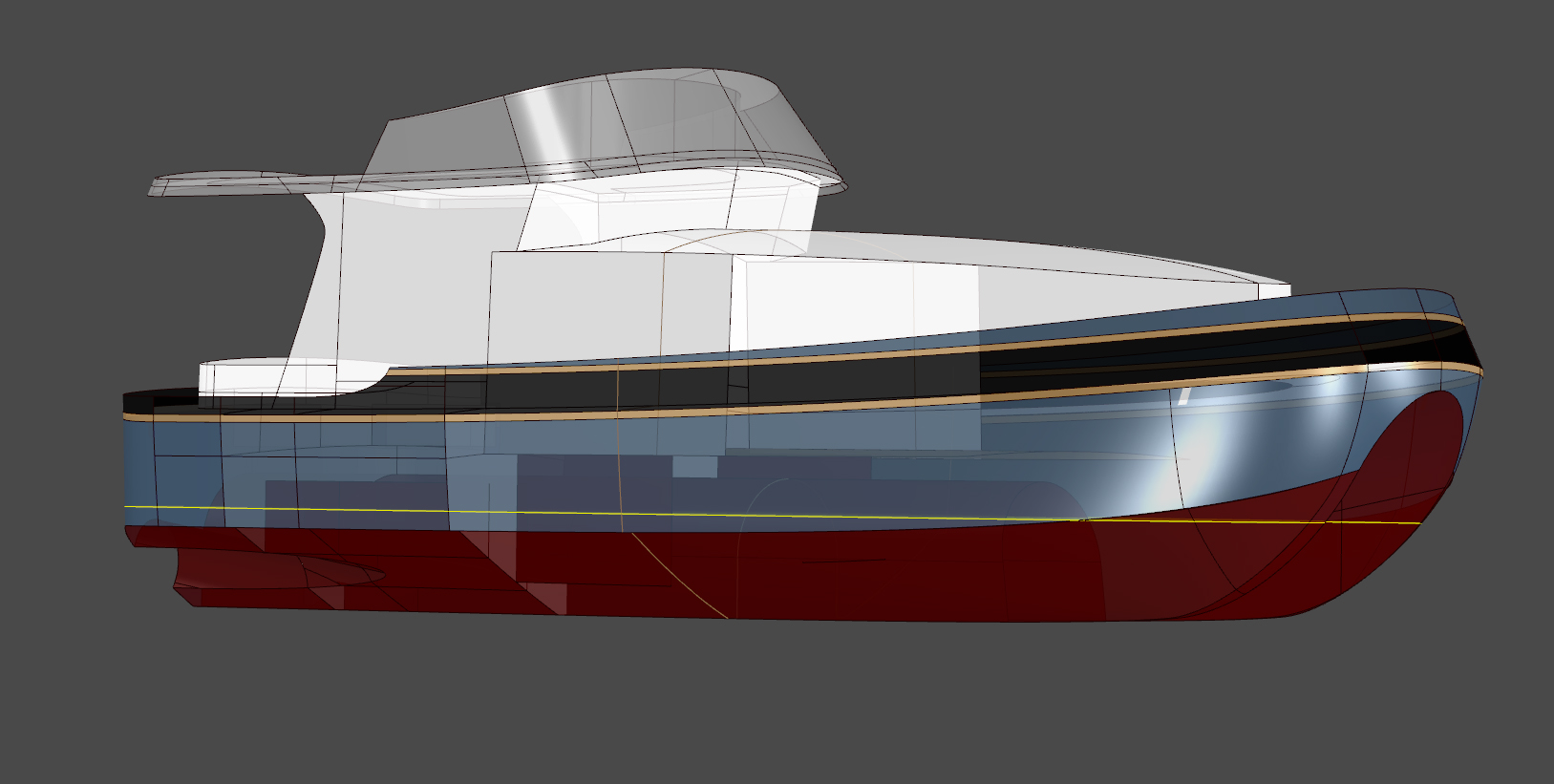
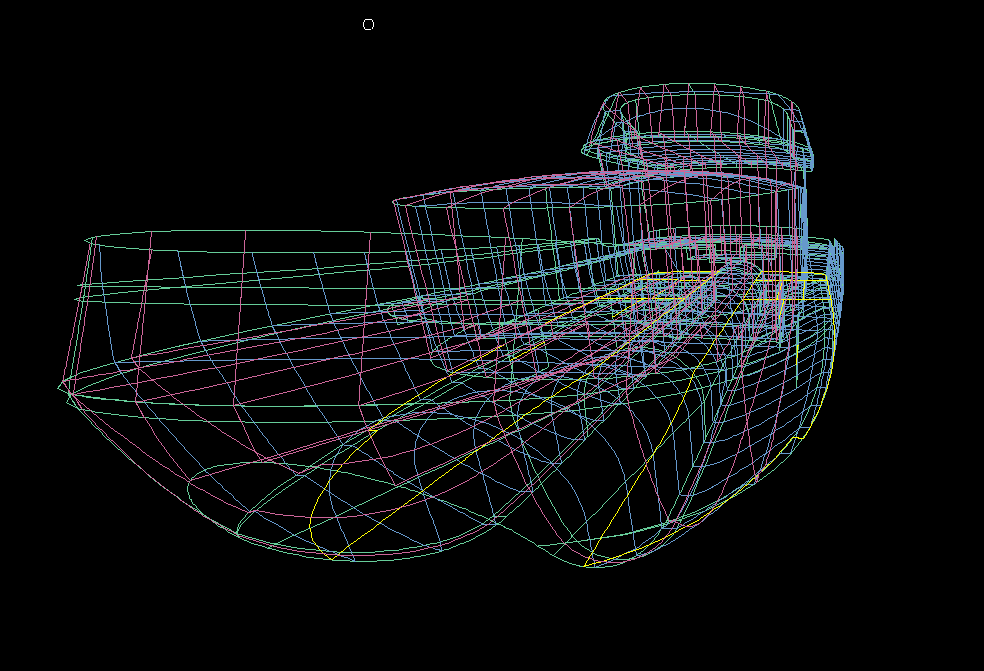
Larger Aft Perspective | Alt Aft Perspective | Forward Perspective | Lines PerspectiveCopyright 2004 - 2011 Michael Kasten
General Concept
We have developed three basic types of Power Cat. This one is essentially a mono-hull with a 'tunnel' between the two halves of the hull. The purpose of this configuration is to produce an easy motion, and to avoid any wake interference between hulls.
This "tunnel hull" type is not new, having been perfected in the rough waters of South Africa, where these craft have often been outfitted with hydrofoils in between the hulls. This hull type can be driven at planing speeds even without foils, but with the foils and with around 25% more horsepower, the speed potential is almost double. This is an extremely rare case of getting something for nothing...! However it does require limited superstructure, light waterplane loading, and quite a bit of power...
The hydrofoils work well in rough water as well, since the foils lift the hull about halfway out of the water. Being between the hulls, the foils are well protected. The 'sub-surface' foil types used for this purpose are self-regulating, in other words they do not need to dynamically articulate for attitude / trim control. The aft foil can however be arranged to articulate to various 'set' positions, allowing corrections for variations in load - say for passengers or varying fuel loads, etc.
While this configuration is quite fast, being foil borne is not a suitable mode of operation for long range because it consumes too much fuel...! However if fuel use is not an overriding concern, the foils provide an ideal way to extend the daily range of operation, allowing a wider variety of day trips, and much quicker voyages.
The model shown here is 50' overall length, but can be sized to whatever larger size might be suitable to the intended use, provided the weight and superstructure are kept within limits well suited to the vessel size. If there is to be a flying bridge, in my view the vessel begins to come into its own at lengths above 60 feet LOA.
Although this configuration is ordinarily intended for planing performance, long range cruising is also a possibility. But... if long distance voyaging under power were the overall goal, much greater efficiency can be obtained with a model more suited to slow speeds such as the Wave Cat.
Construction
The Fast Cat will function best if kept light in weight. With this hull type, steel is not a viable option for structure until the size approaches somewhere around 120 feet. In all sizes, aluminum will be much more suitable, as will GRP.
If built in metal the greatest construction efficiency would be achieved via NC Cutting of the structure.
What is NC...? It simply means 'Numerically Controlled' and implies that the plates and internal structure will be defined by computer modeling, and will be pre-cut by plasma jet or by water jet cutting. This has the potential to save a considerable number of fabrication hours, and offers the benefit of extremely accurate fit-up of the parts. Ordinarily NC Cutting is most conveniently applied to metal structure, although it is a technology that is just as readily adapted to plywood construction.
For a vessel built of fiberglass, computer modeling can still provide an excellent means to achieve the mould shapes. Many builders have taken advantage of this technology, where either a plug (male) or mould (female) will be cut out of foam by a large 5-axis router. This eliminates the complex and labor intensive mould-building step, entirely eliminates lofting, reduces shop space requirements and builder lead-in time - ultimately saving the builder's labor and the customer's overall boat cost.
Further Development
It is our routine to work with new designs on a custom basis, therefore we are able to develop just about any type and size. As a boat becomes larger, a much greater variety of cabin arrangements become possible. This is entirely up to one's preferences, with the result that the hull and superstructure will be given the best shape in order to fit the required accommodations.
A larger Power Cat of this type is our 90' Tunnel CAT, an example that shows how this vessel type can be scaled upward rather easily, and even re-styled as needed. Another unusual adaptation of the Tunnel CAT type is the Nemo - Nautilus combination, where a 70' Tunnel CAT acts as the mother ship for an 80' Submersible. When mated, they act as one single ship. When the Sub is deployed, both Sub and mother ship are each fully autonomous.
For more information, please inquire.
Please see the AVAILABLE BOAT PLANS web page.
Home | Intro | Our Design Process | Stock Design Info | Motor Yacht Designs | Sailing Yacht Designs | Prototype Designs
Plans List | Articles | Our CAD Design Stream | Maxsurf | SITE MAP..! | Site Search | Design Team | Contact Us