Messing about in boats since 1975. Online Since 1997.
Home | Intro | Our Design Process | Stock Design Info | Motor Yacht Designs | Sailing Yacht Designs | Prototype Designs
Plans List | Articles | Our CAD Design Stream | Maxsurf | SITE MAP..! | Site Search | Design Team | Contact Us
Please see the AVAILABLE BOAT PLANS web page
The 36' Coastwise Cruiser
"MOLLY"
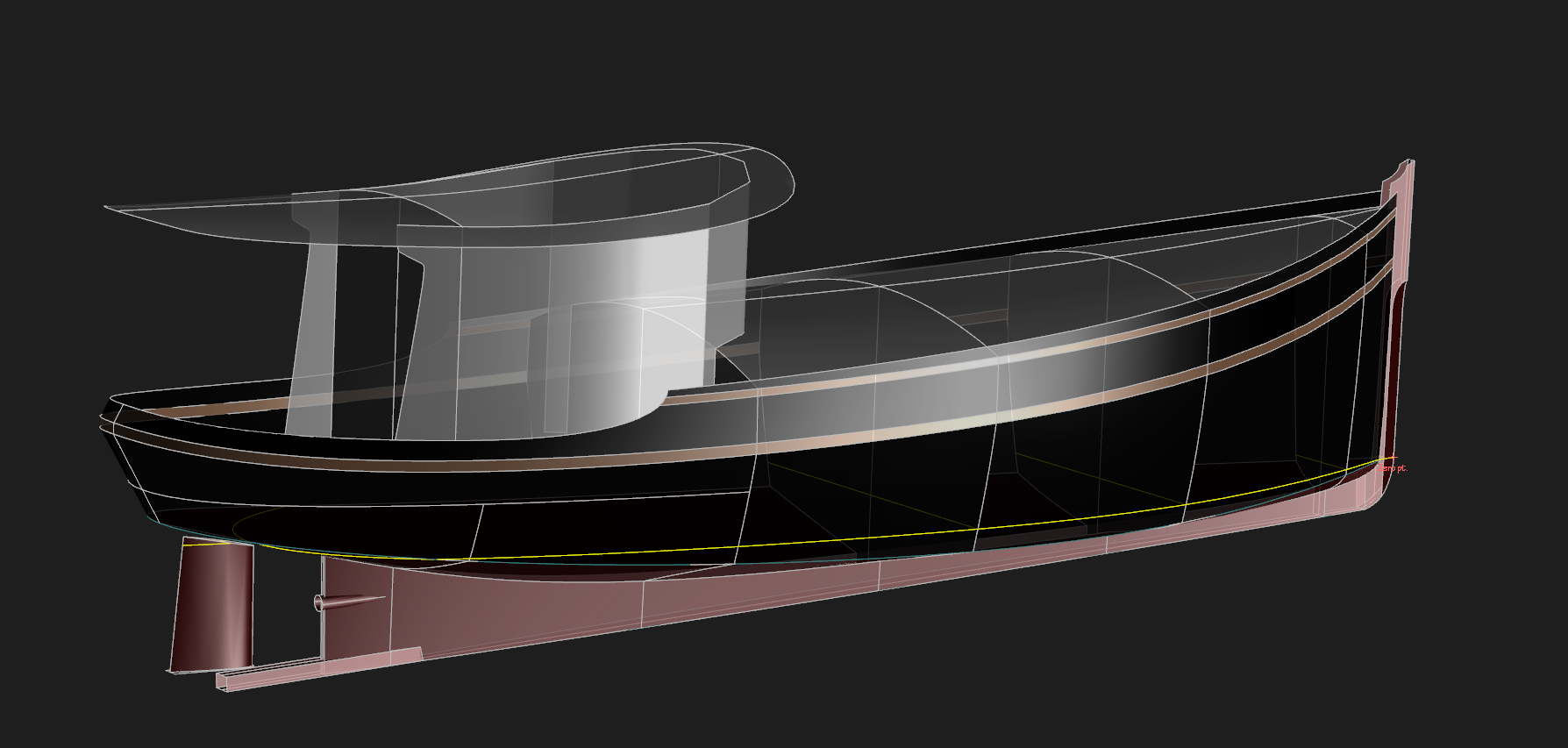
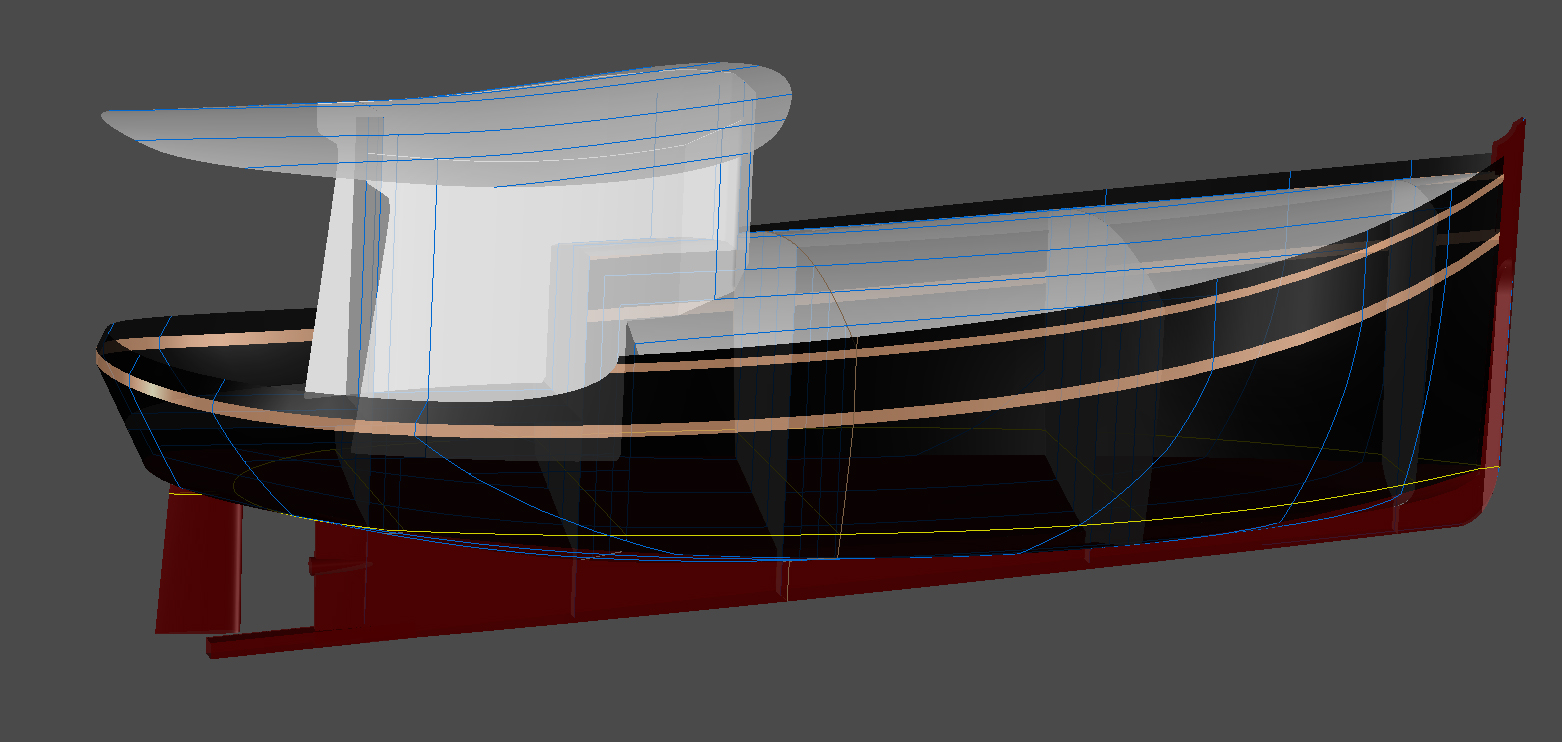
Larger Aft Perspective | Larger Side Perspective
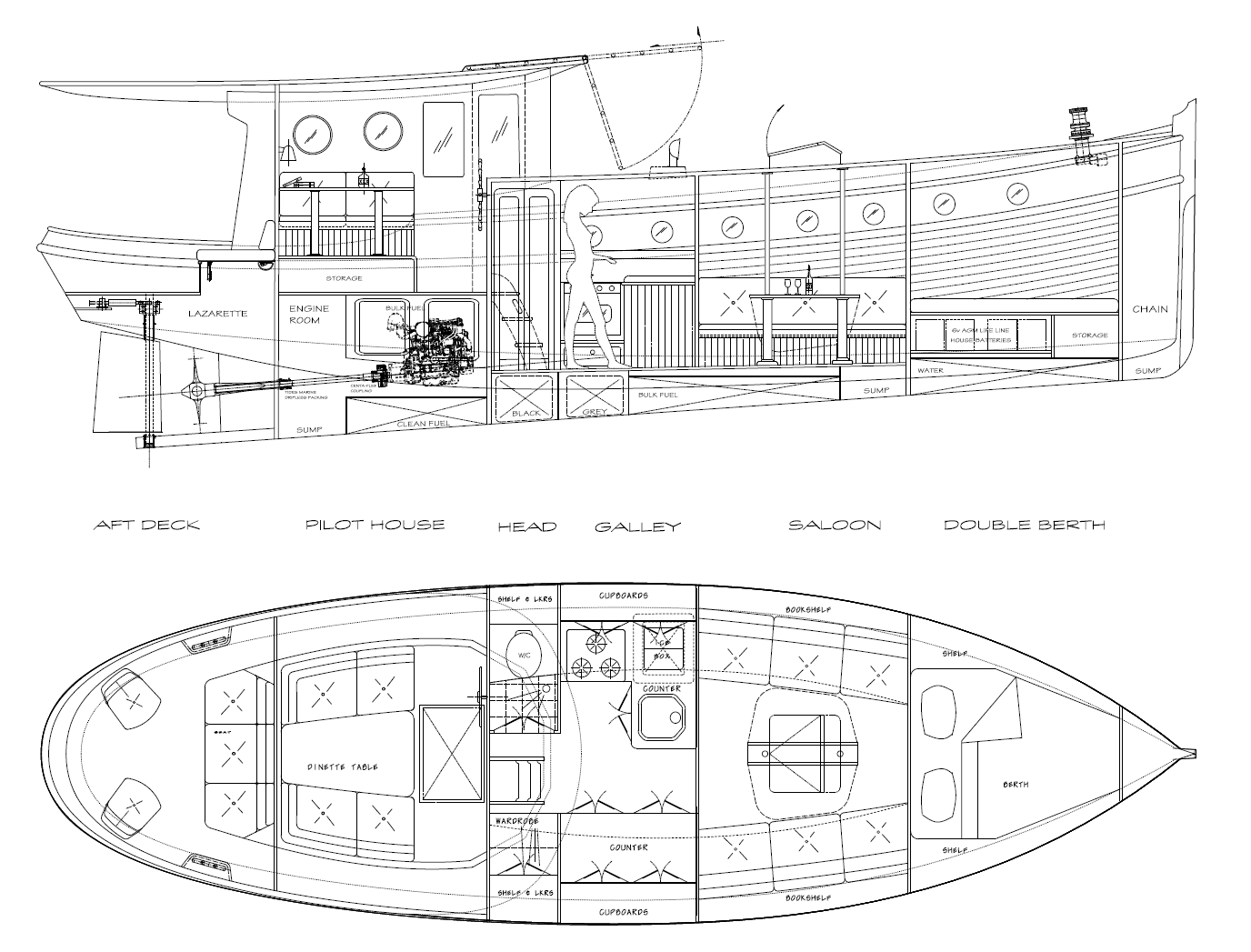
Interior Profile & ArrangementCopyright 2003 - 2012 Michael Kasten
General Concept
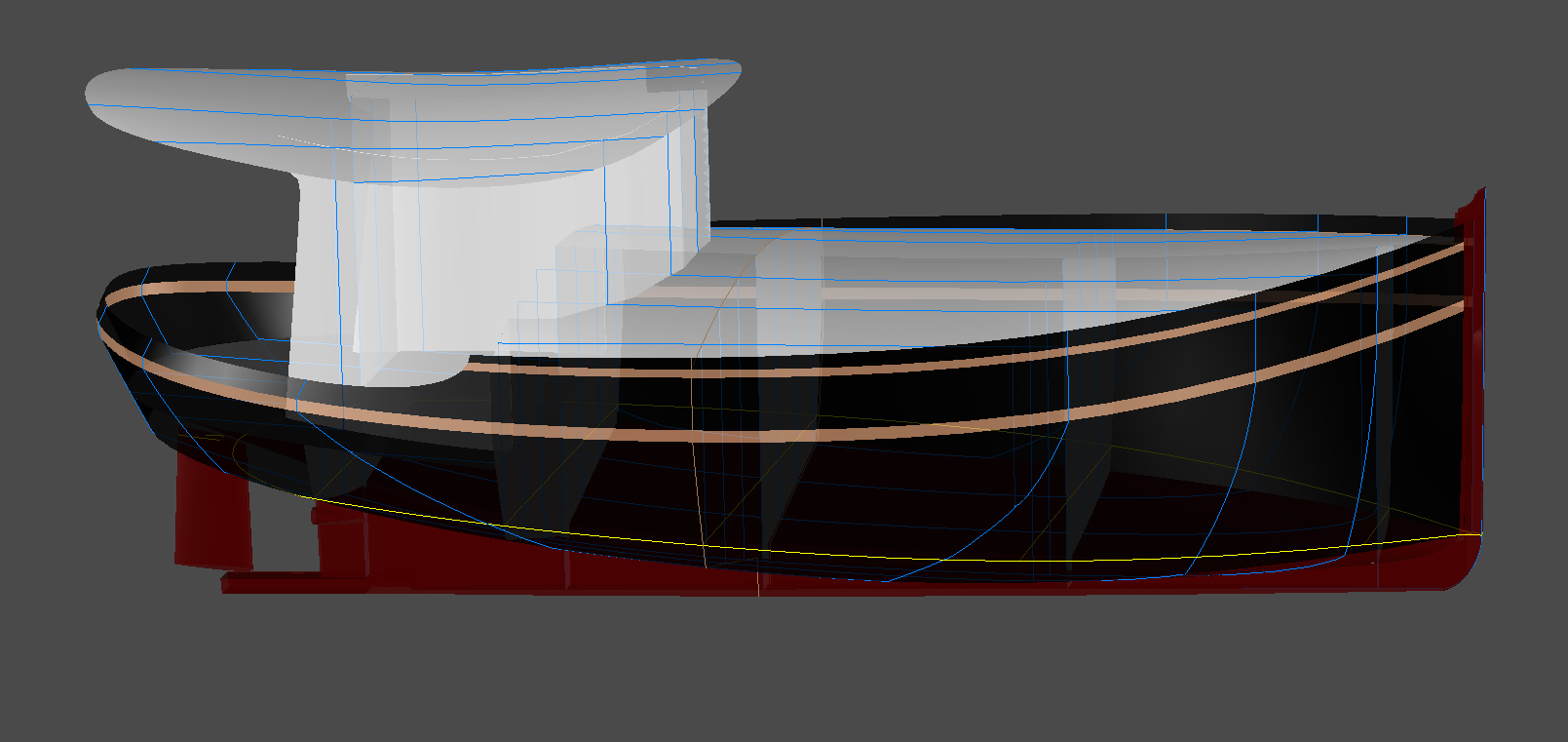
The Molly 36 is a prototype design that resulted from a request to scale down the 43' Moxie to 36 feet, but to still have a good interior layout. The result of that design study is shown here.
Molly's displacement is planned to be approximately 13,800 at the design waterline. Loaded displacement is planned to be around 18,000. Other particulars are:
- Draft 3.2 ft
- LWL 32 ft
- Beam WL 9.3 ft
- Beam Overall 10.5 ft
- CP 0.62
With a Displacement to Length at the DWL of 190, it is apparent that this vessel would be very easily propelled..!
As with the 43' Moxie, the 36' Molly is intended to be an ideal family cruiser for coastal and inland waters. For a place like the US Pacific Northwest, the San Francisco Bay estuaries, the Columbia River, the entire US East Coast Inland waterway, for the coast of Chile, the canals of Europe, the Aegean Sea... a more perfect small power boat would be hard to imagine, unless perhaps it would be one of the larger vessels in this series (see the links below).
Click for Larger ImageInterior
The Molly 36 is planned to comfortably accommodate a couple with occasional guests.
Above and aft are a spacious pilot house and an aft deck that could easily be screened-in. In the pilot house is a dinette right aft with dining table on center, and a steering station forward to port. A door leads out to port & starb'd to access the side decks. On the aft deck a seat faces aft along the aft face of the house. A table and folding chairs allow comfortable dining outside.
Below there is sleeping for four, including the settee berths. A compact head / shower is forward of the pilot house to port, and to starb'd is a wardrobe with radio shelf above. A generous galley is forward of the head and occupies both port and starb'd sides. The starb'd counter top is also able to be used as a chart table / office table. Forward of the galley is the saloon, with settee berths to each side, with folding table in-between.
Headroom inside is intended to be approximately 5' - 9" throughout. The fore deck deck and PH top are cold moulded wood, and the hull is steel. If building in aluminum, the deck beams would require a 4" deck thickness, therefore headroom would be reduced by around 1" and freeboard raised by around 2" yielding an interior headroom of approximately 5' - 8" in the galley and saloon. If building in aluminum, the pilot house top could still be cold moulded, and this would preserve the originally intended headroom there.
In all, it makes for a great little pocket cruiser. As with the 43' Moxie, the Molly 36 is intended to be extremely economical to build for the amount of living space provided.
Construction
When building the hull in steel, weights must be watched very carefully. For example, 10 gauge plate would be a requirement for the hull, or in a metric venue perhaps 4 mm for the bottom and 3.5 mm for the topsides. The fore deck and the pilot house structure will necessarily be cold moulded wood.
Molly would benefit from the use of aluminum as a hull material. In that case, the hull, decks, and pilot house could all be built with one material, with only the pilot house roof being cold moulded wood, a choice based upon maximizing headroom and simplifying construction.
Molly would also be a good candidate for construction in plywood with epoxy/fabric sheathing. This would give the boat a structure that is both strong and light in weight. With attention to detail, much of the internal structure such as stringers could be left visible, saving weight and providing a very handsome interior. As with metal, all parts can be pre-cut using a computer driven router - an excellent candidate for "stitch and glue" construction. Very simple stuff.
My own preference favors metal construction. With metal, one can arrange for the parts to be pre-cut by computer driven plasma arc or water jet cutter. Via the computer model shown above, the plating, frames, tank faces, and other internal structure can be quickly detailed for NC cutting. The resulting "boat kit" would make for very fast assembly.
Since all surfaces are developable, Molly could also be easily built in GRP using pre-made flat panels. If composite construction were preferred, and it were instead desired to do a single lay-up for the hull, a female mould would be made using flat sheet material such as particle board. For this purpose, it can be quite expedient to create mold frames and cut the sheathing for the mold via NC router. As with metal, the mould parts are easily developed directly from the computer model of the hull.
Power And Range
With 250 gallons of diesel fuel and a 10% reserve, per the Beebe algorithm Molly's range would be around 2,500 miles at S/L 1.15, or 6.5 knots, for which the engine power requirement would be around 12 - 15 hp. Variations would be noted between the various choices of hull materials, with steel being the heaviest and plywood the lightest, and range would vary accordingly.
Maximum speed depends on engine power. An engine of 30 hp would push Molly at "normal" hull speed of around 7.5 knots. Due to being a relatively light displacement boat though, the hull has a speed potential of around 9 knots. The engine could therefore be around 50 hp in order to take best advantage of the hull shape and its full speed potential.
A controllable pitch gear and propeller could be provided if desired. For more information on this arrangement, please see our Controllable Pitch article.
Another interesting choice would be the recently released Beta-Marine Hybrid Diesel-Electric combination - now offered as a complete package. Basically a marine adapted Kubota tractor engine coupled to a generator, which then drives a Hybrid Marine electric motor for propulsion. The Beta-Marine / Hybrid-Marine package is currently available with an electric motor of 10kW, sufficient to drive the vessel at its basic hull speed in a "Serial-Hybrid" arrangement, i.e. no drive shaft directly from the diesel to the propeller.
Hybrid-Marine also makes a "Parallel-Hybrid" system, whereby there is the usual diesel-gear-driveline-propeller arrangement, but which has a "power-split" unit in line that allows the diesel engine to drive the propeller, or alternately allows the electric motor to drive the propeller direct from the batteries, or both. In this case the "power split" unit allows charging of the batteries from the turning of the drive shaft, whether that turning is provided by the diesel, or (under sail) by the propeller.
In the end however, the conventional arrangement of diesel-gear-driveline-propeller involves the least first-cost by far, and will therefore continue to be the most likely candidate for propulsion.
In Summary
The Molly 36 is a concept design for which the hull, deck and house structures are planned as shown above and below. The hull form has been modeled, preliminary calcs have been done, and an interior has been sketched - primarily as a "feasibility study."
I have developed various prototypes of this vessel type in sizes ranging from 32 feet to 80 feet. Of course, those sizes are not the limits of what could be done; they are simply the range that we have so-far investigated in terms of achieving a viable layout and general form factor.
Three designs in the Moxie family have been fully detailed in order to expand on this concept: the 43' Moxie for steel or aluminum, the 49' Quinn for aluminum, and the 50' Renegade for steel or aluminum. A larger prototype has also been developed in the form of the 60' Peregrine. Even in the larger sizes, the layout is optimized to accommodate two people, with guests able to sleep on the saloon or pilot house settees. Of course as the vessel becomes larger the layout possibilities become more numerous. For example on the 60' Peregrine there is the possibility of a second sleeping cabin which could alternately be used as an office.
Please also check out the article written about the 43' Moxie design by Steve Knauth in Soundings Magazine here.
Other Versions..?
A 32' version called "Mandy" is intended to have the same accommodation plan below forward as the Greatheart 36, except that Mandy would have a large aft deck instead of the Greatheart 36 aft cabin. The Mandy 32 prototype has a preliminary displacement of 10,600 lb, a beam of 10.5 ft, and a DWL of 28.5 ft.
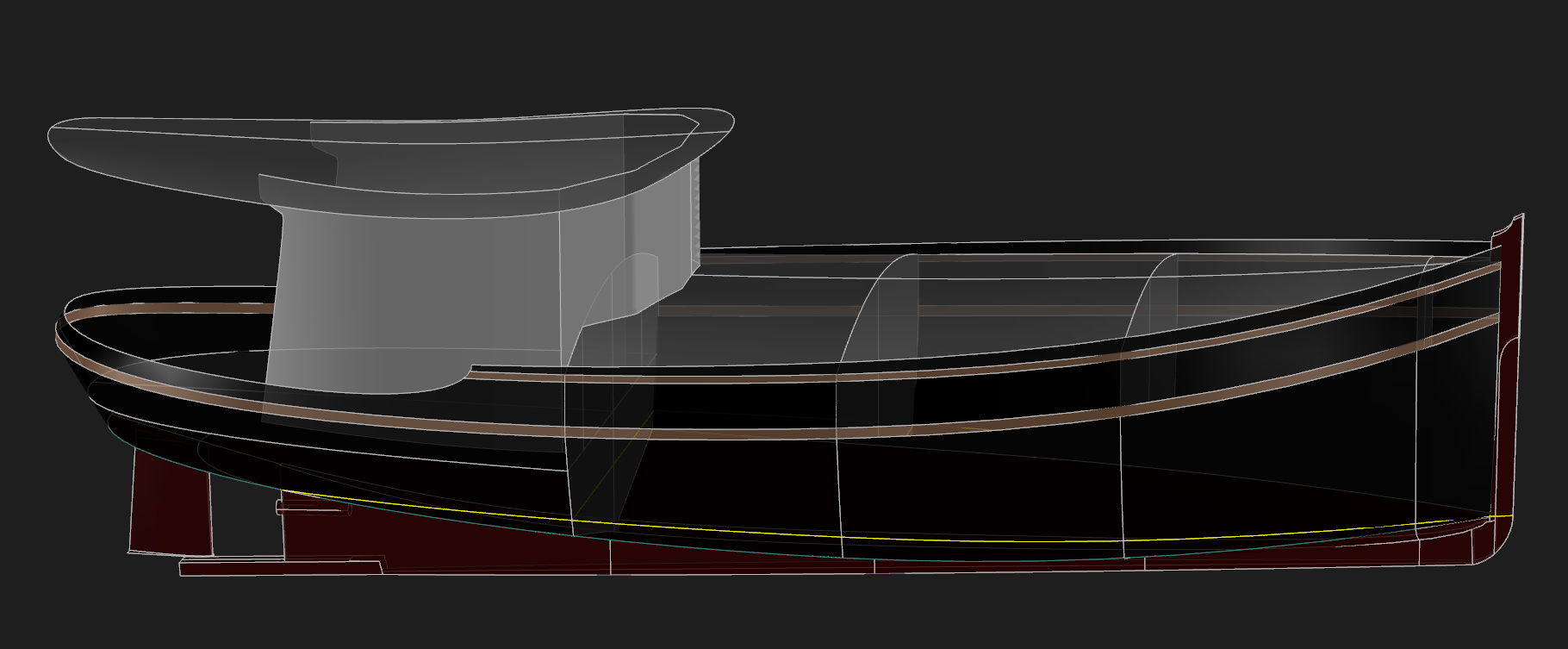
Below we see Molly in an even smaller size... a 30' version of Molly...! The layout would be quite similar, but with a galley length of 4.5 feet to port, and a 3' head to starb'd with a 1.5' bureau forward of the head. The pilot house would be smaller, and would ideally have a bench seat across the aft end, facing forward, with a folding table just forward of the seat.
Larger Aft Perspective | Larger Forward Perspective
Other designs in the "Peregrine / Renegade / Moxie" Family:
36' Molly | 43' Moxie | 49' Quinn | 50' Renegade
61' Peregrine | 82' Peregrine | 100' Amazon | 164' Peregrine
60' Pennywise Trimaran | 70' Peregrine-on-Thames
Direct Quote from an aluminum boat owner...
As an owner since 5 years of an aluminum boat I could not agree more with your preference for this material. She is a great boat and requires very little in the way of maintenance. I do a lot more reef snorkeling than the paint, polish, varnish and wax guys!--Peter Kminek
Please see the AVAILABLE BOAT PLANS web page.
Home | Intro | Our Design Process | Stock Design Info | Motor Yacht Designs | Sailing Yacht Designs | Prototype Designs
Plans List | Articles | Our CAD Design Stream | Maxsurf | SITE MAP..! | Site Search | Design Team | Contact Us