Messing about in boats since 1975. Online Since 1997.
Home | Intro | Our Design Process | Stock Design Info | Motor Yacht Designs | Sailing Yacht Designs | Prototype Designs
Plans List | Articles | Our CAD Design Stream | Maxsurf | SITE MAP..! | Site Search | Design Team | Contact Us
Please see the AVAILABLE BOAT PLANS web page
The 30' Trawler Yacht
"BUSTER"
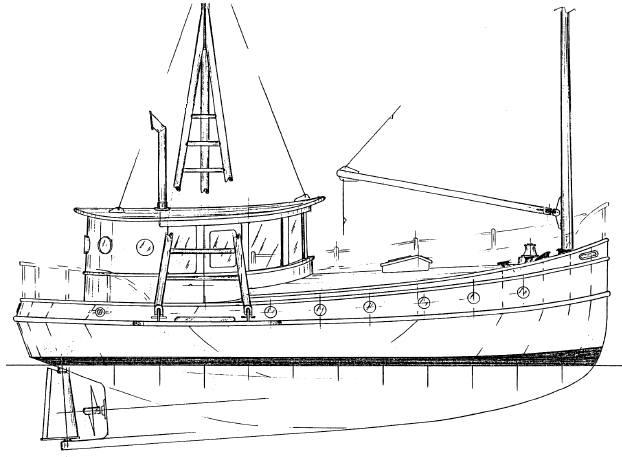
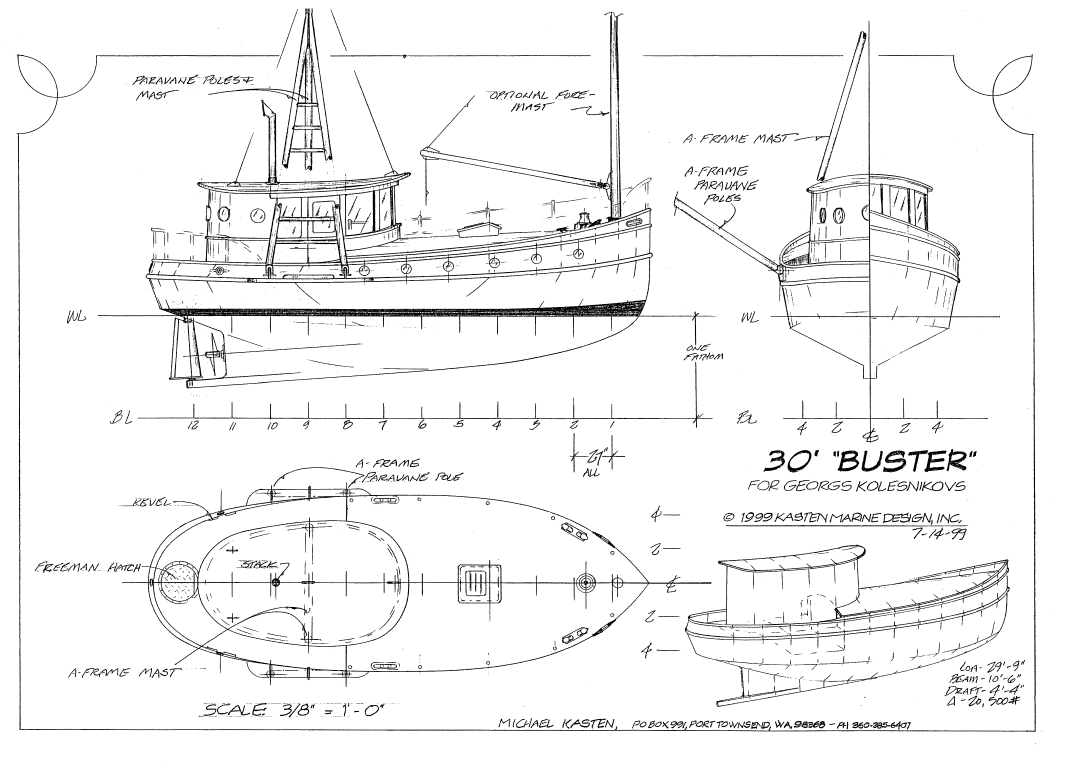
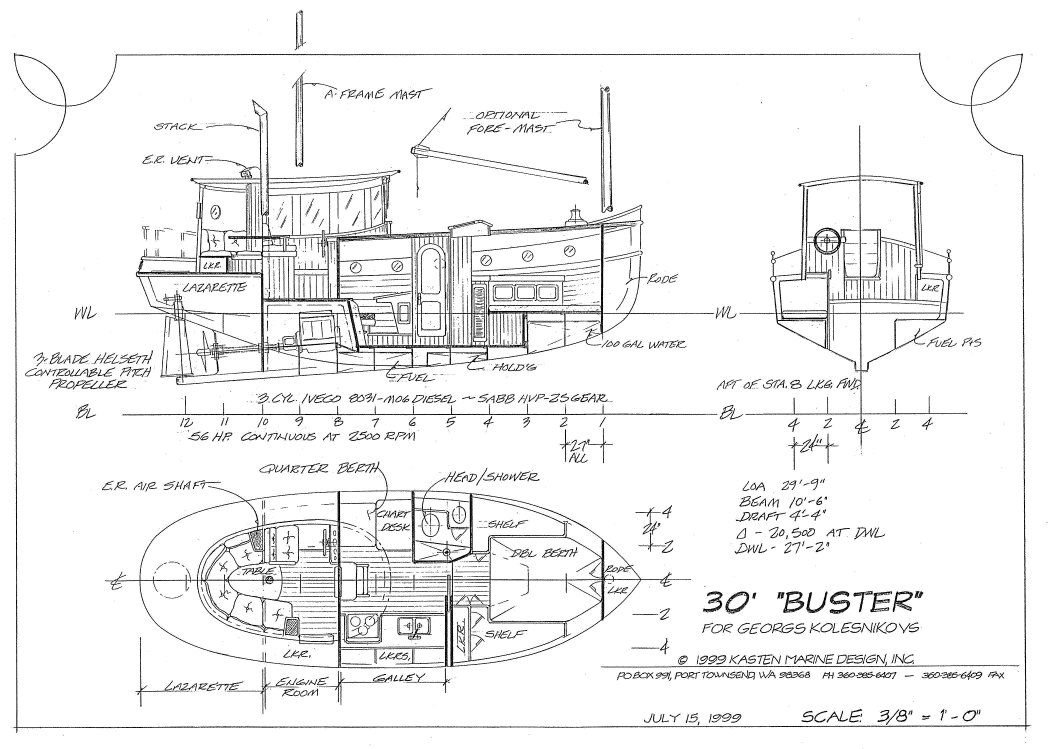
Buster Outboard Profile | Buster Interior P & A
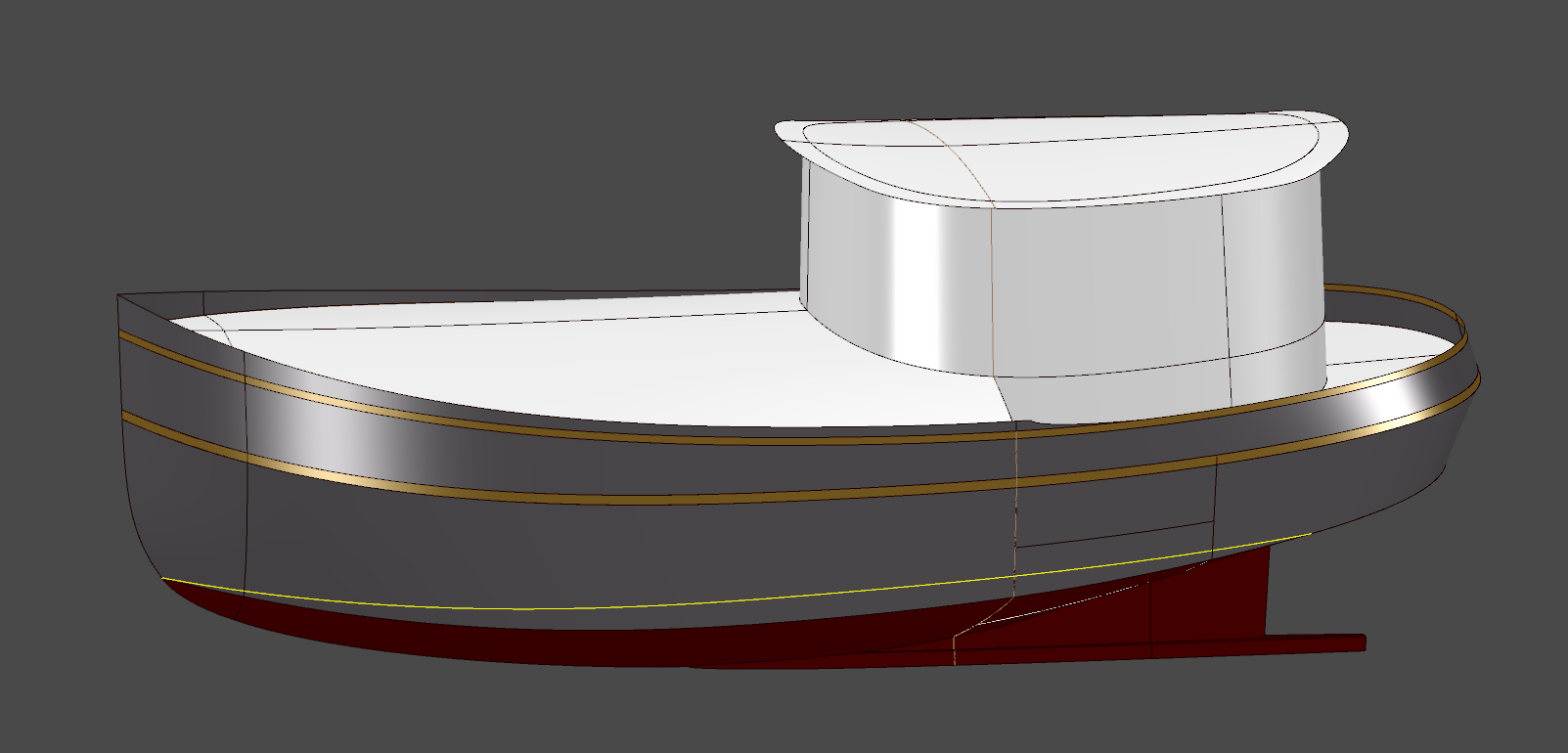
Perspective Aft | Perspective Forward | Perspective PortsideCopyright 1999 - 2014 Michael Kasten
General Concept
This design has been created for Cape Horn veteran Georgs Kolesnikovs as the ideal power cruiser under 30 feet LOA, capable of voyaging anywhere on the World's oceans. As Georgs has said, "I don't need to go fool around at the Horn again, but I might like to see Canada's Northwest Passage."
So, with ice in mind, and the requirement for plenty of fuel for the Canadian north, and for trans-Pacific passages, we have come up with a vessel that has a substantial carrying capacity. Particulars are: 29' 9" LOA x 27' DWL x 10 '6" Beam x 4' 6" Loaded Draft. Displacement will vary from around 20,000# to a full load capacity of 25,000# with all tanks full, and the boat ready for a long voyage, complete with stores for two people.
At the time this design was prepared, the engine was originally planned to be an Iveco 3 cylinder diesel producing 56 hp continuous at 2,500 rpm, mated to a Sabb HVP-25 gear and Helseth controllable pitch propeller. The Iveco engine was at that time offered by Sabb with their gear as an assembly. If that Iveco engine is still available, it would be an excellent and long lasting choice.
Another engine offered by Sabb pre-mated to the Sabb HVP-25 gear and Helseth CP propeller is the excellent Lister Alpha 55-T, having a 55 hp intermittent duty rating at 2,800 rpm. Yet another engine that fits the bill of being a slow turning 3 cylinder marine diesel is the Deutz TD 203-3. It weighs 809 lb and produces 62 hp at 2800 rpm continuous.
The engine space and the weight budget have been planned to allow for the possibility of using a Lugger or John Deere naturally aspirated 4 cylinder diesel. Those two engines are nearly identical and weigh around 1,200 lb. Power is 67 hp continuous at 2,500 rpm, so these engines offer considerably more power than is needed.
The Iveco and Deutz 3 cylinder engines are not quite as long nor quite as heavy, so if available, they are a slightly better fit for the vessel, however any number of slow turning 3 cylinder diesel engines would be suitable, including offerings from Isuzu, Kubota (Beta Marine), Ford (tractor engines), etc. Although we like controllable pitch equipment, one could easily substitute a Twin Disc gear and fixed pitch propeller.
The engine is tucked under the Pilothouse sole and has access both via a door forward, and a hatch above, providing good access to the engine. Although not a walk-in engine space, there is plenty of room for a full size person to get to all parts of the engine and gear, plus a generous allowance all around for an effective sound attenuation package.
There are two bulk tanks aft and two forward with a separate clean tank as a day tank. The clean tank is to have no deck fill. Using the Beebe algorithm for range under power, along with the Beebe prescribed fuel rate of 16 hp/gal/hr as the specific fuel consumption, with a tank capacity of 600 gallons, a 12% reserve, and the average Load Case, the Beebe algorithm yields approximately:
- 4,000 nm at 5.5 knots
- 3,000 nm at 6 knots
- 2,400 nm at 6.5 knots
Hull Form & Rigging
The hull is designed after that of a working tug in order to get the largest carrying capacity (the largest possible water-plane) within the smallest overall length. The hull has been optimized for ocean conditions and the lines provide for an easily driven hull, even though of medium to heavy displacement. Displacement to length varies from D/L 320 at her design waterline, to just over D/L 500 if fully loaded.
Hull and pilot house construction are all aluminum. The hull is extra heavily built for this size boat, having 5/16" aluminum plating. The pilothouse windows and portlights are tempered and / or laminated safety glass. Windows are bonded in place, as is our usual practice. This is strong, simple easy to build, and elegant.
There is lead ballast amounting to around 2,000 pounds (depending on engine choice). Paravanes are provided for roll attenuation, and are deployed via a pair of A-frame paravane poles. The poles are supported by an A-frame mast, stayed to the pilot house top. The A-Frame poles provide a ladder for conning into a pass, and when faced with a fixed pier at low tide you can climb right on up to get ashore...!
An optional fore-mast is shown on the drawings for the purpose of lifting a skiff or pram aboard onto the fore deck. The fore-mast would allow spreading a few sails as get-home power.
The rig being all made with aluminum can easily be struck for the sake of passing under bridges. What more ideal boat for a canal cruiser?
Interior Arrangement
The accommodations are intended to provide comfortable cruising for two people on extended passages, with the occasional addition of a third crew member or couple for shorter trips. There is full standing headroom throughout the vessel for anyone up to 6' 5" height. For anyone of slightly less height, as the song says, "You can keep your hat on..."
The deck steps up near the forward end of the Pilot house, creating a very spacious cabin area below forward. The resulting low forward cabin extends from the stem all the way to the aft pilot house. With a flush deck forward, there is an enormous amount of space below for such a small vessel. Right forward is a generous double berth in a big "master suite" that's complete with cabinets and dressing area. The head to port also provides a shower. Aft of the head is a chart desk and a quarter berth which extends below the pilot house. To starb'd of the head / desk / berth is a good sized galley.
The "saloon" is contained within the pilot house and is in the form of a wrap-around dinette. The table leaves fold up to permit access on either side. The whole table can be placed between the seats to create a large guest berth, should the need arise.
The "dashboard" forward of the wheel holds instruments and engine controls. VHF and SSB radios are mounted near the helm. Some instruments may be mounted overhead as needed. Being an aluminum vessel throughout, a magnetic compass may be mounted prominently just forward of the wheel.
Alternate Interior...?
One interesting variation is the Sweet Okole 30 which has a "bridge deck" amidships. This would ideally be combined with widening / lengthening the pilot house (to eliminate the walk-around deck to the sides and aft), which would allow more space in the pilot house so that the galley would have plenty of room. A few interior sketches are at the Sweet Okole 30 web page.
Why Buster...?
The first vessel for Georgs Kolesnikovs will bear the name "Great Promise." Georgs says however that for a lady she's mighty tough looking... As a result she has already earned a few good nicknames, all of which contributed to her final design name: "Buster..."
In all, one stout Li'l all-ocean vessel!
Click for Larger ImageSimilar Designs and Prototypes in this Tug / Trawler Yacht Series
Tug Types
Boojum 22 | Boojum 25 | Boojum 30
Terrier 32 | Talisker 32 | Nidaros 38
Trawler Types
Sweet Okole 30 | Buster 30 | Boojum 43
Roberta 43 | Roberta Jean 43 | Roberta Jean 47
Far Horizon 40 | Far Horizon 43 | Far Horizon 46 | Far Horizon 50 | Far Horizon 54
Direct Quote from an aluminum boat owner... As an owner since 5 years of an aluminum boat I could not agree more with your preference for this material. She is a great boat and requires very little in the way of maintenance. I do a lot more reef snorkeling than the paint, polish, varnish and wax guys!
--Peter Kminek
Please see the AVAILABLE BOAT PLANS web page.
Home | Intro | Our Design Process | Stock Design Info | Motor Yacht Designs | Sailing Yacht Designs | Prototype Designs
Plans List | Articles | Our CAD Design Stream | Maxsurf | SITE MAP..! | Site Search | Design Team | Contact Us