Messing about in boats since 1975. Online Since 1997.
Home | Intro | Our Design Process | Stock Design Info | Motor Yacht Designs | Sailing Yacht Designs | Prototype Designs
Plans List | Articles | Our CAD Design Stream | Maxsurf | News..! | SITE MAP..! | Site Search | Design Team | Contact Us
Please see the AVAILABLE BOAT PLANS web page
38' Tug Yacht Series
"NIDAROS" - "SCUFFY" - "BOOMER"
Aluminum Nidaros #1 Profile | Aluminum Nidaros #1 Interior
Steel Nidaros #2 Profile | Steel Nidaros #2 InteriorCopyright 1999 - 2014 Michael Kasten
General Concept
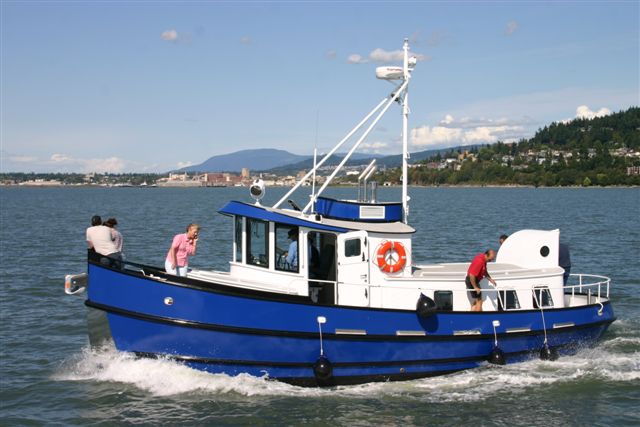
Yes, that is a real tug fender on the bow...! It is created using a pair of long through-rods, with tire tread cutouts stacked like pancakes, then shaped to fit and bolted to flanges on the forward bulwark.
This design was created for long time boat owners Bruce and Nancy Wright. After owning quite a few different boats, they now want their "final boat." When looking around the boat yards, Bruce visited a yard in Bellingham, Washington, where he saw our smaller 32' Tug Yacht design "Terrier" under construction. Bruce called me immediately and said, "I want one just like that, only bigger!"
Nancy Wright's father owned a sailing yacht named Nidaros, aboard which he had won several races. Thus the origin of the name for Bruce and Nancy's new Tug Yacht. The name Nidaros comes from the name of the post-Viking town founded at the mouth of the river Nid in Norway around AD 1,000. The town that once was called Nidaros is present-day Trondheim. The most prominent structure in Trondheim is the Nidaros Cathedral, the crest of which can be seen to the left.
Three Versions...
There are actually four slightly different vessels represented here, ranging from the basic to the deluxe... The first version of Nidaros was developed as a simple tug yacht, intended to be built in aluminum. A second version of Nidaros was then modified to make use of a steel hull and aluminum house.
The third version of the same overall design is named Scuffy, which was adapted to another owner's requirement for all aluminum construction, a higher wheel house, AC generator, full air conditioning, and top notch equipment throughout including active Naiad stabilizers... The fourth version of the design is named Boomer, a closer sister to Nidaros, having steel hull and alloy house.
NIDAROS
NIDAROS #1: It was with a specific engine in mind, the Lugger 4 cylinder naturally aspirated diesel, that the first all aluminum version of Nidaros was created. Particulars of the first all aluminum version are: 38' LOA x 34' DWL x 12' Beam x 4' 10" Draft. Displacement of Nidaros #1 in all aluminum will vary from around 26,000# to a full load capacity of 33,000# with all tanks full, and the boat ready for a summer cruise complete with stores for two people. Using 18 hp/gal/hr specific fuel consumption for the Lugger, and allowing for a 15% fuel reserve, a tank capacity of 450 gallons yields around 2,100 nm range at 6.8 knots.
NIDAROS #2: The second adaptation of Nidaros was created in order to allow the hull to be built in steel, but with the house structures still built in aluminum. The steel hull version requires a beam of 12' - 9" and the hull displaces around 3,500 lb more in each load condition. These changes were made to carry the added weight of structure for the steel hull and deck, and to accommodate a slightly higher house structure for greater interior head room and visibility from the helm. To drive this added displacement, the steel hull version uses a Lugger 4 cylinder turbo-charged engine. The Lugger 4 cylinder turbo produces 86 hp continuous at 2,200 rpm, and 110 hp intermittently at 2,500 rpm. Other particulars are the same, except that range is slightly less.
Nidaros Photo Courtesy of Nancy Wright
BOOMER
Essentially the same as Nidaros except for a raised roofline on the pilot house and aft house, plus a scuttle for access to the aft house. Below is a photo of Boomer, ready for launch.
Boomer Photo Copyright 2005 Owen Youngblood
Larger Boomer Pic Aft | Boomer Pic Forward | Boomer Under Way..!
SCUFFY
This version was developed for all aluminum construction, but with the same height of cabins as Boomer and a more lavish approach to the equipment provided. We therefore retained the hull form of the steel hull version in order to carry the added equipment. Thus, Scuffy has a beam of 12' - 9" and the same displacement as Nidaros #2. As with Nidaros and Boomer, Scuffy also makes use of a Lugger 4 cylinder turbo, so has the same power and range as Nidaros #2. For Scuffy, Naiad active hydraulic stabilizers were considered important to combat the many boat-wakes on the ICW, and air conditioning was added for true Southern Comfort! This naturally required the addition of an AC generator. The engine space has plenty of room for it though, so these equipment items have still not managed to use it all up.
All versions share the same layout below. The engine room is located under the pilot house sole. The engine room has access both through a door forward, and via a pair of hatches above, located in the pilot house sole.
There are two bulk tanks in the engine space, and a separate 'clean' day tank. The clean tank has no deck fill, so always provides clean fuel to engine and generator. Even though it is not a full-headroom engine space, there is plenty of room for a full size person to get to all parts of the engine and gear, plus enough extra space for the possibility of providing additional equipment at a future time.
Boomer Photo Copyright 2005 Owen Youngblood
Boomer Pic Aft | Boomer Pic Forward | Boomer Under Way..!
Hull Form & Rigging
The hull form of a working tug was used in order to get the most boat within the smallest overall length. The lines provide for an easily driven hull, being of medium to somewhat light displacement. The all-aluminum Nidaros #1 has a displacement to length of 306 at her design waterline, while Nidaros #2, Boomer and Scuffy have a D/L of 338 at the DWL.
The main deck has substantial bulwarks all around for safety on deck. A fisherman's open reel type of windlass was chosen for the foredeck. This has proven to be very workable, and keeps the mess of the anchor rode completely out of the boat.
Although adequate for coastwise cruising as-is, more fuel capacity could be built into Nidaros for longer passages. Paravanes were not originally specified for Nidaros or Scuffy though they would make a good addition for open water. The simplest paravane arrangement is to use a pair of A-frame paravane poles held in turn by a mast that is rigidly stayed to the pilot house top. You can see an arrangement very much like this on the Buster design and you can see a similar type deployed while underway on the Boojum.
One of the concepts for the Nidaros design and for our 32' Terrier tug-yacht was to have a layout and configuration that would allow for occasional light towing. An example we had in mind would be "beach logging" in order to salvage adrift or beached logs and tow them to a location for milling. Another good option would be for use as a companion vessel to a small barge-house or houseboat such as my 36' Drifter design - rather an ideal combination for life on the water...
Interior Arrangement
The accommodations are the same in all the Nidaros variants. The layout is intended to provide comfortable cruising for two people on extended summer cruises, with privacy in the saloon for the occasional addition of a couple of guests during shorter trips.
Right forward is a generous double berth in the master suite. It is complete with port and starb'd bureaus and a generously sized dressing area.
Stepping up and aft into the pilot house we find two large seats there, one for the pilot and one for the navigator. Two small tables fold up to allow dining in the wheel house or for working at a lap-top computer. The 'dashboard' forward of the wheel holds instruments, engine controls, navigation and communications equipment.
Whether built with a steel or an aluminum hull, all versions have an aluminum pilot house and cabin structure, so a magnetic compass may be mounted prominently just forward of the wheel without substantial magnetic interference.
Stepping aft and down into the galley / saloon, we find a spacious head to starb'd, which provides both a shower and a tub! To port, opposite the head, is a U-shaped galley. The galley has a large wrap-around counter, full size range, double sink, and an under-counter refrigerator. It is very nearly a house-size galley!
Aft of the head / galley we find a unique feature of the layout for this vessel: two swiveling easy chairs opposite each other, a side table for each, and then a pair of quarter berths aft... quite cozy.
In Summary
Just how in creation does one fit all this into a 38 footer?? Check it out... I think the result is one very comfortable boat with a good open feeling, yet one with plenty of stowage space, lots of lockers and several feet of book shelves.
Nidaros at Anchor
Similar Designs and Prototypes in this Tug / Trawler Yacht Series
Tug Types
Boojum 22 | Boojum 25 | Boojum 30
Terrier 32 | Talisker 32 | Nidaros 38
Trawler Types
Sweet Okole 30 | Buster 30 | Boojum 43
Roberta 43 | Roberta Jean 43 | Roberta Jean 47
Far Horizon 40 | Far Horizon 43 | Far Horizon 46 | Far Horizon 50 | Far Horizon 54
Direct Quote from an aluminum boat owner... As an owner since 5 years of an aluminum boat I could not agree more with your preference for this material. She is a great boat and requires very little in the way of maintenance. I do a lot more reef snorkeling than the paint, polish, varnish and wax guys!
--Peter Kminek
Please see the AVAILABLE BOAT PLANS web page.
Home | Intro | Our Design Process | Stock Design Info | Motor Yacht Designs | Sailing Yacht Designs | Prototype Designs
Plans List | Articles | Our CAD Design Stream | Maxsurf | News..! | SITE MAP..! | Site Search | Design Team | Contact Us