Messing about in boats since 1975. Online Since 1997.
Home | Intro | Our Design Process | Stock Design Info | Motor Yacht Designs | Sailing Yacht Designs | Prototype Designs
Plans List | Articles | Our CAD Design Stream | Maxsurf | SITE MAP..! | Site Search | Design Team | Contact Us
Please see the AVAILABLE BOAT PLANS web page
The 36' Houseboat-Yacht
"DRIFTER"
Click for Larger Image
Copyright 1997 - 2015 Michael Kasten
THE CONCEPT
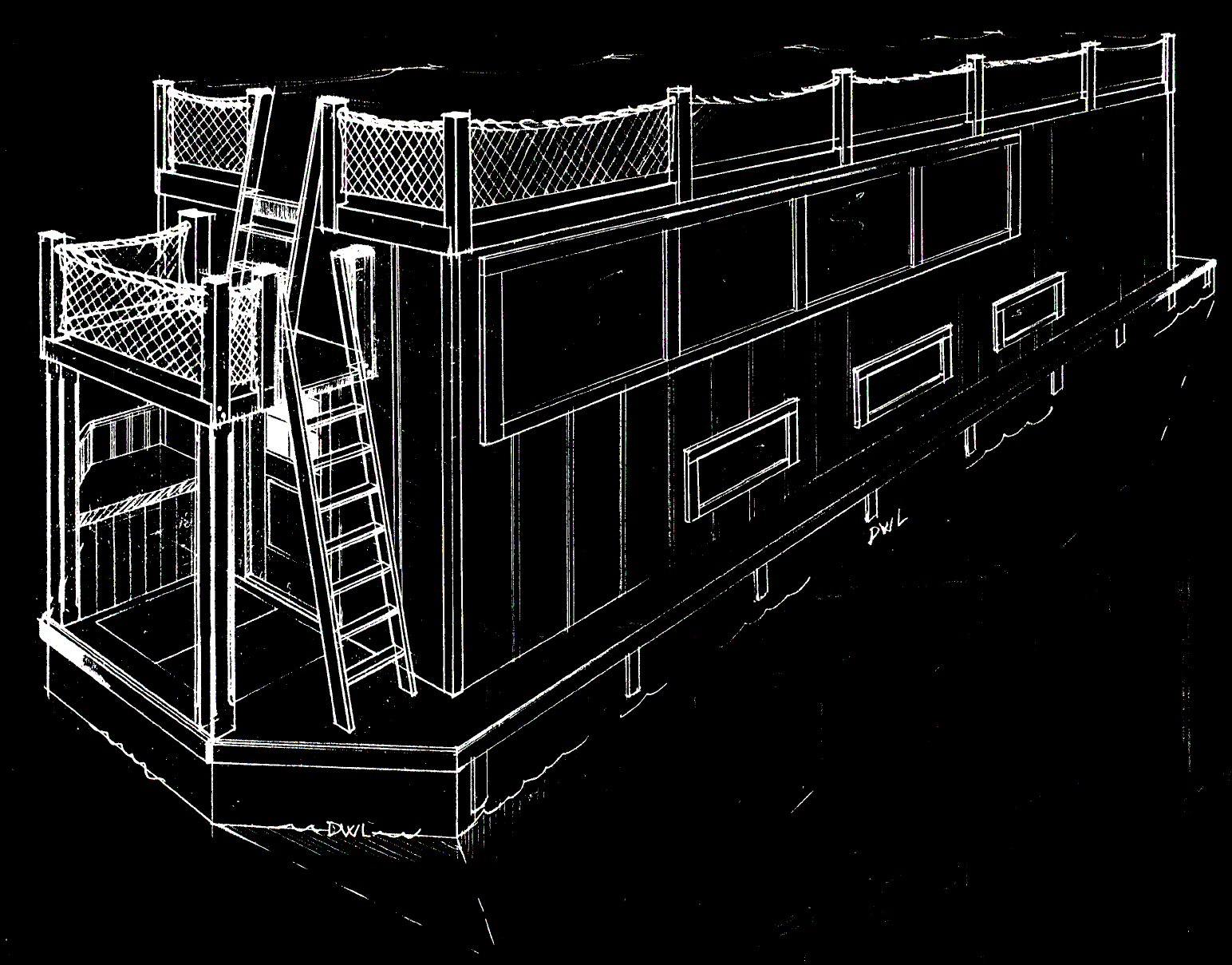
The Drifter 36 design was created for permanent living aboard. While designed to fit a moorage in Seattle's Lake Union, the proportions would allow the Drifter 36 to be used in nearly any marina. The ability to be moved under its own power allows the vessel to satisfy marina requirements, and to actually be a navigable vessel so it can be easily moved to a new location as needed. In this case the available slip on Lake Union was quite narrow... but the requirement was to create adequate living space for a single person or couple, to have two stories, and to also include a roof garden...!
Click for Larger Image
THE CHALLENGE
The size of the slip was the most challenging restriction. Here is why...
In order to gain sufficient interior space for the requested accommodations, our only choice was to build vertically, which created weight up high as well as windage. The windage created by the height of the 'house' combined with the weight of the house combined with the potential weight of party goers on the roof combined with the limitation of 12 feet of beam gave us quite an interesting puzzle to solve.
Difficult..? Yes. Impossible..? No.
THE SOLUTION
After experimenting with several monohull shapes, it became readily apparent that no matter how deep we would make the hull it would not add appreciably greater stability. The reason for this is not so intuitively realized: By adding depth we were also adding volume, so yes we could add ballast and yes that weight could be located lower down thus lowering the center of gravity - both of which are righting forces - however we also were adding buoyancy low down - an upsetting force! It quickly became evident that with a mono-hull shape, we were chasing our tail...!
Then we investigated a 'tunnel hull' or semi-catamaran hull form and quickly realized we could add depth without adding very much to the total immersed volume. This allowed a deep location for the ballast, allowing us to lower the center of gravity without adding too much buoyancy where it was not wanted - i.e. low down.
A further benefit of the 'tunnel hull' form is that yet another requirement of the design could be accommodated: That the house boat be able to move around under its own power. The 'tunnel' thus allowed us to place two outboard motors aft and on center, and still have reasonably good water flow to the propellers.
Within the parameters set forth, the tunnel hull was the only way improve upon the stability results without seriously degrading one of the stated parameters. Due to the combination of 'tunnel hull' and deeply located ballast, we were actually able to exceed the IMO stability requirements for ocean going motor vessels. That's quite an achievement for such a structure! Thus I’m certain we converged upon the best solution.
As designed, the benefits of the resulting semi-catamaran tunnel hull are:
- Draft is not excessive (vs a true catamaran)
- Roll accelerations are gentle (vs a true catamaran)
- Course keeping stability is vastly improved (vs a simple barge shape)
- Large angle stability resulting from variations in the vertical center of gravity is excellent (vs a simple barge shape)
- Grounding on an uneven beach is not at all problematic (vs a simple barge shape)
- When grounded at low tide most of the bottom is accessible for inspection / maintenance / painting (vs a simple barge shape)
- Propulsion using one or more long-shaft outboard motors is favorable with regard to water-flow to the propellers (vs a simple barge shape)
- Wake under way is significantly reduced (vs a simple barge shape)
Although this is not a vessel that was planned for travel over great distances under its own power, it certainly would be capable of doing so. For example anywhere in the Pacific Northwest from Olympia Washington to Juneau Alaska. The structure and stability are up to the task.
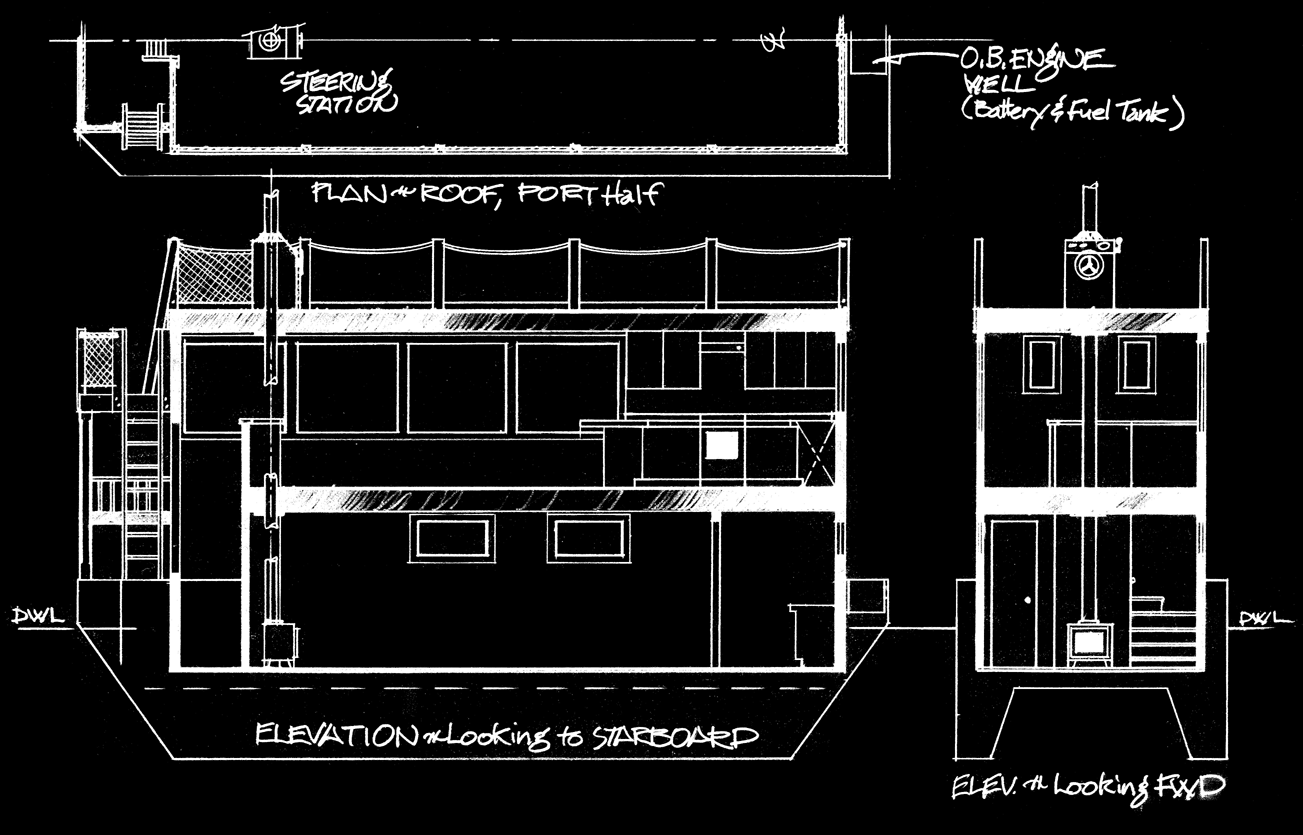
The more modest objective has simply been to allow the owner to move the vessel without a tow boat - basically in order to have "portable waterfront property" during the mild summer months - a really great concept! Thus, the houseboat has a steering station on the roof with controls for the outboards, running lights, anchor, and so forth. A perfectly secure and safe motor home on the water.
With a beam of only 12 feet, the hull itself can be transported by highway without much fuss, and it is of a proportion that would fit into most marina slips without paying a premium for extra width as is customary for a multi-hull boat.
The drawings shown here were developed to show the original concept to the owner. A separate and fully detailed set of Building Plans have been developed for actual construction which further detail the interior, the structure, tanks and ballast. If they are of interest, please see our Plans List web page, and look in the Power Boats section for the Drifter 36.
Click for Larger Image
THE LAYOUT
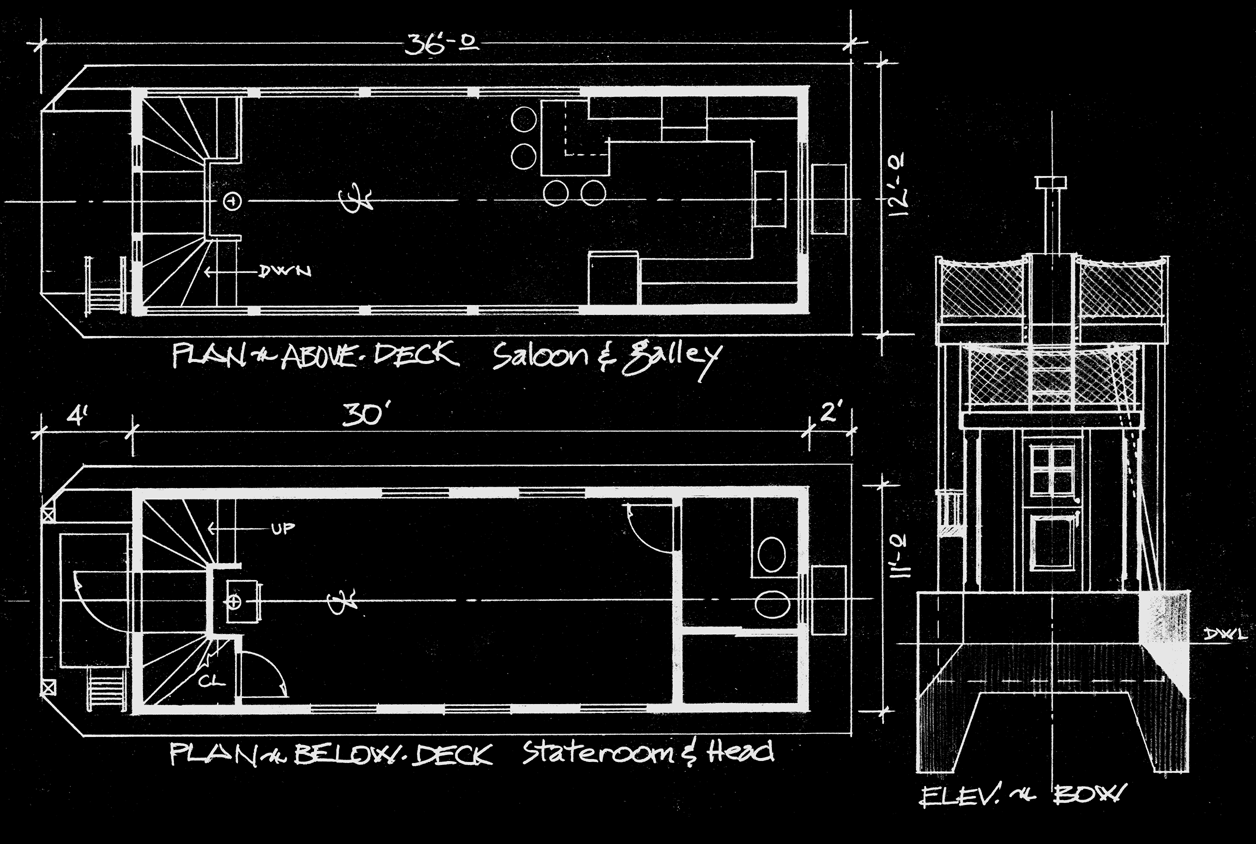
The interior is on two levels, and the entry is halfway between the two accommodation levels. A stairway is located at the bow end, which leads from the stateroom (bedroom) below, to the saloon (living room) and galley (kitchen) above.
The stateroom on the lower deck has a walk-in closet, plus an ample head (bathroom) with a big combination shower / tub. One of the best features of the stateroom is the fireplace at the bow-end, enclosed by the wrap-around stairway. There are plenty of windows in the stateroom for sunlight and views. On the second deck, the saloon is intentionally quite open and has several big windows. The galley is large - actually bigger than many house kitchens! A breakfast bar is at one end of the galley. At the forward end, the saloon looks down through an open bannister - handrail into the stairwell and entry.
An interior landing is located half-way up the stairway, and is at the same level as the exterior fore-deck (entry porch). On the foredeck, the entry porch has a small seat opposite the ladder. The fore deck is covered by a balcony above that is large enough for two chairs and a small table - a good perch from which to keep an eye on the antics of dockside neighbors... A ladder leads from the fore deck to the balcony, and a second ladder leads from the balcony to the exterior top deck where a roof-garden is located. The top "garden deck" is really the crowning glory of the whole affair. Wildflowers, green onions and cherry tomatoes if in the Pacific Northwest...
If it were my own houseboat, the top deck would have a dining table with a large umbrella and a several comfortable chairs for nice weather, then maybe a small potted tree or two. In warmer climates maybe a Sago Palm or Pygmy Date Palm... In all likelihood, that would be my favorite spot aboard.
THE STRUCTURE
The "house" part is detailed for construction using typical high quality dimensioned lumber and plywood, with either drop-siding or sawn cedar shingles. The floor and house top make use of BCI joists in combination with standard lumber (#1 tight knot Douglas Fir or Larch). In other words, the house structure is basic and economical yet very durable high quality house-type construction.
The houseboat hull and exterior decks are intended for construction in fiberglass, which offers the lightest overall structural weight combined with high strength, freedom from corrosion, and long life in the marine environment. Given that the hull shape consists of all flat panels, the construction is very simple, easy and fast.
As designed, the hull scantlings are fully compliant with the ABS rules for ocean-going fiberglass vessels. As a result the hull structure is robust and very rigid. This is quite intentional, since one further requirement was that the houseboat be able to be beached during low tides - mainly just for fun, but also for periodically cleaning the hull.
OPTIONS...!
Due to the extreme limit on beam imposed by the specific marina for which the Drifter was designed, we had no choice but to limit the design to a maximum beam of 12 feet. However it would be a very simple matter to widen the hull, say to around 14 feet. To accomplish this, we would simply add a 2 foot slice right down the middle. The Drifter is robustly designed to exceed ABS standards for ocean-going yachts, so this would not require any change to the structural specification.
Widening the hull would greatly improve stability and would therefore require less ballast to achieve the same stability compliance. As a result of having less ballast the hull would ride higher in the water, opening up a wider range of cruising grounds. And of course a wider hull will provide considerably more living space inside. All to the good..!
WHY A HOUSEBOAT...?
I have been asked whether one would be better off to build a houseboat as a starter project, or to just go straight for building "the yacht". If one envisions a life on the water with occasional travel on an ocean-capable boat, then my own preference would tend to favor building the houseboat as a first step. This is so for reasons of mitigating the long-term damage inflicted upon one's personal finances by regulations, rent, mortgage interest, property taxes and shore-side utility bills.
It turns out that since a houseboat of this type can qualify as a self-propelled "boat" it need not be considered under building codes applicable to fixed or floating homes. The result of this loophole is that construction can proceed without undue interference or government red tape. What I mean is that as a boat, local building department officials need not be involved since code compliance for self-propelled marine craft is not within their purview. This is not to say that the vessel should be built without standards...! As designed, the Drifter's house structure is considerably over-built versus the dwelling codes for houses.
With the burden of 'building inspections' relieved, another less obvious benefit is realized: The project can proceed at its own pace as time and finances allow. As a result, it shold be unnecessary to involve a bank for financing. Without a bank involved, the project will not be subject to periodic 'progress inspections' by bank minions, which tend to force a rigid time-table upon your project.
The upshot of these subtle but important factors is that a houseboat project is able to be accomplished in relative privacy without undue external interference and unnecessary expense. The objective after all is to achieve a perfectly viable, robust, safe, self contained personal habitat... not to line the pockets of bureaucrats and bankers...!
Once settled into the houseboat, organizing the build of a modestly sized sailing or power yacht as a second step would be a natural. In this way you would have a comfortable and economical place to live whilst constructing the yacht. When completed, you'd have a portable houseboat as a home base... plus a capable small yacht for traveling. To me, that would be ideal...!
THE CABIN BOAT PRIMER...
We have an excellent story from the 'Cabin Boat Primer' - a guide to shanty boating during the late 1800's and early 1900's. It was written with drifting in mind - primarily drifting down rivers, and especially along the Mississippi River system. The 'Cabin Boat Primer' describes a way of life in such a way as to put you already on the path to making it your own - a particular gift of the author. In that sense, the book is very much in the vein of Tom Sawyer and Huck Finn. It is also the spirit of Laubin, Whitman, Kazantzakis, Fletcher, Slocum, Moitessier.
Certainly things have changed since the beginning of the 1900's but the spirit of 'cabin boating' remains the same. There is much among the following brief words that can be equally well applied to all of our boating pursuits... Shall we listen...
- The main thing is patience; the next observation; and last of all, skill.
- There is no reason why life on a cabin-boat should be lived in rags and tatters. They do not lead to comfort.
- The boat will cost from $25 up, and a fit one for two persons $50 or more, in all probability.
- One should look further before paying more than $100 for an ordinary river house boat, unless it is new, in first class condition, of good wood, and far up the stream.
- The true cabin boater is also a philosopher.
- Troubles come to mean something in the way of a cause for congratulation rather than dismay.
- Reasonable care should be taken to ward off trouble.
- Always find a good landing, as regards wind and water.
- Never tie to a wobbly stake.
- Never let the wood pile or oil can get low.
- In one sense of the word, shanty boating is simply finding new lands to travel and a new view-point from which to see the land.
- To no-one does the mockingbird sing so beautifully, or the huge trees seem so majestic, or the geological formations appear so attractive as to the man in a cabin boat.
- Raymond Spears, 1913
It is interesting to note that those words from 'The Cabin Boat Primer' were penned during the very same year as the creation of the Federal Reserve Bank. It was also the year of enactment of the US Income Tax. Shiver me timbers, what a horrid year...! Soon afterward came prohibition and the first world war... Clearly an inauspicious time! Much has changed since then, not least of which has been the value of our money....! And so it goes.
Think of the Drifter as an affordable habitat for our troubled times...
For more information about this or any of our other yacht designs please inquire.
Please see the AVAILABLE BOAT PLANS web page.
Home | Intro | Our Design Process | Stock Design Info | Motor Yacht Designs | Sailing Yacht Designs | Prototype Designs
Plans List | Articles | Our CAD Design Stream | Maxsurf | SITE MAP..! | Site Search | Design Team | Contact Us