Messing about in boats since 1975. Online Since 1997.
Home | Intro | Our Design Process | Stock Design Info | Motor Yacht Designs | Sailing Yacht Designs | Prototype Designs
Plans List | Articles | Our CAD Design Stream | Maxsurf | SITE MAP..! | Site Search | Design Team | Contact Us
Please see the AVAILABLE BOAT PLANS web page
An Overview of a Few Common
ROLL ATTENUATION STRATEGIES
For Motor Yachts and Motor Sailers
Copyright 2002 - 2012 Michael Kasten
Introduction
This article was originally prepared as a response to a post to the Trawler World mailing list on the subject of Twin Keels and Roll Reduction. The following includes a brief description of the research done by Lord Riverdale and others regarding the benefits of Twin Keels and other roll reduction strategies.
Please see my web article Beam vs. Ballast for a general discussion of how static stability relates to dynamic stability and roll motion.
The 'Twin Keel' Research of Lord Riverdale
Naval architect Pat Bray and yacht designer Ted Brewer have been proponents of Twin Keels; Ted Brewer for sail boats, and Pat Bray for both sail boats and power boats. The many points offered by Bray and Brewer in favor of Twin Keels for sailing yachts were originally researched by the late Lord Riverdale, whose conclusions were published in a technical paper offered to the Royal Institute of Naval Architects on December 15, 1967. During the 45 years prior to writing that paper, Lord Riverdale had designed, built, and sailed a series of twin keel sail boats dating from 1922 called "Bluebird" and "Bluebird of Thorne." The last "Bluebird of Thorne" in the series, Lord Riverdale developed in cooperation with British designer Arthur Robb.
The last Bluebird of Thorne, built in steel at 50 feet LOA, now resides on nearby Lopez Island (among the San Juan Islands in Puget Sound). During 1995 and 1996 I had the good fortune to be asked by Bluebird's current owners, Jeff and Dianne Dyer of Lopez Island, to create a new interior for the vessel to house the Dyer family and to re-design the deck structures to allow for Jeff's height.
Working on the Bluebird of Thorne was a great opportunity to learn first hand the incredible research efforts of Lord Riverdale. He made a significant contribution to the design of twin keels over the course of 45 years of boat building, sailing, research, tank testing and development. Those efforts reached no small degree of perfection with his last Bluebird of Thorne.
Lord Riverdale offered the following definitions when referring to twin keel yachts:
Twin Keel Type: Has no center keel. Ballast is carried within prominent twin keels. May have either single or twin rudders.
Bilge Keel Type: Has a center keel that carries most of the ballast. Bilge keels long and shoal. Single rudder.
To this, I would add a sub-category to the "Twin Keel Type" that uses a skeg / rudder combination on center aft; essentially a "third keel" that houses and protects the propeller, and provides robust support to the rudder (as with Boojum). This "three-keel" type is possibly most appropriate for a small power vessel that has roll reduction as its main focus. For a review of the rationale that went into the twin keel arrangement given to Boojum, please see the article, Boojum's Twin Keels.
A larger power vessel that makes use of twin engines might effectively eliminate the center keel, and use twin rudders, as did Bluebird.
Due to being focused on Twin Keels for sailing vessels, Lord Riverdale in his entire body of research did not see the need to address the benefits that Twin Keels or Bilge Keels might offer in terms of roll reduction, since that is mainly an issue for power vessels.
Benefits of Twin Keels...
Aside from the obvious benefits offered by twin keels published elsewhere such as when taking the ground, a few points emerge from Lord Riverdale's research that are more subtle, and that may be of some interest to those experimenting with Twin Keels, as defined by Lord Riverdale, on power vessels and motor sailers...
* Ballast Location: The keels that were employed on Bluebird (after no small amount of testing) were fairly prominent features, and contained the vessel's ballast. This was for the sake of sailing performance on those vessels. For power vessels, locating the ballast within twin keels has a further benefit: it distributes the mass of the vessel farther from the centerline, augmenting the transverse "roll moment" and providing an inherent "inertial" resistance to rolling. This "inertia effect" is further enhanced by the entrained mass of water in the boundary layer around the keels. These effects were briefly mentioned by Lord Riverdale, but were not of great import to his quest for sailing performance.
* Twin Keel Location: The most successful Twin Keels were located approximately amidships, with the root of the keel beginning roughly 45% of the DWL aft, and the largest section being perhaps 60% or more aft. Forward twin keel locations were not favorable, as that location tended to provide poor steering characteristics and a poor wave form at speed. Aft locations were not investigated, as they would not have located the ballast where needed for the sake of proper trim.
* Steering Stability: Twin Keels, if located and proportioned correctly, were observed to provide enhanced directional stability, and an enhanced ability to heave-to during heavy weather. Bluebird's Twin Keels were observed to provide improved seakeeping in all conditions. These qualities are a benefit to power vessels as well.
* Toe-in: A small amount of "toe-in" seemed to benefit the overall resistance upright as well as under sail. The best results were achieved using a toe in of between 0.5 degree and 1.25 degrees. For Lord Riverdale's purposes, some amount of toe-in was deemed to be desirable for better "lift" to windward when sailing. While upright, the observed benefit to there being some amount of toe-in was attributed to providing better alignment with the under water flow lines.
This latter assumption is correct, as larger vessel flow analyses have shown. The amount of toe-in is therefore a variable which will be different with each hull shape, and which will vary with the longitudinal location of the keels. It would be interesting to test the effect of toe-in on yaw while rolling. It is questionable whether any amount of toe-in will benefit a motor vessel, since one would expect to observe that any amount of toe-in would enhance yaw, and therefore be undesirable in terms of directional stability.
* Sectional Foil Shape: The Twin Keels chosen for Bluebird were of an asymmetrical foil shape, flat outboard and cambered inboard, much like an airplane wing. This was done in order to achieve greater "lift" when sailing to windward.
It is questionable whether asymmetry would provide any benefit to a power vessel. For a power vessel, one would expect that a symmetrical section aimed at providing low drag would be the most appropriate. For a power vessel, one would expect that the foil shape chosen should be "stall tolerant" or able to take a large variation in the angle of attack, and therefore within the 00xx family of NACA shapes. In order to contain the ballast, and also for the sake of being "stall tolerant" one would also expect that the foil would not be too "skinny."
For a motor sailer, as has been very adequately proven by Lord Riverdale and others, an asymmetric foil shape will provide the greatest benefit, with the same requirement for "fatness" to contain the ballast, and to be able to tolerate a variety of angles of attack while rolling, so as to avoid a large induced drag due to turbulence. For a motor sailer, one may make use of other NACA foil sections to provide better lift characteristics, keeping in mind the requirement of being "stall tolerant."
Other Roll Reduction Strategies...
In addition to the benefits that Twin Keels offer to sailing vessels as researched by Lord Riverdale, there have been many tests done on power vessels aimed at quantifying the effects of Bilge Keels, Twin Keels and other stabilizing methods on roll reduction.
A few general observations about the most commonly considered methods of roll reduction are as follows:
* Sails: Depending on sail area and wind strength, roll reduction can be considerable. We might assume a roll reduction on the order of 40% to 70% depending on sea state, etc. The sails and the rig provide inertial damping even at anchor due to the weight of the rig and its distance from the roll center (increased roll moment of inertia). Sails can contribute significantly to propulsive efficiency, at times completely eliminating the need for the engine. Excellent synergy when motor sailing. Possible as a retro-fit, depending on hull form and stability characteristics. Relatively expensive. Somewhat complex. Fun!
* Active Fin Stabilizers: When sized correctly, Naiad claims up to a 90% roll reduction for active stabilizers, depending on vessel speed. Active stabilizers are most effective at maximum vessel speed, less so at lesser speeds, minimally effective with no forward speed. Active stabilizers provide some efficiency loss due to frictional resistance, generally considered to be compensated for by lesser overall resistance of the more stable vessel. Some power draw due to the operation of the hydraulics to actuate the fins, which translates into higher horsepower requirements and greater fuel use. Possible as a retro-fit. Relatively expensive. Relatively complex to install.
* Fixed "Twin" Keels: Depending on the twin keel geometry, per research published in Marine Technology, roll reductions have been observed on the order of 40% to 65%. Deeper keels having greater area provide greater attenuation. Low aspect ratio is considered a benefit due to being able to tolerate larger angles of attack (while rolling) without stalling. Location and geometry have been shown to be quite important for optimum vessel handling and resistance, as noted above. Vessel speed does not appear to be important to roll damping. Twin keels will add some frictional resistance due to increased wetted surface area. Enhanced directional stability, if proportioned correctly. Very unlikely as a retro-fit. Relatively inexpensive. Relatively simple.
* Fixed "Bilge" Keels: Long, low aspect ratio bilge keels, per research published in Marine Technology, have been observed to offer possible roll reductions on the order of 35% to 55%. Vessel speed is not important to roll damping. There is some added frictional resistance due to increased wetted surface area. If proportioned correctly, bilge keels offer enhanced directional stability. Very common as a retro-fit. Relatively inexpensive. Relatively simple to build.
* Paravanes: Per published data from various sources, roll attenuation can be on the order of 40% to 60%. Vessel speed does not appear to be important to roll damping benefit. There is some speed and efficiency loss due to drag of the usual types of paravanes. Drag can be substantially mitigated by use of low-drag paravane design (see below). Loss of one paravane is likely to degrade stability should the vessel be caught in a beam sea with the one remaining paravane to leeward (per research published in Marine Technology). Paravanes are relatively easy to retro-fit. Relatively inexpensive. Medium complexity in use.
* Passive Anti-Roll Tanks: According to published research in Marine Technology, in some sea conditions, with optimized tank / vessel design, roll reductions in both amplitude and acceleration on the order of 50% to 60% have been documented. In other sea conditions, the percentage of roll reduction appears to vary considerably. Vessel speed does not appear to be important to roll damping benefit. There does not seem to be any negative effect on vessel speed or efficiency, except of course for the added displacement required to carry the extra deadweight of the tank contents. Anti-roll tanks seem to vary in size from around 1.5% to around 2.5% of a vessel's displacement. If located higher, the overall weight may be able to be less, since the tank will have a greater effect due to being farther from the vessel's center of gravity. Similarly, if the tank is able to be the full width of the vessel, its effect appears to be greater and there may be the potential for a reduction in tank weight. Space requirements are very difficult for small pleasure vessels (say below 60 feet). Possible undesirable effects on stability, depending on the vessel (large free surface effect). Very unlikely as a retro-fit. Possibly noisy. Relatively complex to design correctly (therefore relatively expensive to design). Relatively inexpensive to build. Relatively simple in use.
* Single Chine Hull Form: Some degree of roll attenuation is contributed by the single chine hull form itself. A single chine vessel appears to have roughly twice the roll damping ability of a rounded hull form (per published model tests in Marine Technology, performed on vessels having similar hull forms). Roll amplitude will be less; roll acceleration may be greater, rolling will decay more quickly. This effect is viewed as being approximately similar to fitting long shoal draft bilge fins on a rounded hull, except that bilge keels appear to also reduce accelerations. Extremely unlikely as a retro-fit. For new construction, chine shapes are relatively inexpensive by comparison to rounded hull shapes, particularly in metal. Extremely simple. Slightly greater wetted surface.
The research mentioned above and the percentages of roll reduction claimed for the various methods have appeared in various issues of Marine Technology, a publication of the Society of Naval Architects and Marine Engineers, during the last five years. Past issues of Marine Technology are available from SNAME at http://www.sname.org.
In our motor vessel, motor sailer and sailing yacht designs, we have used all of the above strategies on various designs, including incorporating an anti-rolling tank on a 40 foot trawler yacht. For more information about those projects, please inquire.
Measuring Roll Behavior
In terms of roll attenuation, there are of course many variables. What works well on one boat, may not be as effective on another boat. For example, paravane size relative to boat size / displacement / righting energy will definitely affect the results.
The percentages quoted above relate in many cases to roll amplitude, which is only one component of rolling behavior... One can isolate several components, as follows:
* Amplitude (measured in degrees)
* Period (measured in seconds)
* Acceleration / deceleration (a result of the above, measured in feet or meters per second squared)
* Rate of Decay (number of cycles to rest or to some other benchmark)Among the behavior patterns directly observable from the numerous data sources are the following...
The wildest rolling is referred to as synchronous rolling, i.e. rolling in beam seas when the wave period is close to the natural roll period of the boat in question. For example, when a given boat rolls to some extent in harbor, say on receiving the wake of a passing boat, it might not do so given a slightly different wake or wave pattern. Another boat that did not roll so much at a given wake or wave pattern may roll wildly with a different wave pattern or period.
The higher percentages for roll attenuation quoted above for any given roll attenuation method (paravanes, keels, etc.) are from measurements of the attenuation of synchronous rolling, and appear to have their effect due to putting the boat out of sync with the wave pattern. The lower percentages in the range of effectiveness quoted appear to be an average of the overall effectiveness. In most of the published research, the majority of measurements were of amplitude. The next most common data quoted were measurements of acceleration.
It is interesting (and important) to observe that in some sea states (wave period and wave height both considered) many of the "passive" roll attenuation schemes will in fact at times slightly augment rolling. This reportedly appears to be at small rather than large roll amplitudes, appears to be random, and does not appear to be considered an issue. Synchronous rolling is considered to be the main adversary, and all methods mentioned appear to be effective there.
Real World Observations
Most commonly, research groups addressed the requirements of commercial vessels, so tended to make use of anti-rolling tanks in combination with relatively long and shoal "bilge keels" or paravanes in combination with bilge keels. These vessels were relatively larger and heavier than typical "trawler yachts."
Combined Methods
The most effective roll reduction appears to be obtainable when two or more methods are used simultaneously, such as paravanes combined with twin keels, or an anti-rolling tank with either, or say, sails in combination with twin keels, etc. Several of the studies in Marine Technology have been aimed at various combined methods. In all cases reviewed, the tests showed that combining roll attenuation strategies does appear to have a dramatically beneficial effect.
A combination of strategies will therefore offer the greatest benefit aboard trawler yachts. A highly effective strategy for trawler yachts might reasonably be the combined use of a single chine hull form, twin keels, a modest get-home sail rig, and paravanes for possible deployment in some conditions. This combination would offer a high degree of roll attenuation, and would be effective over a wide variety of conditions. In way of example this is the combination of roll attenuation strategies given to our Greatheart 48, Valdemar 53, Greatheart 60, Swallow's Nest 60, and Chantage 64 motor yacht designs.
A motor sailer with ample sail area can be an ideal platform for the use of twin keels. In terms of resistance or propulsive efficiency, it is interesting to note that, should one be concerned about losing some speed to paravanes, that sails have the ability to increase speed in proportion to the extent the sail rig is employed. Rather than losing a knot or so to paravanes, one can instead gain a knot or so...
Paravanes
It is unlikely that one would make use of paravanes at the same time as sails, although paravanes could easily be provided on a motor sailer for use when sailing is not possible. For this use, the mast and the paravane poles will usually be detailed to be economically built of aluminum pipe. The whole design will ideally be kept quite simple, so the rig is economical to build, to maintain, and to travel with.
Attention given to reducing the drag of the paravanes themselves should provide significant benefits. Paravane drag can be substantially reduced via the use of foil shaped paravane surfaces.
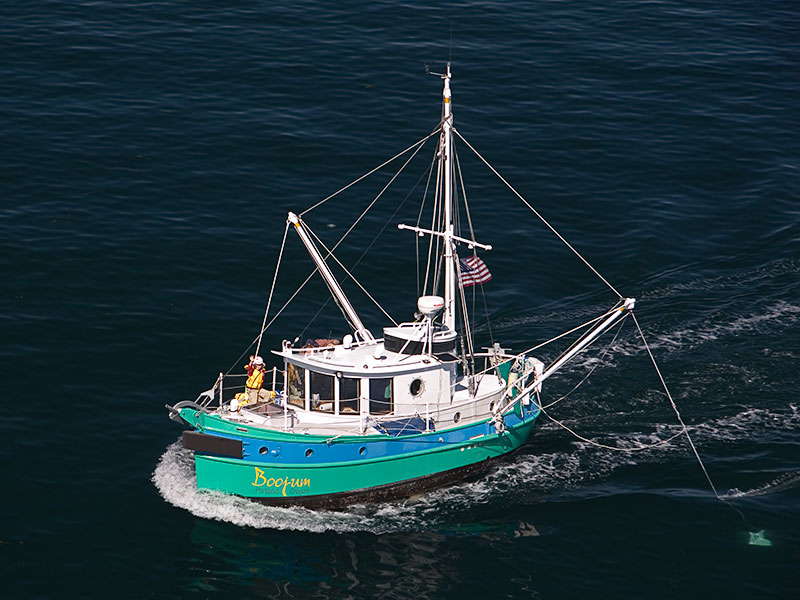
I have designed such a set of low drag NACA 00xx series foil shaped paravanes for Charles Vollum for use on the 25 foot Boojum. The paravane body, wings and fin are accurate high-lift low-drag foil shapes. Sea trials have verified the effectiveness of this strategy in terms of reduced drag. The foil shaped paravanes are also able to maximize lift for the greatest stabilization effect. We estimate that these foil shaped paravanes cut the amount of drag in half as compared to typical crudely shaped steel paravanes made out of flat plate and a cylindrical weight chamber.
We have developed NACA foil paravanes in three sizes, as follows:
LARGE NACA FOIL PARAVANES
Plan square area is 383 square inches for the wings, not counting the bulb.
Weight is 79 lb., of which approx. 19.5 lb. is lead in the nose of the bulb.
Appropriate for boats up to approximately 50 to 65' on deck by 15' of beam, depending on displacement.
MEDIUM NACA FOIL PARAVANES
Plan square area is 233 square inches for the wings, not counting the bulb.
Weight is approximately 40 lb., of which approx. 10 lb. is lead in the nose of the bulb.
Appropriate for boats up to approximately 35 to 50' on deck by 12' of beam, depending on displacement.
SMALL NACA FOIL PARAVANES
Plan square area is 138 square inches for the wings, not counting the bulb.
Weight is 17.5 lb., of which approx. 4.25 lb. is lead in the nose of the bulb.
Appropriate for boats up to approximately 35' on deck by 10' of beam, depending on displacement.
All of these low-drag paravanes make use of NACA foil shaped surfaces combined with a lead ballasted NACA foil shaped bulb. They are balanced and are adjustable for different speeds. These paravanes are designed to be machined out of marine grade aluminum plate and rod so they are lighter for a given wing area than steel paravanes would be.
The sizes given above are conservatively rated. In other words each size can be used on a larger vessel than is indicated. It is all a matter of degree. The roll attenuation will simply be more or it will be less, as compared to that of a larger or smaller wing area. Their effectiveness is a function of wing area and pole length vs. your vessel’s righting moment. With a larger the vessel the poles can be made longer, achieving greater leverage, therefore a greater effect for the same size paravane.
For more information about these low drag paravanes, please inquire. For our NACA foil paravane design prices, please see our Plans List page.
Anti Rolling Tanks
On vessels above, say, 60 feet it is possible that the use of anti-roll tanks may be preferred over the use of paravanes, primarily due to the large forces involved in terms of being able to easily handle the paravane rig. Anti-roll tanks operate by allowing water to slosh (passive type) or by pumping water (active type) from side to side out of sync with the wave induced roll of the ship. There are several different styles of each. Anti-roll tanks must be designed carefully, sized right, tuned to the ship, and then tweaked to match the anticipated conditions.
For vessels below around 60 feet LOA, the space, weight and stability requirements of anti-roll tanks may prove to be prohibitive. For example, a 50,000 pound boat would need around a half ton of water in an anti-roll tank located at least as high as deck level. For supply vessels, research vessels or fishing vessels, all of which spend some amount of time at sea while not making any headway, anti-roll tanks can make a lot of sense. For example, per published data in Marine Technology, the combination of anti-roll tanks and bilge keels have been shown to be capable of reducing roll amplitude and accelerations by as much as 90% in some sea conditions.
In spite of their potential benefits, as a retro-fit anti-roll tanks are a very unlikely solution. During new construction however, there may possibly be justification for their use, since they can then be more gracefully incorporated into the design.
Active Stabilizers
Most larger yachts will favor active stabilizers... providing an "off the shelf" solution that's very effective under way. When the vessel is not moving forward however, active stabilizers don't provide much, if any, benefit. Naiad has however developed a system that is claimed to have reasonably good effect at anchor. If first cost and maintenance concerns are less of an issue, then certainly active stabies will be an excellent choice, and appear to provide the ultimate in motion comfort under way. Per published data mentioned above, active stabies appear to be capable of providing roll attenuation roughly equal to that of Twin Keels or Bilge Keels in combination with either anti-roll tanks, or paravanes.
What About Anti-Rolling Tanks for Smaller Boats...?
While the displacement penalty of an anti rolling tank may not seem to be a big deal in some cases, the positioning of an anti-rolling tank is usually very problematic in terms of the accommodations, deck space, etc.
Many anti-roll tank geometries have been tried. It seems that the simpler the approach, the better. Active tanks that pump water around do not appear to be optimum, since the water pumping requirements may be quite extreme, therefore they tend to be expensive, noisy, and power hungry. The most viable "active" system appears to be one that is configured as a broad "U" tank that is joined by an air tube across the top, having a valve that's controlled by the ship's gyro. It should go without saying that these are complex and expensive to set up even aboard larger ships.
For the sake of simplicity and economy, it appears that passive tanks may be the best. Among them the simple "H" tank seems likely to be the most easily implemented with the least impact on the vessel layout, etc. If the budget allows a slightly more sophisticated system, then there may be other possible configurations, and with them, the possibility of improved roll reduction as noted above.
The simplest tank, in the form of a broad "H" will have a large volume tank (perhaps twice the volume of the contained liquid in its capacity) at each end, joined by a somewhat narrower "slot" which forms the cross bar of the "H." In some designs, the "cross bar" of the "H" may be less narrow, and may instead be heavily baffled. There must be a good spot onboard, ideally offering the full width of the ship, and as a rule of thumb about 20% as high as that off the water. We have used this type of anti-rolling tank on our 40' Coaster design, and reports are that the tank is quite effective.
Anti rolling tanks need to be planned quite carefully. The weight of water in the tank must be able to be tolerated in terms of the stability of the boat, as well as the "free surface" effect of the water as it sloshes back and forth. The trick seems to be to get the slosh to happen out of sync with the roll of the boat.
The stability of the boat must be known precisely in order to know the correct proportions of the tank, the weight of water required for roll reduction, whether the boat can tolerate the lessened stability effect of the tank, etc. For a motor yacht, if thorough calculations show that the applicable criteria can be met with an anti-rolling tank in place, then the vessel may be a workable platform for an anti-rolling tank.
Given adequate knowledge of a vessel's stability, and given the willingness to invest in the cost of planning a proper solution, anti-roll tanks may possibly be able to be integrated into smaller craft. The real benefit of a passive anti rolling tank is that it can provide a system that does not degrade the propulsive efficiency of the vessel in order to achieve roll reduction. Several studies appear to have shown the opposite, i.e. that if a vessel can be kept from heavy rolling, efficiency seems to be increased.
Until they become commonplace, the cost of proper planning will likely keep anti-rolling tanks from being a strong contender among the other roll attenuation options mentioned here.
Measuring Stability...
It is an unfortunate fact that in North America quite a number of builders (and no small number of designers) simply do not have any idea what the stability figures are for their boats. Builders are generally not willing to invest in the "design time" to find out.
This claim may sound surprising... I have to agree! If you dare to know the truth about this, by all means ask your builder or designer for the vessel's "Weight Summary" and "Stability Report." In many cases - especially for older designs - the information will simply not exist.
At the very least, an offshore motor yacht should meet or exceed the minimum Stability Criteria established by the IMO (International Maritime Organization). In recent years we have seen increasing use of the IMO Extended Weather Criteria which heavily penalizes excess windage and low freeboard. Alternative and equally rigorous are criteria within the US Code of Federal Regulations (46 CFR), as used by the US Coast Guard.
These criteria do not merely offer simple "range of positive stability" requirements. Both the CFR and the IMO provide for measurement of the vessel's righting energy represented (by convention) as the measurement of the area below the stability curve within various prescribed ranges of heel; the initial GM of the vessel; the position of maximum righting arm measured in degrees of heel; the amount of "reserve" righting energy available to meet extremes of wind and wave; degrees of heel to deck edge immersion and to downflooding.
In the European Union the Recreational Craft Directive requires that motor yachts and sailing yachts meet certain minimum stability criteria. For motor yachts, it is the ISO-12217-2 standard, which outlines a requirement for the range of positive stability, minimum downflooding angle, and several other parameters, then assigns a "category" of allowable operations for the vessel, with the highest being "all ocean" or Category "A". For sailing yachts, ISO-12217-1 outlines a minimum STIX value (Stability Index), which is based on a number of parameters such as the range of positive stability, the amount of "area" below the righting curve, the downflooding angle, sail area, beam, draft, etc. A sailboat that qualifies for Category "A" or "all ocean" voyaging must have a STIX value above 32.
For a summary of what information should be included, please see our article on Essential Design Data. For a general discussion of how static stability relates to dynamic stability and roll motion please also see our article Beam vs. Ballast.
25' Boojum with Paravanes deployed.
Please see the AVAILABLE BOAT PLANS web page.
Home | Intro | Our Design Process | Stock Design Info | Motor Yacht Designs | Sailing Yacht Designs | Prototype Designs
Plans List | Articles | Our CAD Design Stream | Maxsurf | SITE MAP..! | Site Search | Design Team | Contact Us