Messing about in boats since 1975. Online Since 1997.
Home | Intro | Our Design Process | Stock Design Info | Motor Yacht Designs | Sailing Yacht Designs | Prototype Designs
Plans List | Articles | Our CAD Design Stream | Maxsurf | SITE MAP..! | Site Search | Design Team | Contact Us
Please see the AVAILABLE BOAT PLANS web page
The 40' Trawler Yacht
'COASTER'
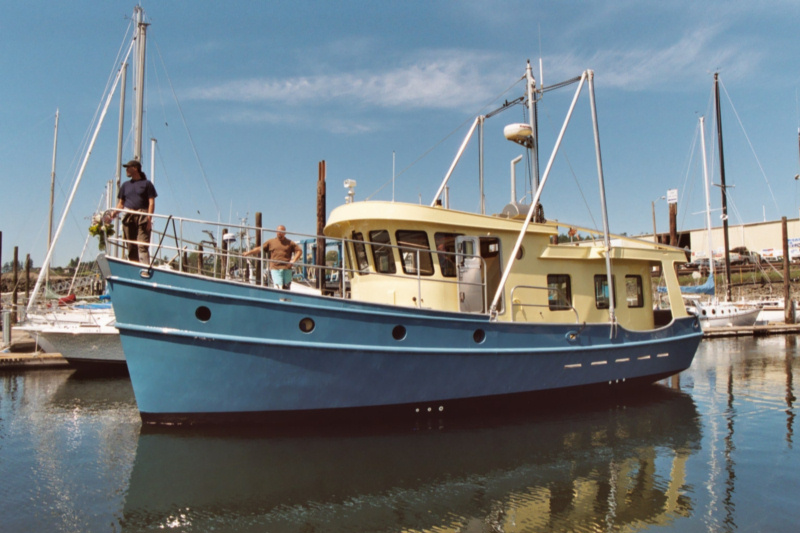
Original Coaster 40 Design - Launch Day - Freshly Painted
Perspective Forward | Side Perspective | Perspective Above Aft | Portside Perspective
Outboard Profile | Interior P & ACopyright 2000 - 2016 Michael Kasten.
Two Basic Versions...
There are several different vessels represented on this page, having two basic configurations. The first configuration is that of the Coaster, and second configuration is that of the Ocean Trawler, each type having been developed for a different purpose, but each using the same hull form and general arrangement.
- COASTER: The 40' Coaster was created for a couple and occasional guests for summer cruises in the Pacific Northwest from Puget Sound to Alaska with occasional coastal hops to ports farther south, thus the design name, "Coaster."
- Existing NC cutting files are available for the Coaster 40.
- CYGNUS: The 40' Cygnus is a slightly modified version that eliminates the paravane poles in favor of using a flume-tank for stabilization. The pilot house top was extended aftward to the mast so that an anti-rolling tank could be placed above the galley, The layout is exactly the same as with the original 40' Coaster in all respects, except for the addition of the flume tank, deleting the paravanes, and adding slightly more fuel tank capacity. Please see our article on Roll Attenuation for more information about the benefits of using a flume tank for roll stabilization.
- Existing NC cutting files are available for the Cygnus 40.
- WIDEBODY COASTER: The 40' Widebody Coaster is described below... It simply involves widening the aft house out to the bulwark, and borrowing one foot of length from the aft cabin to give to the aft deck. This provides more room to the galley, the saloon AND the aft deck...
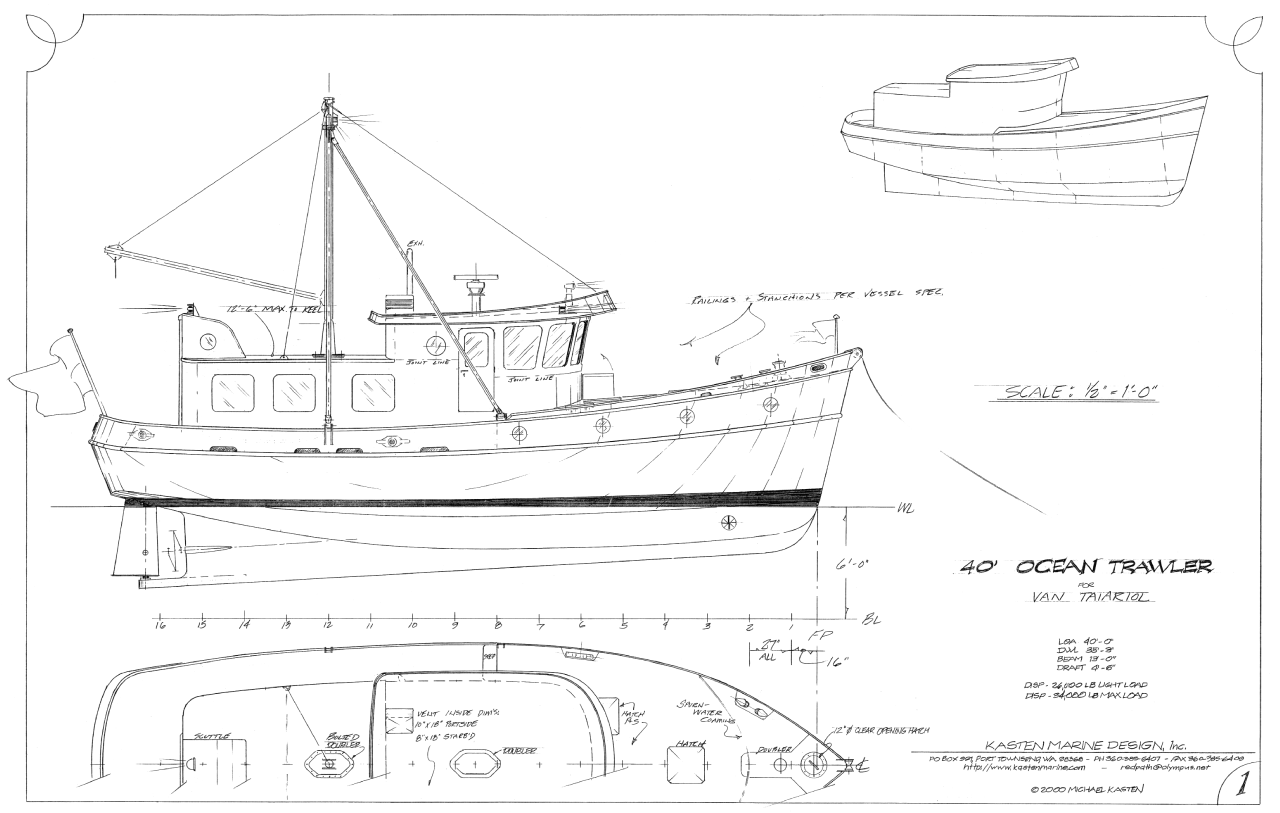
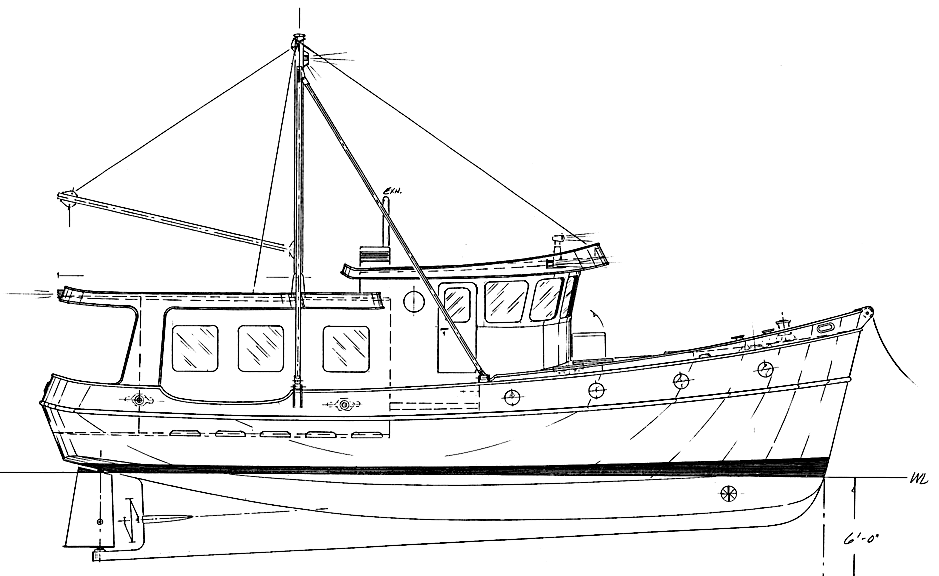
- OCEAN TRAWLER: The 40' Ocean Trawler makes use of the same layout, but lowers the profile in order to adapt the vessel to heavy weather passage making.
Coaster General Concept
The general approach taken with this design has been to produce a trawler for the least possible cost, and with the least possible long term maintenance requirements. Therefore, light displacement for economy of construction and propulsion, and aluminum construction, unpainted except below the waterline for the ultimate in a maintenance free boat...
Coaster is designed after working West Coast fishing vessels for their excellent sea keeping qualities. Coaster's lines provide for an easily driven hull, being of relatively light displacement (displacement to length of 256 at her design waterline).
Particulars
- 41' Length on Deck
- 36' Waterline Length
- 13' – 2" Beam
- 4' – 5" Draft light
- 4' – 9" Draft loaded
- 26,500# Displacement light
- 34,000# Loaded for a long cruise.
Power & Range
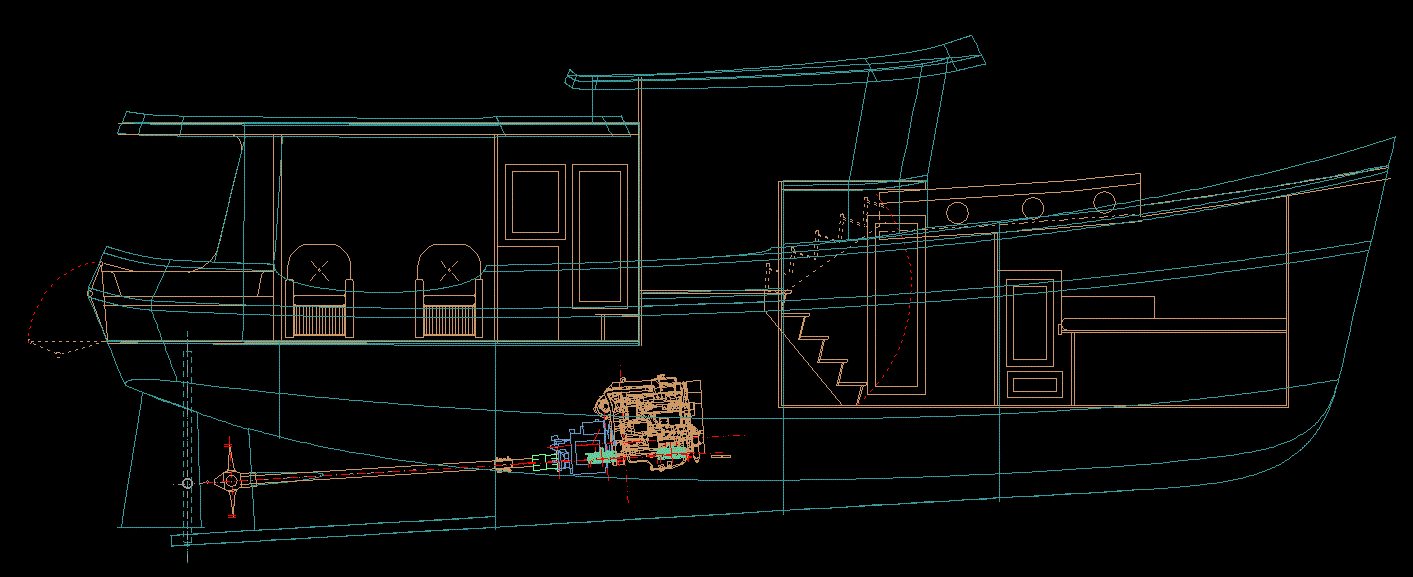
The engine specified is a John Deere 4045 DFM - 4 cylinder diesel, which produces 76 hp continuous at 2,400 rpm. It is mated to a Twin Disc gear using a 3:1 reduction to drive a three blade 26" fixed pitch propeller on a 2" Aquamet 22 stainless shaft.
Any alternate engine for this vessel should be a diesel within the range of around 70 to 80 horsepower using a continuous (M-1) rating, and a weight of no greater than 1,200 lb complete with gear. The "cruising speed" for long range voyaging with this hull is assumed to be 7 knots. Theoretical hull speed is about 8 knots. However due to the relatively light displacement hull form of the Coaster, over 9 knots should be easily attained.
There are two bulk tanks in the engine space, each of which holds ±150 gallons of fuel. There is a separate 50 gallon clean fuel tank which functions as a day tank. The clean tank has no deck fill, so receives only filtered fuel from the bulk tanks.
Using the Beebe range algorithm with 20 hp/gal/hr as the specific fuel consumption for the engine, and allowing for a 15% fuel reserve, a tank capacity of 350 gallons yields around 1,700 nm range at 7 knots. The waterline length in the average load case is approximately 36.5 feet. The high-average displacement used for the Beebe range calculations is 30,000 pounds.
Note that for the original Coaster 40, range was not given top priority. Instead the requirement was for large water capacity. The result is that it would be quite an easy matter to simply re-specify the forward water tank as a fuel tank. This would gain 120 to 150 USG of fuel. Additionally, the port and starb'd wing tanks in the engine room can be expanded inboard slightly, yielding another 25 USG each. This would bring the fuel total to around 550 USG, and range would increase in direct proportion to the increased fuel capacity.
The engine space is located under the Pilot House sole. Access is through a sound proofed door behind the pilot house ladder, as well as through two hatches in the PH sole above. Low levels of noise and vibration are assured by substantial sound insulation. Vibration damping is provided by flexible engine mounts along with a flexible shaft coupling. Ample engine room ventilation is provided by separate entry air and exit air vents, which lead up to / from the Pilot House top.
Space has been allowed for a 5 KW generator to be installed to starb'd and aft in the engine room. A full size person still has plenty of room to access all parts of the engine, gear and generator.
Construction
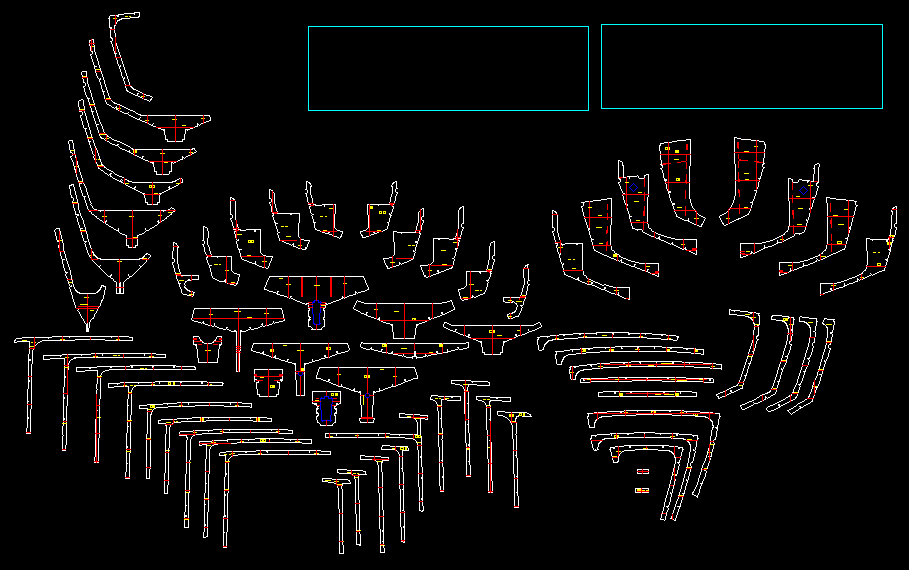
Hull; deck; cabin and pilot house construction are built of aluminum. Scantlings have been determined according to the ABS Rule for Motor Pleasure Yachts - 2000. Plating and framing have been fully detailed for NC cutting. Check out this image of Coaster's Frames, ready for nesting. Coaster was built very economically in Vancouver, BC. A few images are below. Also see the following Construction Photos:
Exterior Arrangement
The aft deck, side decks, and saloon / galley are all at one level. The deck structures provide 6' - 6" standing headroom throughout. Along the exterior side deck there is a step up to the Pilot House side deck, and a further step up to the foredeck. The foredeck spans the full width of the vessel. In the cockpit area aft, a ladder leads up to the "boat deck" through a hinged hatch at the top of the ladder. The side and aft decks are surrounded by substantial bulwarks, especially around the cockpit area.
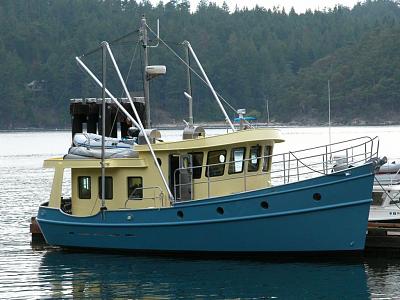
Additionally the decks are protected by welded stanchions and railings along both sides of the pilot house deck and the fore deck. There are welded hand-holds on each house top, per owner's preferred locations. There is a manual windlass on the fore deck. The Pilot House doors are water tight. A water tight door is specified for the saloon, leading aft to the cockpit. The mast is arranged with a boom, to allow placing a small shore boat on the top of the aft cabin. The following photos show Coaster afloat:
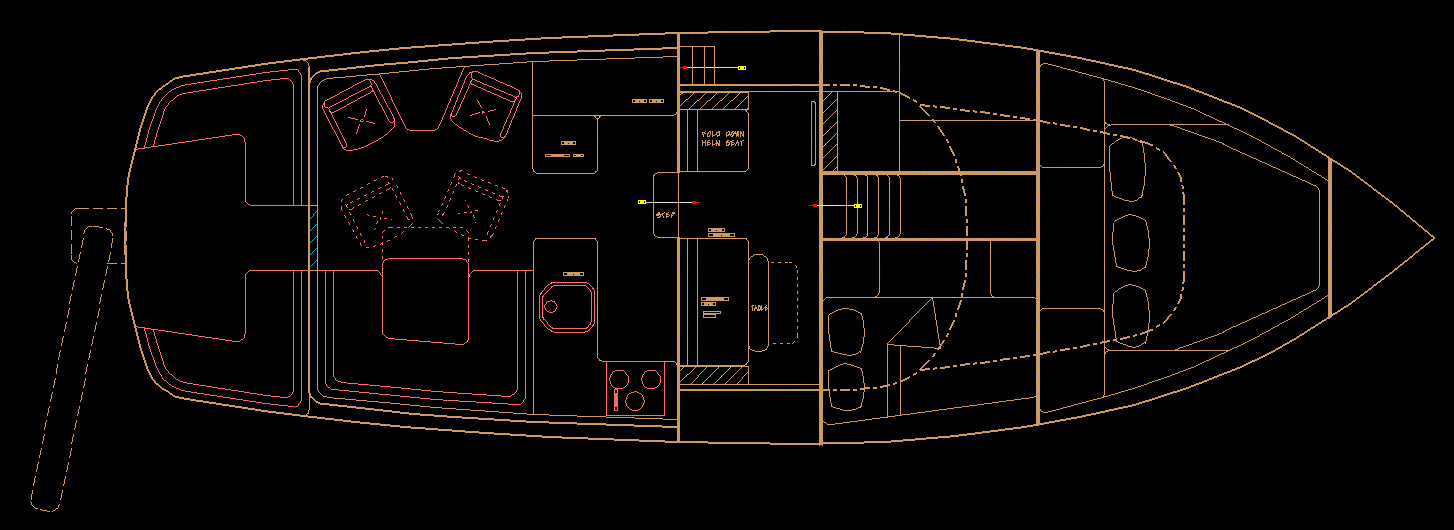
Interior Arrangement
The accommodations are intended to provide comfortable cruising for two people on extended summer cruises, with the addition of a third crew member or a couple for shorter trips.
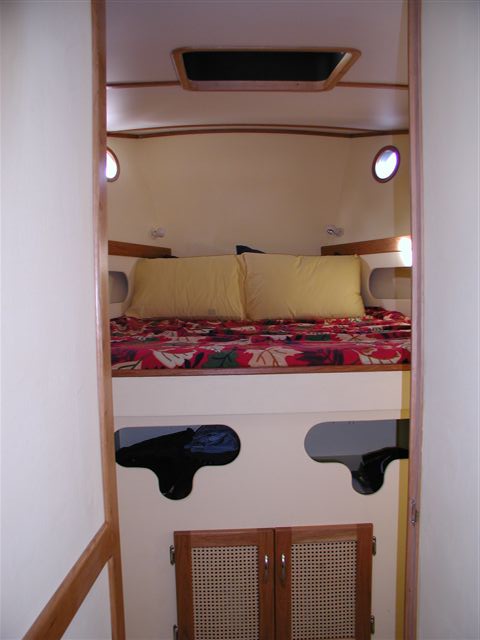
Right forward is an "island" berth in the owner's cabin. There are port and starb'd shelves with reach hole access to lockers below it. A hanging locker is located on each side of the master stateroom. A door leads aft into the hallway.
To starb'd of the hallway is a guest stateroom, containing a small double berth, and lockers at each end. To port of the hallway are the head and shower. Within the head, a vanity cabinet with sink are outboard and a marine toilet is located forward. At the aft end of the hallway, a ladder leads up and aft into the pilot house. Behind the ladder a door is provided to access the engine space.
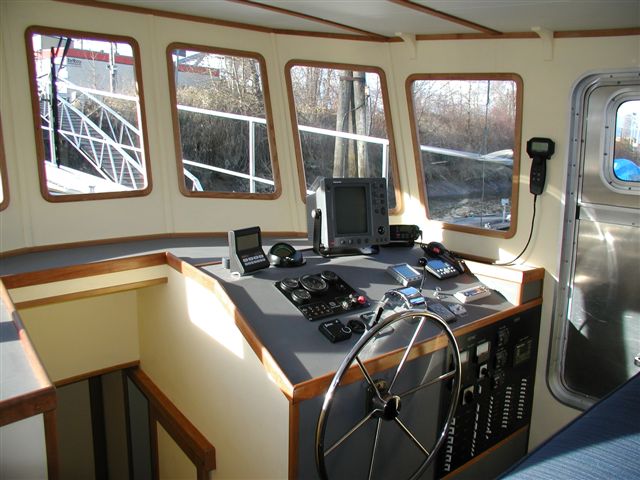
Within the pilot house there is a built-in seat to starb'd. The wheel is located slightly to starb'd of center. The "dashboard" forward of the wheel holds navigation instruments and engine controls.
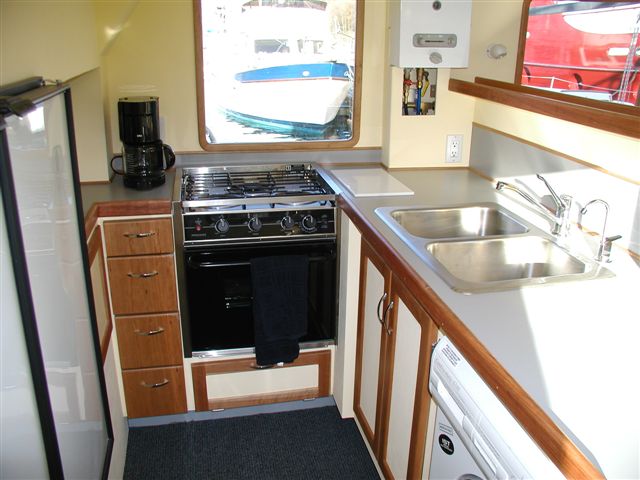
A few steps lead aft on the port side from the Pilot House to the galley. In the aft cabin the galley is to starb'd. A peninsula counter is located along the aft face of the galley, and contains a double sink and an under-counter combination washer / dryer. A three burner propane range with oven is located outboard to starb'd. Along the forward face of the galley, there is a 'pocket' occupying the space below the pilot's seat, which provides a place for the 12v DC refrigerator. The fridge is flanked by a counter having a cupboard above and cabinet below.
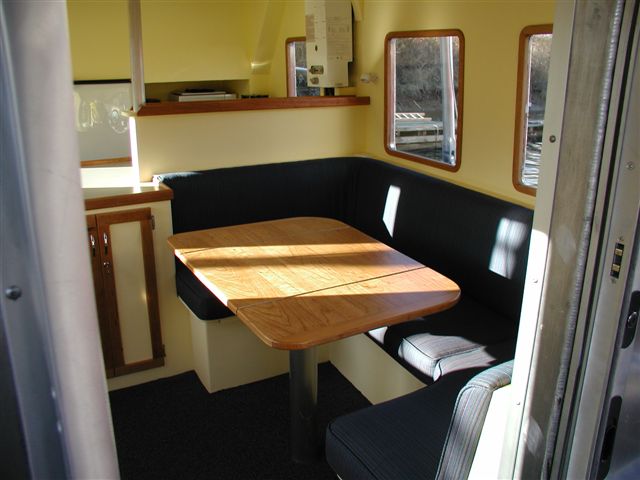
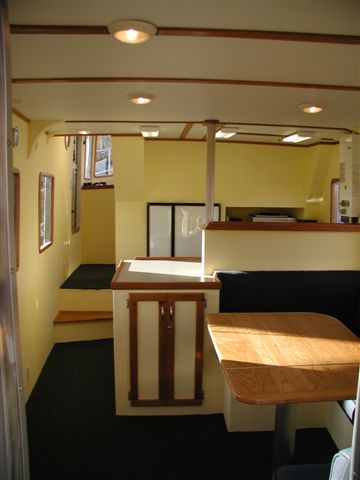
Aft of the galley there is a full width saloon. A pair of easy chairs are located to port with a small table between, and to starb'd is a dining table with wrap-around settee. An alternate arrangement has been drawn as well, with all saloon seating built in, so that table leaves can be folded up to create a large central saloon table. The following are photos of the as-built interior:
40' Ocean Trawler...
Transforming the Coaster into a preliminary design that we've called the 40' Ocean Trawler required only a few changes:
- To raise the aft deck to the height of the rub rail.
- To lower the saloon and galley in order to have a lower profile aft house.
- To eliminate the cover over the aft and side decks.
- To provide a ladder that leads down via a scuttle from the exterior deck to the saloon.
The raised aft deck of the 40' Ocean Trawler provides substantially greater buoyancy aft, as well as much less enclosed cockpit volume (inside the bulwarks), therefore the "Ocean" designation. The interior is exactly the same as that of the Coaster, except that the saloon and galley have been moved lower down.
The raised aft deck combined with the lowered aft accommodations and lowered house top means that there is not sufficient headroom to have a covered aft deck, therefore the aft roof overhang has been eliminated. This combination has reduced the windage of the house, eliminated the windage and weight of the exterior overhead structure, lowered the center of gravity, and raised the freeboard. Since the saloon is lower in the hull than the exterior deck, there is a ladder / stairway from the saloon up to the aft deck, which has been turned into a scuttle with a pair of water tight doors. All of these are ultimately positive attributes for offshore voyaging.
At present these changes have been proposed and modeled, plus a new profile and one section have been drawn. It only remains to make changes to a few of the other drawings to match. This can be easily done and thus will not involve much added cost for the design. The NC cutting files however will need substantial revision in way of the aft house structures.
The following images of the Ocean Trawler concept show two sizes, one at 40' and another at 45' length on deck:
40' Coaster 'Widebody' ...
A variant of the 40' Coaster arrangement widens the aft house in order to make the saloon and galley considerably larger. We are so-far calling this version the '40' Coaster Widebody.' In the Widebody layout, the port and starb'd sides of the aft house have simply been pushed outboard to within 6 or 8 inches of the bulwarks, eliminating the exterior side decks in way of the saloon and galley. This leaves an inset to the house sides above the bulwark - just enough to refer to as a 'cat walk' on each side. As can be seen in the images of this concept linked below, a much more spacious saloon and galley are the result. Due to the elimination of the side decks, the aft deck seating can wrap around to port and starb'd.
With this layout it is possible to make the dinette larger, and it could wrap around forward along the aft face of the galley as shown in the layout sketches linked below. The chairs and table to port can be quite a bit larger. Access to the aft deck is also excellent, with unimpeded passage directly through from the pilot house right through the saloon and out the aft door. This makes any side decks entirely redundant, and they have thus been eliminated.
Given the much greater width of the saloon we can steal a foot from the length of the saloon and donate that to the aft deck. Outboard of the pilot house, access to the house top is quite simple. From the exterior PH side decks an integral ladder/stair leads right up to the galley / saloon top. This allows excellent access to the paravane rig for deploying and retrieving the poles and the paravanes.
A substantial benefit of these changes is that the vessel would be much better suited to big water. Why? Because the low-freeboard side decks would be eliminated, thereby vastly increasing the buoyancy aft - especially when heeled. This provides an excellent enhancement to seakeeping and large angle stability.
Preliminary concepts in the links below show three different Widebody designs, all variants of the Coaster, but each one differing in length, superstructure, and hull form, as follows:
- The 40' Coaster Widebody would make for an easy adaptation from the existing 40' Coaster design. The preliminary concept is as shown in these links...
- The larger 43' Petrel Widebody is a completely new design optimized for dive operations, which lengthens the Coaster just enough to incorporate an integral dive platform aft. This version uses the same layout in plan view as the 'Coaster Widebody' but has all of the on-deck accommodations at the same level, including the pilot house. This creates quite a high profile, so it is best to consider this arrangement for 'protected' inshore or coastal waters.
- The larger still 45' Gannet Widebody expands on the excellent Coaster Widebody interior arrangement, but provides considerably more elbow room throughout. As with the 43' Widebody, the aft deck includes an integrated swim deck. The Pilot House is slightly farther forward, allowing sufficient room below it for the guest cabin and head. The Pilot House is also larger, providing for a large dinette within. This means the saloon can be dedicated to actually being... a saloon...! A cushy couch with a coffee table and a pair of easy chairs opposite as well as a greatly expanded galley occupy the aft house. On top of that... a Flying Bridge. In my view, this is where the Coaster design comes into its own as a true 'trawler yacht'.
- The 45' Nomad Widebody combines the hull form of the 45' Gannet with the house structure of the 50' Vagabond Widebody. A large owner's suite forward with a walkaround island berth, a guest cabin / office, and a large all-in-one galley / saloon / pilot house on deck to have an all-around view and excellent access to the water. A great combination we think.
Design Summary
At first it seemed nearly impossible to fit two staterooms into a vessel of this size without making the boat too tall. With diligence in fitting it all together, the interior has worked out very well, and there is ample room for the accommodations, plus a sizable engine space. In all, whether given the form of Coaster or the Ocean Trawler or the Widebody Trawler these boats are economical to build, simple to maintain, and a pleasure to travel with...
Direct Quote from an aluminum boat owner...
As an owner since 5 years of an aluminum boat I could not agree more with your preference for this material. She is a great boat and requires very little in the way of maintenance. I do a lot more reef snorkeling than the paint, polish, varnish and wax guys!
--Peter Kminek
Please see the AVAILABLE BOAT PLANS web page.
Home | Intro | Our Design Process | Stock Design Info | Motor Yacht Designs | Sailing Yacht Designs | Prototype Designs
Plans List | Articles | Our CAD Design Stream | Maxsurf | SITE MAP..! | Site Search | Design Team | Contact Us