Messing about in boats since 1975. Online Since 1997.
Home | Intro | Our Design Process | Stock Design Info | Motor Yacht Designs | Sailing Yacht Designs | Prototype Designs
Plans List | Articles | Our CAD Design Stream | Maxsurf | SITE MAP..! | Site Search | Design Team | Contact Us
Please see the AVAILABLE BOAT PLANS web page
Affordable Boatbuilding
Copyright 2004 - 2016 Michael Kasten
Below is a bit of information about the costs involved with boat building and several strategies that can be used to make boats more affordable. . . .
WHAT DOES IT COST TO BUILD A BOAT. . . ?
In general, when considering like-to-like boat comparisons, one can make good use of the methods outlined in our 'Boatbuilding Costs' article in order to pre-estimate the cost of building a new boat. Of course there are caveats at each step of the way, each of which are clearly outlined in that article.
It is generally true that, provided the materials of construction and the equipment and finish are the same, and provided the general vessel type is the same, and provided the vessel's cabin configurations are similar, costs will vary approximately directly with displacement.
The reason to throw in the vessel type' qualifier is that fast boats or very light weight boats per length will tend to cost more per pound, so can't be compared to boats of other types with much accuracy. The reason to include the 'cabin configurations' qualifier is that actually the more accurate variable (than displacement) is the vessel's entire cubic content, i. e. everything inside the vessel whether above or below the water.
As an example, a boat that has a larger cubic content, but which has the same displacement and other factors, will cost more approximately in direct proportion to the difference in cubic content. Unfortunately the cubic content is not a commonly available design parameter, so instead we make use of the more common and expediently available 'displacement' number, even though it must be qualified more carefully.
As long as these qualifying factors are kept in mind, the 'cost per pound' method of comparison presented in the article is entirely valid.
DIVIDE AND CONQUER. . . !
There are a number of ways to reduce costs.
One path toward affordability that has been successfully used by a number of people is to divide the project into manageable segments, each of which is also aimed at separating the project into convenient milestones of achievement. This may involve building the hull oneself, but more commonly it will involve having the hull built to a given stage of completion at a professional yard, then completing the rest oneself - or completing the rest with the cooperation of others, or possibly having the rest completed by professionals, but in stages.
For example, possibly the most convenient milestone during construction is what we would call the 'power-away' stage of completion. That means the boat is completed to the point where it is painted, insulated, lockable and weathertight, with the steering, propulsion and anchoring systems functional. For sail boats this stage of completion might also include the spars and standing rigging. At this point (except for propulsion equipment) there are no systems and no interior, but the vessel 'looks' finished on the exterior, complete with ports, doors, hatches and anchor gear, and can be transported under power to another location for finishing the interior and other systems. .
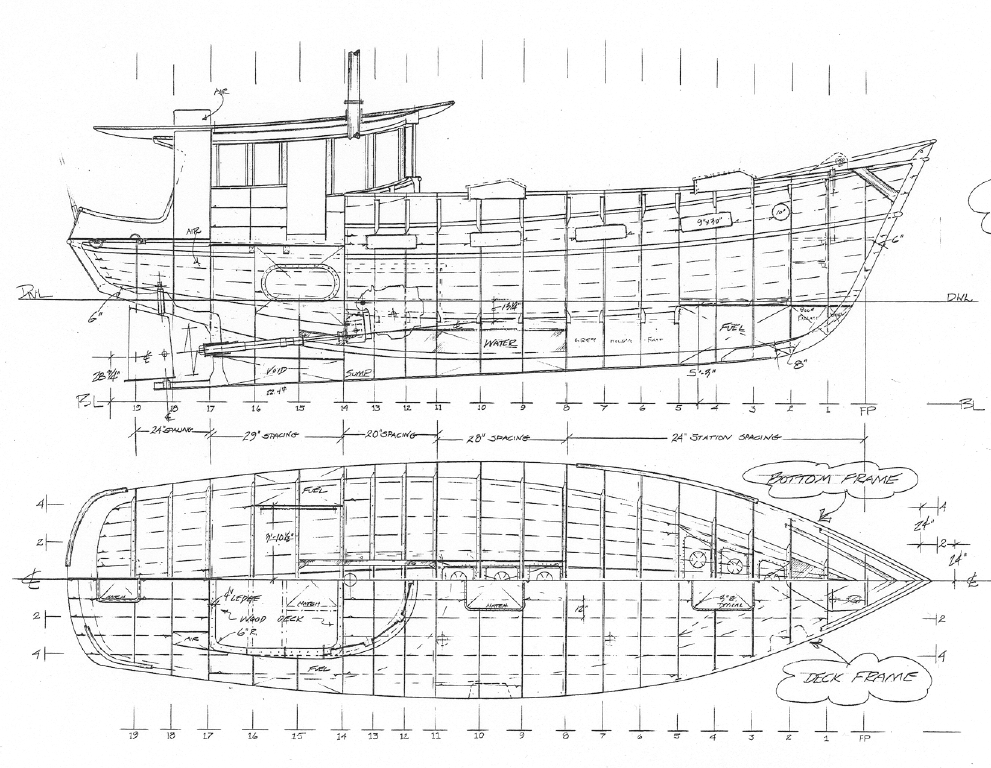
In a fully enclosed metal vessel, it's ordinarily desirable to arrange for a pile of plywood to be placed inside, possibly even including bolting up the bulkheads and soles. The bulkhead installation is easily accomplished, since in our designs the frames are intentionally coincident with bulkhead locations so that it is simply a matter of bolting them to the frames.
Compared to the cost of a completed boat that has been done to a 'turn-key' stage of completion, the cost of a power away package (very approximately) will amount to around 30% to 40% of that total, depending on what an owner has chosen to include to that point, and depending on the complexity of the systems that will be included.
If the rest will be finished by the owner, it represents a substantial savings - a large enough savings to make the incremental 'stage of completion' approach extremely worthwhile. The primary advantage to the owner with this approach is that the vessel's structure and the basic propulsion and steering systems are completed professionally.
The advantage to the builder is not having to install, test, perform sea-trials on, nor provide warranty service on a variety of systems that have been manufactured and supplied by others, thus the savings... After all, quite a generous allowance is built into the cost of installing the various systems in order to allow for post-installation testing and the possibility of having to provide warranty service.
A second advantage to the boat owner is that having installed the various other systems, he or she will have a good familiarity with the inner workings of their boat. They will then be in a better position to service those systems without having to rely on professional help. This familiarity is especially important out on the water where self-reliance is its own reward.
A third advantage to the boat owner is that they've saved the best part for themselves: the joinery... At least in my view, the interior joinery is really the fun part!
KEEP THE SYSTEMS SIMPLE
Costs will vary widely depending on the equipment that is specified. Each system adds its own first cost and also adds complexity, therefore exponentially increasing the labor required for installation.
It is all too easy to over-equip a boat, and in so doing place it out of reach financially. We have seen this happen a number of times and it is extremely unfortunate, quite unnecessary, and it is totally avoidable...!
After all, being on the water is not about having the most toys, nor about maintaining a vast array of complicated equipment -- rather it is about recreation and enjoyment. Keep it simple..!!
KEEP THE DESIGN SIMPLE
For simplicity of construction in metal or plywood, a single chine hull shape is the best choice. When using sheet materials, it goes without question that single chine shapes are the least expensive in terms of labor. When correctly designed, a chine hull shape will yield a fast boat whether power or sail.
It may come as a surprise that a single chine shape may even be the best choice for a one-off fiberglass boat..! Why? It is all a matter of keeping the labor to a minimum. If the mould can be built using simple flat sheet materials such as particle board, then it can be built quickly and economically.
Whether metal or composite, one can think of single chine shapes as being able to allow more boat length per dollar, offering a real performance advantage both in terms of cost and of actual boat speed.
To better understand what I mean by 'simple' please have a look at my article on Nomadic Watercraft.
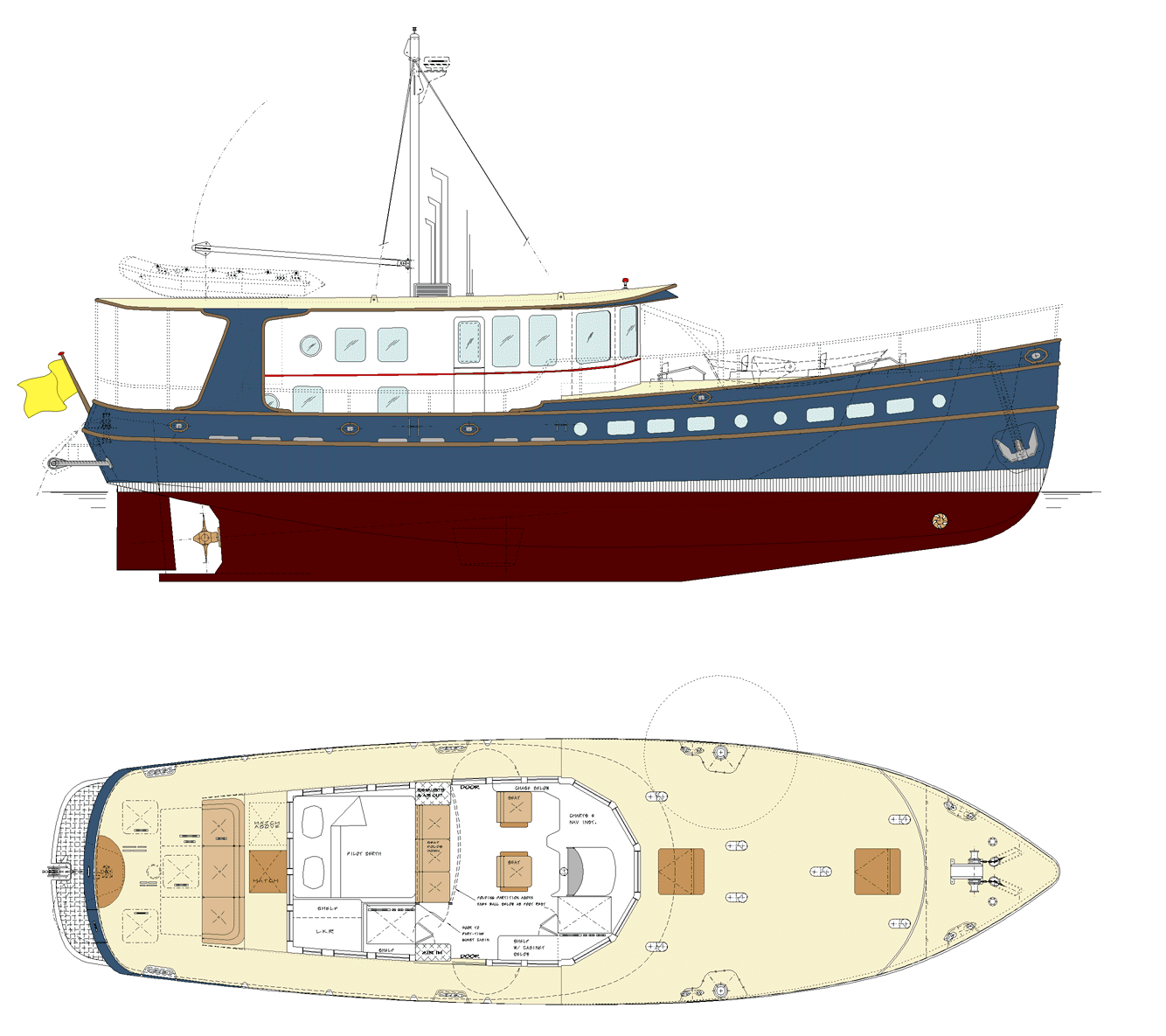
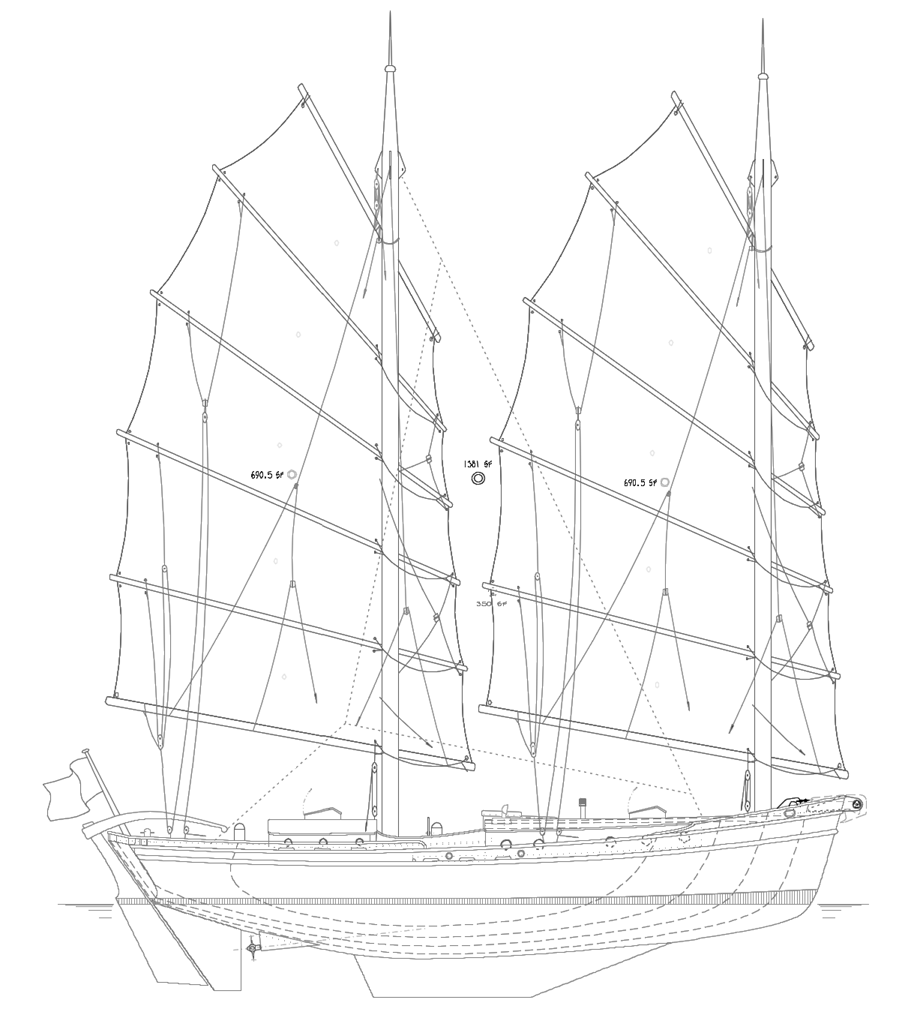
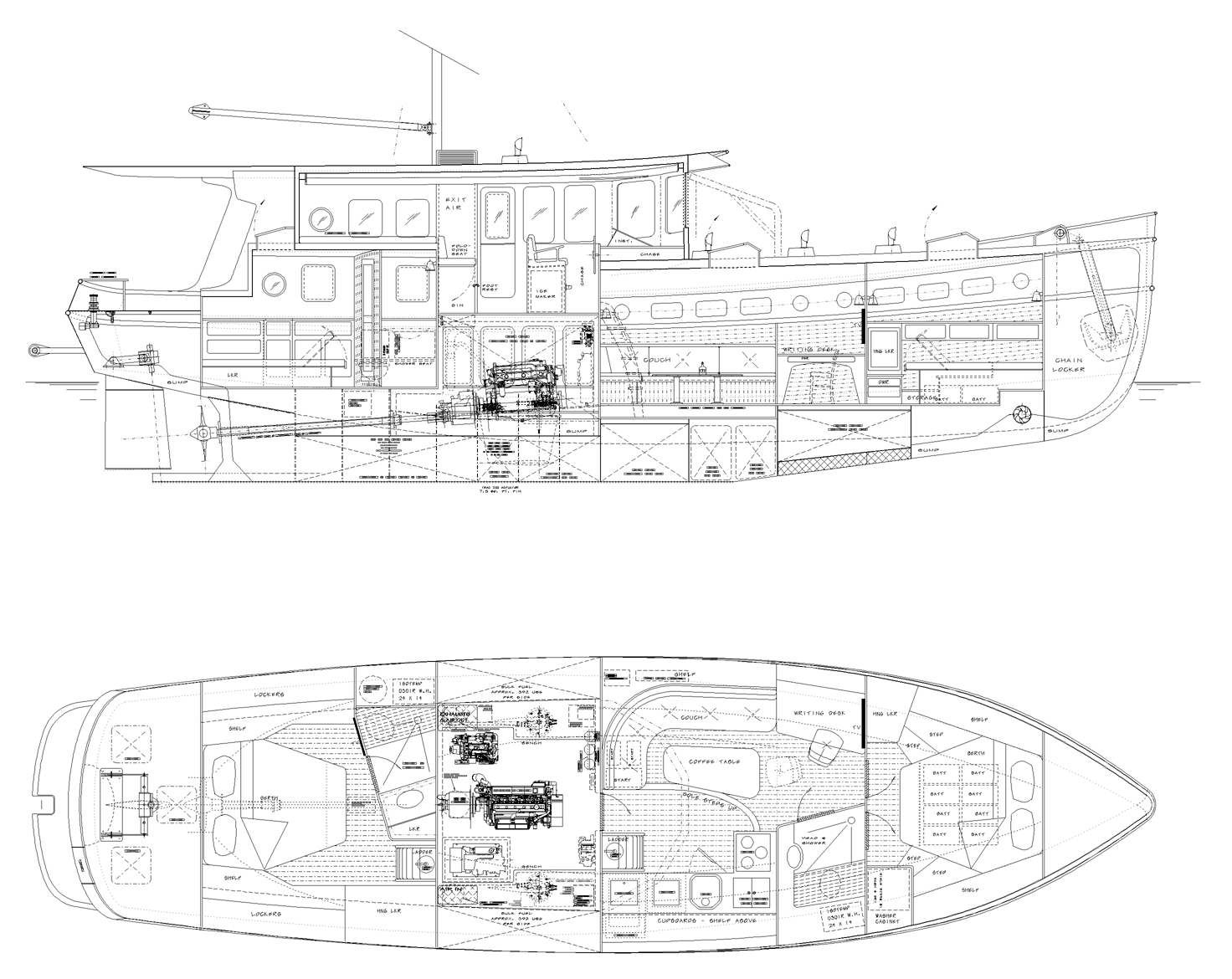
Examples of this 'keep it simple' approach both regarding systems and hull form are the 32' Tug Yacht Terrier, the 43' Moxie, and the 36' Grace, a few of my favorite small vessel designs. Moxie is slender, simple, easy to build, etc. As with Moxie and Terrier, Grace is very simple to build and an excellent sea boat. If larger boats are preferred, then the 50' Renegade and the 50' Vagabond are fine examples of simple and economical motor vessels. Similarly the 42' Zephyr and the 44' Redpath are examples of simple and economical sailing vessels.
KEEP THE BUILDER PRODUCTIVE
How do we propose to have any effect on the builder's work from a distance after the design work has been completed...??
NC CUTTING...!
What is NC..? It simply means "Numerically Controlled."
By this method, the design hours already expended modeling the hull model via computer are leveraged in order to actually create the structural parts of the boat.
Regardless of the build location, we have seen excellent results via NC cutting. It is highly accurate and saves the builder a substantial amount of time. In metal, we observe the fabrication hours saved by the builder to be on average around three times the NC cut file development hours.
What this means is that for metal boats the use of NC cutting can save a professional builder some 30% to 45% of their fabrication labor, depending on their experience, the complexity of the design and on the thoroughness of the NC development. This translates into a direct savings, which not only pays for the cost of developing the NC files, but also 'earns back' a substantial portion of the original design costs.
For an amateur or first-time builder, the amount of time saved with all pre-cut parts is vastly greater, since there will be no lofting, no pattern making, no cutting, and... no worrying about each of those steps!
Oddly, many professional yacht builders in the US do not have any experience with NC cut projects, and will therefore not be inclined to give it much credit when estimating hull construction costs. Are they still in the dark ages...? It is a question I've addressed in an editorial on Boatbuilding Tools.
Builders who do have experience with NC cut projects already know how much work it will save. As a result they will be able price an NC cut project more accurately and far more competitively.
NC cutting can be employed for boats of any material. For flat sheet materials, the method essentially amounts to pre-determining the shapes of all the structural components via computer modeling, then nesting those parts onto the sheets or plates from which they will be cut. In the case of metal, the cutting is done by computer driven plasma torch or abrasive water jet. In the case of plywood, a computer driven router.
NC cutting can also be used to reduce construction labor on fiberglass boats, where NC cutting will be used for pre-cutting the mould parts. For a chine vessel, this is very much as above, except the structure that is being pre-cut is that of the mould. For a rounded vessel, the computer model of the hull shape can be directly used to drive a 5-axis router, which carves either a one-off mould, or to create a plug from which a permanent mould can be made.
More information on the benefits of NC cutting can be found within our CAD Design Stream article and the other articles linked from there. There you'll find several good images of the actual process of developing a design and detailing it for NC cutting.
CHOOSING A VENUE
Costs will vary fairly widely depending on the venue where the boat is built. Our 'Boatbuilding Costs' article describes this strategy and provides an approximate method of gauging the amount of savings that may be possible. For more information on the process of choosing a builder, consider the following. . .
CHOOSING THE BEST..!
Believe me, in writing the above notes about cost savings, I am in no way disparaging the wish to have only the finest yacht available. In fact, we have focused our efforts on creating the highest quality yacht designs possible within the owner's design budget, and we expend no small amount of effort to connect our clients with builders that will provide the best quality workmanship.
After all is said and done, we want successful projects and happy owners..!
FINDING A BUILDER
While we always make builder recommendations, we do not provide builder lists or any builder contact information until an Estimating Plans set has been purchased.
Why. . . ?
Actually there are quite a few reasons:
- Builders will have very little to offer in way of pricing until they are presented with Estimating Plans, which include a Structure Drawing and the complete Vessel Specification and Equipment List.
- Only with these drawings and documents will they be able to create an accurate construction estimate.
- If a builder is not presented with a completed concept, they may simply offer an alternative design or possibly a boat they have in production, which may be quite different from the design the owner had envisioned.
- Without complete plans and documents a builder's only other option is to provide an incomplete estimate - one that is likely to be substantially different when it comes time to build the boat.
Our builder recommendations are based on a number of considerations:
- The prospective boat owner
- The type of vessel being considered
- The anticipated level of completion
- The finish that is expected; etc.
In other words, a builder can't provide a meaningful quote without a good set of drawings. Without a good set of Estimating Plans, a builder will be in the unfortunate position of attempting to apply a fudge factor to a variable that's been based upon an assumption about an unknown. In absolute terms they can only end up with. . . an unknown!
Further, our builder recommendations will be made on the basis of the builder's suitability to the project being considered.
Why is this 'suitability' consideration important. . . ? Some builders prefer to only build the metal hull / deck / cabin structures, while others prefer to build the whole boat. Some can build only up to a certain size of boat. Some do not want to fool with power boats, nor others with sail boats, some have a specific suitability to providing the owner's specified level of finish, and so forth.
Essentially, for every design there will be several qualified builders, and there will be others that are neither suited to the project nor possibly even interested. So, while we most definitely do make builder recommendations, we will do so only when we have also supplied the prospective boat owner with sufficient information for those builders to determine construction costs in the form of actual Estimating Plans.
In this way an owner will not be wasting their own time.
Just as importantly, an owner will not be wasting the builders time. . . !
WHAT ARE ESTIMATING PLANS. . . ?
In order to be able to determine a 'completed vessel' cost or even a 'power-away' cost, there must necessarily be a well defined plan. In other words, the owner must present sufficient information to the builder so that the builder can actually sharpen their pencil and provide a firm quote for construction. At the very least the builder must be provided with what we call an 'Estimating Plans' package. This consists of the first few drawings of the actual "Building Plans" plus a few preliminary design documents, as follows:
Drawings
Documents
- Vessel Specification
- Scantlings
- Surface Areas
- Structural Weights
- Equipment List
- Designer Cover Letter to Owner
- Designer Cover Letter to Builder
- Owner Cover Letter to Builder (Template)
The Equipment List includes all the various mechanical and electrical equipment items. The Vessel Specification outlines the intent of the design, gives the vessel's proposed scantlings, construction materials for the hull and the interior joinery, the proposed paint schedule, and a preliminary indication of power, range, tankage, performance and stability.
With the Estimating Plans, Vessel Specification and Equipment List in hand, one can then approach builders to inquire about actual construction costs.
For a complete list of our available Study Drawings, Estimating Plans and Building Plans, please see our Plans List page.
WHY BUILD...?
Although I don't keep track of what new or used production boats are selling for, I do know that a yacht broker's commission is ordinarily 10%. This seems quite a heavy price to pay simply as a finder's fee.
Even when an entirely new Custom Design is created out of an owner's preliminary description and a few napkin sketches, the design work will cost far less than a yacht broker's commission... and there are no "finder's fees" to contact boat builders. Naturally, if a Stock Design has been chosen, the entry fee is even smaller...
Why build, you ask..? Why not...!
For more information on this subject, please see our web article on Yacht Design Costs.
More Articles on Cost:
Estimating Boat Building Costs | Affordable Boatbuilding | What Will The Boat Cost..? | What Will the Design Cost..?
Please see the AVAILABLE BOAT PLANS web page.
Home | Intro | Our Design Process | Stock Design Info | Motor Yacht Designs | Sailing Yacht Designs | Prototype Designs
Plans List | Articles | Our CAD Design Stream | Maxsurf | SITE MAP..! | Site Search | Design Team | Contact Us