Messing about in boats since 1975. Online Since 1997.
Home | Intro | Our Design Process | Stock Design Info | Motor Yacht Designs | Sailing Yacht Designs | Prototype Designs
Plans List | Articles | Our CAD Design Stream | Maxsurf | SITE MAP..! | Site Search | Design Team | Contact Us
Please see the AVAILABLE BOAT PLANS web page
The Fast Aluminum "Trawler"
60' - 70' Express
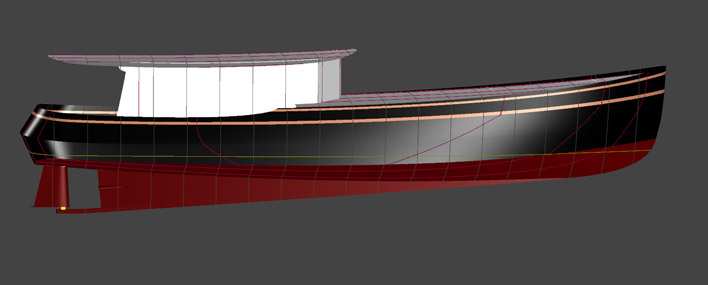
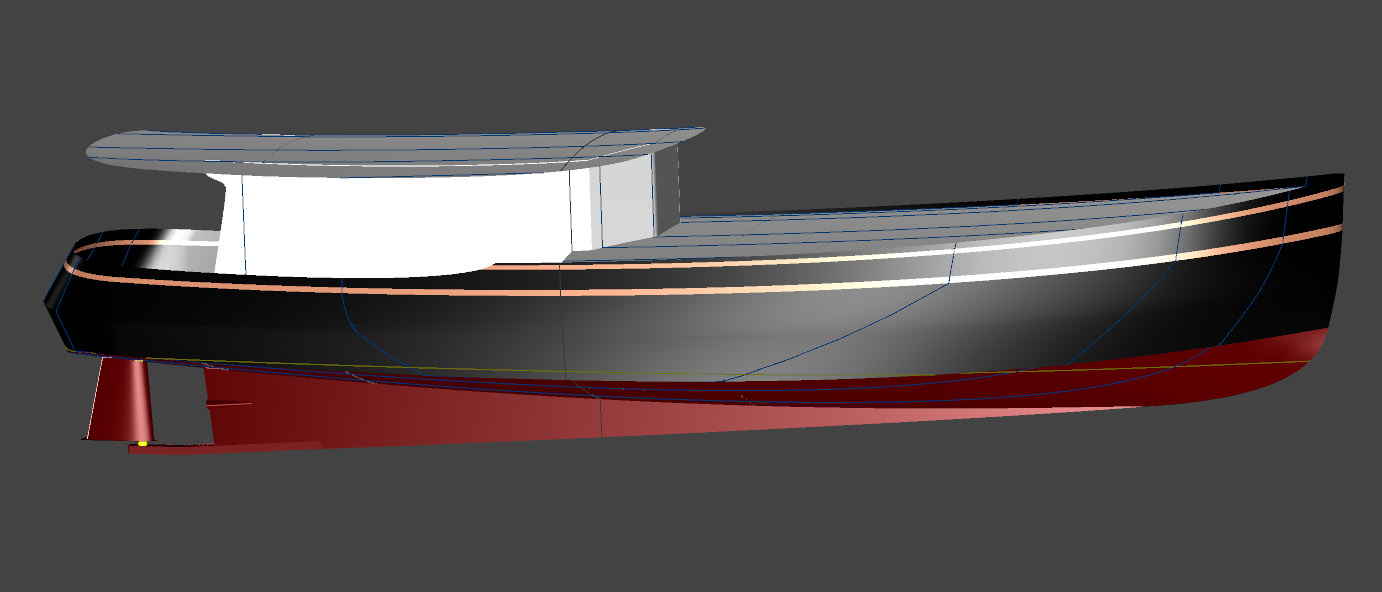
Perspective Aft | Perspective ForwardCopyright 2007 Michael Kasten
General Concept
After perusing several US West Coast rum runners from the prohibition era, the inspiration for this prototype emerged. In terms of styling, there is a 'retro' theme that seems to be persistent these days, one that is very evident in cars but also in large 'classic' sailing yachts and run-about motor yachts.
The concept with the Express Cruiser has been simple: why not take inspiration from the rum runners of yore and use the concept as a yacht type - black hull, just enough varnished wood to catch one's eye, long, sleek, and fast, but now also deluxe and very comfortable interior - somewhat in the direction of the Lake Union dream boats, but... faster...
In terms of structure - and very much in the vein of having been inspired by the rum runners - they should also be 'bulletproof' and ocean-worthy. To me, bulletproof means heavily plated aluminum construction with a minimum of framing - somewhat like the Strong-all system used by Meta of France - but based on ABS scantling rules.
It is well known that reducing internal framing will dramatically reduce hull fabrication labor. What is less obvious is that increasing plate thickness also reduces hull fab time - due mainly to eliminating weld distortion, allowing faster weld-up. In aluminum, all of this is practical because the weight of plating can easily be tolerated.
The hull form I've used here is that of a semi-planing hull, pinched in slightly at the stern as would have been the case in earlier times. The overall size I have envisioned is somewhere between 60 feet and 70 feet. The example we have chosen to illustrate is the 60 footer.
The long fine run and light displacement will yield an excellent combination of speed and economy. Relatively short overhangs maximize WL length and therefore vessel speed and accommodation space below. Height to the top of the Pilot House is under 11 feet, which allows access to the majority of canals in Europe.
Power
At 70 feet and around 60,000 lb displacement or so, speed potential even in displacement mode is nearly 17 knots! If somewhat less horsepower were supplied this hull form can be driven very economically and quickly, allowing very long range with a modest amount of fuel. If much greater horsepower were supplied, planing speeds can be achieved at well over 25 knots. Engine choices are therefore numerous and the amount of horsepower provided would depend entirely on the top speed required.
This is a vessel we can truly call EXPRESS...!!
Interior
Here I will describe an interior that will fit nicely into a 65 to 70 foot overall length.
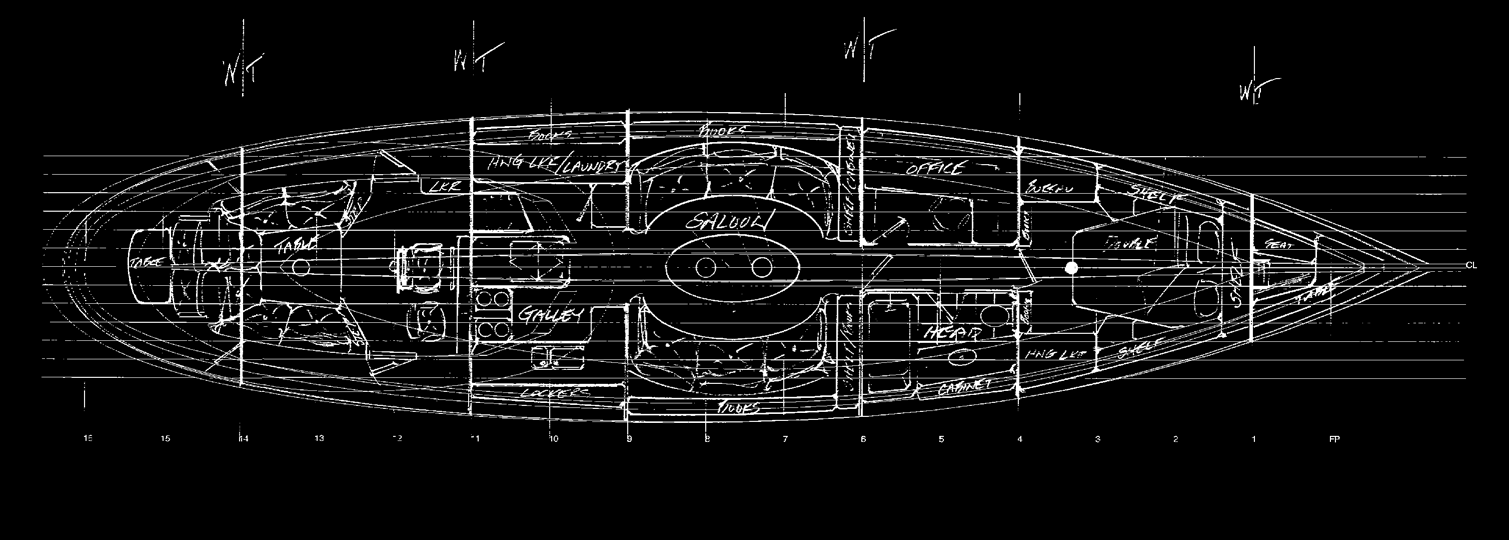
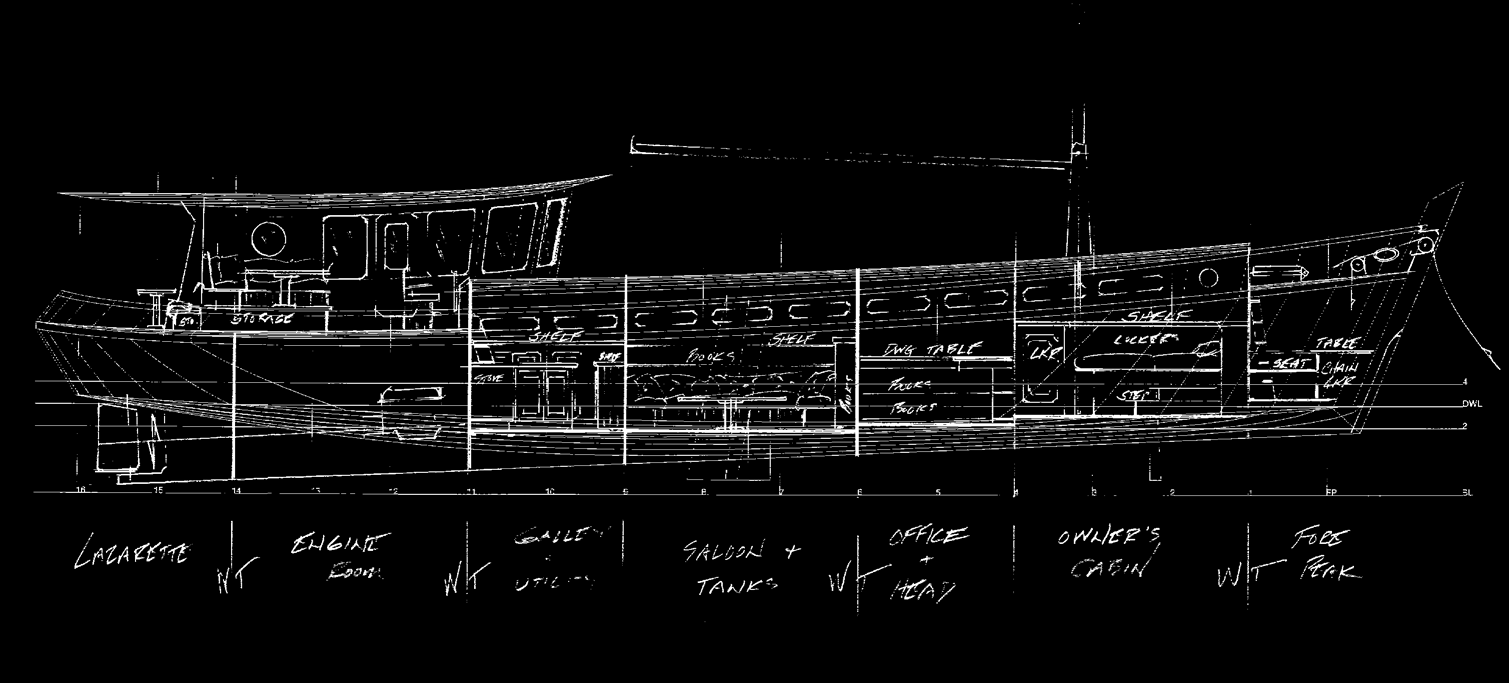
Below Forward: The whole forward layout below will ideally be very close to what we have sketched for the 60' Peregrine. Check out the 60' Peregrine Interior Layout and Interior Profile to clarify the description that follows... Note however that the Express Cruiser described here is wider, yielding even more room below.
Beginning right forward there is a generous forepeak for anchor gear and rode storage. Right aft of that, a large owner stateroom. The head & shower are just aft of the owner's stateroom to starb'd, and to port, either a guest suite or a generous ship-board office.
Aft of that and nearly amidships is a large saloon having a comfortable 8' or so couch to port and to starb'd of a center coffee table. A convenient side board will be located forward and aft of the saloon seats - four in all - essentially functioning as end tables with drawers / doors for storage below.
Aft of the saloon, located to starb'd is the galley which is arranged in a large "U" shape open toward the aft end, and having a large 'peninsula' counter on center. Outboard of the companionway and all the way to port is a long side table at counter top height. This counter / cabinet will house the laundry at the aft end, and will serve as either a large desk or project table on top, or it could just as easily be made into a raised "berth in a box" for additional guests.
Immediately to port of the centerline peninsula counter is the companionway leading up and aft into the pilot house.
Above Aft: Here we have the Pilot House, plus a large combination Saloon / Dining area aft. The pilot house is intended be arranged similarly to that of the 64' Chantage. The Chantage Deck Plan shows this layout reasonably well, though on the Express Cruiser the dining area will be slightly less long.
Briefly, a large dashboard is located right forward with the companionway to port leading below. A pair of doors exit the forward end of the pilot house to port and to starb'd. A pair of pilot seats are intended aft of the doors. A walk-through between the pilot seats will lead aft into the saloon / dining area.
A bureau / bar will be located forward against the pilot seats, and the rest is dedicated to an open dining area, with large opening doors directly out onto the aft deck. On the aft deck, a seating arrangement similar to that on the Chantage is intended, as can be seen on the Chantage Deck Plan. Note however that the Express Cruiser shown here has much greater beam aft so the aft deck seating area would be considerably larger.
Below the Pilot House sole are the engine and bulk fuel tanks. Unlike the Chantage however there is plenty of length here to use a direct in-line shaft and gear. The engine space is easily accessed by a door from forward, as well as by large hatches in the pilot house sole.
Alternative Layout: If the length were limited to 60 feet overall, then the interior, the pilot house, and the aft deck layout would be nearly identical to that of the 60' Peregrine.
Further Development
Let's see... bulletproof structure, easily driven hull, efficient propulsion, elegant, retro-cool, sleek, fast, comfortable and spacious interior... okay what did I miss...??
If this sort of wildness is of interest, please inquire for more detail.
Please see the AVAILABLE BOAT PLANS web page.
Home | Intro | Our Design Process | Stock Design Info | Motor Yacht Designs | Sailing Yacht Designs | Prototype Designs
Plans List | Articles | Our CAD Design Stream | Maxsurf | SITE MAP..! | Site Search | Design Team | Contact Us