Messing about in boats since 1975. Online Since 1997.
Home | Intro | Our Design Process | Stock Design Info | Motor Yacht Designs | Sailing Yacht Designs | Prototype Designs
Plans List | Articles | Our CAD Design Stream | Maxsurf | SITE MAP..! | Site Search | Design Team | Contact Us
Please see the AVAILABLE BOAT PLANS web page
An Analysis of Slocum's 37' Yawl
'SPRAY'
And a Strategy for Improvement..!
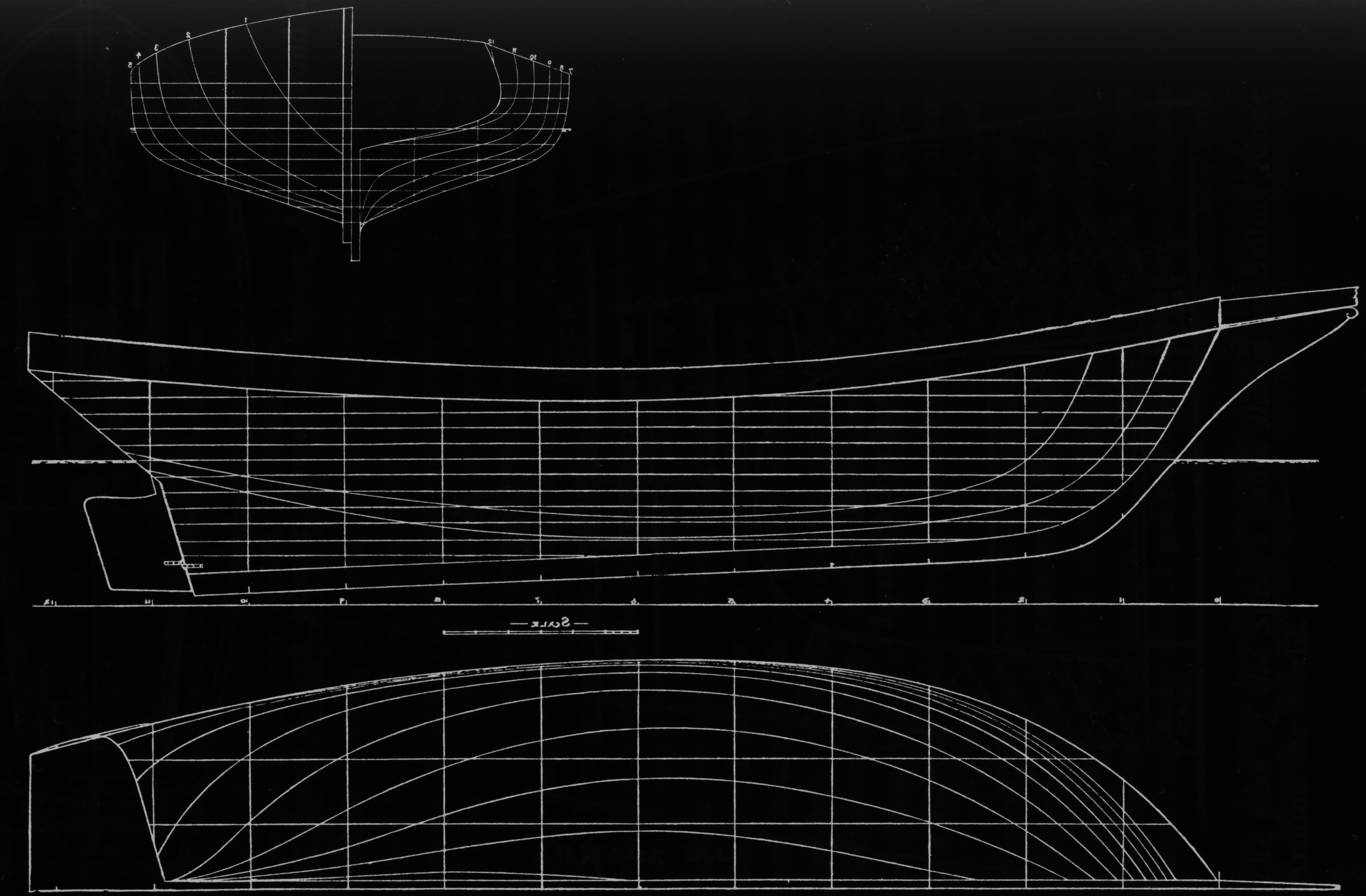
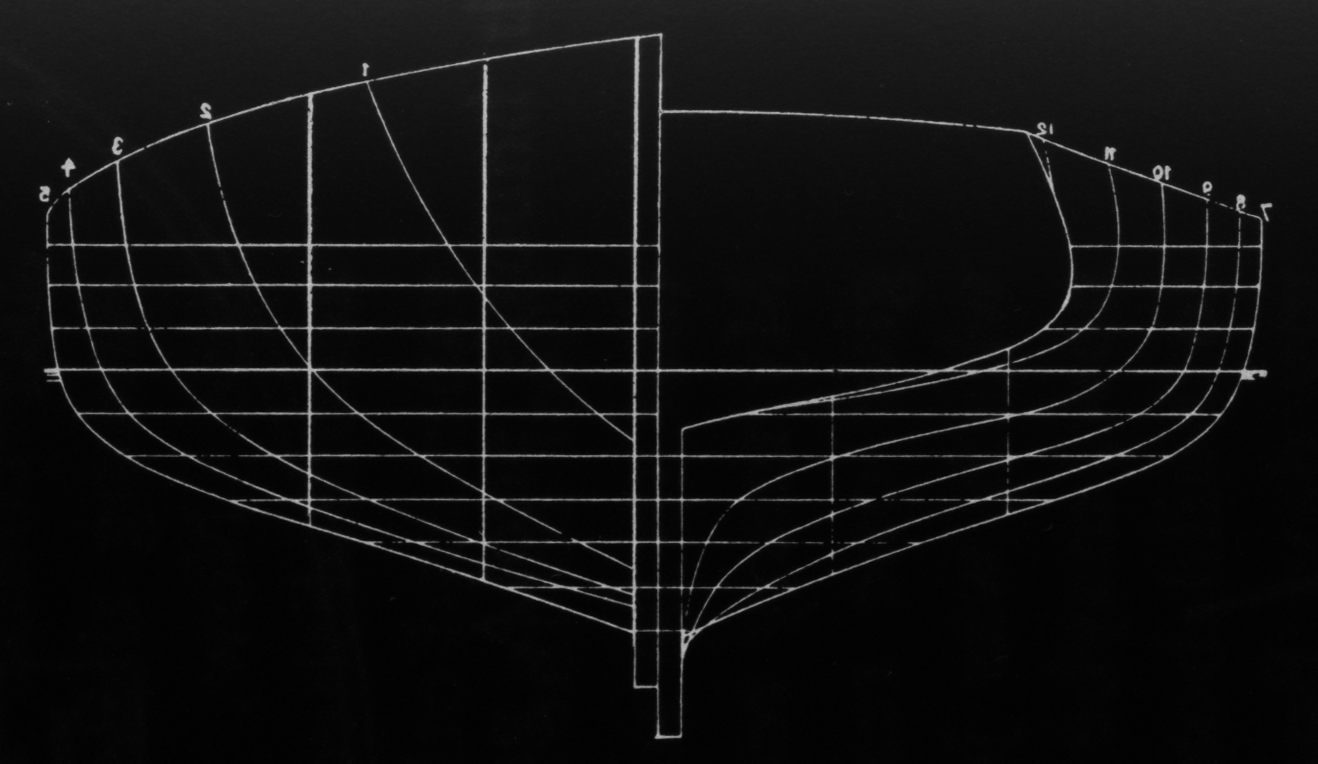
Click for a Larger ImageSpray Original Sail Plan | Spray Original Hull Lines | Spray Original Body Lines
Article & Screen Shots Copyright 2011 - 2019 Michael Kasten
QUALITIES OF SLOCUM'S SPRAY
First, I should confess that I am actually a fan of the original Spray - i.e. the one that Joshua Slocum sailed around the world. However I am only a fan in a limited sense. Allow me to elaborate...
What the ORIGINAL Spray was most notably able to contribute to Slocum's voyage was excellent directional stability, i.e. outstanding and apparently infallible course keeping ability. This inherent self-steering ability was the result of several factors:
- A long straight keel, deepening aft
- A full and rounded bow
- A long straight run aft
- A forward-of-amidships center of buoyancy.
This combination allowed the vessel to behave somewhat like a dart, with the weight forward and the feathers aft. Alternately you can imagine a tear-drop shaped bomb with fins aft - the ideal shape for stability in a free-fall environment.
This made the Spray rather poor to windward, but superb off the wind. The Spray was not slow, as many might imagine. On the contrary, the Spray was capable of quite fast sailing when off the wind or on a reach. This was due to her shoal draft, far forward CB, long straight run of the buttock lines aft, extreme stiffness due to her excessive beam and shallow draft, and having a low aspect but very ample gaff yawl rig. In other words, a slippery shape and plenty of sail area...!
DRAWBACKS OF SLOCUM'S SPRAY
As a long distance voyaging boat the Spray did have several drawbacks, the most important of which were excessive beam and extremely shoal draft. This combination resulted in the vessel being just as stable upside down as it was upright. In plain words, the Spray had zero self-righting ability.
It should be noted that the wooden oyster smack that Slocum named the "Spray" was presented to him as a gift, i.e. for free. At that point it was a rotten old hulk which Slocum then proceeded to restore on a very limited budget. Due to Slocum’s extraordinary talent as a master mariner he had quite a successful voyage despite the limitations of the vessel, which was never intended for sailing offshore in the first place, but rather intended as an inshore “dragger” with ample sail area for that purpose.
This is a prime example of a commonly shared characteristic amongst many of the well known long distance sailing voyages that have been accomplished by various sailors in various diverse kinds of craft. These were invariably not the result of long arduous planning to create the "ideal" voyaging boat. Instead, the most spectacular individual sailing achievements have occurred when a determined sailor encountered a 'more or less' suitable craft that they could acquire inexpensively and in which to put to sea, without too much fooling around... In other words, they were opportunists who made expedient use of what was ready to hand. It is a good lesson!
Slocum's spectacular voyage with the Spray was no exception.
FAITHFUL REPLICAS...
The above comments apply to the ORIGINAL Spray, as rebuilt by Joshua Slocum, which has subsequently been reproduced by others such as Pete Culler and Gilbert Klingel, often with very good success. Most of them were highly faithful to the original.
I was fortunate enough to go aboard a very good replica of the Spray in Hawaii in 1979, built by Bob Carr in Vermont, which he single-handed from there to Honolulu. He had been some 180 days from Panama to Hawaii, possibly a record for the slowest passage on that route..! However Bob had encountered long periods of calm, and a number of storms. His mains'l was blown out, and he was nearly down to the bottom of his "bean barrel" even though he did catch a lot of fish..! It was impressive to see three large garbage pails in the store room: one for beans, one for rice, one for wheat.
A friend Michael Colfer and I helped Bob Carr paint the boat's bottom while he was hauled out at Keehi Lagoon, near Honolulu. Bob told us several good stories during that time and we were well fed, albeit on chicken stew of questionable vintage. There being no refrigeration aboard, this actually was cause for concern. Like many before him, Bob Carr sailed without an engine and he used kerosene for lights and for cooking. The only electricity aboard was contained within his flashlight and a Zenith transoceanic radio...!
Another friend, George Maynard, built a faithful replica of Slocum's Spray in Noank, Connecticut - Slocum's original starting place. Maynard named his vessel "Scud" and subsequently sailed it around the world with his wife and young children - a daughter and two sons. Maynard's voyage, like that of Slocum and Bob Carr, was accomplished without the aid of an engine or any fancy electronics.
Since then I have read that a sailor purchased Maynard's "Scud" and has once again circumnavigated in the vessel, also without an engine. Quite a number of Spray replicas have achieved similar success. Others have met with shipwreck or loss without a trace such as the ferro-cement Pandora. This in fact is what happened to the original, which took along Mr. Slocum himself.
... AND THE UNFAITHFUL
In recent years the name “SPRAY” has been used by a few boat designers in order to take advantage of name recognition for marketing purposes. Most notably, several steel "Spray" models have become popular among amateur steel boat builders. This is largely because the plans are heavily marketed and very cheap to buy. Despite the obvious fact that those designs have nothing in common with the original Spray, the renown of the name itself is apparently convincing to those amateur boat builders. The lack of any semblance to the original is also the case in terms of the vessel's rig, its hull shape and many other parameters, but most notably it is so in terms of their appearance.
I regard these so-called “Spray” designs as being extremely crude attempts, especially in terms of their total disregard for the beauty of the original Spray. In my opinion these “Spray” poseurs have little if any relationship to the original except to say that they have borrowed the "Spray" name, and that they are fat, overweight, and total dogs to windward - nothing else in any way resembles the original. They are an unconscionable travesty vs. the finesse of Slocum's original Spray.
Further, those vessels have failed to improve upon the inadequate ultimate stability of the original Spray. As insult to injury, the structure of these vessels is inordinately complex, in other words poorly adapted to amateur construction, as is their claim. I am quite sure you know the vessels of which I speak... I do not need to name names.
MODELING THE ORIGINAL SPRAY
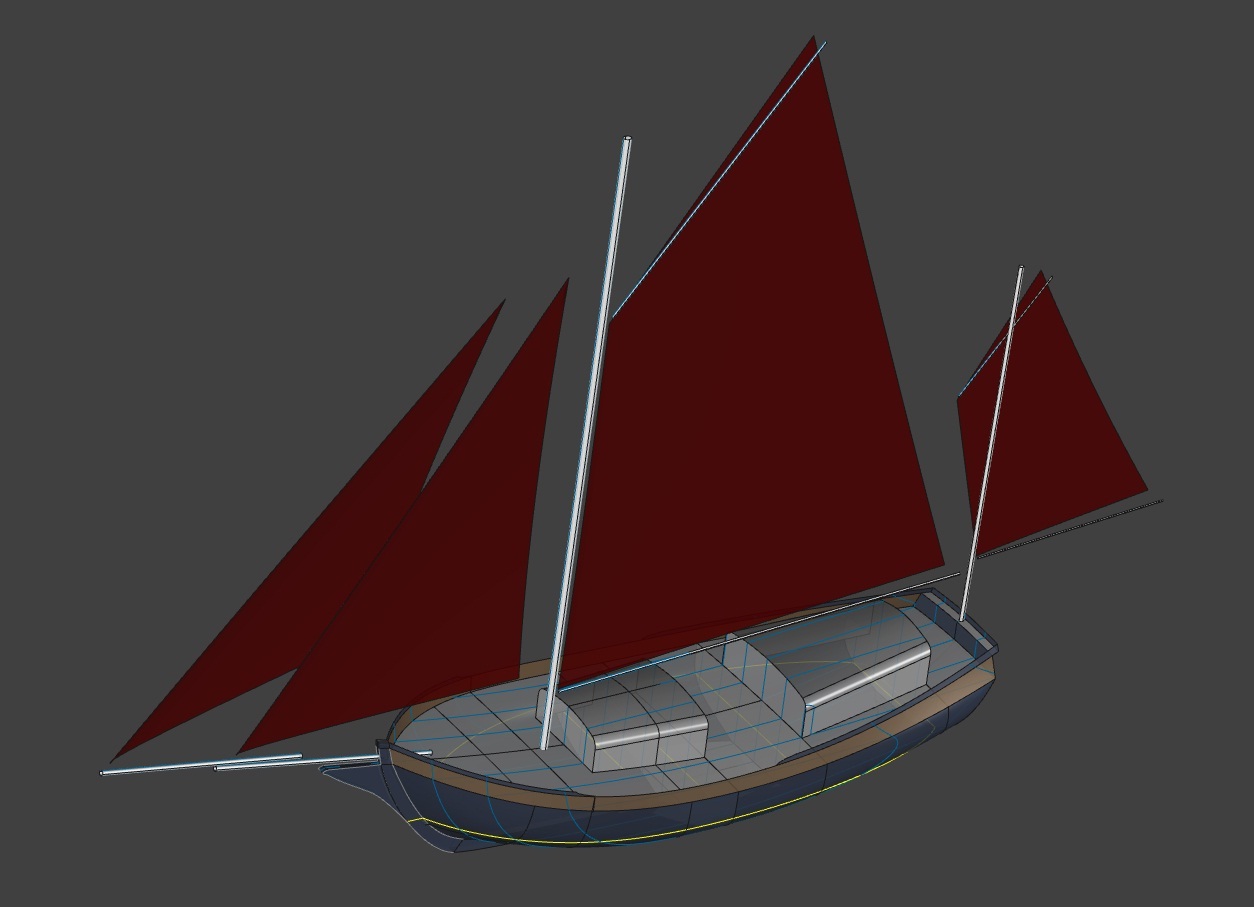
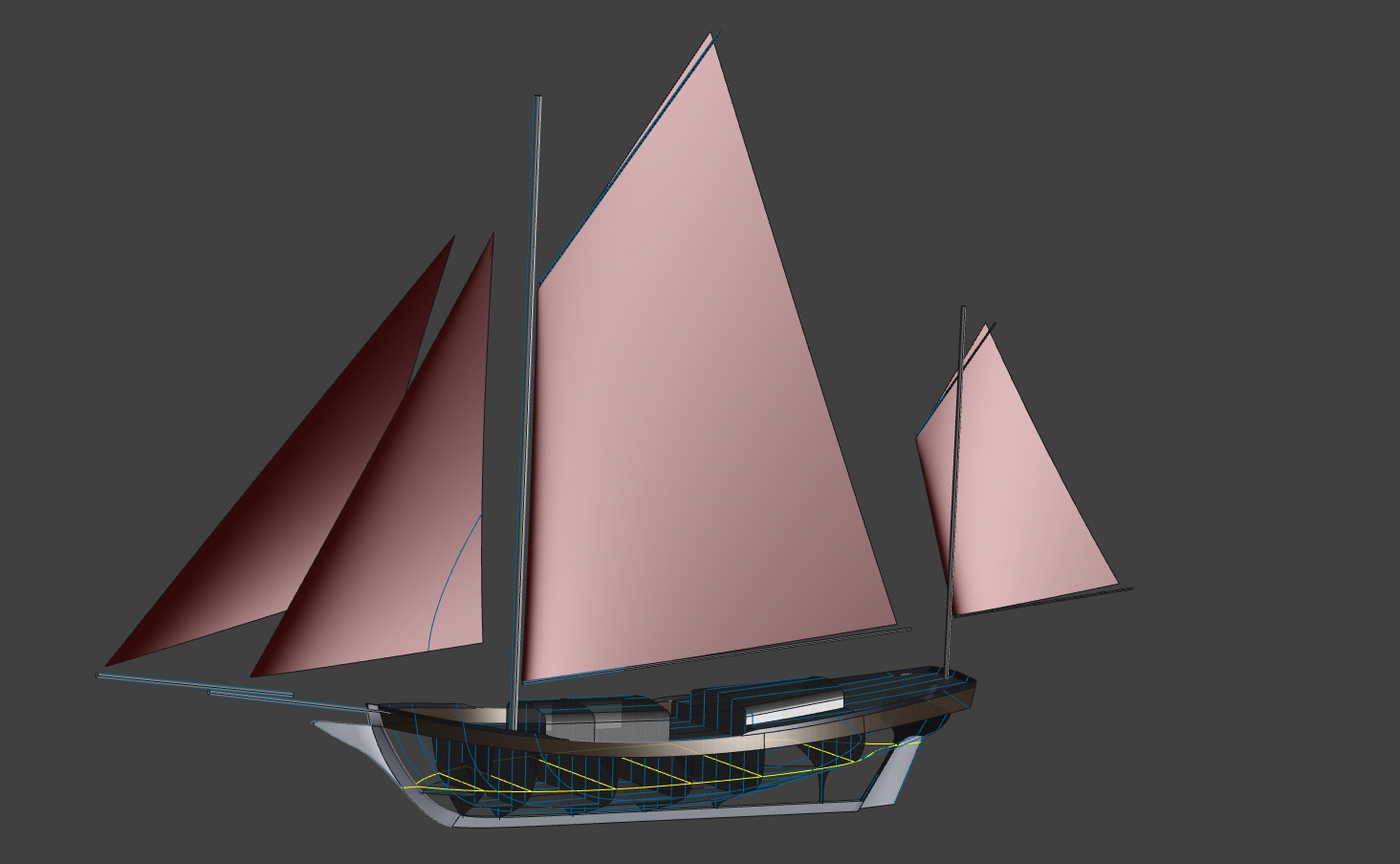
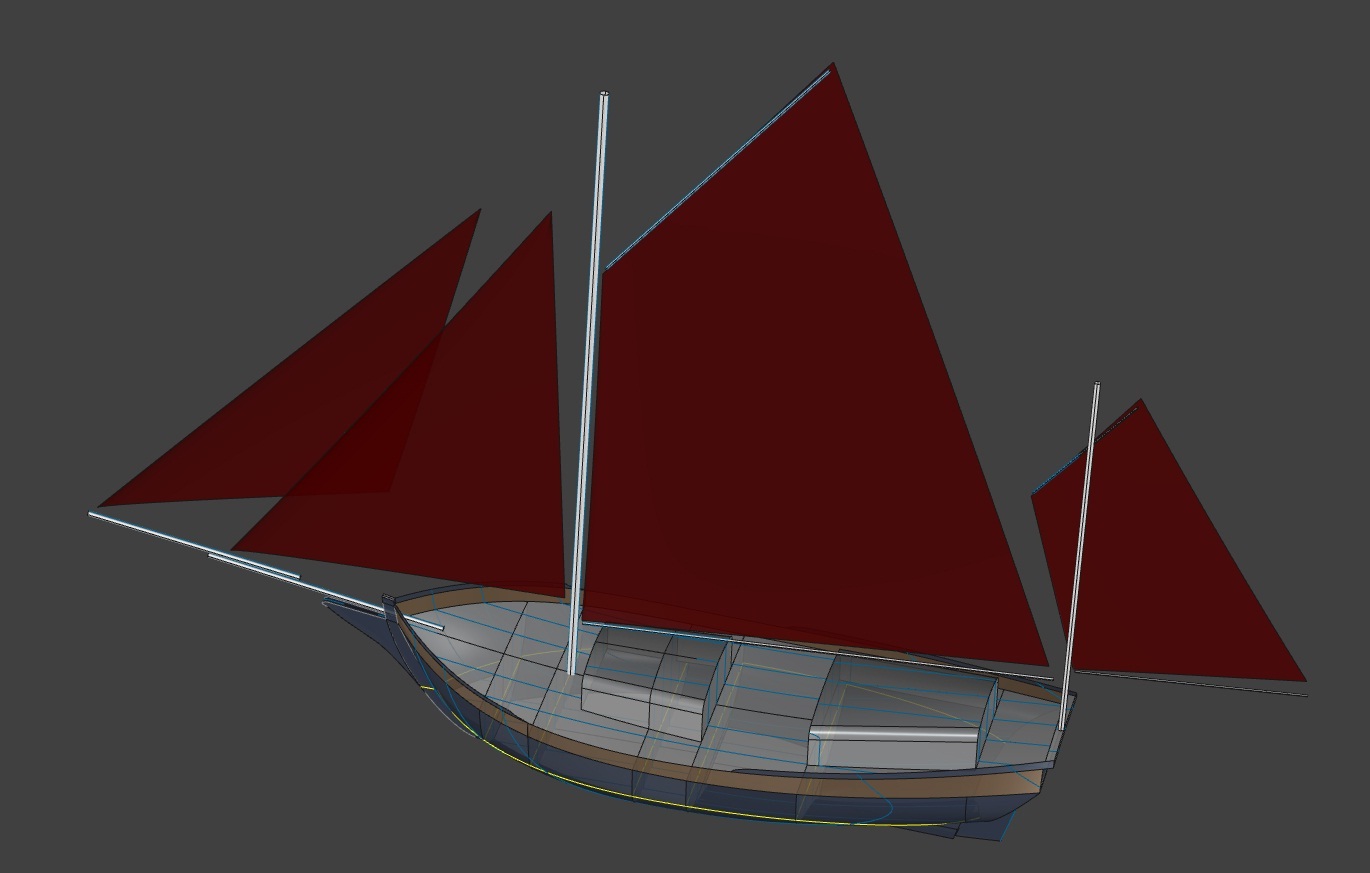
Having said these things, I have always been curious about the SPRAY. In particular I have wanted to understand and possibly replicate its excellent course keeping ability for use on other designs. In order to know more about the SPRAY, I went to the trouble to model the design so that I could investigate its hydrostatics, stability, balance and sailing performance in greater detail. Images that show the results of that modeling effort can be seen in the following links and the image below:
Original Spray Above Aft | Original Spray Above Forward
Click Image for Larger View
PARTICULARS & COMMENTARY
Particulars of Slocum's Original Spray are:
- Length on Deck: 36' - 9"
- Length on WL: 32' - 2" (including stem)
- Length on WL: 31' - 3" (excluding stem)
- Beam on Deck: 14' - 1"
- Beam on WL: 13' - 9.5"
- Draft at DWL: 4' - 2.5"
- Displacement: 16.1 Long Tons (including keel)
- Displacement to Length: 483
- Long'l Position of CB: 50% (including keel, measured from stem rabbet)
- Prismatic Coefficient: .673 (including keel)
- Prismatic Coefficient: .668 (body only)
- Beam to Length on Deck: 38.5%
- WL Beam to WL Length: 44% (excluding stem)
- Yawl Rig Sail Area: 1,137 sq. ft.
- Sail CE Lead vs CLR: 8.9% (about right considering extreme beam, shoal draft, and low aspect rig)
- SA / Displacement Ratio: 16.6 (typical range: 16 to 21, therefore fairly low)
- SA / Wetted Surface Ratio: 2.5 (typical range: 2.0 to 2.6, therefore about right)
Commentary: Looking at the above data, a few comments are in order.
- A Displacement to Length of 483 is very high. Please see my Calculations PDF for the ranges one should expect in a cruising vessel, which indicate a D/L more on the order of around 300 to 325 for fairly heavy cruisers.
- The Prismatic Coefficient at .673 is very high. Having been originally built as an oyster smack, Spray was designed for maximum carrying capacity on a shallow draft, therefore a high Cp is not entirely out of place. Such a high Cp means very full ends, in this case weighted slightly more in favor of the bow than would be the case with a modern sailboat. A high Cp favors high speed, but is a disadvantage in terms of wavemaking resistance when sailing at slower speeds, as is more often the case.
- More typically a sailing yacht's Cp should be in the range of between .55 and .58 for all-around cruising, possibly a bit higher for a racing sailboat.
- In my view, for this type of vessel used as a yacht, Cp would ideally be reduced to somewhere in the range of .58 to .61 at the most, which would still favor higher sailing speeds, but which would confer improved pitch dampening and added buoyancy in the ends for heavy weather (as compared to a typical sailing yacht's Cp).
- The sail area to wetted surface ratio of 2.5 is quite good in the original Spray, indicating good light weather performance, however the SA to Displacement ratio of 16.6 is less than optimum. Sail area could therefore be increased, especially so given the enormous initial stability (stiffness) under sail, aiming closer to a ratio between 18 and 20. See my Sail Area Ratios PDF for more information.
- A ratio of WL Beam to WL Length of 44% is really rather extreme. Something on the order of around 33% is much more in keeping with sea-going sail boats.
- Assuming a VCG of 6 inches above the DWL (an assumption only), the Dellenbaugh Angle is calculated to be 5.8 degrees with 15 knots of wind abeam. Raising the VCG to 9 inches above the DWL results in only a small increase in heel: to 6 degrees... in other words, the hull shape is EXTREMELY stiff, as would be expected. A typical range of heel angles for this size sail boat is on the order of 13 to 19 degrees. Quite a difference..!
Model Notes: It should be pointed out that Slocum’s originally published lines DO NOT match between all three views. In other words, one or more of the views is incorrect, or just poorly drawn, or maybe the lines were messed up by the publisher in trying to squeeze them onto a book page, who knows... Since the model I created is a fully 3-D NURBS surface model, it has no choice but to match in all three views…! The model I created is as close as I can get it to the originally published design.
In 1909 an article was written about the Spray for the Rudder magazine by naval architect C. Andrade Jr. In the article, C. Andrade published his own faired lines drawings and calculations. Interestingly, Andrade’s calculated hull data match my own very closely.
In 1976 another article was written for Rudder magazine by Naval architect Weston Farmer, who also faired the lines and published them along with the offsets . Farmer’s calculated displacement, max section area, waterplane area, etc. do not match my own modeling results, nor those of C. Andrade. Farmer's max section, WP, etc. were less than what I have found, and were off by some two tons in displacement. So even though the Farmer lines are sweet and nicely faired, I intentionally did not use Farmer’s lines because I wanted get as close as possible to the original.
Naval architect Pete Culler actually built a Spray of his own, then wrote a book about building the boat and sailing it. In his book, Culler published his own lofted and faired Spray lines drawing. But Culler had changed the design slightly (deeper keel, different bow profile, different rabbet line, different cabins, etc.) so I did not use Culler’s lines.
Among them, C. Andrade Jr. comes the closest, and even though there are a few minor differences, my data matches Andrade’s hull data very well. It should be noted that C. Andrade was a contemporary (more or less) of Slocum and was therefore possibly better positioned to have access to Slocum’s own records.
Between Culler, Farmer, Andrade and Slocum, I elected to use the original lines from Slocum’s book in order to make the most accurate possible model of the ORIGINAL Spray.
REFINEMENTS..?
Based on the above, my conclusions have been that the original SPRAY model would benefit greatly by being made deeper and longer, with possibly slightly greater freeboard, but without changing the favorable attributes of the hull. With those changes accomplished, the ratio of beam to length will be brought more in line with traditional cruisers, as will be the ratio of beam to hull body depth.
These changes would be introduced primarily for the sake of enhanced large angle stability (greater length and depth), but also to improve the windward ability of the hull (greater depth & outside ballast). In so doing, ideally the Center of Buoyancy would not be moved forward or aft, however as a consequence of the deeper body the CB would be lowered as would the CG. This combination would preserve most of the vessel's stiffness without degrading its inherently excellent self steering capabilities.
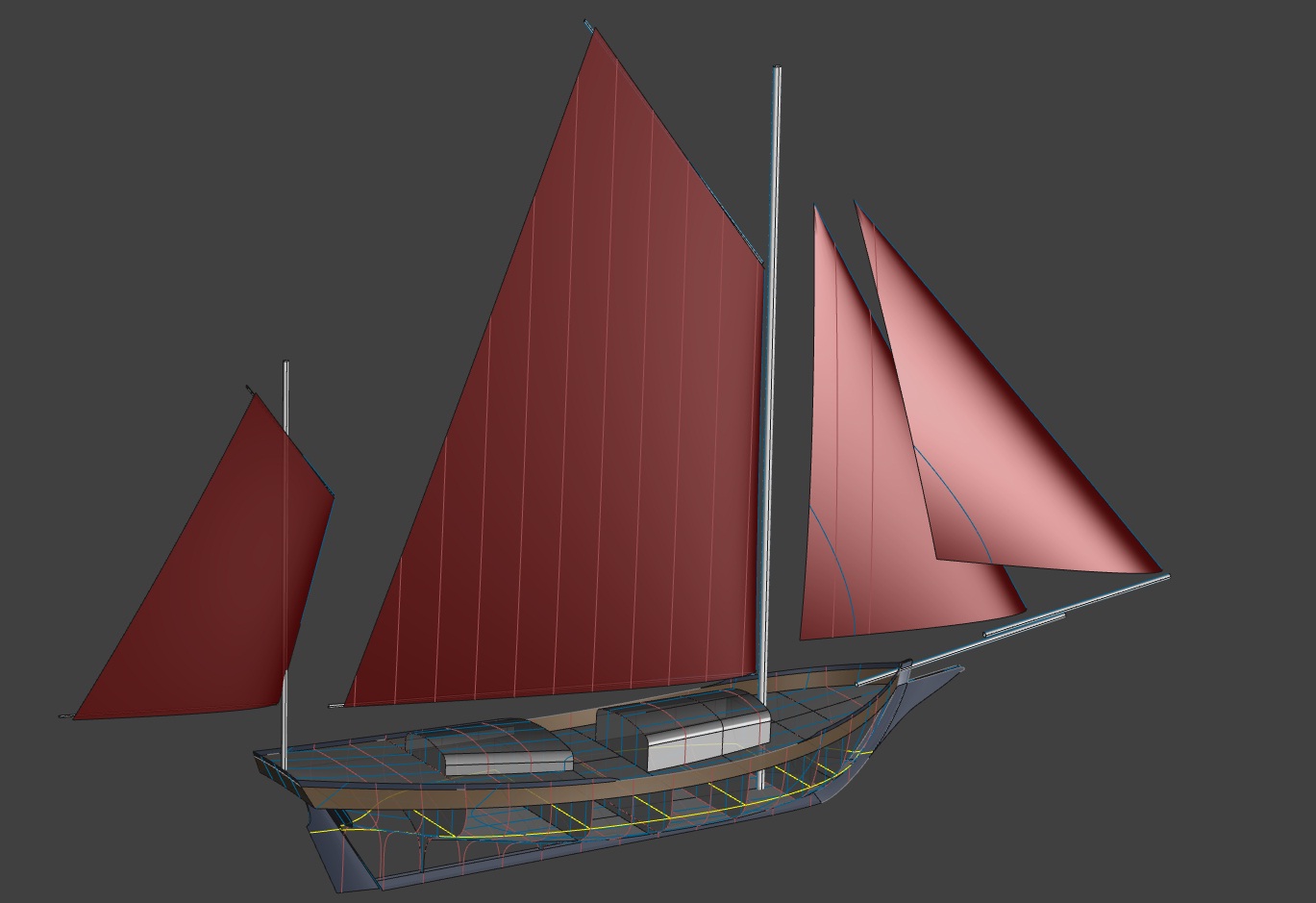
After I had created the NURBS surface model of the original SPRAY, I then made the above mentioned modifications to the hull shape to see what that might offer. Though my modifications may not be all that easy to detect in the images linked below, they have indeed produced the desired result...
Modified Spray Perspective Forward | Modified Spray Perspective Aft
THE MODIFIED SPRAY MODEL
Length on deck has been increased to 48 feet, and the WL length to around 41 feet; beam is unchanged; depth of hull is increased and the resulting draft is 4.72 feet; displacement has been increased to 22.9 long tons; and sail area is increased. As a result of having been made longer but without changing the beam, the Displacement to Length has been reduced to around 329, which is still a robust hull shape but not overly heavy.
The Prismatic Coefficient is down to .64 including the keel and stem, and .66 for the hull body only. This is still a bit too high for optimum performance at typical sailing speeds, but is indicative of a high speed potential and ample buoyancy in the ends for better support in heavy weather. The Center of Buoyancy remains approximately amidships, and is therefore unchanged. The fore and aft distribution of displacement is unchanged, i.e. there is still a full bow and fine run aft.
To simplify construction, the rudder was made wholly external, which required that the transom rake be changed slightly and that the deadwood be extended slightly farther aft. The aft deck has been given an overhang just sufficient to house and protect the rudder head, and to create a convenient landing for the mizzen mast.
In the image above, you will notice that I have also raised the aft deck to the height of the bulwark top, then introduced a toe rail around the aft deck. Raising the aft deck is not at all necessary, but it does provide advantages in terms of reserve buoyancy and self righting, as well as providing a drier aft deck, and considerably greater interior space aft.
Along with those hull refinements, a few improvements will ideally also be made to the rig – not to change it from Slocum's Yawl rig, but to increase the relative size of the rig for the sake of improved performance. Ideally the SA / Displacement ratio would be above 18, preferably closer to 20. This implies a Sail Area of around 1,500 sq. ft. or more. I have proposed a sail area of 1,700 sq. ft.
The amount of lead from the CE to CLR should stay the same, i.e. approximately 9%, or possibly it could be reduced slightly due to the reduced beam ratio. By increasing sail area, a higher CE will result, but this will be offset by the lower CG inherent in the deeper hull. The result of having less beam will be an increased amount of heel vs the original SPRAY. Having a lower D/L ratio, increased sail area, a deeper hull and external ballast, the result will be better performance on all points of sail, especially to windward.
All of these changes are possible without having to degrade the inherent excellent tracking of the original Spray design on a passage, nor to adversely affect the traditional aesthetics of the original.
THE ORIGINAL SPRAY vs THE MODIFIED SPRAY...
In The Rudder magazine article (Vol. 21, 1909), C. Andrade attempts to analyze the Spray. It is interesting to note that the article was written roughly a month after Slocum was lost at sea... It is also interesting to read a fairly elaborate but rather arcane analysis using the extant naval architecture principles of the day...! Anyone curious can read the article on Google Books.
In any analysis of the qualities of the Spray, it must first be pointed out that:
1. To my knowledge the vertical center of gravity of the original Spray has never been documented.
2. The lines of the Spray as published by Slocum in Sailing Alone Around the World are not accurate. In other words, as noted above the three views do not match…!Others have published their own version of the lines of the Spray, including Weston Farmer and Pete Culler. I have not checked those versions of the lines against the original, nor against my own model of the Spray, but I will say for certain that the lines that Slocum published are not accurate. Per my own modeling efforts, the lines and calculations done by C. Andrade are likely to be the closest to the original.
SLOCUM'S ORIGINAL SPRAY
In my analysis of the original Spray model I have assumed the VCG to be approximately 8 inches above the WL. This is only an assumption, since I have not taken the trouble to actually calculate the VCG, however it is an assumption that's based on having calculated the VCG of several other heavily built wooden craft, so it is probably not far off.
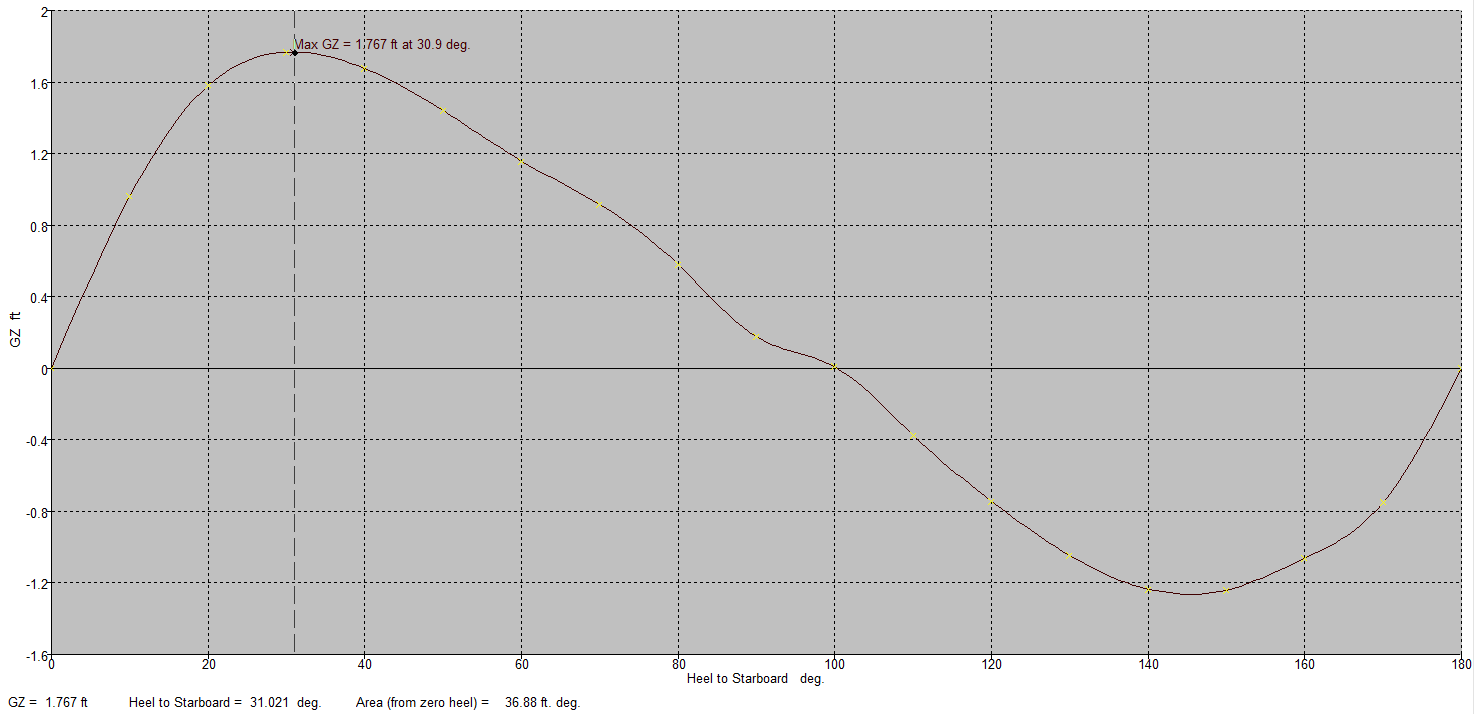
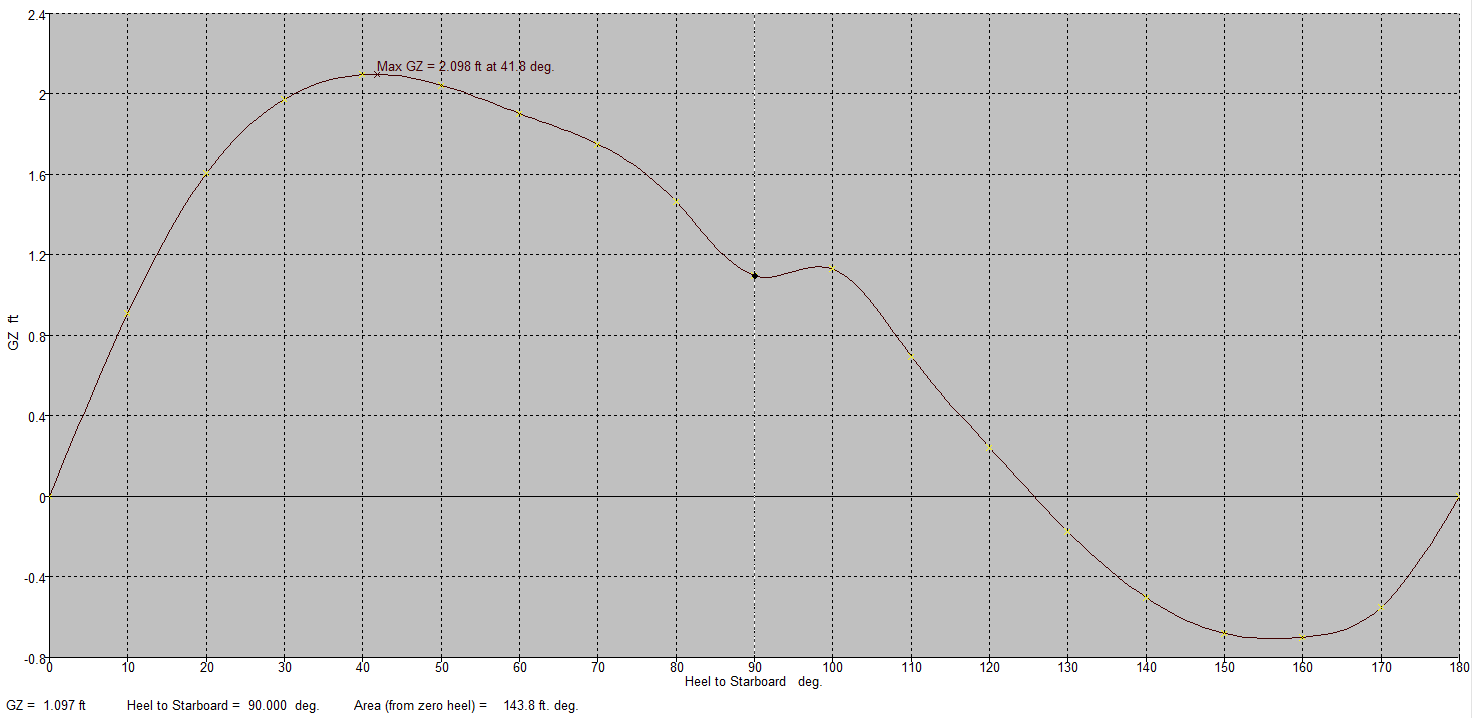
Using that VCG, the stability curve shown below was derived. This curve takes credit for the volume of the deck houses, as well as the floatation of the masts. Despite those credits, it is evident that stability is lost at 100 degrees of heel, after which the vessel is quite stable when inverted.
Click for Larger ImageIf I lower the VCG to the WL height, then the righting moments that I calculate closely match those calculated by C. Andrade. It is therefore evident that C. Andrade made the assumption that the VCG was located at the WL, which I believe to be much too optimistic, especially considering the inside ballast of stones and cement..!
However if the VCG were to actually be located at the WL (highly unlikely), then the point of vanishing stability would be approximately 116 degrees – quite a difference..! In other words, the righting curve derived by C. Andrade is likely to be in error by that amount, or possibly even more (say in the event that I have also been too optimistic with regard to the VCG).
A range of positive stability of 100 degrees or less is considered to be inadequate for a sailing vessel. In the EU, a Stability Index is calculated, called the STIX value. The EU requirement for all ocean operations is a minimum STIX score of 32. With the VCG located 8 inches above the WL per my assumption, Spray earns a STIX score of 25. Thus the Spray fails the STIX criterion by over 20%. Ideally there should be a substantial margin of safety above the minimum score, i.e. a STIX score in the mid to upper 40's or greater.
Regardless of all the many discussions of the Spray and her admirable qualities, and notwithstanding the obvious achievements of the vessel, the stability characteristics of the original Spray are plainly inadequate.
THE IMPROVED SPRAY MODEL
I have gone to the trouble of modeling the original Spray so that I could see what improvements could be made, starting with the original Spray lines. I wanted to modify the model in such a way as to preserve the good qualities of the Spray, but to improve the stability range and sailing performance.
Using the modified Spray model that I eventually settled on, the length on deck is 48' with a WL length of 41', a deeper hull body, external ballast, and an assumed the VCG at 3" above the WL, (possibly too conservative, i.e. a higher VCG than would actually be the case). With these changes, the stability range increases to 121 degrees, and the STIX score comes to 43.6.
Assuming it is possible to lower the VCG all the way to the WL (possibly achievable by deepening the keel farther and using external ballast), then the stability range comes to 126 degrees and the STIX score is 49.1.
Click for Larger ImageThis is a dramatic improvement, although I would like to improve the range of positive stability even more…
My primary goals in making such tweaks to the SPRAY have been to see what could be done to make the design safer and more seaworthy. I also wanted to show that such improvements could be made without affecting (i.e. screwing up) the excellent traditional aesthetics of the original, nor adversely affecting its excellent tracking ability and its consequent value as an ocean voyager.
The updated model preserves the balance and course keeping of the original, and introduces a variety of improvements for the sake of better performance on all points of sail, and to provide a much safer platform for voyaging on the briny deep…!
OTHER CHANGES...??
The question then arises, "Would I make additional changes...?"
Yes. I would prefer to reduce the beam a little more, but without changing the distribution of displacement. Displacement would decrease and the resulting model would have a more modest D/L ratio. With that change made, I'd prefer to reduce the prismatic coefficient to between .57 and .60 for the sake of improved all around sailing performance. This combination would result in a more comfortable ride, and would actually increase the range of positive stability...!
CONCLUSIONS...
Many are attracted to the SPRAY simply on the basis of it having been the first vessel to carry a human around the world, sailing single handed. It is quite an achievement to say the least. What must be realized however is that the voyage was accomplished by a determined and highly experienced professional sea captain, not by an ordinary beach bum.
Just like many other world-voyaging sailors who have also achieved extraordinary sailing feats, Slocum was an opportunist who made excellent use of what was available to him, in his case a freely provided old wreck which he rebuilt on a shoe-string, and which he then quite stunningly sailed into permanent fame and an honored place in the history of seafaring.
Before Slocum left on his historic voyage, a dockside wag said of the SPRAY, "It'll crawl...!" Lest we imagine that to be a reference to her speed potential, we should note that he was referring to Slocum's amateur caulking job...!
When he returned, his dockside advisors would only deign to say, "You were lucky...!"
Luck or no, one cannot deny Slocum's extraordinary achievement, which was accomplished more or less in spite of the tool that he was given, i.e. the SPRAY.
In other words, it was Slocum's WILL and long experience at sea that allowed him to achieve this feat, rather than it having been some sort of caprice conferred upon him by imagined magical attributes inherent in the vessel on which he sailed.
Copyright 2011 - 2019 Michael Kasten
Please see the AVAILABLE BOAT PLANS web page.
Home | Intro | Our Design Process | Stock Design Info | Motor Yacht Designs | Sailing Yacht Designs | Prototype Designs
Plans List | Articles | Our CAD Design Stream | Maxsurf | SITE MAP..! | Site Search | Design Team | Contact Us