Messing about in boats since 1975. Online Since 1997.
Home | Intro | Our Design Process | Stock Design Info | Motor Yacht Designs | Sailing Yacht Designs | Prototype Designs
Plans List | Articles | Our CAD Design Stream | Maxsurf | SITE MAP..! | Site Search | Design Team | Contact Us
Please see the AVAILABLE BOAT PLANS web page
INDONESIAN CARGO PINISI
Would a Cargo Pinisi or KLM Make a Good Yacht...?
Copyright 2009 - 2016 Michael Kasten
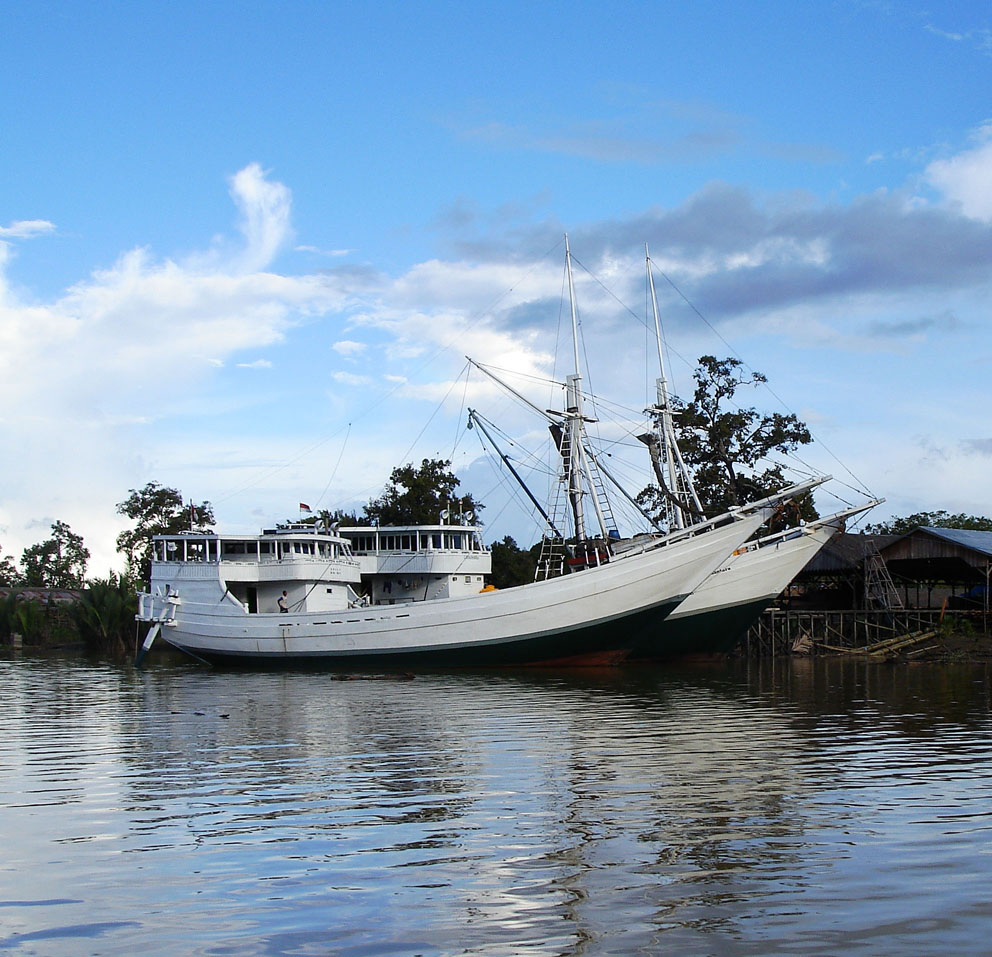
Two fine Cargo KLM on the Sangkulirang River, Kalimantan Timur (Borneo), 2006CHASING A CARGO PINISI
The following notes are in response to several inquiries I've received about the prospect of finding a good Indonesian cargo Pinisi or KLM for use as a personal or charter yacht, primarily in order to save time and costs. My thoughts on this concept are as follows...
There are several characteristics of the cargo Pinisi boats that conspire to make them somewhat less than ideal as private yachts or as charter yachts. Among those factors are the following:
- The cargo Pinisi boats are built with a relatively "box-shaped" mid-section so that they can both carry their own rather hefty weight (very heavy wood is used), and also carry cargo. This means that when they are not laden with cargo, they can have a rather mean-spirited motion in terms of rolling behavior, and it is possible there could even be stability issues.
- For the most part, the cargo Pinisi are built on an extremely tight budget with whatever wood pieces are available.
- Often the timbers and planks are rather short with many joints, and often they are of lesser quality timber. This is less so for the Pinisi boats built in Kalimantan because the build site is located closer to the big timbers, but it is still an important factor to keep in mind in terms of their longevity and their structural integrity for chartering.
- The usual scarph joint that is used throughout Indonesia in order to join two timbers together end-to-end is very short - usually about twice the depth of the timbers being joined between the nibs. An 'approved' scarph joint will have a 12 to 1 taper, with the ends nibbed, so the total length of the joint from nib to nib is 6 times the depth of the timber.
- Most cargo Pinisi are built using plain steel bolts without any galvanizing, which translates into a relatively short life for the fastenings.
- Since a significant aspect of the structure of these craft is that the planks are edge-fastened, that poses a real problem because those fastenings are not replaceable.
- The superstructure of the cargo Pinisi is nearly always limited to a two story house aft, extending for maybe as much as 1/3 of the main deck. Often there is limited headroom. This is a good thing in terms of stability and windage, but may present limited interior possibilities.
- It is not advisable to build a larger superstructure, nor to add to the length of the deck houses - primarily due to the added windage and weight up high, which will both have an adverse effect on stability.
- The charterable space in a cargo Pinisi will usually be limited to the cargo hold itself.
- Most cargo Pinisi will have a very small engine, ordinarily mounted on rather short engine stringers inside of quite a small engine space. This whole affair will usually have to be completely changed, however the position of the primary bulkheads should not be changed without expert consultation.
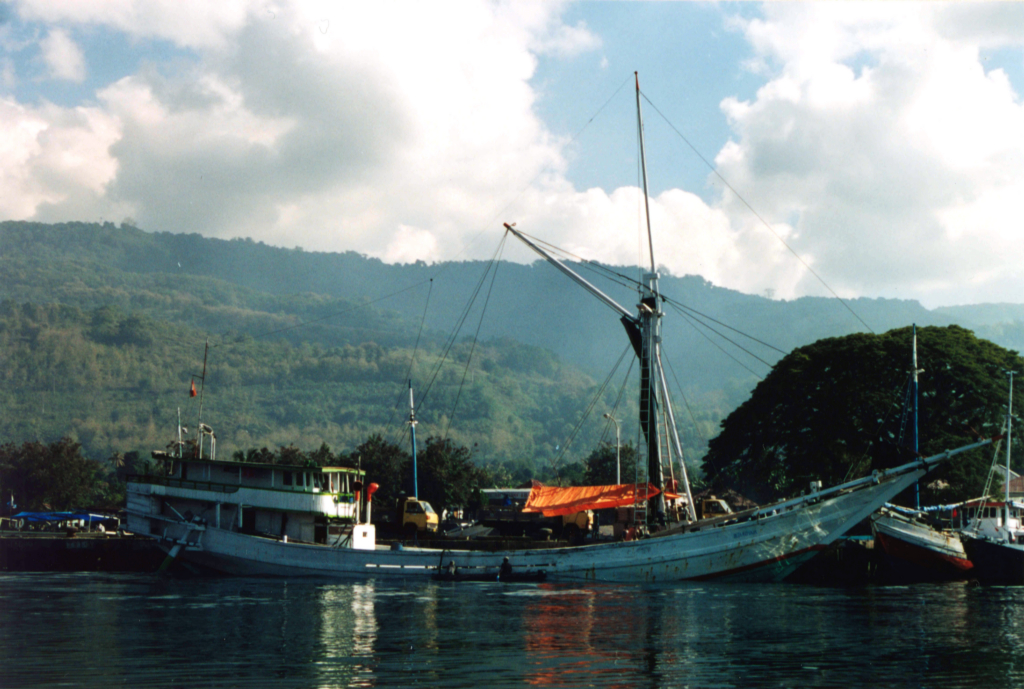
Deeply Laden Cargo KLM in Alor, Nusa Tengara (Indonesia's Eastern Islands), 2001Now... if one could find an extremely fine cargo Pinisi for sale, it might very well make a good yacht, but its life-span still could be fairly short. This is so even if you happen to find a really fine cargo Pinisi / KLM under construction, and for the reasons given above.
Whether it is newly built or used, it is always highly advisable to hire an experienced and trustworthy surveyor to assess the condition of the vessel, its quality of build, its underwater shape, rigging, superstructure, etc. A traditional aesthetic quality should also be present, primarily for its own sake, but also because it is an indication of quality and pride of workmanship on the part of the builder.
It is extremely unlikely that any Pinisi that was originally built for a Westerner will even come close to the required quality. What's more, most of them end up with deck structures that are, in my view anyway, dreadful looking, too tall, and too long. As a result they impose a much greater liability in terms of weight and windage.
If one were to actually find a worthy vessel, it will be difficult to justify spending too much on remodeling it unless it happens to be a spectacular specimen that is fairly new. I have seen many extraordinary cargo vessel examples, so they do certainly exist. Conversely I have also seen many extremely sad cases, in particular where some misguided Westerner has bought an old derelict local and is trying to revive it.
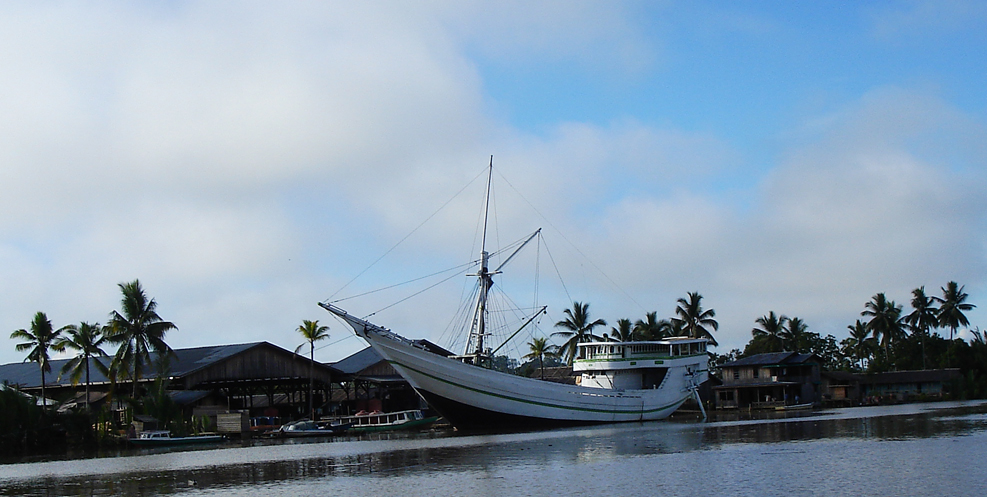
45m Cargo KLM on the Sangkulirang River, Kalimantan Timur (Borneo), 2006
HOW TO DO IT RIGHT...?
If we were to create an interior design for one of these boats, the vessel would have to be a top quality specimen in order to be worth the effort and cost. The chances are that I would encourage keeping the traditional house structures as-built, with a newly defined purpose on the interior only.
On an existing vessel, an inclining test should be done in order to precisely determine the as-built stability. This is quite accurate, but it requires that the shape of the vessel also be accurately known. Therefore the first task would be to record the hull and superstructure shapes so that the overall weight and center of gravity can be determined via the inclining test.
After the stability has been determined, the structural scantlings should be recorded and the "percentage" of compliance with existing structure rules determined. Indonesia has a good rule for wooden vessels, but it is not often followed. Our approach is to use the Germanischer Lloyds rule for wooden ships.
Next would be to reinforce the structure wherever it might be needed and to sub-divide the interior for water tight integrity and structural integrity. Next would be to create a design for the use of the interior spaces. Next would be to install tanks and machinery, and then finally, to build out the interior and finish out the systems.
Regarding the cost of this work, as a very rough guide it would be more or less as follows:
- Whether we were to make use of one of our existing prototypes, or create a totally new design, the cost would be approximately the same. See our Power Prototypes and our Sailing Prototypes for several good examples.
- If one of our pre-existing completed Pinisi or KLM designs were used, the cost would be as given on our Plans List web page, assuming no changes are made.
- If a really spectacular cargo Pinisi were found, our assessment and re-design would probably cost somewhere in the neighborhood of 2/3 the cost of creating a new design.
Overall, if done properly it is unlikely that there will be much difference in overall design costs. And, since the machinery and systems represent such a large portion of the overall vessel cost, there is very little incentive to try to find a "bargain" on the hull itself...
MORE INFORMATION
An interesting article on our work with these vessels appeared in the New York Times, called The Traditional Pinisi - And Then Some.
For complete information about our work with these vessels please see the following links, or for more information please inquire.
Our articles about building an Indonesian Pinisi or KLM:
Pinisi History | Pinisi Building | The Ultimate Charter Pinisi
Sailing vs. KLM Types | A Cargo Pinisi as a Yacht...?
Pinisi and KLM designs that we have created or have planned:
30m Pinisi, DATU BUA | 36m Pinisi, SILOLONA
38m Pinisi, AMANDIRA | 50m Sailing Pinisi
27m DIVE Charter KLM | 30m Charter KLM | 33m Charter KLM
36m KLM, DUNIA BARU | 40m Charter KLM | 50m Charter KLM
Descriptions of our adventures with these boats:
Silolona "Homecoming" | Indonesia Boatbuilding Images
Five Schooners and Two Arabian Dhows Suited to Building in Indonesia
17m Flores Privateer | 20m Sulawesi Privateer | 31m Komodo Privateer
36m Tern Schooner | 36m Lombok Privateer | 45m Kalimantan Privateer
22m Arabian Baghala | 36m Arabian Baghala
Two junk rigged KLM types for construction in steel:
25m Lady Destiny | 55m Lady Destiny
Please see the AVAILABLE BOAT PLANS web page.
Home | Intro | Our Design Process | Stock Design Info | Motor Yacht Designs | Sailing Yacht Designs | Prototype Designs
Plans List | Articles | Our CAD Design Stream | Maxsurf | SITE MAP..! | Site Search | Design Team | Contact Us