Messing about in boats since 1975. Online Since 1997.
Home | Intro | Our Design Process | Stock Design Info | Motor Yacht Designs | Sailing Yacht Designs | Prototype Designs
Plans List | Articles | Our CAD Design Stream | Maxsurf | SITE MAP..! | Site Search | Design Team | Contact Us
Please see the AVAILABLE BOAT PLANS web page
BUILDING AN INDONESIAN PINISI
What Are The Essential Ingredients...?
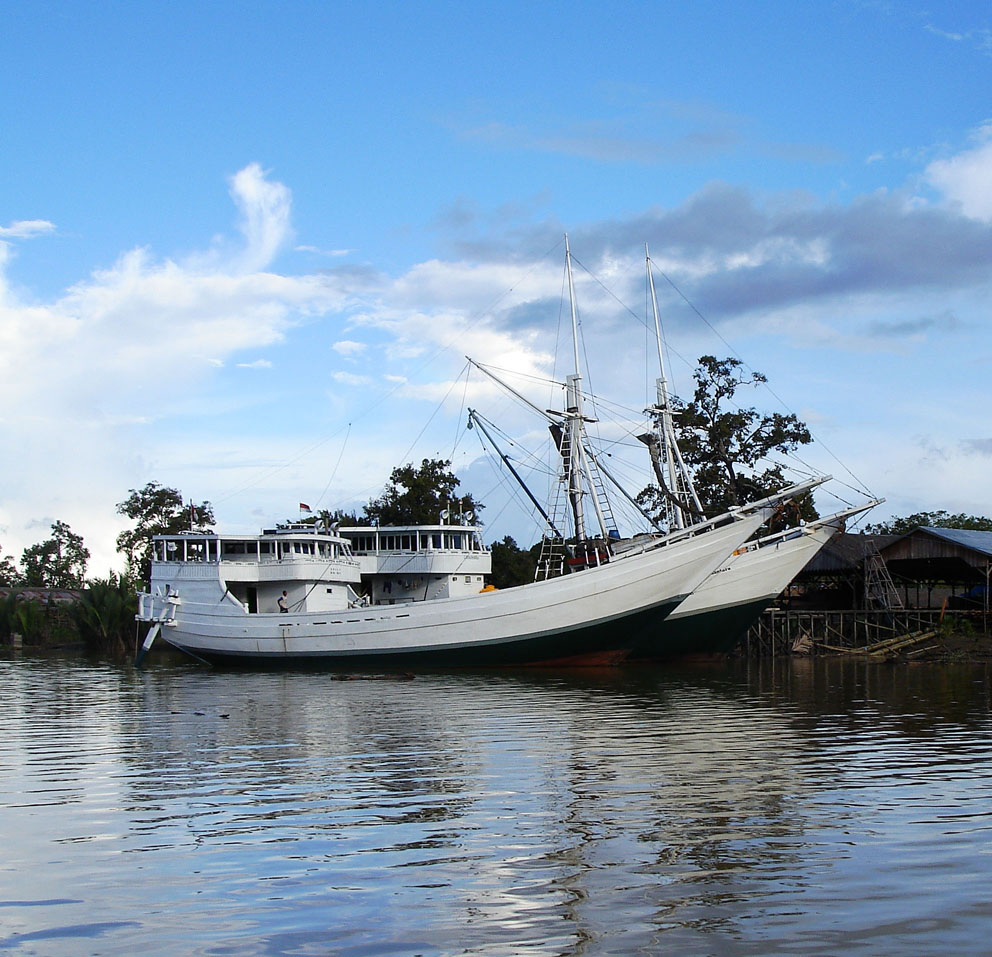
Two Cargo KLM in Kalimantan (click for larger image)
For a complete introduction to the history of the traditional Indonesian Pinisi types
as well as the relatively newer KLM types, please see our Pinisi History web page.
Please also see the links at the bottom of this page
for an introduction to our work with these craft.
THE PINISI AS A YACHT...
What have we done to change these craft for a newly defined purpose as a yacht or charter vessel...?
Our goal has been to preserve the extraordinary aesthetic tradition of these vessels and to carry their best qualities forward, but to improve them where needed in order to serve their new purpose as charter yachts.
Changes: Our aim has been to provide greater strength and longevity of structure than is found among local craft. Our goals in so doing have been to reduce maintenance, to provide a high degree of comfort, improve the performance under power, and to increase the long term safety of the ship.
In order to create a luxury yacht or charter vessel out of the traditionally built Pinisi or KLM types has mainly been a matter of sizing and arranging the cabins for their new purpose and to refine the hull shape for use as a yacht, rather than as a much more burdensome cargo vessel.
As a bonus, the more refined yacht hull shape is much more comfortable in the sea than the much more boxy cargo hull types, which have a reputation for having a rather harsh and unkind motion when not deeply laden with cargo. After all, a yacht need only carry a load of fuel, food, passengers, and their water toys.
Power: Motive power is provided by a relatively much larger diesel engine than would be locally used. This is for vastly improved performance, safety and convenience as well as in order to achieve a more dependable charter schedule. For example, where we would specify an engine of around 850 hp, an equivalently sized local cargo vessel would rarely have more than around 250hp to 350 hp...!
Of course the engines we specify would be larger still if it were required to get these boats to reach their full theoretical hull speed (i.e. an S/L of around 1.34). However above a speed to length ratio of around 1.10 the power requirements and the consequent fuel use, as well as the machinery cost become excessive.
Tradition: Still further requirements have been to blend the excellent Konjo / Bugis boat building traditions with a few of the specific requirements of the West, primarily in terms of comfort, structure, safety, and stability.
Structure: A number of structural improvements over the typical cargo vessel construction have been specified. These were not dramatic changes in terms of the construction methods, but definitely they were a big change in terms of finesse and quality, so cumulatively the changes have been very important to the structure.
Examples of our modifications to the structure are that we have specified:
- The use of only top quality timbers;
- That the timbers be of the maximum obtainable length;
- That the proximity of joints in planking and other structure be according to Germanischer Lloyd's requirements;
- That the frames be top quality and nicely finished;
- That proper scarf joints be used for all structural members;
- That an increased quantity and higher quality of fastenings be used throughout;
- That there be substantial bilge and deck stringers inside;
- That there be watertight bulkheads as specified by GL;
- That there be heavy duty long length engine girder timbers in order to handle the additional stresses imposed by the higher powered machinery.
These changes plus many less obvious refinements to the methods used for joining the primary structural members have all gone into the specification for a robust and long lasting wooden ship.
Cumulatively, these changes have been very significant - and indeed there is quite a large difference in terms of the quality and integrity of the resulting vessel as compared to the vessels built for cargo. Even more dramatically, these refinements offer a vast improvement over the more typical poorly planned attempt to turn one of these local craft into a private yacht or charter vessel.
CAN A NEW WOODEN YACHT BE BUILT ECONOMICALLY...?
Yes! ...and of course that is the ultimate goal...!
Given that such a vessel is largely based on the very common local Pinisi / KLM types, it can still be very economically built in Indonesia using locally available timbers and locally available talent.
Unfortunately, we have consistently observed that due to the relatively low cost of building the wooden structure of these vessels, there always will be a steady supply of misguided Westerners who approach the Indonesian boat builders with the idea of turning one of their locally built craft into a yacht or charter boat at the lowest possible cost. Most often the result is extremely poor - mainly due to extremely inadequate planning and virtually non-existent project management.
These half hearted attempts to create a yacht inevitably result in an ill-conceived and / or poorly executed vessel, i.e. one that has not been 'designed' nor built to any standard, nor even effectively 'managed' during construction. Although the local builders are very capable of producing excellent results with their own local vessel types, having been developed for carrying cargo they are not ordinarily so well suited to being turned into yachts.
Even worse, when these indigenous vessels get arbitrarily modified by various misguided 'owner requests' during construction, the final product can be shockingly bad - even to the point of being unsafe. Of course there are exceptions, but they are not so common.
Most of the pre-existing charter vessels or private yachts that we have seen for sale in Indonesia are really not worth much. Yes there are exceptions, however it should be kept in mind that any cargo vessels built for knowledgeable local cargo skippers that are still in excellent shape... it is extremely unlikely to actually find one for sale while there is still some working life remaining.
The overall point is that whether new or old, there is a very big difference between those vessels and the likes of what I have outlined in these pages.
The essential differences...?
- The amount of planning;
- The verification of structure per GL standards;
- The assurance of stability per IMO standards;
- Designing a shape that will behave well as a yacht;
- And finally, following through to assure that the vessel is constructed accordingly via an on-site team.
Having taken these steps, you can be assured that the resulting vessel will be a fine, safe, robust, and long lasting asset.
THE PURSUIT OF QUALITY
Building an Indonesian wooden vessel is a unique sort of adventure. It is not unusual for someone to surf the web, see the Indonesian designs we have created, note their excellent qualities, print a few images off the web show the builders and ask them "can you build one like this?" This has occurred several times. Those events have been verified and duly noted.
The next crazy step is for someone to order 'Study Plans' and attempt to do the same. I'd venture to say that the result will possibly be better than if they had made a drawing in the sand (as is also very common), but nowhere near the calibre of vessel that could have been.
Due to this apparently common tendency amongst those who are wild enough to want to build a boat in Indonesia, we have priced our 'Estimating Plans' for these vessels so that there is relatively little reason not to go for the whole package of 'Building Plans' which actually includes the vessel's hull shape..! In other words, if you already know that a given design is what you want there is little point in ordering the Estimating Plans separately, which only runs the cost up (and causes us extra work..!). Please review our complete Plans List for more information.
Overall, I want the as-built result with these craft to be the best that it possibly can be. If owners go off into the bush with a half baked plan, they certainly will not end up with a fully baked result. Since our aim is to encourage only the very best, we wish to arm our clients with all the information that will require.
CONSTRUCTION SUPERVISION
It is our intent to remain on-call as needed during construction to help supervise the information flow to the builders and to answer questions. We do not get involved in actual project management per se, and we do not get physically involved in the build itself, except purely in an advisory capacity.
However via our prior various projects in Indonesia we have become familiar with a number of excellent contacts on Java and Sulawesi and we have a mountain of highly useful information to accompany our plans, including a clearly laid out strategy to achieve the build and how to put a team in place to get the best result.
We also have a short list of those who should be avoided...!
HOW TO DO IT RIGHT
Planning: We find that the key to success with any project of this magnitude is thorough planning, done well in advance of any actual boat building being done, and in advance of any contract arrangements being made.
The essential ingredients for a successful project are:
- That the design itself be considered as the first essential ingredient
- That highly skilled and reliable local boat builders be found
- That during the building of the boat there be adequate communication between the builders and the design team
- That there be competent on-site project management.
In order to accomplish these goals we have developed a successful "Working Strategy"... Our contribution with these craft is not just to design an interior and general layout suited to the owner's chartering or yachting requirements, but also improve the design of these indiginous vessels. The means to achieve this is to specify a pre-determined hull shape; to specify the structure so that only the highest quality wood and hot dip galvanized fastenings be used; and then to follow through during construction in order to assure that the requested enhancements to the structure be made and the original plans be followed faithfully.
The specific improvements we have introduced to these vessels have been to:
- Respect and preserve the historic traditions of the indigenous boat builders;
- Provide an aesthetic in the final design that will nicely 'blend in' with traditional local cargo and charter vessels;
- Specify a pre-determined hull shape with known performance and stability;
- Assure compliance with IMO stability standards;
- Improve the performance under power by use of modern marine diesel engines;
- Provide a high degree of comfort and reduced rolling via a more yacht-like hull form;
- Provide greater strength via scantlings and construction methods that comply with Germanischer Lloyd's rules for wooden ships;
- Reduce maintenance and increase longevity of structure by the use of only first rate materials throughout;
- Enhance the comfort of guests by specifying top notch systems, human friendly design, and silent running equipment;
- Provide an interior and exterior layout that is eminently suited to yachting and / or to dive and cultural charters throughout SE Asia;
- Follow through during construction in order to assure that
- The requested enhancements to the structure be made
- The original plans be followed faithfully
- Only the highest quality wood and hot dip galvanized fastenings be used.
Overall: We view the design of the vessel as being the first essential ingredient to success. The other essential components are that highly skilled builders be found, and that during the building of the boat there be adequate communication via competent on-site project management.
The following is a brief outline of the process we have found to work best....
BUILDING...
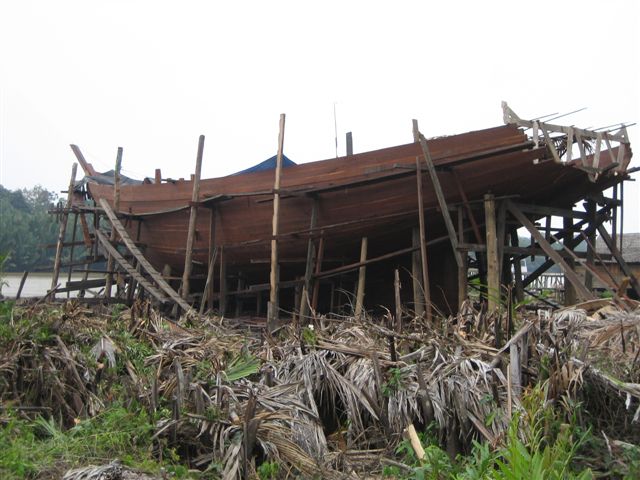
The Venue: For maximum economy, the ideal build venue for a wooden hull of this size (meaning all the heavy woodwork of the hull, deck, and superstructure) will always be close to the best supply of good timbers. Presently in Indonesia this means Kalimantan (the Indonesian part of the island of Borneo).
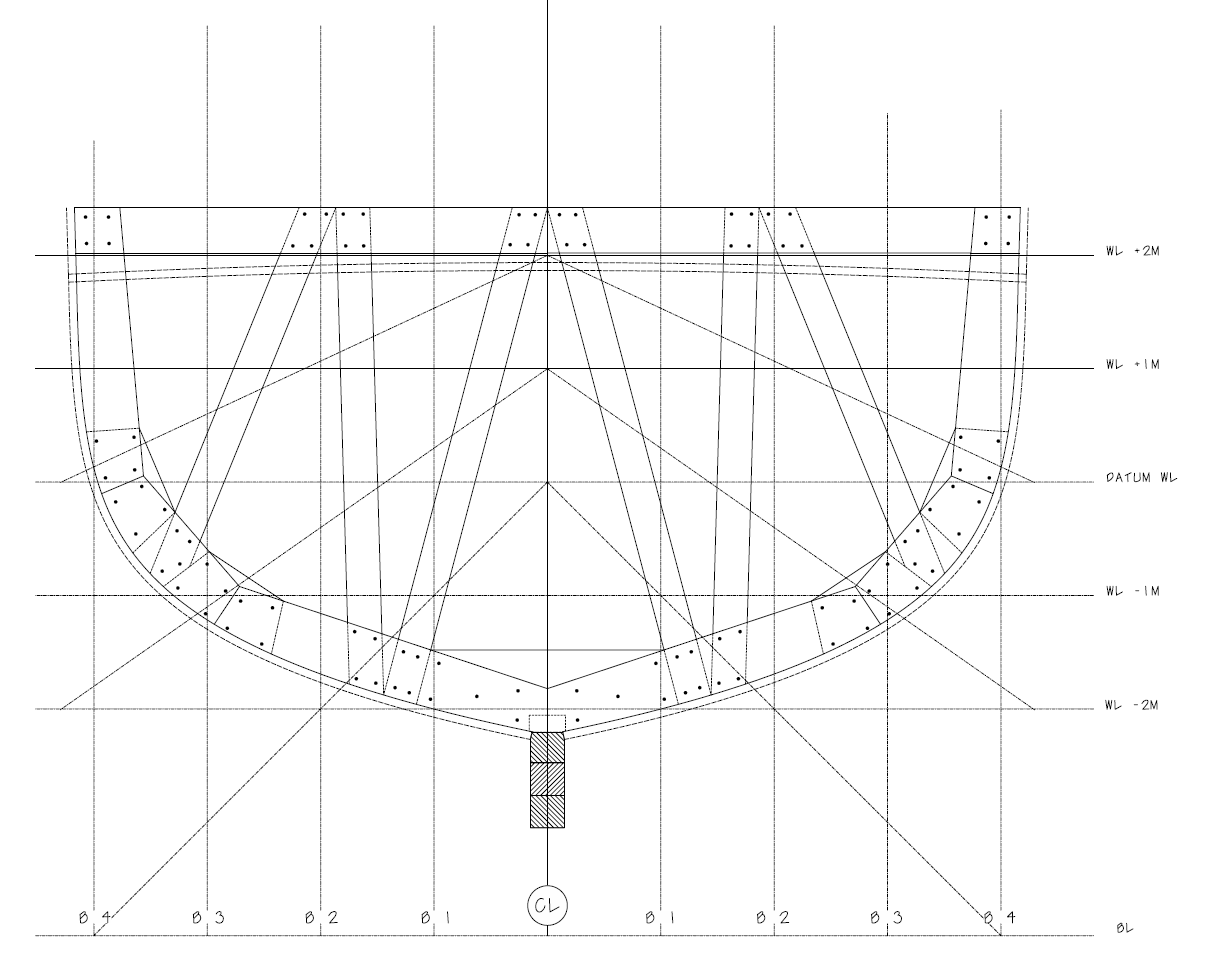
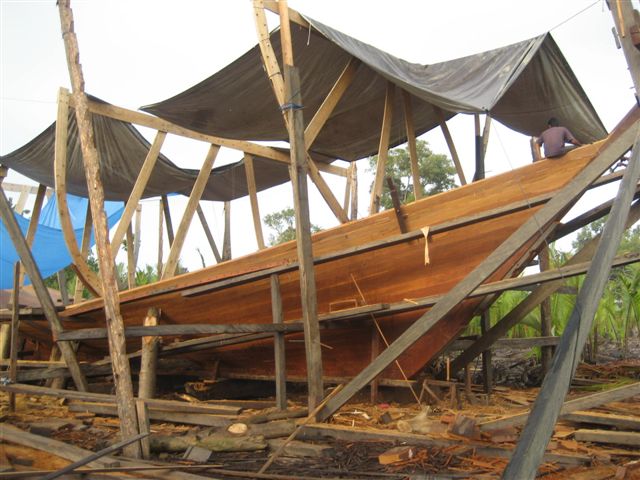
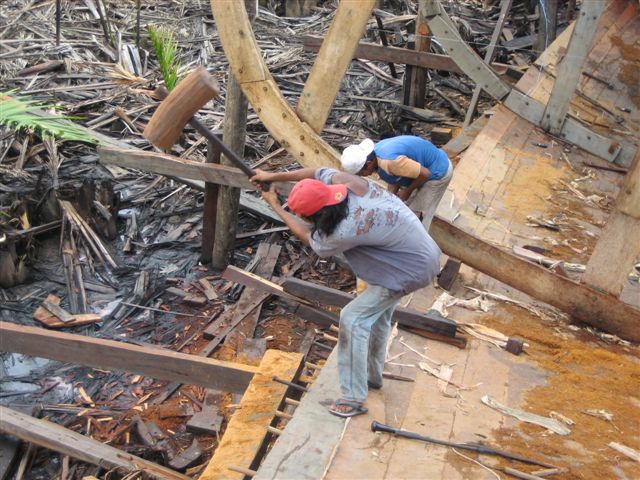
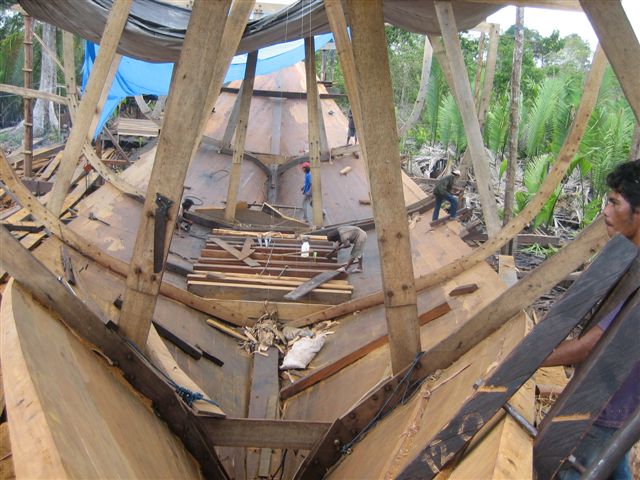
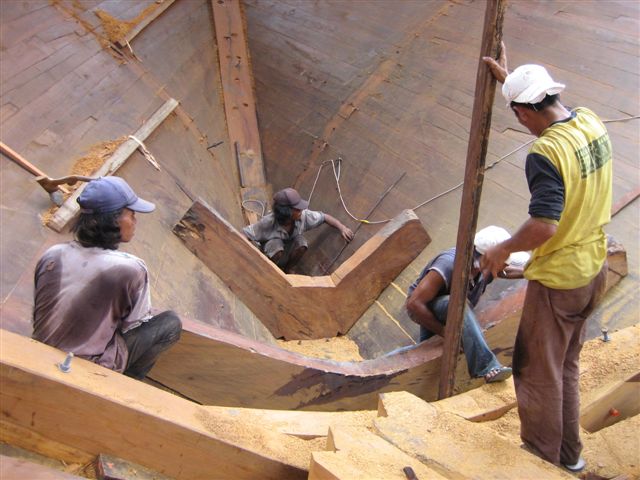
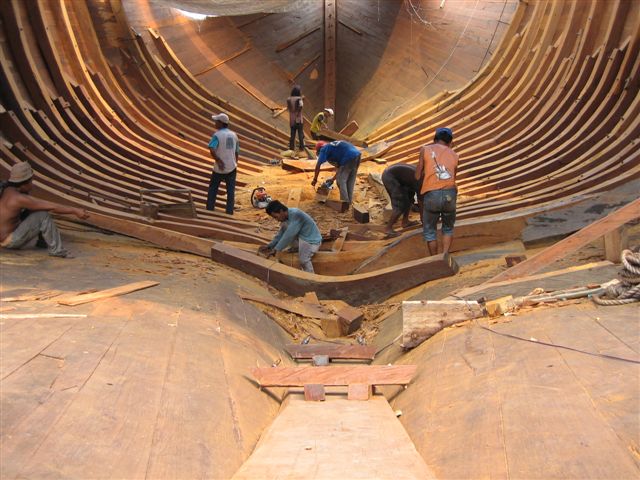
The Shape: With each of our boat projects in Indonesia, in order to achieve the intended hull form we have made use of temporary internal mould frames. The hull shape is first "lofted" and then the mould frames are built to match the lofting. The mould frames are then erected onto the keel to act as a guide for the planking. This allows us to pre-determine the section shapes in order to match our computer generated hull shape (see image links above). You can observe the process of creating mould frames at our Indonesian Boatbuilding Pictures web page.
Per typical Indonesian practice, the planks are placed first, and the frames afterward. This lends itself perfectly to the use of mould frames to guide the shape. In other words, once the hull is planked according to the moulded shape, the internal framing is added later, very much as is the usual wooden boat building practice throughout Asia. By this means we will have strayed from traditional methods only slightly in order to achieve the required shape, and then as needed in order to assure integrity of structure, longevity, and lessened maintenance.
Please see the following links for photos of the project recently completed in Kalimantan:
The Outfitting: Once the hull has been built, there is still plenty of additional work in outfitting such a craft. To finish out the interior joinery, we have found that the Konjo builders themselves are highly skilled and can produce extremely fine results when guided by a clearly articulated plan.
After that, the primary task is to properly specify and install the mechanical and electrical equipment and various related systems.
The installation of the equipment and systems will always present a challenge throughout Indonesia - mainly because the typical locally built craft are extremely simply outfitted, therefore the requisite engineering skills for a charter vessel or a yacht can be difficult to find. Thus it is only in large harbors such as Jakarta or Surabaya or Benoa in Bali where one will find the expertise required for the more elaborate systems that are found on a yacht of this size.
Other locations are also available with regard to the installation of systems... For example, Indonesia's Batam island (near Singapore) has become a possible venue for this stage of the work, and has the advantage of little or no import duty and ready access to parts and equipment in Singapore. Other possibly more enjoyable venues for systems completion are Bali in Indonesia, Langkawi or Penang in Malaysia, and Phuket in Thailand. Though labor costs will be higher in Phuket than in Indonesia or Malaysia, labor will still be relatively inexpensive when compared to any Western venue.
In Use: When finished according to the plans and specifications, the result will be a world class yacht. Whether used as a private yacht or in charter mode, this kind of vessel will offer a generous measure of luxury to anyone who steps onboard.
MORE INFORMATION
An interesting article on our work with these vessels appeared in the New York Times, called The Traditional Pinisi - And Then Some.
For complete information about our work with these vessels please see the following links, or for more information please inquire.
Our articles about building an Indonesian Pinisi or KLM:
Pinisi History | Pinisi Building | The Ultimate Charter Pinisi
Sailing vs. KLM Types | A Cargo Pinisi as a Yacht...?
Pinisi and KLM designs that we have created or have planned:
30m Pinisi, DATU BUA | 36m Pinisi, SILOLONA
38m Pinisi, AMANDIRA | 50m Sailing Pinisi
27m DIVE Charter KLM | 30m Charter KLM | 33m Charter KLM
36m KLM, DUNIA BARU | 40m Charter KLM | 50m Charter KLM
Descriptions of our adventures with these boats:
Silolona "Homecoming" | Indonesia Boatbuilding Images
Five Schooners and Two Arabian Dhows Suited to Building in Indonesia
17m Flores Privateer | 20m Sulawesi Privateer | 31m Komodo Privateer
36m Tern Schooner | 36m Lombok Privateer | 45m Kalimantan Privateer
22m Arabian Baghala | 36m Arabian Baghala
Two junk rigged KLM types for construction in steel:
25m Lady Destiny | 55m Lady Destiny
Please see the AVAILABLE BOAT PLANS web page.
Home | Intro | Our Design Process | Stock Design Info | Motor Yacht Designs | Sailing Yacht Designs | Prototype Designs
Plans List | Articles | Our CAD Design Stream | Maxsurf | SITE MAP..! | Site Search | Design Team | Contact Us