Messing about in boats since 1975. Online Since 1997.
Home | Intro | Our Design Process | Stock Design Info | Motor Yacht Designs | Sailing Yacht Designs | Prototype Designs
Plans List | Articles | Our CAD Design Stream | Maxsurf | SITE MAP..! | Site Search | Design Team | Contact Us
Please see the AVAILABLE BOAT PLANS web page
Creating The Ultimate
Indonesian Charter Pinisi
Copyright 2010 - 2015 Michael Kasten
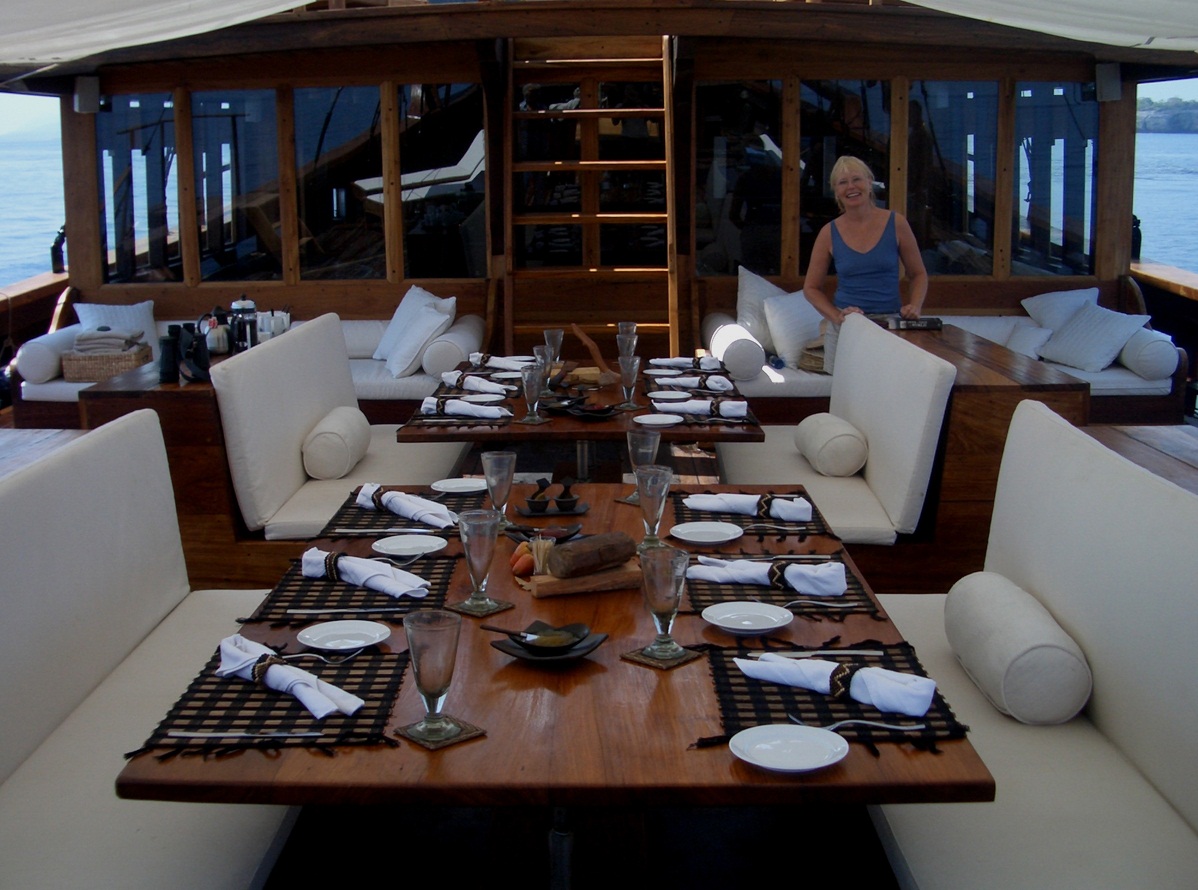
Anyone who is interested in the Indonesian Pinisi as a platform for charters in SE Asia would do well to emulate the 36m Dunia Baru, the 36m Silolona, the 30m Datu Bua, or the the 38m Amandira, all now chartering. Soon to be added to that list is the 20m Sulawesi Privateer.
I'd like to provide some background that does not appear among my other web articles about those boats and my continuing work with the Indonesian Pinisi types .
THE SILOLONA
The 36m Silolona is a design that I created in 2001 for Patti Seery. When Patti first contacted me by phone, she asked if I had any knowledge of the Pinisi boats of Indonesia.
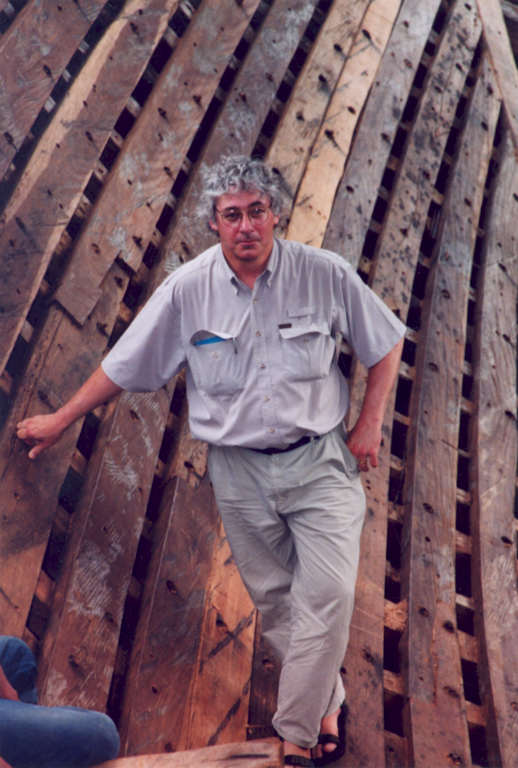
As it turns out, yes I did. This was by virtue of my friend, PhD Anthropologist Michael Colfer, who had planned his PhD thesis to be specifically about the Indonesian Pinisi and their builders, the Bugis of Sulawesi. Michael and I had been sailing together many years prior to Patti's inquiry, so I already knew about these craft, how they are built, and how they have been used by the indigenous Bugis sailors for carrying cargo throughout the Indonesian archipelago.
Once Patti had articulated the preliminary requirements for a charter Pinisi, I was invited to propose a new design. My proposed charter Pinisi design was accepted, and so I commenced work in order to bring the vessel into being...!
During the creation and detailing of the Silolona, I considered it to be an essential part of my personal mission to create the best marriage between the boat building methods of the East and those of the West. My specific goal with the Silolona design was to bring the local Pinisi types into compliance with worldwide standards for both structure and stability, but at the same time to follow the local traditions, aesthetics, and construction techniques to the maximum degree possible.
The links given at the bottom of this page are a good source of information about just how we have managed to accomplish that feat.
OTHER PINISI DESIGNS
Since that time, in addition to the four different Pinisi and KLM designs I've created for Patti Seery, I have also developed several other sailing Pinisi and KLM designs for construction in Indonesia. Naturally, each of these designs is an improvement on prior designs based on what we have learned over the years with these boats.
In addition to my Pinisi / KLM designs, in order to take the locally built charter yachts in a new direction I've developed a new wooden sailing yacht type that I call the "Privateer" series. These boats are intended for construction in Indonesia by the same builders, using the same traditional Bugis / Konko boatbuilding techniques.
The first design in this series is the 20m Sulawesi Privateer. The next one to be developed is the 31m Komodo Privateer. Both of those carry a traditional Western Brigantine Schooner rig. Another Privateer design is the 36m Tern Schooner which carries a three mast schooner rig.
IMPROVEMENTS TO TRADITION...
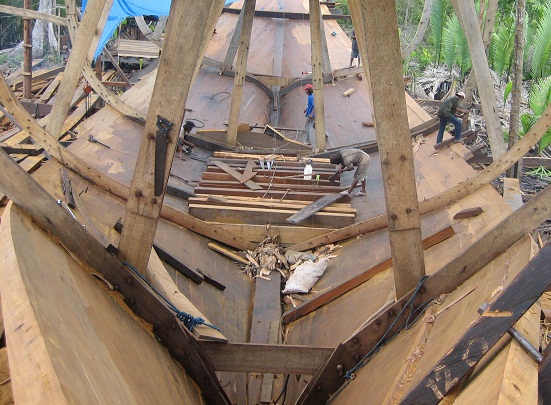
During the development of each of these Pinisi designs I have sought to improve the standard of local construction by keeping intact the best local methods such as the 'Asian' approach to building (for example, planks first), and then to change only what was necessary in order to achieve the layout and safety that we required for the intended service as a charter yacht.
My design drawings have therefore had a dual purpose. On the one hand the drawings are a means of accurate communication to the builders, and on the other hand they provide sufficient documentation so that the vessel could be classed if desired.
For the local Bugis / Konjo builders my goal has been to show the shape and structural arrangements with sufficient clarity that they can build the precise hull shape we want. We achieve this by the use of mould frames rather than building the hull "by eye" and we provide step-by-step illustration of the arrangement of primary structure along with the required methods of fastening.
Since the builders are entirely unaccustomed to reading "plans" of any kind, my drawings have had to be good illustrations.
TEAM WORK
All of this has required good team work among the players.
For example, during the development of the Silolona, in one marathon phone conversation Patti outlined what she wanted to achieve in a 40 meter charter Pinisi. With those goals in mind, I designed a 40m sailing Pinisi type of hull, detailed the structure according to Lloyds, and created a charter layout that would gracefully fit within it.
With those preliminary drawings approved, Patti invited me to Indonesia in order to introduce me to the builders and to their culture. The Bugis / Konjo builders in turn introduced me to their methods of boat building, including specifics of their long-standing traditions, the Bugis names for the myriad boat parts, and the wood species that they prefer to use.
I subsequently introduced the builders to several new ideas, including:
- The use of mould frames and "lofting" in order to create a precise hull shape so that we could predict and then achieve the requisite stability, efficiency and comfort;
- The design of timber joints and methods of fastening them for maximum strength and longevity;
- The use of only the best quality timbers;
- How to specify the placement of plank and timber joints for compliance with Western structural standards.
STANDARDS - EAST vs. WEST
While I was on-site in Batulicin (Kalimantan) to set up the mould loft floor so that we could create the mould frames to shape the hull, suddenly the overall size was changed from the original 40m we had planned, to being 36 meters on deck. This meant that I had to completely re-design and re-fair the hull shape on-site, re-calculate the sizes of all the timbers and planks, re-calculate the overall weight, and generate a new table of offsets - essentially creating an entirely new design within an extremely short time...!
Miraculously this was accomplished within the span of about two days, even though there were innumerable details yet to be determined.
Having carefully re-calculated the structure according to the British Lloyds and German Lloyds rules for wooden ships, I sat down with the master builder pak Haji Abdul Wahab (and a translator) to inquire as to the recommended timber and plank sizes per his own Bugis tradition, as well as to learn the Bugis name for each part of a boat's structure. Based on the vessel's newly specified smaller size, p'Haji Wahab recited the dimensions of each and every part of the vessel... from memory. No books, no calculators, just knowing...!
I was somewhat shocked to discover that nearly every timber was sized almost exactly the same according to the Bugis tradition as the calculated size according to Lloyds. So much for all my calculations..!
It seems that with regard to the sizes of the timbers and planks for each size of vessel, the Bugis builders and the Western classification societies have been taught the same lessons by the Ocean itself..! In other words, within the traditions of both East and West, boat structure has evolved to be what it needs to be in order to survive the sea.
I should not have been too stunned by this discovery, but I have to admit that it was quite a surprise.
THE RESULT...
As a result of this kind of teamwork, the Bugis / Konjo builders have learned that not all Westerners are complete fools... and I have developed a very high regard for the indigenous boat building methods used in Indonesia. In all, we have developed a well-deserved mutual respect.
And... for the sake of the improvement of the fleet, I sincerely hope that the structural features that I have helped to introduce will be widely copied, not only among the local builders but also among potential owners of these craft. In particular I hope that our general approach and our methods will take root, i.e. pre-planning the hull shape, the structure, the weight, the performance and the layout that is desired. These are all simple elements of good planning, and therefore of good design.
My Silolona, Dunia Baru, Datu Bua, and Amandira designs have been widely copied. Although I find it highly disturbing when my designs are outright copied by others, I do sincerely hope that my contributions with regard to structure will become an integral part of the Indonesian boatbuilding tradition.
I also hope there is a commensurate recognition of the value of good planning, including calculating and verifying the structure and stability according to international standards. Unsurprisingly though, I have seen precious little evidence of those factors actually being employed.
Naturally there are exceptions among a select few projects where 'design' and adequate planning have been given their due. I consider it a privilege to have been an integral part of promoting this process, and I look forward to continuing my design work with these vessels well into the future.
WHY A CHARTER PINISI...?
Prior to building the Silolona, Patti had been hiring other Pinisi boats for her cultural charters but had often been disappointed in their relatively poor quality and their typically unreliable service schedule, having even become stranded once with her charter guests in Irian Jaya.
Those experiences are what prompted Patti to build her own vessel. In order to realize her goals, her immediate tasks were to inspire a few investors in order to make it possible; to find a design firm familiar with the Indonesian Pinisi that could create what she envisioned; and to find a Bugis builder that would be qualified to make it so. Thus the call I received...
With the success of the Silolona having been widely recognized, many other charter operators have jumped into the game. It is my hope that the newfound interest in building high quality wooden boats for cultural charters throughout the Indonesian islands will continue to flourish.
We can be sure this sector will continue to see prolific growth, however the successful vessels will always be those that have been designed well in advance of construction; built to a high standard; and that are properly outfitted to serve the luxury end of the market..
MARKET SATURATION...?
Over the years I have been contacted by quite a number of people who want to build a Pinisi for charter. A few have said they think the field is now becoming saturated. However, the consensus is that this is only the case among the vessels of lesser quality, the vast majority of which are adaptations of cargo hulls that have been built "by eye" as cheaply as possible without the involvement of modern naval architecture or adequate advance planning. This has become rather commonplace.
Basically, those boats have no 'pedigree.' Their aesthetics literally beg forgiveness, and their functionality, structure and safety are very much in question. Those vessels do not by any stretch of the imagination meet whatever 'standards' may have been pandered. The sad result is that the vast majority of Pinisi boats built for unsuspecting Western owners do not even come close to what I know the Bugis / Konjo builders can create.
My comments here are in no way intended to disparage the extraordinary talent of the Bugis / Konjo builders, but I do want to emphasize that for a discerning cultural or dive charter audience, merely adapting a cheaply built cargo Pinisi hull to charter work is not an especially desirable path to achieving a successful long term charter business. Especially so since the mid to low end of the market has become a bit crowded.
Conversely, I believe it will be quite a long time before the high end of the charter market is anywhere close to being saturated. Therefore our focus is to promote quality and good planning.
THE PATH TO RUIN...
I have also been contacted many times by people who are already be in the midst of building their own Pinisi. It is usually a call for help, and it usually comes too late. Contracts have already been made and the wheels are already in motion...
Anyone venturing into a new Pinisi build should beware that there are several high profile promoters of locally built Pinisi boats who talk the talk, but who unfortunately do not have the requisite knowledge to even know the difference between good planning, and none..! One in particular is a well-known charter and yacht brokerage out of Jakarta who pander their services as 'Project Manager'. Others have taken root in Bali, Lombok, Bira... but few of them are actually qualified for the job. Some are just plain crooks. In other words, there are many unscrupulous characters who pander their services under questionable pretenses to unsuspecting Westerners.
The typical result is that 'commissions' are paid for simple introductions. Money is wasted on bad advice. There is often inadequate to non-existent planning and little follow-up management. With no formal 'design' the whole adventure quickly devolves into a costly and poorly run farce. The outcome is often shockingly bad. Such a project can in no way be called a success.
THE PATH TO QUALITY...
It has instead been my wish to promote quality, safety, longevity, comfort and refined aesthetics. In other words, to promote vessels that inspire confidence and that appeal to a more qualified, world-traveling, luxury minded, culture oriented clientele.
The essential ingredients are first, a sensitivity to the local traditions and styling of the cargo Pinisi - past and present - rather than attempting to impose a modern notion of aesthetics. Then it comes down to designing a hull shape to improve the comfort and safety; making the structural changes needed for strength and longevity; providing a functional layout for charters; and involving thorough project planning, done well in advance of beginning construction.
This goes well beyond creating the design concept, producing the drawings, and calculating the structure and stability. The planning must extend well into the construction phase in support of the Project Management team; to monitor the build quality; to answer questions from the builder and the management team; and to be sure that the systems are adequately planned and correctly installed. This requires a commitment all the way from concept to launch.
Vessels that have followed this path stand head and shoulders above the crowd. They represent the caliber of Pinisi I wish to promote.
MORE INFORMATION...
An interesting article on our work with these vessels appeared in the New York Times, called The Traditional Pinisi - And Then Some.
For complete information about our work with these vessels please see the following links, or for more information please inquire.
Our articles about building an Indonesian Pinisi or KLM:
Pinisi History | Pinisi Building | The Ultimate Charter Pinisi
Sailing vs. KLM Types | A Cargo Pinisi as a Yacht...?
Pinisi and KLM designs that we have created or have planned:
30m Pinisi, DATU BUA | 36m Pinisi, SILOLONA
38m Pinisi, AMANDIRA | 50m Sailing Pinisi
27m DIVE Charter KLM | 30m Charter KLM | 33m Charter KLM
36m KLM, DUNIA BARU | 40m Charter KLM | 50m Charter KLM
Descriptions of our adventures with these boats:
Silolona "Homecoming" | Indonesia Boatbuilding Images
Five Schooners and Two Arabian Dhows Suited to Building in Indonesia
17m Flores Privateer | 20m Sulawesi Privateer | 31m Komodo Privateer
36m Tern Schooner | 36m Lombok Privateer | 45m Kalimantan Privateer
22m Arabian Baghala | 36m Arabian Baghala
Two junk rigged KLM types for construction in steel:
25m Lady Destiny | 55m Lady Destiny
Please see the AVAILABLE BOAT PLANS web page.
Home | Intro | Our Design Process | Stock Design Info | Motor Yacht Designs | Sailing Yacht Designs | Prototype Designs
Plans List | Articles | Our CAD Design Stream | Maxsurf | SITE MAP..! | Site Search | Design Team | Contact Us