Messing about in boats since 1975. Online Since 1997.
Home | Intro | Our Design Process | Stock Design Info | Motor Yacht Designs | Sailing Yacht Designs | Prototype Designs
Plans List | Articles | Our CAD Design Stream | Maxsurf | SITE MAP..! | Site Search | Design Team | Contact Us
Please see the AVAILABLE BOAT PLANS web page
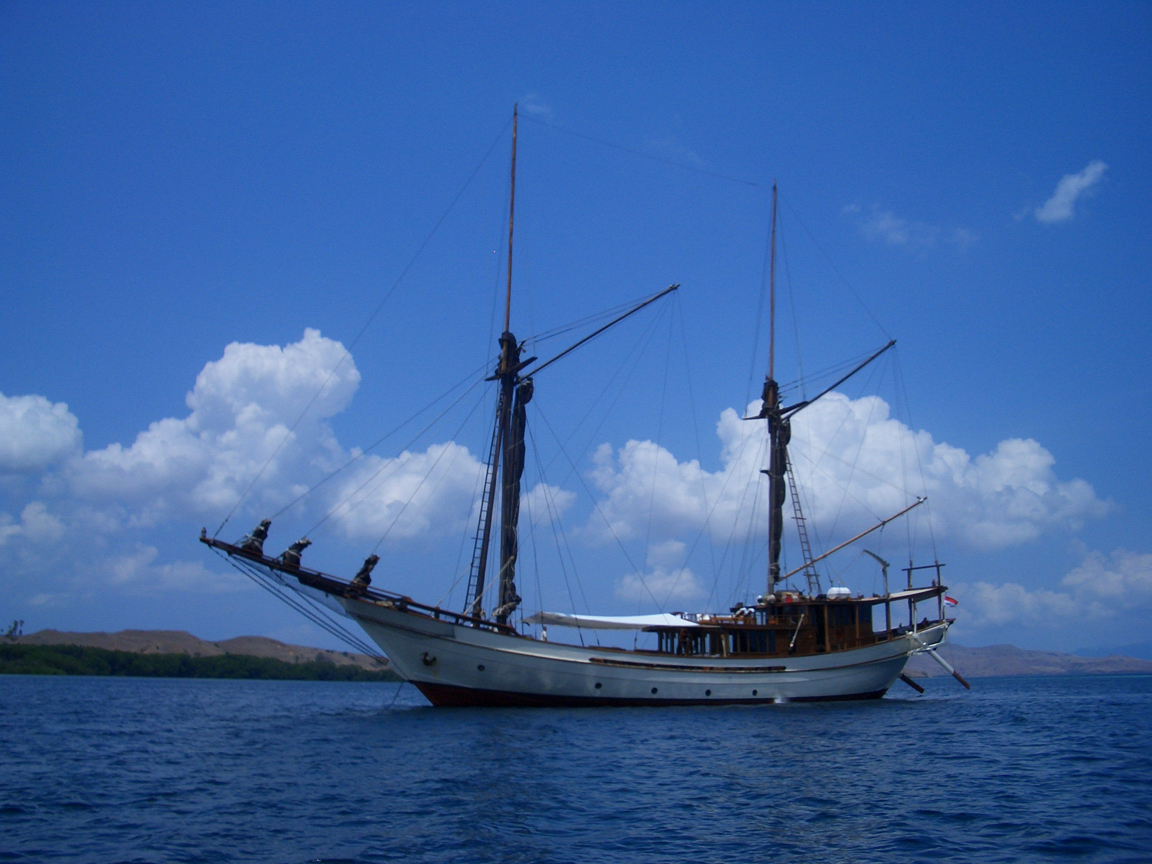
36 Meter Indonesian Pinisi, SILOLONA
For Luxury Charters
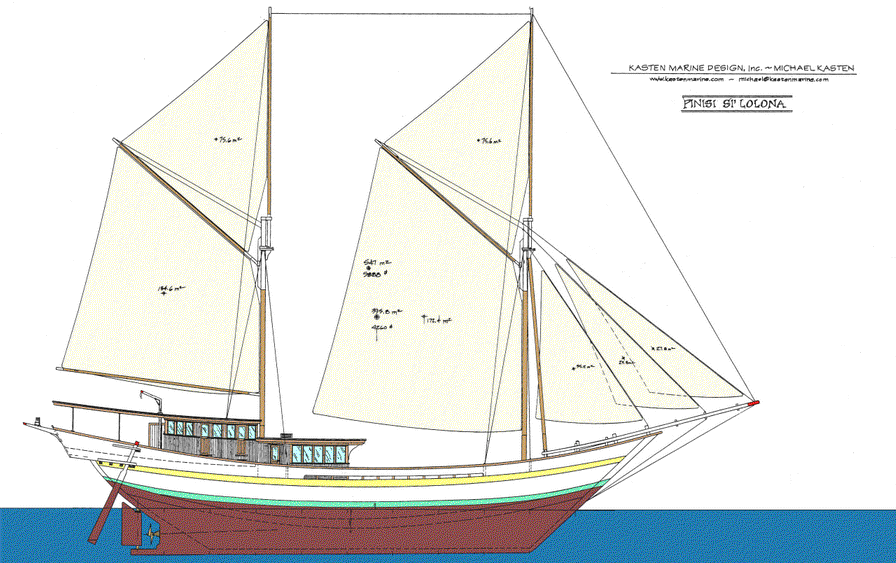
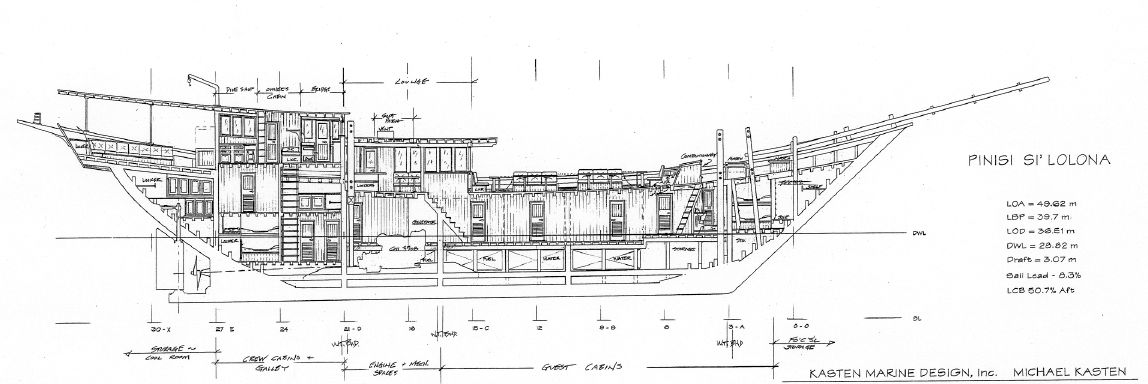
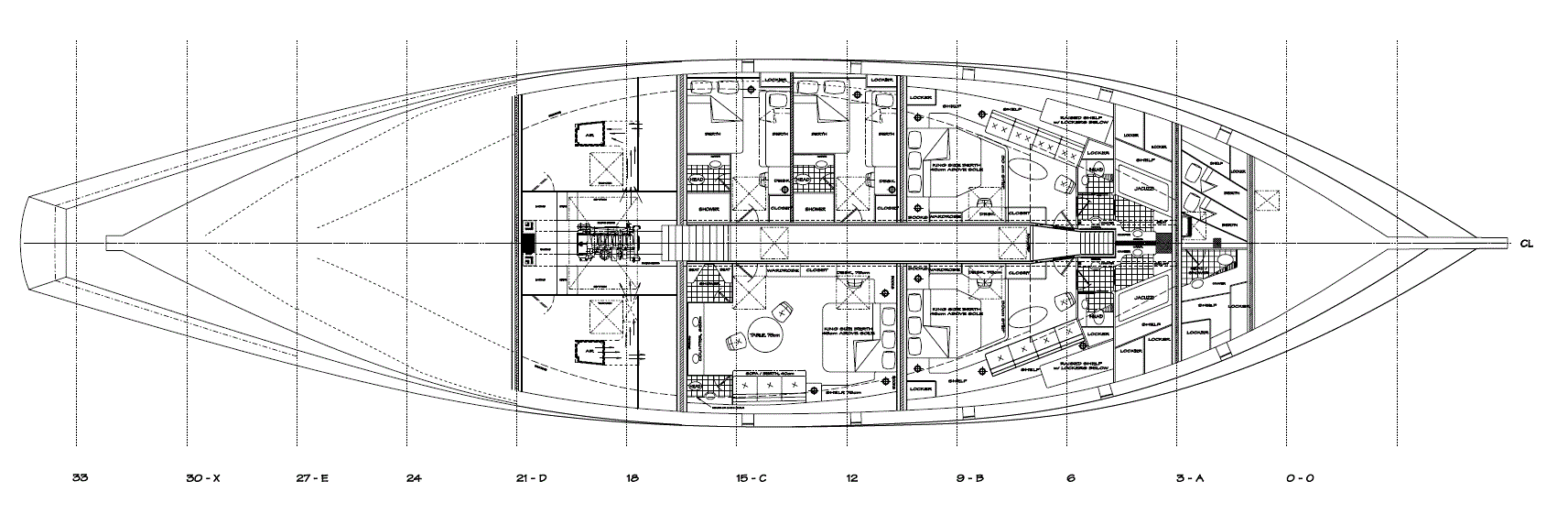
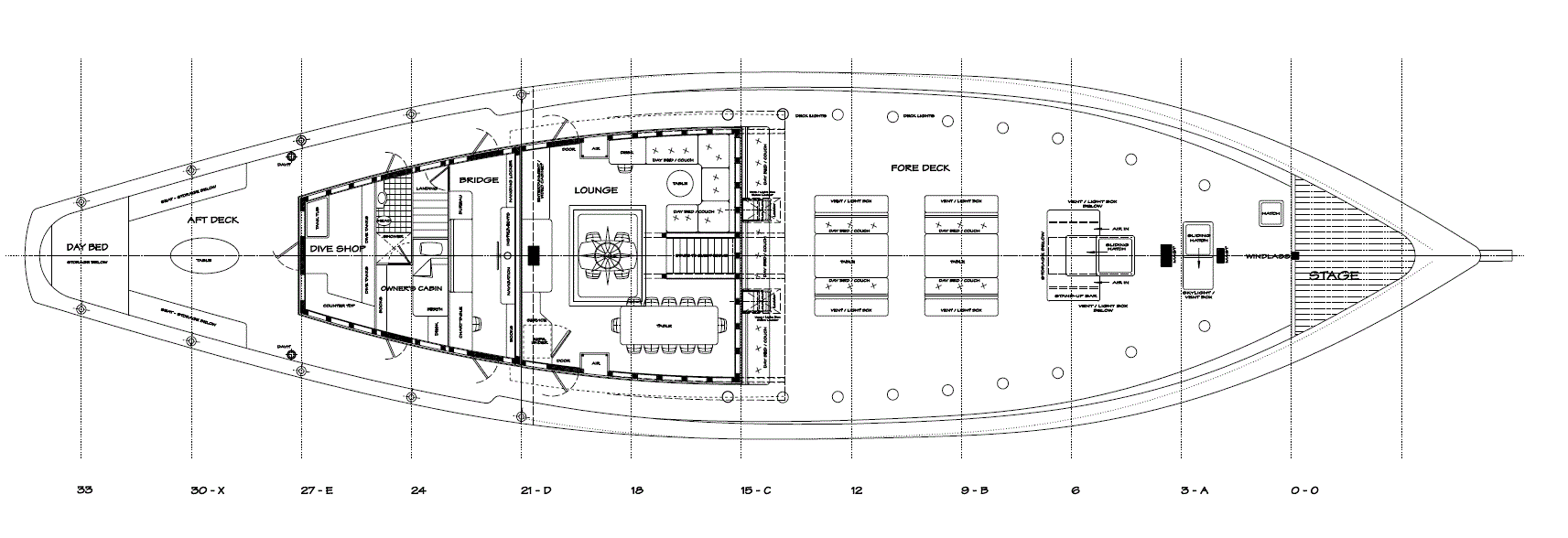
Large Color Sail Plan | Interior Profile | Interior Cabin Plan | Deck Plan
Final Stateroom Layout Below | Final Lounge & Fore Deck LayoutCopyright 2001 - 2014 Michael Kasten
Design Origination...
Is this the same well known Indonesian Pinisi Silolona of SEA Yachting and Phuket King's Cup renown...?
Yes it is..!
Although others may wish to claim credit for having designed the Silolona, it was designed here at Kasten Marine Design, Inc. and copyright to the design is owned by Michael Kasten.
In 2001 we were asked by Patti Seery to propose a design for a 40 meter charter Pinisi. After having developed the shape, the structure, and a suitable layout, I traveled to Bali, Indonesia to meet with Patti. From there we traveled onward to Sulawesi to meet with the builder to discuss the structure and the local boat building methods. We then traveled by boat from Sulawesi to Kalimantan (Borneo) where the vessel was to be built. The purpose of our trip to Borneo was to "loft" the mould frames for the hull so we could assure that the as-built hull shape would match the as-designed shape.
During the course of negotiations with the builder, Patti decided to reduce the size of the vessel to 36 meters. After re-calculating and re-modeling the whole design on-site, we proceeded with the lofting. The hand-drafted layout drawings among the above links reflect the original interior design that I developed for Patti during 2001. Those are the drawings from which the Silolona was built. During construction of the Silolona, I was in contact with the on-site crew on a regular basis via email and fax exchanges all the way to the vessel's launch in 2004.
When Silolona was being fitted out for chartering during 2004, I was asked to re-design the interior in order to accommodate three Large Staterooms (to replace six of the original eight planned staterooms below) and to re-design the Lounge On Deck, both in order to better accommodate the upcoming charter season for Aman Resorts.
I think we did well..! Even better would have been to replace all eight of the smaller staterooms, creating four ultra-deluxe private charter cabins. Possibly on a future vessel...?!
The following describes how I developed the Silolona design, including background information about the roots of the sailing Pinisi type and how we integrated the owner's wishes with those roots in order to produce one of the most highly acclaimed and best known motor-sailing charter yachts in Southeast Asia today... the Pinisi Silolona.
You'll find a few pictures taken during this adventure on our Indonesia Boatbuilding web page, and you'll find commentary by the owner on our Testimonials web page.
Size Clarification...
Charter agents like to promote the Silolona as having a length of 49 meters, which includes the bowsprit and stern davits, etc. This does sound impressive but it is technically incorrect, highly misleading, and unfortunately all too common among the charter fleet. The proper way to refer to a vessel's length is to quote the length of its hull, in other words, the length of the enclosed volume. Thus, the length on deck is its true length, omitting rail overhangs or appendages, and is the only honest way to describe the length of a boat. The Silolona measures 36 meters on deck, and that is how we refer to the design in these pages.
Pinisi Tradition
The Pinisi (also spelled as Phinisi) have been sailing the waters of Indonesia since early times. There is not a record for the exact origins of the type. Many sources indicate that similar craft were trading in Indonesia at the time of the earliest Western explorations of Indonesia, in other words prior to the 1500's. Of course these indigenous vessels have evolved over time and have absorbed various elements from a variety of traditions.
From those times until the mid to late 1970's, the fairly large fleet of cargo carrying Pinisi throughout Indonesia were strictly sailing vessels. In the mid 1970's there was a push to motorize the fleet of sailing Pinisi. The presence of an engine has changed these craft rather dramatically.
Currently, the vast majority of the local cargo fleet have been given engines. As a result, they are now referred to as 'KLM' for Kapal Layar Mesin, literally translated as "Boat-Sail-Machine" or as we would say, "Motor Sailor." To see two KLM types of our own design (intended as yachts), please have a look at our 30m KLM and our 36m KLM web pages. There, you'll find the traditional Indonesian KLM types transformed into yachts for private ownership and / or luxury charter.
For a thorough introduction to the origins and present use of the Indonesian Pinisi, please review our Pinisi History web page, which describes in detail the traditional and contemporary basis for these craft, as well as for this design.
Refinements...
Our intent with this new vessel has been multi-faceted. The owner asked us to create a design in the older indigenous sailing Pinisi style for use as a charter vessel throughout the eastern islands of Indonesia.
The owner also asked that we design a vessel with much greater strength and longevity of structure than would be lavished upon local craft. Our aim in so doing has been to reduce maintenance, to provide a high degree of comfort, improve the performance under power, and to increase the long term safety of the ship. These were our goals... and they have been very amply met in the resulting vessel.
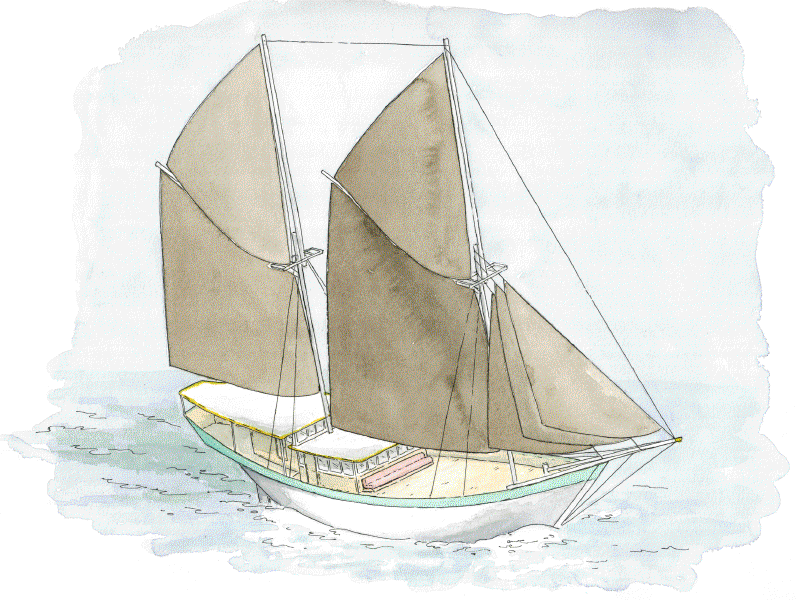
Watercolor Copyright 2002For power, my preference was to strike a middle ground. Rather than provide the relatively enormous amount of horsepower that would be required to achieve top hull speed, the engine power relatively modest. Power is provided by a 650 hp Yanmar diesel - sufficient for a consistent 10 knots depending on conditions. Above this speed and the power requirements and consequent fuel use, as well as the machinery costs tend to become excessive. Even so, this is far more horsepower than would be typical among the Indonesian cargo Pinisi.
With more than 650 hp, the Silolona is able to maintain a dependable schedule and a more ambitious itinerary. Beyond providing increased safety, the power provided allows a much larger part of Indonesia to be accessible during each trip.
Other refinements have been to blend the excellent Konjo / Bugis boat building traditions with several Western requirements in terms of structure, safety, and stability. In order to create the best possible result, a number of structural improvements over the typical cargo vessel construction were specified. These were not dramatic changes in terms of the construction methods, but cumulatively these refinements are quite important to the structural integrity and the safety of the vessel.
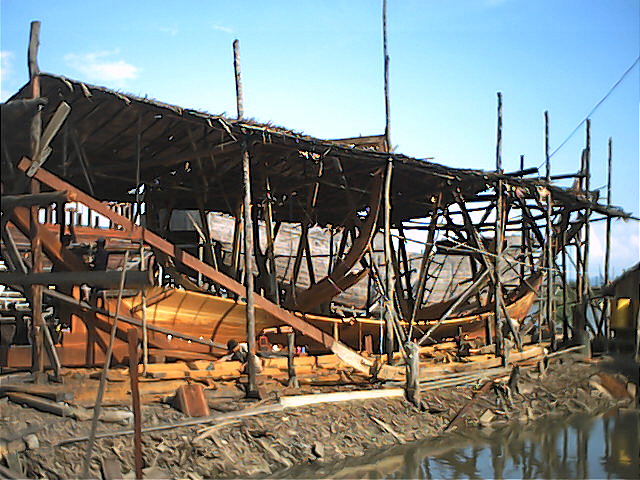
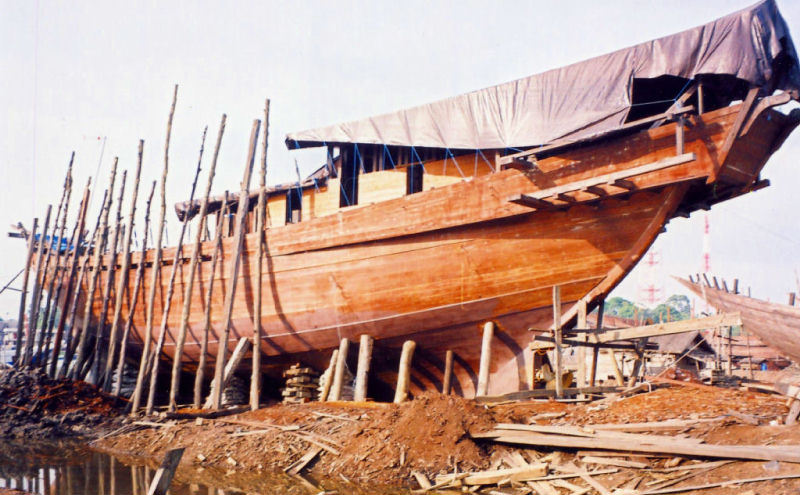
Many less obvious refinements were included in my design for the Silolona such as to improve local methods for joining primary structural members, all of which have gone into the creation of a robust, safe and long lasting wooden ship. For complete information about the refinements that we introduced, as well as the process we recommend for building such a vessel, please visit our Pinisi Building web page. Please also see the Indonesian Boatbuilding Images page for a variety of interesting photos taken during our trips to Indonesia. Click any of the following links to see images of the 36m Pinisi under construction:
Start of Construction - Borneo - October '01 | Close to Launching - Borneo - November '03 | Finishing Out - Bali - April '04
The Layout...
For the interior, the owner's request was that the interior layout enable the vessel to be used in either of two modes:
- As a personal world-traveling yacht for a private owner and guests, or
- For use as a charter yacht with "managed ownership."
By "managed ownership" we mean that the yacht is privately owned, but is managed by a charter company who is able to charter the vessel when it is not being used by the owner. In exchange for its use, the charter company takes care of the vessel's maintenance and repairs, and provides the owner with an income stream. Done correctly, this is a rather ideal way to own a boat - no maintenance, it pays its own way, and the owner can step aboard a well maintained vessel nearly any time and simply enjoy their time aboard rather than having to manage the vessel's upkeep.
Accommodations...
The owner's stated mission for the Silolona was to take charter guests on cultural excursions to remote regions of the vast Indonesian archipelago, the majority of which are only reachable by boat; and to do so in safety and comfort. The further aim was to provide charter guests with the experience of sailing aboard a locally built indigenous craft, handled entirely by a local crew.
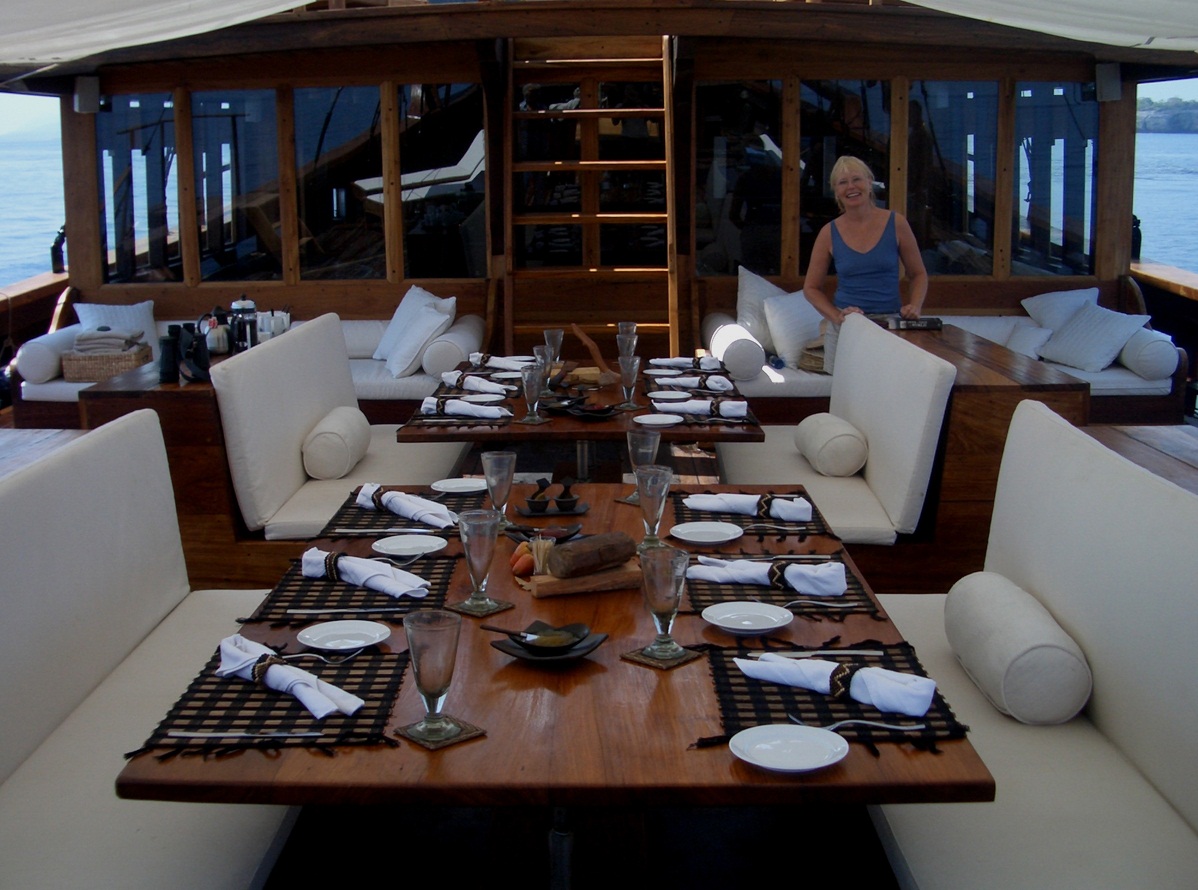
Among the drawings presented here, the original layout for the decks and cabins is shown along with the large deluxe cabin layout that I subsequently created. In both versions, the forward deck is kept fairly open so it can be used as an outside lounge area. In actual charter use, we find that most meals are preferably served there. The low cabin aft of amidships is an air conditioned guest lounge area for protection from wind and weather. The slightly taller house aft of the lounge contains the bridge, the charter guide's cabin, a day head, dive shop, and a shower.
The aft deck is traditionally where the vessel's local crew prefer to hang out. Aboard the Silolona however, guests and crew are invited to interact, therefore the aft deck was made into a comfortable and inviting place for everyone. A generous engine and machinery room occupies the middle of the ship below the guest lounge. Crew quarters and galley are located below the bridge house structure, aft of the engine room.
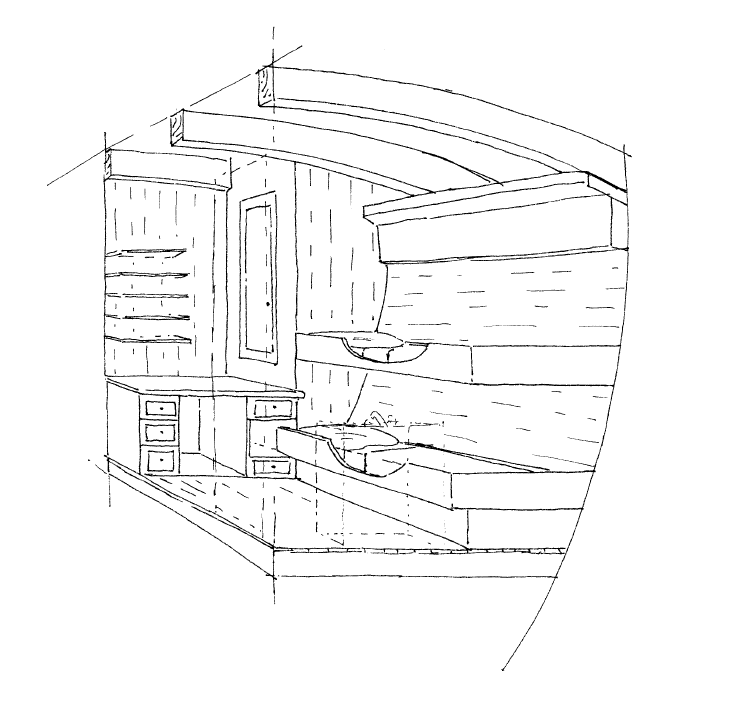
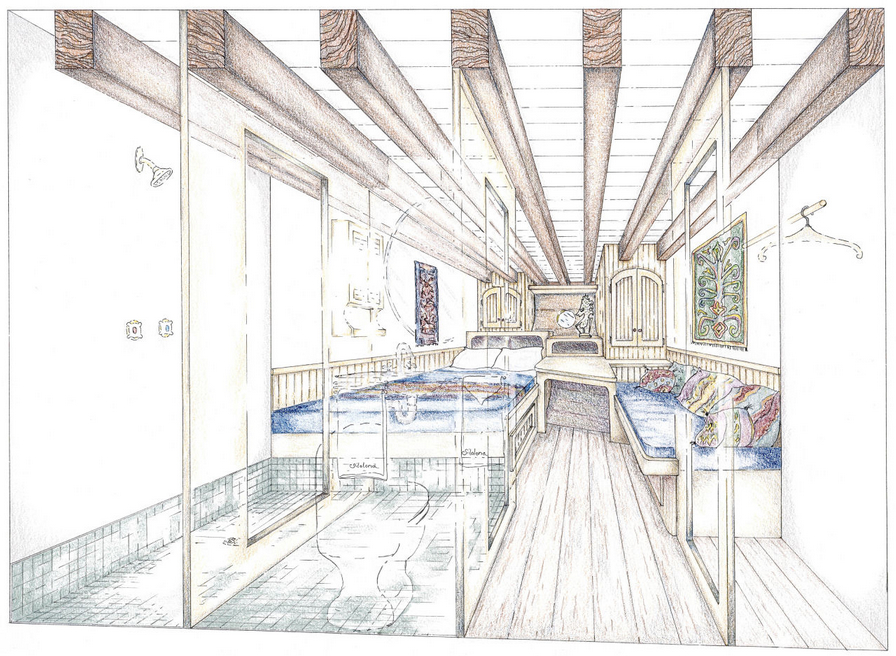
Ink Drawing of Captain's Cabin - Copyright 2002Right aft, a cool room provides secure long term food storage. Guest quarters extend forward of the engine room for the length of the ship below the open deck above. The vessel size was determined by the initial requirement to achieve several private staterooms to accommodate guests for charters lasting several weeks at a time. In addition to the charter guests, the requirement was to accommodate a full complement of twelve or more Indonesian crew members plus the charter leader. Comfort and privacy have been primary goals. Given the overall size, the accommodations are not at all crowded. Each cabin has a private head and shower and all accommodation spaces are air conditioned.
Colored Pencil Drawing of Guest Cabin - Copyright 2002
Since the Silolona has a highly traditional appearance, none of these luxuries are visible from the exterior. To a casual observer, this 'charter yacht' has the aspect of being a typical cargo vessel, albeit one that is rather well kept. See the images linked below for finished views of the interior and exterior - truly a magnificent vessel. As one fellow so aptly noted when touring aboard, "Three hundred fifty tons of Borneo Ironwood definitely gets your attention...!"
Designing a Pinisi...?
One might well ask, how can one actually "design" a craft that will be built on the beach with what would seem to be a rather amorphous approach to hull form. . . A good question! Let no one be fooled; the Konjo boat builders have a long and highly successful wooden boat building tradition. They also have an excellent eye for shaping a ship.
In order to begin this project, I visited with the owner's hand picked Konjo builder at his home in the town of Ara in South Sulawesi. While there, we had a close look at the variety of vessels being built nearby at Tanah Biru. We then discussed the vessel's structure and building methods at length with the builder. After researching this thoroughly it became obvious to me that there would be no need for a radical departure from the basic elements of the local boat building traditions.
My essential contributions to this tradition have been to create an interior and general layout suited to the owner's chartering requirements; to specify a pre-determined hull shape; to specify that only the highest quality wood and galvanized fastenings be used; and to follow through during construction in order to assure that the already mentioned enhancements to the structure be made in order to satisfy the Germanischer Lloyd's Rules for wooden vessel structure.
Even though it has been our intent to preserve traditional methods wherever possible, the overall contributions made by actually having the vessel "designed" have been significant... For example, in order to achieve the intended hull form, I introduced the use of mould frames in order to assure a predictable shape.
In Batulicin, Kalimantan Selatan we lofted the section shapes. We then built mould frames so that the hull shape would match our computer generated model (see image links below). The mould frames were then erected onto the keel to act as a guide for the planking. You can see us at work on the mould frames for the 36m Pinisi and also for a 36m KLM project at our Indonesia Boatbuilding Images web page.
Once the hull was planked according to the moulded shape, the framing was added inside very much as usual. For this vessel, the traditional Bugis / Konjo boat building ceremonies, construction methods, materials, general aesthetic and the overall vessel functionalities have been retained as much as possible. By intent, my design strayed from traditional methods only where necessary in order to achieve the required shape, integrity of structure, longevity, lessened maintenance, as well as vastly improved sea-kindliness and safety.
What makes this vessel unique is having honored the experience and traditions of the Konjo builders both structurally and aesthetically, combined with having brought into the design what we have historically found useful in the West. The general proportions and structure have been determined by combining the Konjo traditions, the Lloyd's traditions, and modern analytic methods, each of which are aimed at producing the best possible result.
The result is a world class charter vessel that is primarily sailed among the islands to the east of Bali (Nusa Tenggara), but also capable of a circumnavigation to visit any of the other islands of the world.
Voyaging aboard the Silolona provides an authentic taste of sailing among the Indonesian islands on a traditional sailing 'Pinisi' manned by an all Indonesian crew, yet at the same time offer a generous measure of luxury to the charter guests.
For complete information about how I've worked to adapt the local craft for this new purpose and to review the process I've come to recommend for building such a vessel, please visit my Pinisi Building web page. For a closer look at the structure of these craft, please visit my Pinisi History web page.
Can One Build a New Wooden Yacht Economically...?
Yes - and this of course is the ultimate goal...!
Unfortunately, due to the extraordinarily low cost of building these vessels, there will always be a steady supply of misguided Westerners who approach the local boat builders with the idea of turning one of their locally built craft into a yacht or charter boat at the lowest possible cost. Most often the result is extremely poor - mainly due to very inadequate planning and non-existent project management.
In other words, these half hearted attempts to create a yacht will inevitably result in an ill-conceived and poorly executed vessel, i.e. one that has not been 'designed' nor built to any standard, nor even effectively 'managed' during construction. Although the local builders are very capable of producing excellent results with their own local vessel types, when those indigenous vessels get arbitrarily modified by various 'owner requests' during construction, the final product can be shockingly bad - even to the point of being unsafe...
Consequently there is a very large difference between those vessels and the likes of what I have outlined here...!
How to Do It Right...?
The key to success with a project of this type is thorough planning, done well in advance of any actual boat building being done, and in advance of any contract arrangements being made. I therefore view the design itself as the first essential ingredient to success. The other essential components are that highly skilled builders be found, and that during the building of the boat there be adequate communication via competent on-site project management.
Since our work with the Silolona, we have created several other Pinisi designs for charter and for private owners. My contribution to these craft has not only been to design an interior and general layout suited to various owner's chartering or yachting requirements, but also to specify a pre-determined hull shape; to specify the structure so that only the highest quality wood and hot dip galvanized fastenings be used; and then to follow through during construction in order to assure that the requested enhancements to the structure be made and the original plans be followed faithfully.
For a bit more on the rationale for this approach please see our Ultimate Charter Pinisi article. To review the process I've come to recommend for building such a vessel in a little more detail please visit our Pinisi Building web page. When such a vessel is finished according to our plans and specifications the result will be a world class yacht. Whether used as a private yacht or in charter mode, this kind of vessel will offer a generous measure of luxury to anyone who steps onboard.
Silolona Homecoming Voyage - 2004...!
During the latter part of 2004, the Silolona made a unique trip - a "homecoming" voyage to bring the boat to the original home of the Konjo builders in Southwestern Sulawesi. For a brief description of that voyage, please see our web page on The 36m Pinisi Homecoming Voyage and also our web page of selected Indonesia Photos taken during our three trips to Indonesia for this and other Pinisi projects.
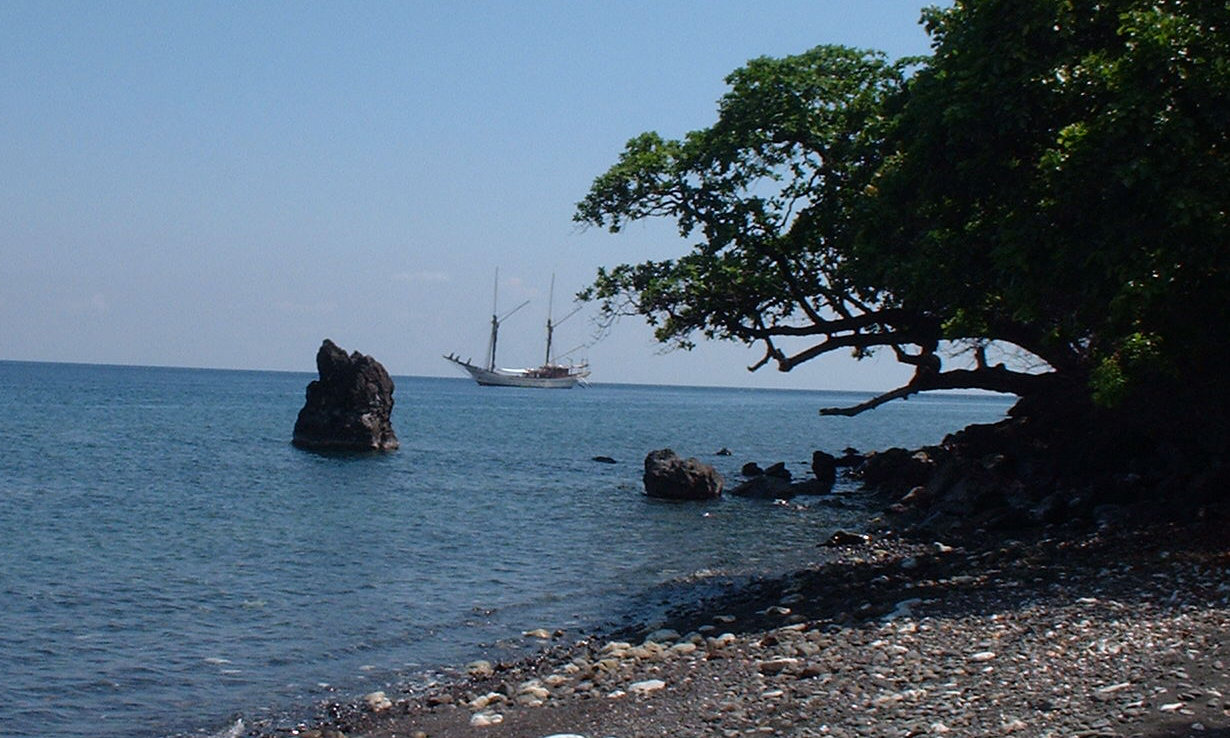
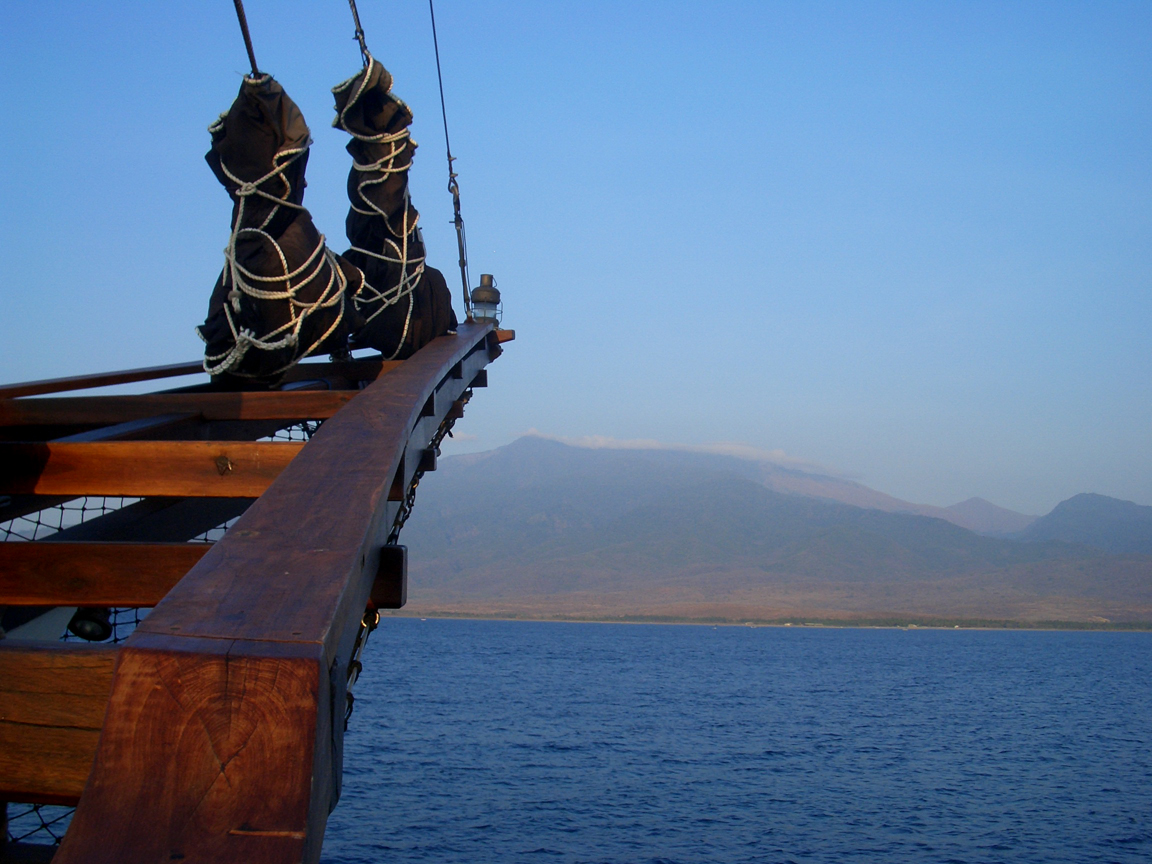
Silolona anchored off Sangeang volcano, Indonesia - Click for Larger ImageService On Deck | Tools of the Trade | Bugis Sailor | Toward the Islands
Accolades
My work with these craft has resulted in some of the most successful designs among the Indonesian charter fleet. The 36m charter Pinisi Silolona shown above has won accolades from SEA Yachting Magazine and was listed among the top 10 super-yachts in Asia-Pacific Boating magazine's annual roundup of "Asia's Top 30 Superyachts" during both 2004 and 2005.
Silolona was featured in the May 2006 Superyachts Magazine, and has achieved cameo appearances in Vogue magazine, Time magazine, La Figueroa and a number of boating magazines in the EU. An interesting article about our work with these vessels appeared in the New York Times, called The Traditional Pinisi - And Then Some. In a review of Asia's Top Super Yachts in January 2010 Asia's leading online luxury magazine, Luxury Insider, writes of the Silolona:
"Her five-star interior has Indonesian-style furnishings. From April to November, she can be found in Indonesian waters, and from December to March, in the Andaman sea. During last year's Phuket Kings' Cup, guests were entertained by traditional Sulawesi music and later by a Bangkok DJ."
We subsequently designed a smaller sister to the Silolona for Patti Seery, called the 30m DATU BUA. As spectacularly as the Silolona has turned out, a larger and much improved version has recently been completed, called the 38m AMANDIRA, now under full time charter by Aman Resorts. The 30m DATU BUA and the 38m AMANDIRA both carrry a much more capable sailing rig than had been specified for the Silolona.
Yet another recently completed Pinisi of our design is the 36m DUNIA BARU. The fit and finish of the 36m Dunia Baru is second to none, and the vessel has already received wide recognition in the yachting press. Many excellent photos of the completed Dunia Baru can be seen here.
Design Summary
The Silolona was our first Indonesian Pinisi design. Since the Silolona was built, we have created designs for a number of different Pinisi types, plus several other wooden boat types well suited to construction in Indonesia.
If this or a similar Pinisi / luxury sailing yacht is of interest, we offer a thorough design service. Our preference is to take advantage of traditional methods to the maximum extent possible, but to bring the construction standard up to a classification society compliant structure. We can modify these types of vessels to suit a variety of requests to change the size or to modify the layout as needed, and then follow that up with our local knowledge in order to facilitate construction.
When Building Plans have been purchased or created, I will be pleased to make local introductions to a proven team for building the vessel and an extended team for managing the construction. Please see my Plans List page for plans cost and ordering information.
For complete information about our work with these vessels please see the following links, or for more information please inquire.
Our articles about building an Indonesian Pinisi or KLM:
Pinisi History | Pinisi Building | The Ultimate Charter Pinisi
Sailing vs. KLM Types | A Cargo Pinisi as a Yacht...?
Pinisi and KLM designs that we have created or have planned:
30m Pinisi, DATU BUA | 36m Pinisi, SILOLONA
38m Pinisi, AMANDIRA | 50m Sailing Pinisi
27m DIVE Charter KLM | 30m Charter KLM | 33m Charter KLM
36m KLM, DUNIA BARU | 40m Charter KLM | 50m Charter KLM
Descriptions of our adventures with these boats:
Silolona "Homecoming" | Indonesia Boatbuilding Images
Five Schooners and Two Arabian Dhows Suited to Building in Indonesia
17m Flores Privateer | 20m Sulawesi Privateer | 31m Komodo Privateer
36m Tern Schooner | 36m Lombok Privateer | 45m Kalimantan Privateer
22m Arabian Baghala | 36m Arabian Baghala
Two junk rigged KLM types for construction in steel:
25m Lady Destiny | 55m Lady Destiny
Please see the AVAILABLE BOAT PLANS web page.
Home | Intro | Our Design Process | Stock Design Info | Motor Yacht Designs | Sailing Yacht Designs | Prototype Designs
Plans List | Articles | Our CAD Design Stream | Maxsurf | SITE MAP..! | Site Search | Design Team | Contact Us