Messing about in boats since 1975. Online Since 1997.
Home | Intro | Our Design Process | Stock Design Info | Motor Yacht Designs | Sailing Yacht Designs | Prototype Designs
Plans List | Articles | Our CAD Design Stream | Maxsurf | SITE MAP..! | Site Search | Design Team | Contact Us
Please see the AVAILABLE BOAT PLANS web page
The 53' Trawler-Yacht
"Voyager"
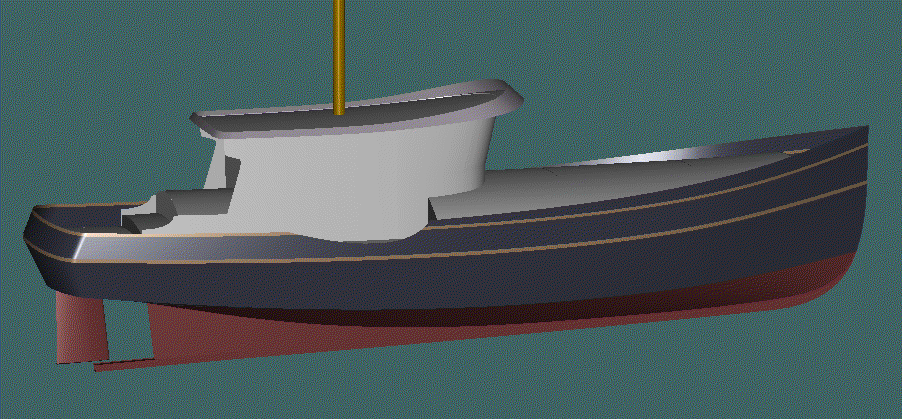
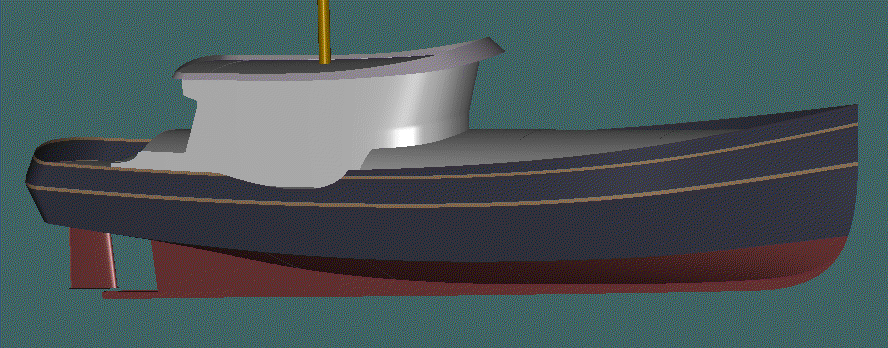
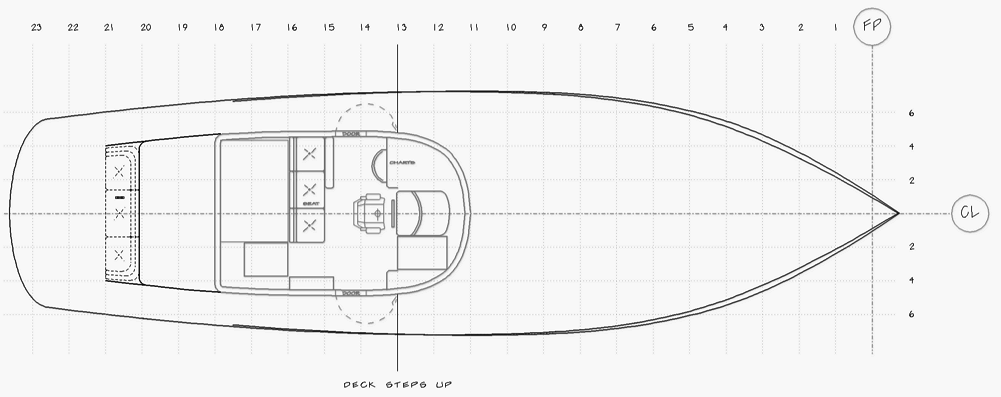
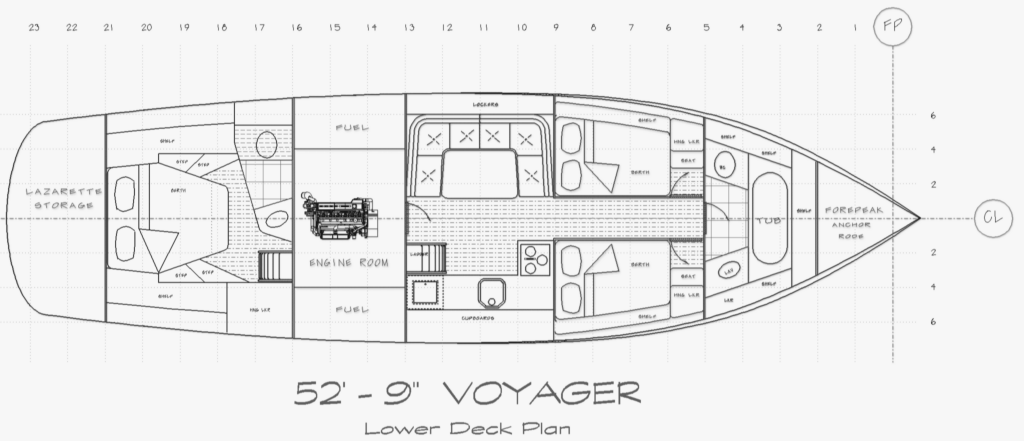
Exterior Deck | Interior Plan | Perspective Forward | Perspective AftCopyright 2004 Michael Kasten
General Concept
The design request for this vessel was to create a strong, classic, three stateroom steel displacement trawler for a couple with guests, with the objective being retirement living aboard, long summer cruises, ocean passage making, and travel on the canals of Europe, including the capability for a circumnavigation.The Freycinet Standard canals of France have a limiting air draft of 3.50 meters (11' - 5.8"), a limiting water draft of 1.80 meters (5' - 10.9"), and a limiting beam of 5.0 meters (16' - 4.9"). Other EU canals are less restrictive. With mast, poles and exhaust stacks down, the Voyager 52 can negotiate the majority of the European canal system. One notable exception is the Canal du Midi, which has a much more restrictive air draft limit of 2.46 meters (8' - 0.84").
As with the various designs in this series, the Voyager 52 hull form has been adapted from working West Coast fishing vessels in order to capture the excellent sea keeping qualities of those working craft, but to refine the lines into 'yacht' form in order to achieve an easily driven hull having relatively light displacement.
Hull, decks and cabin are planned for steel construction with scantlings according to the ABS Rule. The house top is cold molded plywood, laminated into a single large structure then sheathed in GRP. All other plating, framing and internal structures are steel, and are planned for NC cutting, including integral water and fuel tank faces, engine girders, etc. Having been planned for steel construction, conversion to an all aluminum structure would be quite an easy task, amounting to a simple re-specification of the scantlings and ballast quantities.
The Voyager 52 will make use of Paravanes for roll stabilization. The rig is detailed to allow economical fabrication using aluminum pipe. In all, the Voyager 52 has intentionally been kept simple for the sake of economy, reliability and ease of maintenance - the often elusive but highly prized qualities of a world traveler.
If there were considerably more in the budget for construction, then of course active stabilizers could easily be specified. Please see our web article on roll attenuation for further consideration of this question...
Vessel Particulars
Displacement will vary approximately from 54,500 lb in the 10% load condition to approximately 67,500 lb in the 100% load condition. Other particulars are:
- 52' - 9" Moulded Length Overall
- 14' - 6" Moulded Beam
- 49' - 8" WL Length, Half Load
- 5' - 2" Salt Water Draft, Full Load
- 11' - 5" Air Draft, Half Load
Power & Range
The engine specified is a John Deere 6068 TFM 6 cylinder diesel, which produces 175 hp at 2,400 rpm in the M-2 rating. The engine is mated to a Sabb controllable pitch gear using a 3:1 reduction to drive a Helseth three blade 34" CP propeller.
The "cruising speed" for long range voyaging with this hull is assumed to be around 8 knots. Theoretical hull speed is around 9.5 knots, however due to having relatively light displacement the hull should reach close to 11 knots with the planned horsepower.
Using 5,000 liters (1,321 USG) of fuel and keeping a 15% reserve, the Beebe algorithm shows range in the average load condition to be around 3,000 NM at 8 knots.
Exterior Arrangement
The aft deck, side decks, and interior pilot house deck are all at one level. There are two exterior water tight doors entering the pilot house. The side and aft decks are surrounded by substantial bulwarks, and the fore deck by a toe rail. All decks are surrounded by lifelines with welded steel pulpits forward and aft.
Right aft is a full width aft-facing seat, arranged in order to be extended into a spare double berth, mainly for the fun of sleeping on deck when the weather permits.
The mast and paravane rig are located just aft of amidships with all control lines easily operable from the side decks.
The fore deck spans the full width of the boat from bulwark to bulwark. This provides a very large volume within the forward accommodations below. Davits port and starb'd allow placing a shore boat onto the fore deck.
A well-deck is located forward, in order to contain the anchor gear. A dual capstan horizontal anchor windlass is located in the well deck, and will accommodate two working anchors - a CQR and a Bruce, which nest well together.
Interior Arrangement
The links above provide a preliminary look at the interior planned for the Voyager 52. This layout is intended to allow comfortable cruising for up to six adults. It also offers the possibility of chartering the boat if desired. In charter mode, the boat could accommodate two couples on overnight cruises or could take on friends or charter guests for each leg of a longer voyage.
Beginning right forward, there is a head with a large bath tub...! Just aft of that are a pair of guest cabins of equal size. The portside guest cabin is intended to be converted into office space when not needed for guests. The guest cabins are each arranged with plenty of shelves, a seat and a hanging locker. A door leads directly from each guest cabin to a center hallway, leading aft to the Saloon / Galley.
The large L-shaped galley is located to starb'd at the base of the companionway. The galley contains a large refrigerator / freezer aft, big single sink, and a three burner propane range. To port is a large wrap-around dinette and table, sized for six. The intent is that this will be the primary entertainment space. Having a full width raised foredeck, the galley and saloon will be light and open, and will have unobstructed views to port and starb'd.
At the aft end of the saloon / galley is a companionway leading to the pilot house. On center is a WT door leading into the engine room below the pilot house. Access to the engine room is also via large opening hatches in the pilot house sole.
Up in the pilot house, a WT door accesses the exterior side decks to port and starb'd. The helm station is located on center, and a large bench seat is located to port, aft. There is a narrow table with a drop leaf, allowing occasional meals to be taken there, or just for observing and conversing with the helms-person.
Just aft of the pilot house and below is the owner's cabin, accessed by a companionway ladder to port, aft within the pilot house. The owner's cabin contains a private head and shower, queen size berth, rather large hanging locker, and wrap-around shelves for storage.
Design Genesis
Several of our designs share the same essential source hull type, in this case derived from the North Pacific fishing trawlers which operate in all weathers in the Gulf of Alaska, a place where the ocean is... well, not so nice. We refined the fishing trawler hull type to create a more yacht-like shape and that became the "Greatheart / Gulliver" series. See the following links for vessels in the Greatheart series...
Greatheart 36 | Vagabond 36 | Gulliver 46 | Greatheart 48 | Greatheart 54
Greatheart 60 | Swallow's Nest 60 | Braveheart 53 | Braveheart 63 | Swallows Nest 70We then modified the hull to create the "Vagabond" series which makes use of a proportionately longer waterline and a more upright stem and transom. Combined, this reduces the overhangs and increases the WL length to gain more interior space with less overall hull length. Check out the following links for boats in the Vagabond series...
Vagrant 49 | Vagrant 70 | Vagabond 50 | Voyager 52 | Valdemar 53 | Valdemar 70 | 37m Peri Laut
For more information on this or other designs, please inquire
Please see the AVAILABLE BOAT PLANS web page.
Home | Intro | Our Design Process | Stock Design Info | Motor Yacht Designs | Sailing Yacht Designs | Prototype Designs
Plans List | Articles | Our CAD Design Stream | Maxsurf | SITE MAP..! | Site Search | Design Team | Contact Us