Messing about in boats since 1975. Online Since 1997.
Home | Intro | Our Design Process | Stock Design Info | Motor Yacht Designs | Sailing Yacht Designs | Prototype Designs
Plans List | Articles | Our CAD Design Stream | Maxsurf | SITE MAP..! | Site Search | Design Team | Contact Us
Please see the AVAILABLE BOAT PLANS web page
The 63' Steel or Aluminum Trawler Yacht
'Braveheart'
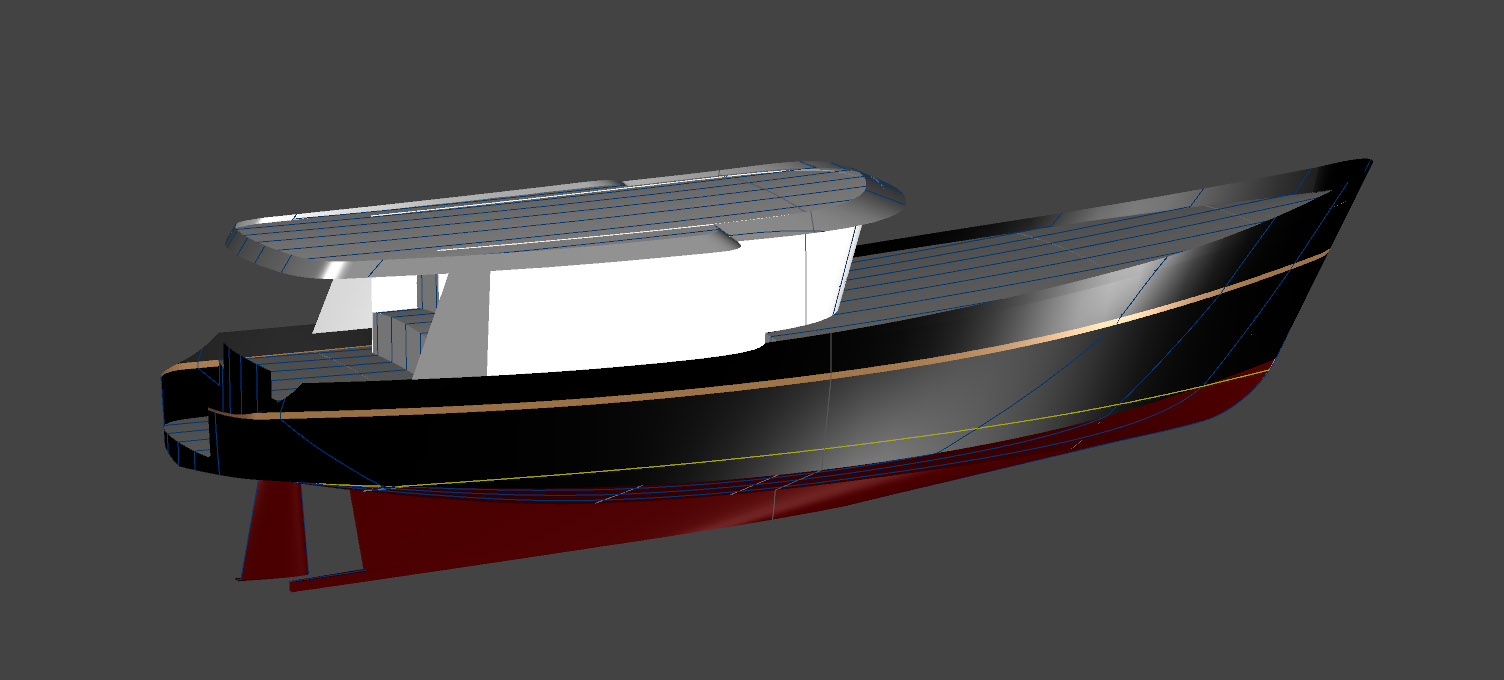
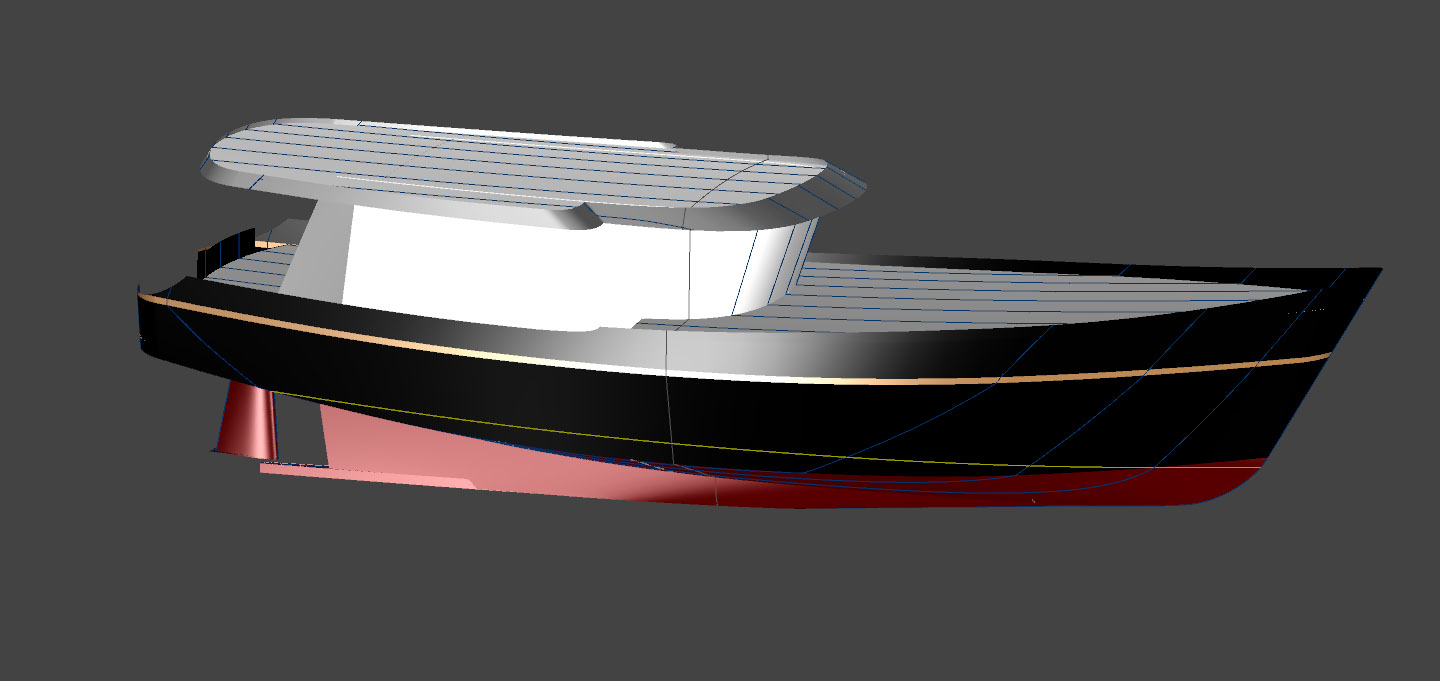
Perspective Aft | Perspective Side | Perspective ForwardCopyright 2003 - 2007 Michael Kasten
GENERAL CONCEPT
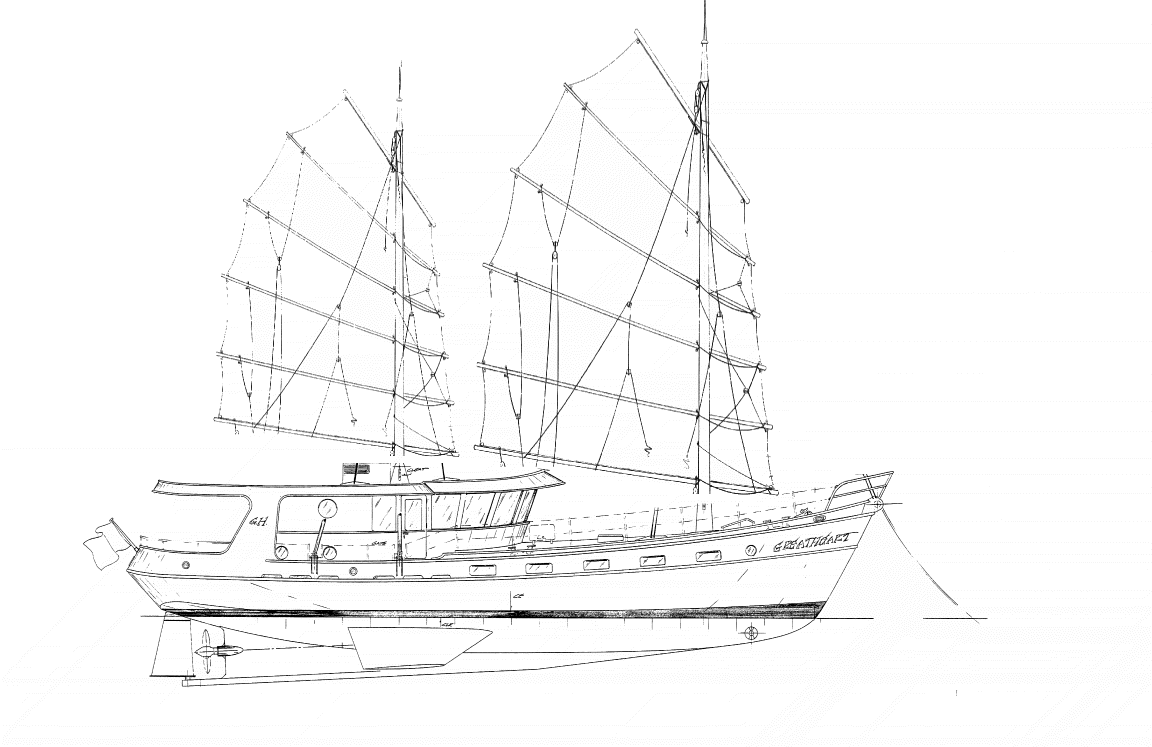
The "Braveheart 63" prototype shown here was directly inspired by the Greatheart 60. However one requirement for the Braveheart 63 was to introduce a swim-deck aft, and there is a slightly modified interior layout.
Forward, the hull and bulwark are faired into a conical bow, which I like a lot on this size craft. The hull has been modified to suit the materials of construction, which is steel, so the hull is wider and deeper than with the Greatheart 60. With the extra beam, the house structures are a little wider, too.
On the interior, there is to be a passage below the pilot house for access to the aft cabin from below. Other than the various changes required in order to accommodate the passage (port side), there have not been any changes to the arrangement of the interior layout or the exterior structure from that of the Greatheart 60.
DISPLACEMENT, PROPULSION, SAIL AREA...
Preliminary calcs with this model give the following: Prelim Beam is 16' with a BODY draft (Loaded) of 4.13' without the keels. Draft (to the keel bottom) is approximately 6' and air draft is 11.6' with the present configuration in the average load condition. Displacement figures for this preliminary model (with keels) are:
LIGHT:
Displacement 70,552
Immersed depth 5.75
Lwl 53.6
Beam wl 14.5
LOADED:
Displacement 91,605
Immersed depth 6.3
Lwl 56.0
Beam wl 14.7In the fully loaded condition, 230 hp would propel the vessel at a top speed of 11.1 knots. In the average load condition, 1450 USG would allow a 3000 NM range at 8.5 knots. We are so-far aiming for a target working sail area of around 2,200 Sq Ft. With this amount of canvas, performance under sail is emphasized.
As with other preliminary / prototype designs, a weight study has not been completed for this vessel. Although it is probable that the above displacement figures will accommodate a Corten hull structure with an alloy superstructure, it is also likely that hull displacement may need to be increased somewhat. An increase in displacement would be made in order to accommodate various toys and equipment, as well as to allow sufficient sail carrying ability for a considerably enlarged sailing rig, i.e. the addition of ballast.
For the best sailing performance, the keel configuration would be slightly different, and would favor longer asymmetric bilge keels, and an abbreviated center keel. These changes may possibly add some 15% to 20% to the above displacement figures.
The preliminary modeling that has produced the above images and performance figures has been mainly to get a prelim "look" of the vessel with an integral swim platform, and to preliminarily increase displacement to accommodate the materials of construction versus the Greatheart 60, which is designed for all aluminum construction.
BELOWDECKS PASSAGE
The passage below the PH is a challenge with this model, not so much due to vessel size or beam, but due to body draft versus the location of the pilot house sole. In a sail boat with center cockpit, there is ample seat and cowl (seat-back) volume in which to accommodate passageway headroom. With a pilot house, having the PH sole extend from doorway to doorway port and starb'd, that becomes quite a different story...
Therefore the means of accommodating the passageway fore and aft below the pilot house is to eliminate the port side exit door, and allow a raised seat all along the port side within the pilot house. This seat would be sufficiently long to double as a pilot berth there to port, or alternately could be partly a seat and partly a counter top / chart table. This is the kind of trick that would be required in order to obtain sufficient headroom for a passage without an unnecessarily large increase in hull depth and therefore displacement and power...
For all other aspects of the intended interior, please see the Greatheart 60 web page, where there are links to the interior for that vessel.
DESIGN GENESIS
As with our other designs in this series, the hull form for the Braveheart 63 has been adapted from real trawlers - US West Coast fishing vessels which have to operate in all weathers - including in the Gulf of Alaska, a place where the ocean is... well, not so nice. Our aim has been to retain the excellent sea keeping qualities of those working craft, and to refine their lines into 'yacht' form to achieve a more easily driven hull with relatively light displacement. See the following links for vessels in the Gulliver / Greatheart series...
Greatheart 36 | Vagabond 36 | Gulliver 46 | Greatheart 48 | Greatheart 54
Greatheart 60 | Swallow's Nest 60 | Swallowtail 60 | Braveheart 53 | Braveheart 63 | Swallows Nest 70In order to achieve a proportionately longer waterline and more interior space without increasing boat length, we developed another series of designs based on the same hull form, but with a more upright stem and transom. Combined, this reduces the overhangs and increases the WL length to gain more interior space with less overall hull length. Check out the following links for boats in the Vagabond series...
Vagrant 49 | Vagrant 70 | Vagabond 50 | Voyager 52 | Valdemar 53 | Valdemar 70
SHORE BOAT
I have developed a series of aluminum Prams that are highly suitable as shore boats. The pram's side "cheeks" provide floatation and leeboards are used in order to avoid a centerboard trunk. The leeboards work nicely and don't really need much tending. Rowing is easy. The prams have a flat bottom for ease of beaching. The rowing thwart pops out so the whole boat is open for lying down / sleeping, etc., so they are great for camping.
This pram for the Braveheart 63 will ideally be around 12 feet. I have developed these prams in four sizes from 8' to 14' and have detailed them for NC cutting. I fabricated one in four days. After that, the outfitting took another week (leeboards, mast, rigging, etc....). Beautiful, simple, rugged, unsinkable, fun to sail...!
SUMMARY
As with the other vessels in the Greatheart series, the hull form of the Braveheart 63 is modeled after West Coast fishing vessel types for maximum sea keeping ability, though the Braveheart 63 is much finer than the burdensome fishing vessel types. In general, long range ocean travel has been the primary requirement, along with the roll attenuation and comfort provided by bilge keels and paravanes. This design has been optimized to suit both requirements.
For more information on this or other designs, please inquire.
Please see the AVAILABLE BOAT PLANS web page.
Home | Intro | Our Design Process | Stock Design Info | Motor Yacht Designs | Sailing Yacht Designs | Prototype Designs
Plans List | Articles | Our CAD Design Stream | Maxsurf | SITE MAP..! | Site Search | Design Team | Contact Us