Messing about in boats since 1975. Online Since 1997.
Home | Intro | Our Design Process | Stock Design Info | Motor Yacht Designs | Sailing Yacht Designs | Prototype Designs
Plans List | Articles | Our CAD Design Stream | Maxsurf | SITE MAP..! | Site Search | Design Team | Contact Us
Please see the AVAILABLE BOAT PLANS web page
The 135' Barquentine
'SHADOW LINE'
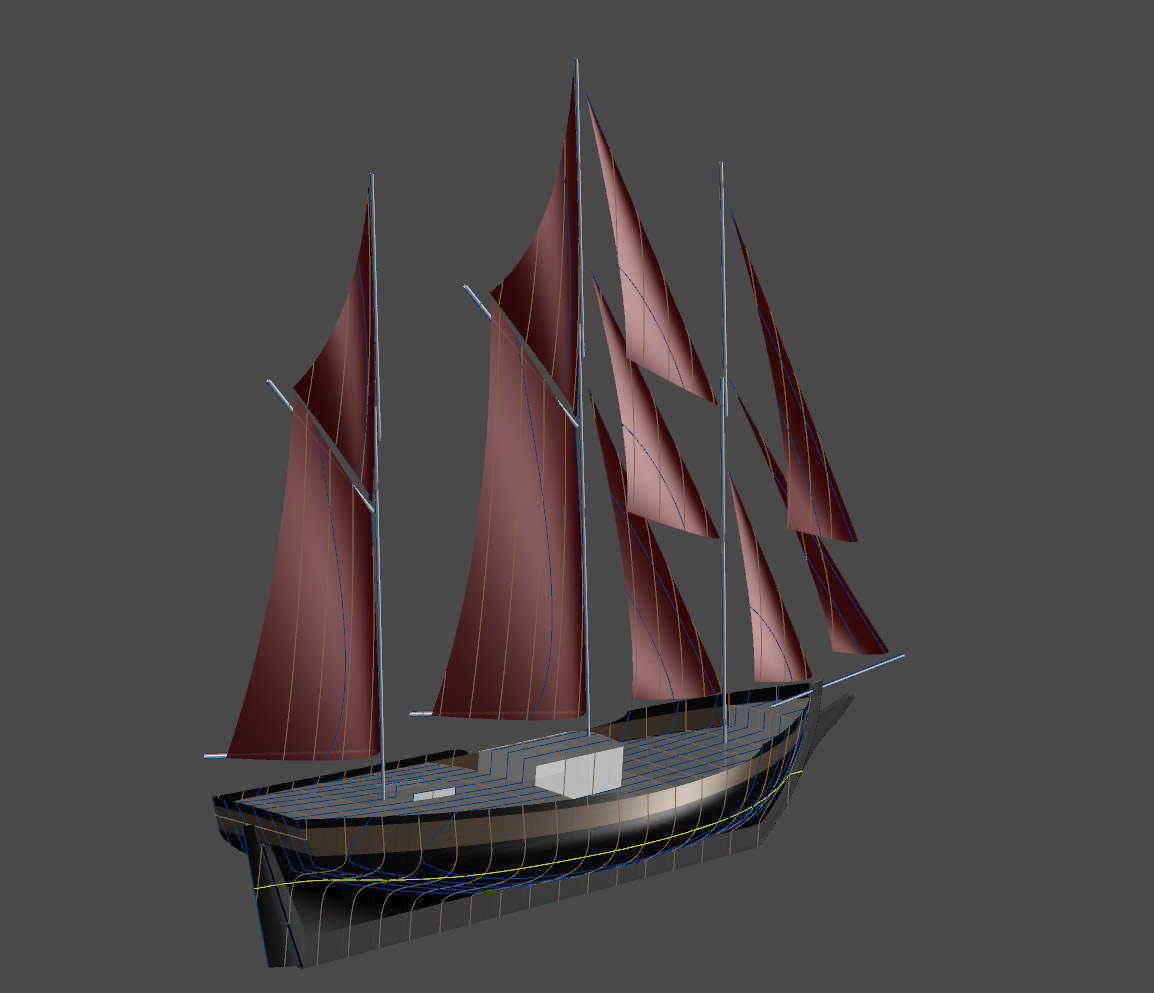
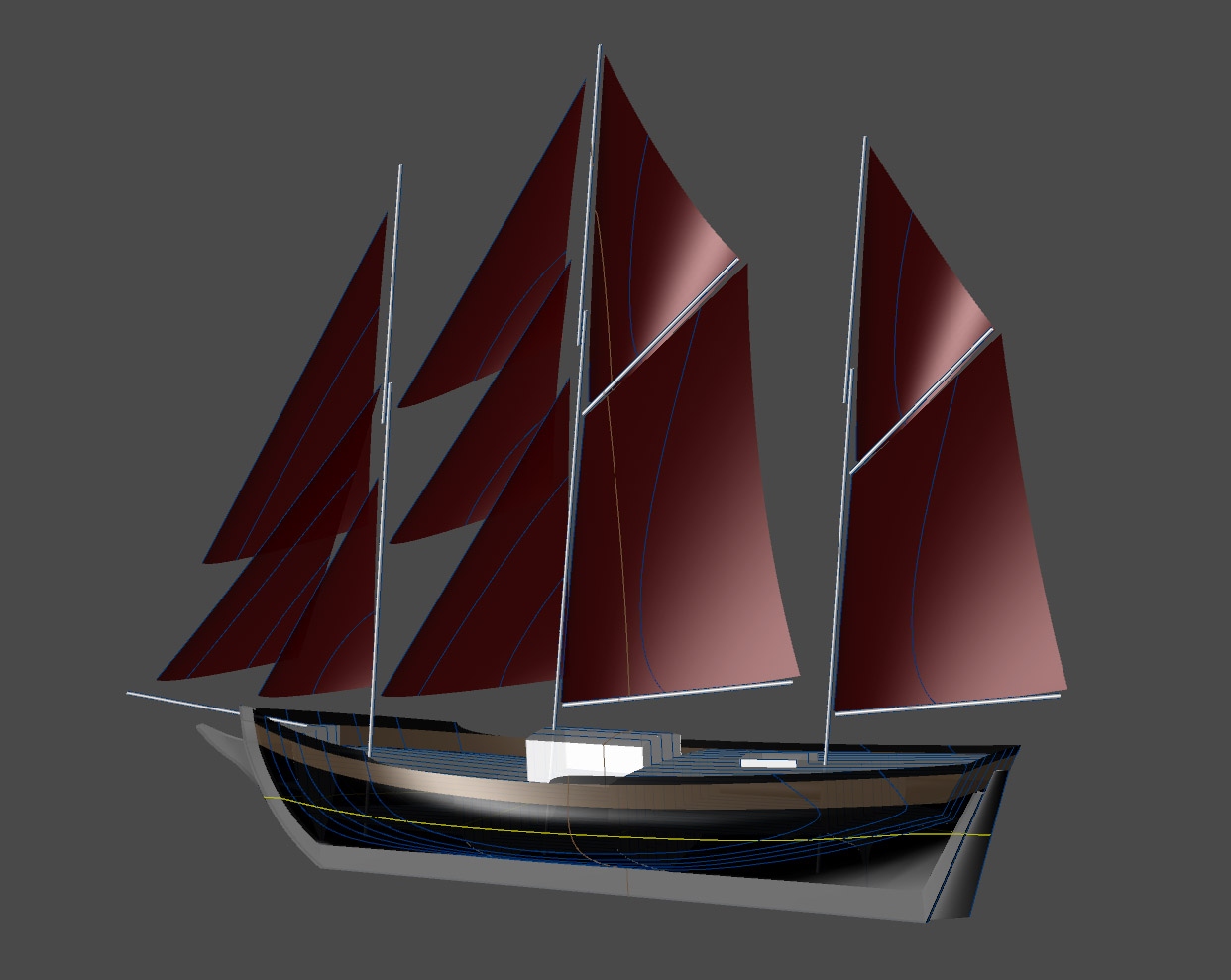
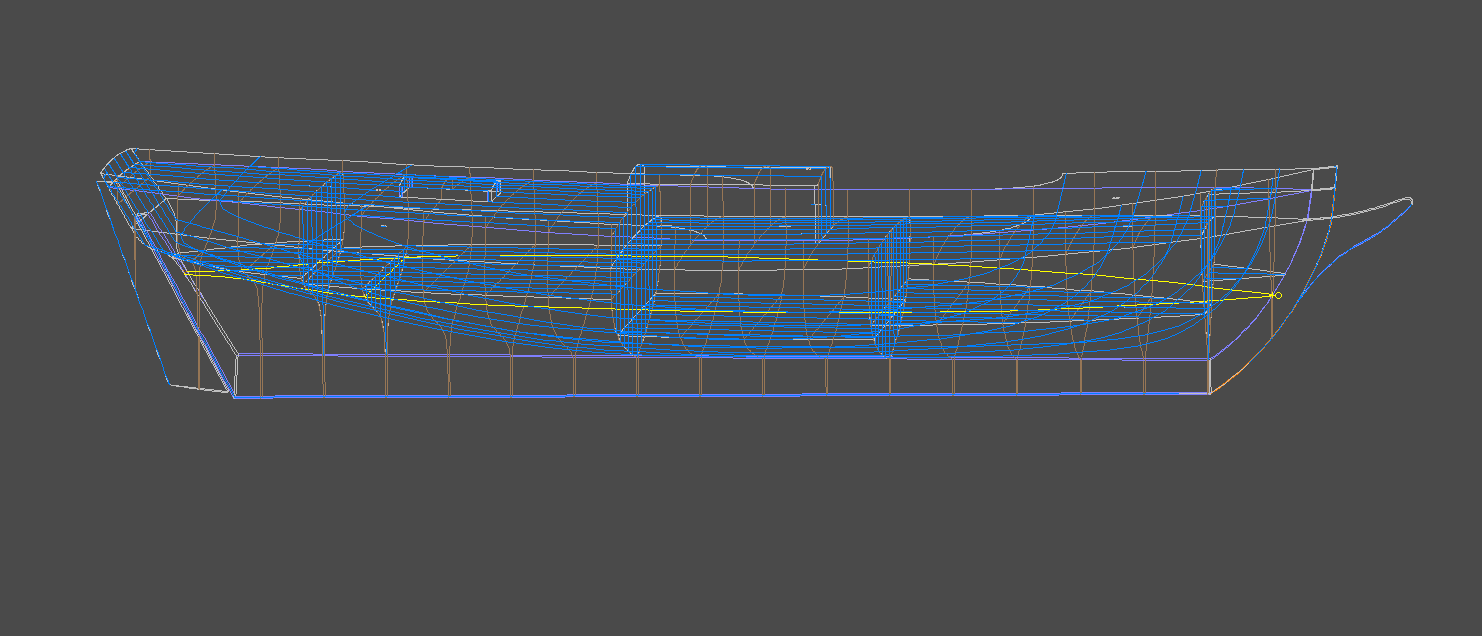
Aft Perspective | Port Side Perspective | Lines PerspectiveCopyright 2007 - 2016 Michael Kasten
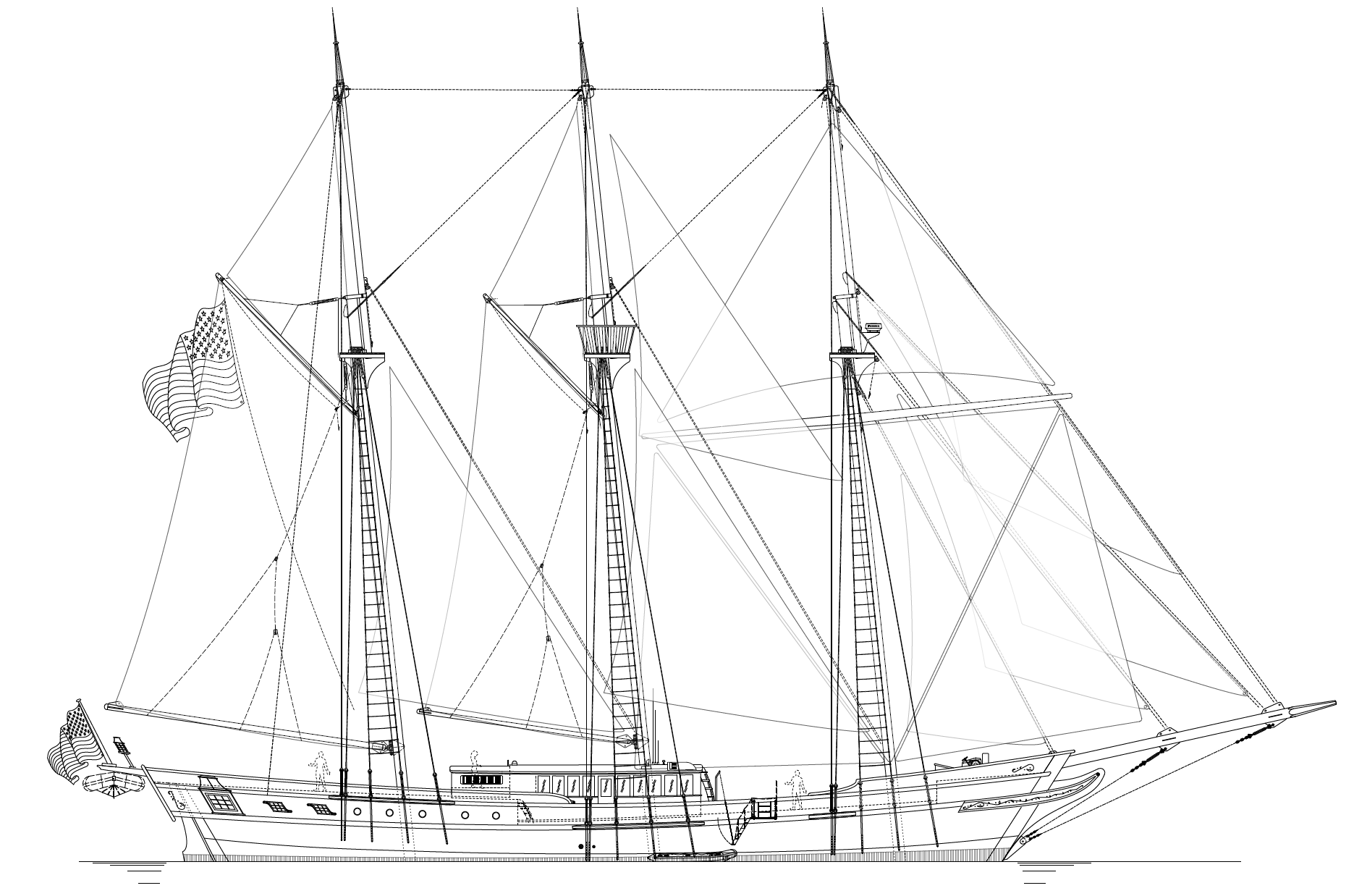
The 135' wooden plank-on-frame vessel shown here is modeled after the traditional privateers of the 19th century, but with a modern sailing hull shape, ample sail area, and external ballast... a winning combination for performance under sail.
For an introduction to our background and experience with a variety of traditional large wooden vessels, please see our Pinisi History web page.
The Privateer as Sail Training Vessel...!
This concept design was developed for the Youth Sail Training Foundation which had planned to operate the vessel for the benefit of youths at risk in California. Accommodations were planned for 32 trainees, four counselors and four deck hands forward, and for 10 crew aft.
What better sailing type than the Privateers of yore to give these young folks an unforgettable experience, and hands-on training in the myriad skills required to operate a ship such as this.
To create a sail training vessel for 32 trainees has first been a matter of sizing and arranging the cabins for their intended purpose. Our next task has been to refine the rather traditional hull type for its new use as a fast sailing vessel, one that will carry only people and the requisite fuel, water, and supplies, but no cargo... As a bonus, the refined and more yacht-like hull shape will provide much greater comfort in the sea than a relatively more boxy cargo hull type, as well as much greater performance.
Additional goals with this vessel have been to provide maximum strength for the sake of longevity of structure. Our aim in so doing has been to reduce maintenance, improve the performance under sail, and to increase the long term safety of the ship.
Power will be provided by an 850 to 1,100 hp Yanmar diesel. The target top speed under power will be 12 to 13 knots, depending on conditions. Of course a larger engine could be provided, however above around 12 knots the power requirements and the consequent fuel use, as well as the machinery cost become excessive. In other words, we're aiming toward the sweet spot in terms of powering, rather than top speed...
Preliminary Particulars...
- Length on Deck: 135' (42 meters)
- Length WL: 124' (without deadwood)
- Length WL: 129.4' (with deadwood)
- Moulded Beam: 35'
- Body Depth: 13' (deck to rabbet amidships)
- Keel Draft: 14' (maximum aft)
- Displacement: approximately 450 Tons (to be determined)
- Prismatic: 0.58 (preliminary)
- Sail Area Target: 12,500 sq ft
- Average Sailing Speed: 11 knots
- Maximum Theoretical Speed: 15 knots
- Maximum Likely Speed: 18 knots
- Engine Power Target: 850 to 1,100 hp
- Max Speed Under Power: 13 knots
- Hull Structure: Traditional Plank on Frame
- Spars: Welded Steel Tube
- Rigging: Steel GIPS 6x7 Wire Rope
- Class: Germanischer Lloyds
LAYOUT
The Lines Perspective gives the best idea of the interior spaces. It is actually the interior layout that drives the overall vessel size and the exterior configuration. In other words, regardless of our choice of hull type, the relative position of the interior and the cabins will remain the same.
On Deck: At the forward end of the fore deck is a Cuddy / Bos'n's Locker. The house structure on the 'midship deck is the Galley. Aft of the Galley is a raised Poop Deck. Centered in the Poop Deck is a large sky light. Ladders will lead upward from the Fore Deck to the Poop. Although it is not shown in the images here, there will be a scuttle located forward for direct access to the cabins below.
Below Forward: Directly below the Galley is the Forward Mess area, having 4 Heads, 4 Showers, and 8 berths at that level. Directly aft of the Forward Mess is the Engine Room Bulkhead. Forward of the Forward Mess is another WT bulkhead with WT doors leading to another sleeping area.
In the forward Trainee Cabin there will be 32 berths as follows (starting at the aft end)... 8 + 8 + 6 + 6 + 4. In the aft two bays there will be 2 berths outboard port and starb'd, plus 4 berths on center. The next bay forward will have 2 berths outboard port and starb'd plus 2 berths on center. The next bay forward will have three berths outboard port and starb'd. The last bay forward will have two berths outboard, port and starb'd. This arrangement will allow plenty of room for a companionway scuttle and ladder leading down at the forward end of this cabin.
Fresh water tanks are located below the Forward Mess. Below the Trainee Cabin will be a pair of water tanks plus two waste tanks.
Below Aft: Aft of the Engine Room Bulkhead immediately below the Poop Deck is the Crew Mess on center, with Crew Cabins outboard and aft. On center above the Crew Mess is a large skylight.
Aft of the Crew Mess are the Captain's and Director's cabins.
Machinery Spaces: Directly below the Crew Mess is the Engine Room. The Engine Room will have comfortable seating all around the perimeter in order to easily tend the equipment without requiring full standing headroom. The propulsion engine will be located toward the forward end. There will be twin generators in-line aft. Fuel tanks will be located outboard within the Engine Room.
Aft of the Engine Room is a small storage room for spares, etc.
It is all rather preliminary at this point... and there may yet be changes to refine the interior, as well as a few other hull types to investigate...!
The Rig...
The rig will consist of three tubular steel masts, each having a single tubular steel topmast. The Main Mast and the Mizzen Mast will have fore and aft Gaff Sails with Gaff Tops'ls. Forward of the Main Mast will be three Main Stays'ls.
Square courses will be placed on the Fore Mast, though they are not shown in the above images. There will be two square yards on the Fore Mast. Above the upper yard will be a Raffee. Between the yards will be a Square Sail. Below the lower yard will be a Cro'jack (Cross Jack), which is defined as a triangular sail having the apex downward.
The Cro'jack sail type has been chosen in order to allow flying a pair of Genoa-shaped Stuns'ls (Studding Sails) outboard of the Cro'jack, thus eliminating the need for Stuns'l yards.
The rig thus described is that of a Barquentine. The mast positions are preliminary, however they fit well with the interior layout.
More Information...
For more information on these or similar craft, please inquire.
Please also see our design of the Mermaid 61 - an all aluminum brigantine styled after these 1700's privateers.
Click for Larger ImageCheck out these web pages related to other large wooden vessels of our design:
Please see the AVAILABLE BOAT PLANS web page.
Home | Intro | Our Design Process | Stock Design Info | Motor Yacht Designs | Sailing Yacht Designs | Prototype Designs
Plans List | Articles | Our CAD Design Stream | Maxsurf | SITE MAP..! | Site Search | Design Team | Contact Us