Messing about in boats since 1975. Online Since 1997.
Home | Intro | Our Design Process | Stock Design Info | Motor Yacht Designs | Sailing Yacht Designs | Prototype Designs
Plans List | Articles | Our CAD Design Stream | Maxsurf | SITE MAP..! | Site Search | Design Team | Contact Us
Please see the AVAILABLE BOAT PLANS web page
What's the Ideal Sailing Rig...?
Kasten Marine Design, Inc.
Copyright 2001 - 2020 Michael Kasten
Rig Choice
Cat, Sloop; Cutter; Ketch; Schooner... these are the basic configurations.
How shall we choose among them?
The type of rig is often a pre-ordained choice once one has determined vessel size, the preferred layout, and the maximum size of sail one can handle. While this may seem somewhat heretical at first, there is no arguing the fact that no one wants a mast in the middle of their double berth...! Therefore, if a double berth right forward is a priority, it is likely to rule out the schooner rig on a vessel under around 50 feet. For that layout, we would instead tend toward the ketch or cutter rig. On a fairly small vessel though, we might make excellent use of the Cat rig.
How shall we choose?
It is always a benefit to windward performance to limit the number of sails. A cutter will perform better for example than a ketch or a schooner due to there being less windage in the rig, in other words less drag, and less turbulence introduced per sail area by the masts.
Since lift is important for windward sailing, one might then ask which sails provide the most lift...?
The answer to this depends on the sail rig, and on the relative proportion of total sail area given to each sail. Since headsails can be varied, their relative contribution to overall lift can be varied as well. It also tends to be that area for area a headsail will provide more lift than a sail mounted on a mast, mainly due to the turbulence caused by the mast. However that can be mitigated by the use of dual-skinned sails that create a true foil with one sail on each side of the mast, as is done on the Ljungstrom rig.
Why would we consider a split rig then?
In nearly all cases this choice boils down to the simple question, "What is the maximum size sail you are comfortable handling?" In answering this question honestly, we nearly always discover that on all but the smallest of boats, for general cruising we will probably be better off with a split rig, such as a ketch or schooner. This will serve to limit the size of the main sail for easier sail handling, and still allow a generous overall sail area. It will also give us the benefit of having a rig that is less tall, so better able to be supported.
Rather than having a preference for any one rig type, I believe this question will best be answered during the course of developing a design. The rig should naturally be suited to the specific purpose for which the vessel is being developed. The following is intended to shed some light on these questions...
Racing or Voyaging...?
We know that lift is important when sailing to windward, across the wind on a reach, and possibly as far off as a broad reach, but not so much when sailing directly off the wind. The farther off the wind you sail from 90 degrees, the less important is lift, and the more important is drag. Of additional importance is a vessel's handling and steering behavior. These factors result in two extremes... and a middle path...
RACING
For racing, it is important to maximize lift and mimimize drag so that windward efficiency is achieved. Given that racing yachts must maximize lift, the aspect ratio of their sails and their keels are designed to be at the maximum that the boat can carry. The more time the boat will spend sailing to windward, the more important its windward performance becomes. Since most races are won / lost on the windward leg, maximizing aspect ratio, and therefore maximizing the amount of lift to drag, that wins the race.
However, with many such boats fairly severe handling problems can arise due to the fact that a higher aspect rig exerts a greater turning moment on the vessel as it fills with wind. In other words, the taller mast provides a longer lever with which to turn the boat to windward. The keel does the same, i.e. a deeper keel provides a longer lever with which to resist and augment the windward-turning force of the sails. This tends to make the boat relatively stable to windward, with both forces in balance, but makes the vessel very unwieldy and hard to manage down wind.
Along with the enhanced windward performance provided by high aspect sails comes rather poor off-wind performance, therefore the use of big spinnakers on racing boats in order to make up for the poor efficiency of the high aspect sails off the wind. This comes at an additional price in terms of steering stability. Moreover, spinnakers themselves are not so easy to handle, nor so well behaved.
Often the boat itself is not optimum for off-wind sailing. For example, the usual wide, shoal body, fat-transom racing type with a deep fin keel and spade rudder will always be unstable downwind, especially when flying a spinnaker, requiring constant attention at the helm.
VOYAGING
By contrast, since any long distance sailing adventure will be specifically planned to take advantage of following winds, or at the very least to make use of favorable winds, if a vessel’s design is to be optimized for sailing with the wind, the aspect ratio should be reduced. In fact, the best sail rig for off-wind voyaging is the square rig, with an aspect ratio of one.
In combination with the low aspect sail rig, the keel should also be low aspect, i.e. long, spread out, and not too deep. This is for the sake of steering stability; to match the aspect ratio of the sails; and so the boat is not so easily tripped by its keel and rolled over in a beam sea.
Although this combination is perfect for running in the trade winds for weeks on end, it can hardly be recommended for sailing well to windward...
MODERATION
Naturally, no modern sailing vessel ALWAYS sails off the wind even if it will be primarily used for voyaging. Neither extreme is appropriate, therefore a compromise is needed. If a boat is to be optimized for all-around sailing, including voyaging, it makes no sense whatever to provide the kind of high aspect rig optimized to win a round-the-buoys race. Nor does it make any sense to do the opposite, i.e. provide a square rig and long shoal keel.
The best is somewhere in-between, i.e. with an aspect ratio for the sails on the order of that recommended below. In order to match the aspect ratio of the sail rig, the keel should also be something in-between, thus a cut-away forefoot and reduced wetted area, without becoming too deep, nor too long and shallow.
This moderate configuration will provide good efficiency all around, the sails will be less tall and easier to handle, and the hull will be better able to provide the all-important course keeping ability desired for ocean crossings.
What About Windward Performance?
To reiterate the above, if the keel is very long and shoal, and the rig is similarly low and spread out with gaffs and bowsprits and multiple masts ( say like a mid-1800's US coastal fishing schooner) then provided there is adequate sail area, performance will usually be excellent when reaching or running, but less than optimum to windward.
At the opposite extreme (disregarding hull form for now) is a deep high-aspect fin keel, with a tall high-aspect Marconi sloop rig. This type of vessel will ordinarily perform very well to windward, but will be quite inferior on other points of sailing, requiring spinnakers and a sizable inventory of reaching and running sails.
As noted above, these are two extremes. Given all that we have learned about windward sailing since the days of old, there is no reason to suffer poor windward performance on any vessel, nor poor off-wind performance necessitating a large sail inventory (read expense and hassle) often accompanied by poor down-wind handling.
There is a wide middle ground...!
Examples among my designs that have maximized voyaging ability, but still have reasonably good windward ability, are Redpath, and Zephyr, both excellent for voyaging. If one were to take the keel design on those vessels just a few notches farther toward reducing wetted surface, but still good for voyaging, you have a keel configuration like that on Jasmine, with separate keel and combination skeg / rudder. In each of these designs, a modern NACA foil keel and modest aspect rig has been provided for the sake of all around sailing both on and off the wind, and good steering stability.
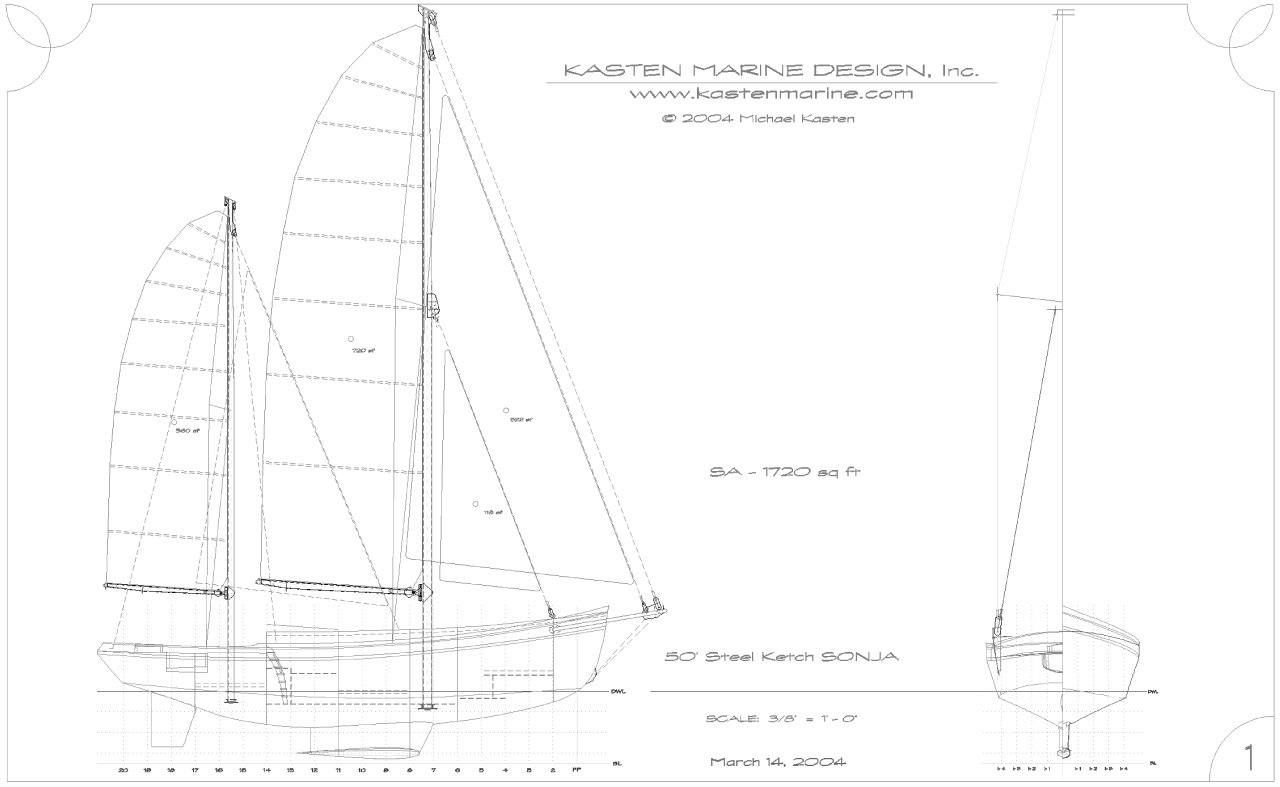
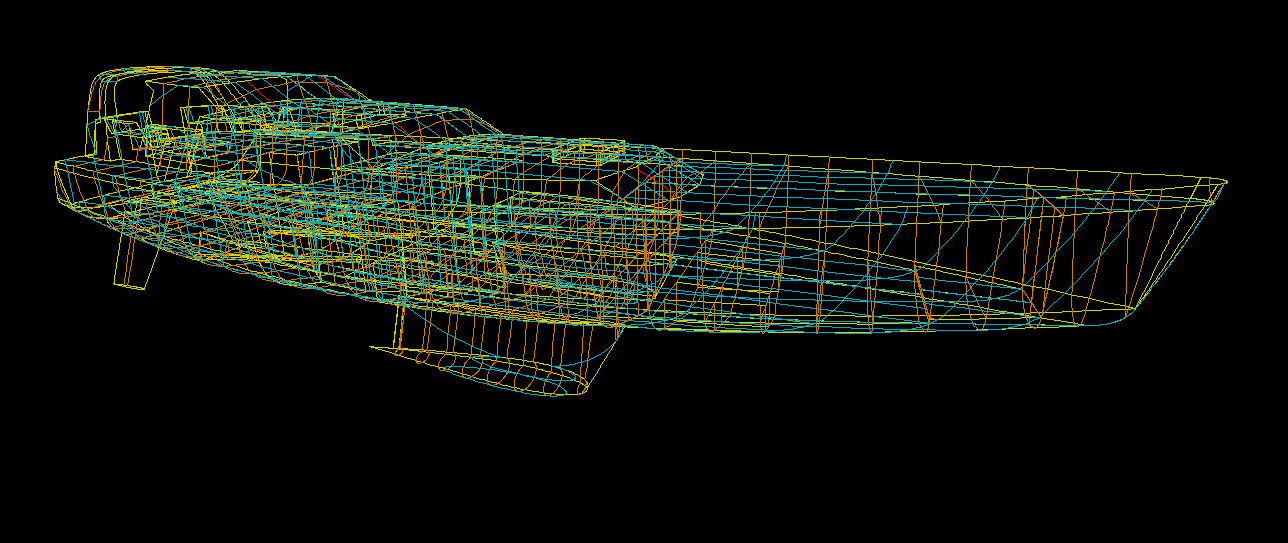
If one were to take this a few steps farther in the direction of windward performance, a configuration like that shown for my prototype design called Sonja makes good sense, in this case having a NACA foil bulb keel and a NACA foil spade rudder. It is worth mentioning that Sonja is not yet a completed design, and when finalized might have a slightly deeper keel, although possibly not. The reason to be equivocal on this point is because the bulb on the keel bottom acts as an “end-plate” effectively doubling the aspect ratio of the keel without having to make it deeper...
If it is desired to not have a bowsprit, then in order to achieve adequate sail area the rig must simply become taller yet, and the keel deeper.
Quantifying Performance
The type of rig one chooses will certainly have an effect on performance, as will the amount of sail area. For maximum performance, there is much benefit to be had with a good hull and keel design, and with well proportioned and well cut sails. We tend to observe many older vessel types which may have neither optimum hull design nor well proportioned sails, and then pass judgment on the type without considering those mitigating factors.
Instead, we should look at the components of good cruising performance, and optimize the hull and sails to suit those highly specialized requirements.
Aspect Ratio is defined as the height of the sail squared, divided by the area of the sail. A perfectly square sail would have an A/R of 1. A 450 sq. ft. triangular sail with an A/R of 6 would have a 52' luff and a 17' boom. They are both extremes.
It is well known that higher aspect sails produce greater lift when close hauled. It not so widely known however that high aspect sails stall much more readily as the angle of attack widens. As A/R gets higher, sails get less and less efficient at pulling when anywhere but close hauled.
For racing, where windward performance is of prime importance, it has been shown that an aspect ratio greater than 6 is of little use on monohull racing craft. An appropriate range for optimum windward sailing will be an A/R of from 4 to 6.
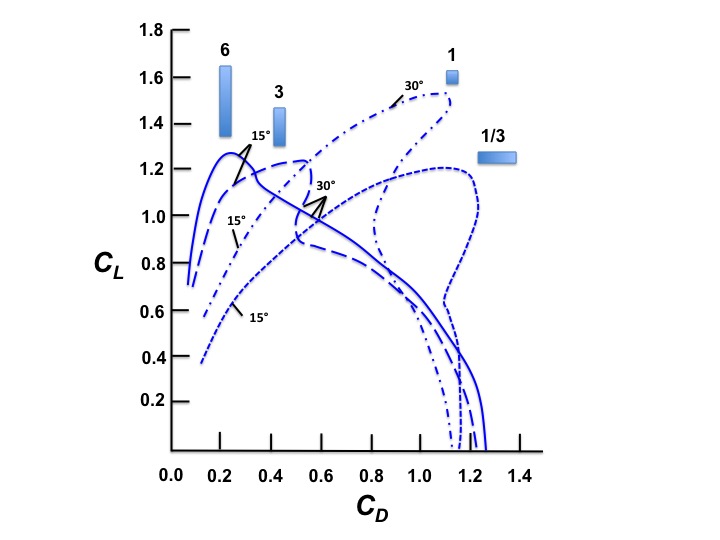
A polar diagram showing lift vs. drag plotted for sails having the same area but differing aspect ratios very graphically shows that the favored lift / drag position is quickly handed off to shorter and shorter rigs as a sail is eased. If you would like see this data graphically presented, please have a look at the Aero-hydrodynamics of Sailing by Marchaj, p. 444, Fig. 2.138, also shown below...
A study of this data shows that the most favorable aspect ratios for ocean cruising, where all-around performance is the goal, an aspect ratio from 2.5 to 3.5 is very appropriate, with an approximate upper limit of around A/R 4. Naturally, these are not "hard" boundaries, only guidelines. In most cases, a compromise is struck in consideration of the times inevitably spent sailing to windward and according to owner preference.
In the data presented by Marchaj in the above graph, the angle of incidence of the sail is plotted against lift vs drag. A sail having an A/R of 6 performs exceedingly well at an angle of attack to the apparent wind of 10 degrees, where lift divided by drag (L/D) yields a ratio of around 8.5. At 10 degrees, a sail with A/R 3 has an L/D ratio of 6.5. At 15 degrees, the A/R 6 sail has an L/D ratio of 4.47, and the A/R 3 sail has an L/D ratio of 4.5. At 20 degrees, the A/R 6 sail has an L/D ratio of 2.7, while the A/R 3 sail has an L/D ratio of 3.3, and so forth. By the time an angle of attack of 30 degrees is reached, the favored position is handed off to a sail with an A/R of 1...!
Note that A/R as used here refers to the A/R of each individual sail. If the A/R of each sail is, say 3, when adding the sails together the overall height of the rig would not increase, but the overall base dimension WOULD increase, therefore the A/R of the whole rig would be less. The optimum A/R discussed above - and as measured, discussed, and graphed by Marchaj as above - is that of each individual sail.
The salient point is that extremely high aspect sails are not "bad" sails, they are just not optimum for general ocean cruising where it is rare to be sailing dead to windward. When required to do so, sails with an A/R of from 3 to 4 will perform quite well, in particular when eased off a few degrees.
The benefits of lower aspect sails become much more evident when performing the engineering stunts required to keep an A/R 6 sail's mast from collapsing..! The simpler rigging made possible by lower aspect sails will be its own reward in terms of ease of construction, less rig stress, easier maintenance, and greater rig longevity. Reduced maintenance and greater longevity... the holy grail for cruisers...!
Whether using a Bermuda rig, a "Marconi" rig, or a Gaff rig, the above factors encourage keeping aspect ratio of the individual sails under around 3.5 to 4 for an ocean cruising vessel. To see an example of this type of modest Bermuda rig, please check out my Fantom design - a perfect all-around cruising vessel.
Rig choice is mainly a matter of assessing one's priorities. If those priorities tend toward racing, then the choices will be quite different than the choices made by a cruising sailor.
Keel Profile
If the rig is tall and the keel deep, the lever arm will be relatively longer from the center of lateral resistance to the center of effort of the sails, therefore the amount of horizontal lead of the CE forward of the CLR must be proportionately greater to compensate. If on the other hand, the rig is kept fairly low, there will be less draft, and the ideal amount of lead will be much less, even though sail area and stiffness are not reduced.
For the best steering and course keeping behavior, and for the greatest overall structural strength, a long full keel offers the most benefit to the long distance cruising sailor. This type of long and relatively shoal draft keel is ideally suited to the lower aspect sail rigs, say up to an aspect ratio of around 3.5.
An example is my design Redpath, having relatively shoal draft and generous sail area, yet good sail carrying ability (stiffness). Other examples with similar A/R and keel configuration are Benrogin, Lucille 42, Lucille 50, Grace, Zephyr, and Shiraz designs.
For the ketch Shiraz, the rig height was limited to 60' off the water for convenience while traveling the ICW along the East Coast, and the draft was limited to 5' - 6" for sailing in the Bahamas. Since Shiraz is an aluminum vessel, there is actually greater sail carrying ability than necessary, so we have the option to give her more sail area, or we may on the other hand choose to keep the rig as-is and assume there will be an extra margin of safety when flying a mule or a spinnaker.
Taking the Shiraz a bit further in the direction of windward performance, we might increase the aspect ratio of the mains'l and mizzen, and deepen the keel. At that point, it might be desirable to consider splitting the keel into a deeper portion to contain the ballast, then a shallow portion to contain the shaft alley, then another deeper portion to act as a skeg for the rudder. This would allow a very efficient foil shaped "cruising fin" type of keel, and a similarly efficient combination skeg / rudder combination, while also limiting wetted surface.
When the aspect ratio of the sails becomes greater than around 3.5, this kind of long "cruising fin" and skeg hung rudder will usually be preferred. Primarily this choice will be made in order to deepen the keel (and the ballast) but to avoid extra wetted surface. For quick maneuvering, this kind of keel will always be a bit more responsive. The "cruising fin" keel, having a higher aspect ratio and therefore greater lift vs. drag, will naturally have better windward performance than a long and relatively shoal full keel. If not carried to extremes, this will not materially degrade course keeping ability nor the strength of the keel and rudder.
Of course when the rig becomes very tall, the keel will become still deeper. Windward performance will be improved, but performance on other points of sail will be degraded, as will course keeping ability. Taken to its logical extreme with deep fin keel and spade rudder, when running in a sea of any size attention to the helm will be critical. This is especially so with fast high aspect sea-going sleds having very fine entries and broad flat sections aft, where lack of attention to the helm may result in an instant broach. While there is no question that this is exhilarating sailing, it can hardly be recommended for safe family cruising...
For long passages with the helm unattended, a long and relatively shoal full keel will always be more steady than any other type. For long distance cruising, a longer keel will "track" somewhat more like it is on rails. In harbor, maneuvering turns will have a larger radius. The tactic in that situation is to use a bit of reverse gear to take headway off the boat, then give it a burst in forward gear with the helm over, then another burst in reverse, etc. With that, any full keel boat can be pivoted in her own length.
Rather than there being any right or wrong choice, the type of keel profile is a matter of preference, usually based on the type of sailing that is planned. During the design process, once the preferred keel configuration and rig type are chosen, it is simply a matter of balancing them against each other in order to obtain the required lead for the sail area vs the lateral area, and to place the ballast where required for proper trim.
Regardless of whether a design is given a long full keel or a "cruising fin" keel, it will benefit performance both on and off the wind to make use of an efficient NACA foil shape. The particular choice of foil type will depend on the keel profile in order to maximize lift, and minimize drag.
What About Winged Keels...?
Should the cruising sailor consider a winged keel...? An excellent question.
The wing keel concept is not brand new. It has come to us as an evolution of various approaches from the past.
For long full-keel applications, the idea was promoted by Henry Scheel from the 1960's onward. It became known as the "Scheel Keel" which has the form of a modified "bulb" along the base of the keel. The particular configuration is to widen the base of the keel via a broadly curved keel bottom (athwartships), with a concave return to the body of the keel above. This creates both a large envelope for the ballast down low, without having to increase draft, and also provides an "end plate" to reduce the induced drag from eddy making at the base of the keel foil, effectively increasing the A/R of the keel without having to make it deeper...
Among racers, this concept is transformed into a blade with a distinct "bulb" at the base containing the ballast. This serves the same function as the Scheel type of arrangement, i.e. to lower the ballast and to reduce eddy making at the tip of the keel. A few bulb keel examples can be seen on the 96' schooner Zebulun and the 50' ketch Sonja.
The further evolution of the simple bulb is a "bulb with wings." Quite a few combinations have been developed, including several that are aimed more at the cruiser / racer types.
In moulded fiberglass or cast lead, nearly any shape can be achieved. In metal construction however, one of the basic challenges in order to keep building costs within bounds is to make use of shapes that are both easily fabricated, and that are also efficient in use. For a cruising boat, an additional priority is to create a structure that is sufficiently robust to withstand serious abuse.
In metal construction, for the greatest economy of labor during fabrication (i.e. the most bang for the buck) the most reasonable approach is to make use of simple and distinct shapes, rather than "blended" surfaces as would be more typical with fiberglass construction. For metal construction therefore, if a bulb is planned, it will ideally be a distinctly formed shape, attached to another distinctly formed shape, the keel foil. If wings are provided on the ballast bulb, they will also ideally be distinct "appendages" having a long low aspect shape. If a Scheel type of keel bottom is planned, then for ease of construction it will ideally make use of large diameter heavy wall tubing for the bottom shape, and sections of similar tubing for the concave "return" to the keel foil.
The cruising sailor empirically observes, "What sticks out, breaks off." To address that observation, appendages to the hull are approached with an extreme conservatism... With a winged keel, we have added an appendage to an appendage...!
I believe an approach such as that taken by Scheel, or possibly a bulb or modest bulb / wing arrangement, will have the greatest merit for the long distance cruiser. The primary requirement is that the boat be able to take the ground and heel right over on the hard without any chance of structural damage, for which the plain keel, the Scheel arrangement or the bulb keel are ideally suited.
Is the Gaff Rig Suited to Modern Cruising...?
If windward sailing is of paramount importance then of course the Bermuda rig has much to recommend it.
For modern day cruising the gaff rig is often maligned. In my view, for blue water voyaging the gaff rig has much to offer.
If a vessel's keel is shaped efficiently and if the sails are cut for maximum efficiency on the wind and if the sail plan has been designed well, a gaff rigged boat will perform incredibly well, in many cases besting the performance of a high aspect ratio Marconi rigged boat. This is especially so if one is sailing on any course other than a hard beat to windward.
A gaff rig provides the chance to set more sail area on a given length of mast. For a given sail area the mast can be quite a bit shorter, so the mast will be that much stronger and will require less complex rigging to keep it in place.
The stiffness of a column is inversely proportional to the square of its length. A mast that is twice as long will fail with only one fourth the load, therefore must be four times stronger. One strategy is to use a heavier mast section. The more typical approach is to divide the mast into several "panels" by the use of spreaders. This is the "Marconi" rig. It introduces more stress, more places for failure, more cost, more maintenance, etc. For racing, this is of course justified.
For general cruising however, we can make a good case for keeping things simple and strong. If set up simply, a traditional rig will be friendly and easy to use. For example, one will be handling soft lines rather than harsh stainless wire and winches. If the sails are laced, we will have eliminated sail track and other hardware, along with its relatively much greater expense. This is not to say that one should be old fashioned... far from it!
For example, nearly all the masts I specify are welded aluminum tube or pipe. These are perfect for the gaff rig as well as for the low aspect Bermuda rig. Compared strictly on a strength to weight to cost basis, aluminum pipe spars are impossible to improve upon.
As further example, among the gaff rigs that I have drawn, one will observe that I prefer short gaffs without tops'ls. Primarily, this is for reasons of simplicity, efficiency, and ease of use. The penalty in excess rigging required for gaff tops'ls is more than I'm usually willing to fool with while sailing. In my experience, due to that added complexity, gaff tops'ls often just sit in their bags unused. In exchange for the added complexity of rigging, gaff tops'ls ordinarily provide little gain in terms of usable sail area.
Notes on the Short-Gaff Rig
My short-gaff sail plans are meant to address the shortcomings of the traditional types of gaff rig sail plan when used on smaller craft (say under around 60 feet). By using a short gaff with no tops'l, there is more luff length to the sail. With a longer luff on the lowers, the lower sails are able to perform much better when on the wind. As an added bonus, sails are not broken into such small units, so are able to be more efficient on all points of sail.
As a further bonus, the short gaff arrangement permits a single halyard to be used with a fixed bridle (not a sliding bridle). With a short gaff there is no need for a separate throat halyard. The bridle legs are balanced during sailing trials, then permanently made fast at the best spot. Luff tension is thereafter adjusted at the gooseneck. As a bonus, the fixed bridle always keeps the gaff in the same attitude while raising and lowering.
This works so well that all of the gaff rigs that I’ve specified for yachts under 60 feet on deck have a single halyard for the gaff. While it is possible to do this with a longer gaff, it works best with a short gaff. Certainly larger vessels can use the short gaff and single halyard, provided sails are not too large. As sails become too large to man-handle, a winch can be used for raising sail. Even on much larger sails the short gaff offers the benefit of greatly reduced weight aloft, and an easier job of raising sail.
The short gaff - long luff sail is not my invention by any means... In fact, in its ideal form the short-gaff-sail is fairly close in profile to the shape of the fully battened elliptical plan form racing sails of today. The short-gaff rig was developed and was well proven on vessels such as the Dutch sloops, Bermuda sloops, and of course the pilot schooners that sailed out of Baltimore during the 1800's and early 1900's.
The pilot schooners needed a foolproof rig that had superior performance, and that could be handled by a man and a boy. They were large vessels...! Applying the same strategy to smaller sailing vessels one can easily single hand a 50 footer. As far as their sailing properties, the improvement in windward performance is well documented among those vessels, and by my own experience having sailed with this arrangement on my own schooner Emerald.
The benefits are to simplify the rig, to reduce windage, to reduce the work of raising and lowering sail, to increase luff length for better windward sailing, to reduce weight aloft, and to eliminate those pesky tops’ls. That said, on a schooner I do like to use a fisherman tops’l beetween the masts since it provides enough area to be worthwhile and is easy to set and strike.
By comparison, gaff tops’ls are often more trouble than they are worth - another point strongly favoring the "bald headed" gaff rig.
What About the Schooner Rig?
The schooner is able to spread more sail per length of spars than any other rig. This allows a generous sail area, while the center of effort is kept low down.
On a schooner of any size I like to arrange for both main and fore sails to be similarly sized. This is done to prevent the mains'l from becoming too big to handle. To determine the size of each sail, one should try to make use of sails as large as can be confidently handled, and no larger.
Much of what is written about schooners and gaff rigs assumes that one will be using a traditional sail plan with long gaffs, two halyards for each gaff, main and fore tops'ls, fisherman tops'l, stays'l, jib, jib tops'l, etc. Added together even on a small schooner, that represents some twenty halyards and other control lines.
As an example of how one might simplify that configuration, Lucille and her sisters, Redpath and Benrogin have only four halyards for the lowers, and two for the fisherman tops'l. The total: six halyards... ! Simple is beautiful...
Redpath as Example
We had the opportunity to sail two 34' schooners having exactly the same hull form and sail area against each other. One vessel had a "traditional" gaff schooner rig, with long gaffs, gaff tops'ls, stays'l and flying jib. The other vessel had a short-gaff rig of my design with exactly the same sail area. One feature of the rig I tend to prefer (as with designs like Redpath) is that the working sails are sized to be as nearly alike in area as possible, so there is no single dominant sail. All of these improvements served to simplify and lighten the rig and provided far less windage.
The result...? Although both vessels performed more or less equally on a down wind course, we out sailed the "traditional" rig hands down both reaching and beating. With the short-gaff rig as I modified it, as compared the other vessel of the same hull design (but having a traditional long-gaff rig and gaff tops'ls) we could better their windward performance by around 5 degrees.
What I had done is to eliminate the tops'ls and raise the throat of the gaffs up farther, like on Redpath and Lucille. The combination of better windward performance with a simpler, but still classic rig... it is a big success! Another bonus is that the simper short-gaff rig was far easier to build, to handle and to maintain. I liked it so much that I made an identical rig for my own schooner, Emerald.
I attribute the improved windward performance to the following factors:
- Fewer sails, therefore more lift per amount of drag (reach, run or close hauled).
- Longer luff length on fore and main.
- Less running rigging and clutter (less than half the number of halyards) so considerably less windage.
- Flatter cut to the sails in order to maximize windward sailing.
- Hollow cut to the jib luff to allow for wire sag, so the sail still has good foil shape to windward.
Redpath was yet another refinement of the concept, having been designed to take best advantage of the optimum rig right from the beginning. A further refinement on Redpath has been the use of a NACA foil keel. The combination of the improved keel with the taller and more efficient short-gaff rig will provide some 7 to 10 degrees closer sailing tack to tack (the "real" measure of performance) than does a more traditional schooner type having tops'ls, multiple jibs, a nest of extra halyards, and a long straight shoal draft keel. The improvement to windward has been accomplished without sacrificing reaching or running performance, and at the same time whilst improving the vessel's tracking ability on all courses.
Redpath is relatively light in terms of displacement to length, and has a high sail area to displacement ratio in her working sails. This not only makes the boat fast, but also makes the rig ultimately easier to deal with, since there are no light weather spinnakers and so forth to fool with. For light weather sailing, the Fisherman Tops'l is kept very well controlled between the two masts, having a line at each corner.
If one could say there is any single factor responsible for providing excellent performance on Redpath, it would have to be attributed to the amount of sail area provided. The sail area given to Redpath is able to be generous because it is located relatively low down, rather than on one single tall stick. A Marconi type of rig will ordinarily require a deeper keel for adequate sail carrying ability.
One cannot make reasonable comparisons of course to vessels having a fin keel, spade or skeg hung rudder, and sloop rig, as those types will always have superior windward performance. What those keel and rig types give up in terms of off-wind sailing is considerable... Steering stability off-wind is compromised, as is safety in taking the ground, as is the ability to heave to gracefully, etc.
The main thing is simply to define the type of sailing one wishes to do. If it is "round the buoy" racing, then shoal draft and low aspect rigs will not be competitive and thus they will be very unsuitable. Nor are they intended to be suited to that type of sailing... It is the windward leg after all that inevitably wins a round the buoys race.
For offshore voyaging, relatively more shoal draft and lower aspect rigs will ordinarily make the most sense. Redpath, for example, is designed for fast sailing. On any course from a close reach to a dead run, using only her working sail (not allowing the Fisherman, spinnakers, or any other light weather sails), Redpath simply will walk away from the majority of equally sized Marconi rigged boats.
For offshore voyaging one would be hard pressed to do better... Particularly if ruggedness, ease of handling, economy and ease of maintenance are of any import.
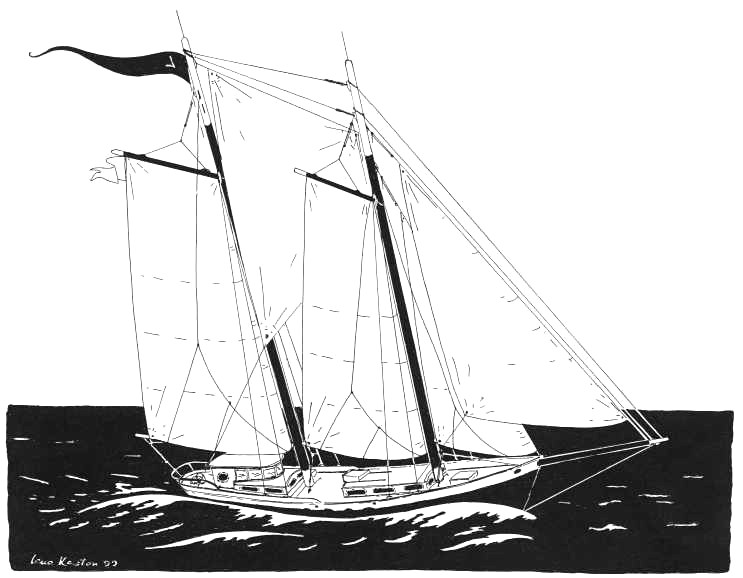
The Schooner Lucille
Image, Copyright 1999
Other Useful Cruising Sails
For Schooners: The Fisherman Tops'l
On a schooner, the fisherman tops'l is an excellent tool, is easy to use, and provides plenty of area, so is well worth it. The fisherman tops'l is a thing of beauty and highly functional, without a lot of complicated rigging. It's like having overdrive... It's up where it can catch the breeze and it has a meaningful size, so that the reward for setting the fisherman is substantial. Of course, a Fisherman tops'l is not absolutely required, but it is almost silly to do without one on a schooner, given the outstanding opportunity between the masts to spread a large amount of sail without much fuss or bother.
For all Sailing Vessels: The Stays'l or "Mule"
One might be tempted toward even greater simplicity, eliminating the staysail and outer jib in favor of a single jumbo jib. We can quickly see however that a staysail and jib combination are a bit better suited to offshore sailing, as follows:
The most obvious advantage of the stays'l, whether it is on a schooner, ketch or cutter, is to make the individual headsails smaller and easier to handle. A much less apparent advantage is that the stays'l also provides for easy self-steering. A "steering sheet" led from the stays'l boom, aft along the windward side, and then to a tiller will give reliable and easy self steering. It's hard to believe, but this really does work...!!
The gaff rig being somewhat lower aspect, lends good self steering to the boat particularly when sailing long passages off the wind. Naturally this statement must be qualified by presuming that the rig is of good design, and that a good hull form for self steering has been provided. You can see example vessels of this type by clicking on the links to the schooners, Lucille and Redpath , and the very fine ketches Grace and Shiraz.
For Nearly any Hull Type: The Junk Rig...
Along with the Gaff Rig, the Chinese Junk Rig has much to offer in terms of simplicity, ease of use, and also in terms of safety, in particular for the long range voyager. For more information, please have a look at my web page on the Chinese Junk Rig.
Choices...
Overall, subtleties abound in copious amplitude...! One cannot say one thing absolutely... there exist many shades of grey. A given boat design is neither good nor bad, but instead simply optimized for a given purpose. This includes the full spectrum from the all-out racing machine, to the square rigged clipper.
These choices are just a matter of degree; of one's intended sailing; and ultimately of one's preference. One type is not inherently "wrong" or the other inherently "right" but instead are just differing expressions of one's preferred style. Therefore... there really is no argument with regard to keel and rig choices. In the end, the these various design factors are simply a matter of the owner's preferences being expressed in the type of vessel being created.
In other words, once you know what you want to do with a boat, i.e. its function, only then do you have a framework within which to create and / or judge its form.
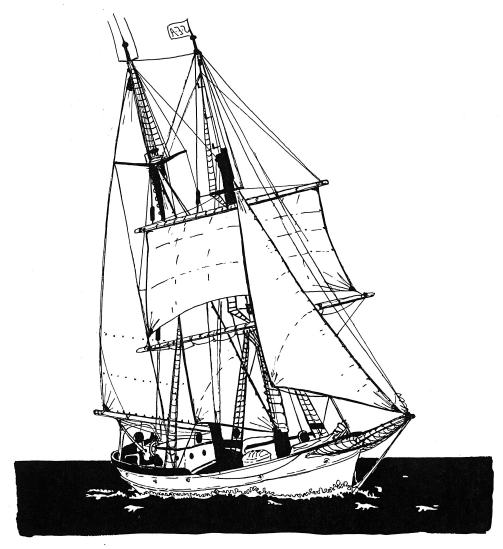
Image Copyright 1999
Other Resources...
For further reading on self steering, please see the excellent book, "Self Steering for Sailing Craft," by Dr. John Letcher. For further reading on the gaff rig, please have a look at "Hand, Reef and Steer," by Tom Cunliffe.
Please see the AVAILABLE BOAT PLANS web page.
Home | Intro | Our Design Process | Stock Design Info | Motor Yacht Designs | Sailing Yacht Designs | Prototype Designs
Plans List | Articles | Our CAD Design Stream | Maxsurf | SITE MAP..! | Site Search | Design Team | Contact Us