Messing about in boats since 1975. Online Since 1997.
Home | Intro | Our Design Process | Stock Design Info | Motor Yacht Designs | Sailing Yacht Designs | Prototype Designs
Plans List | Articles | Our CAD Design Stream | Maxsurf | SITE MAP..! | Site Search | Design Team | Contact Us
Please see the AVAILABLE BOAT PLANS web page
Composites for Boat Building
How Do Composites Compare with Steel & Aluminum for Boat Structure...?
Copyright 2008 - 2010 Michael Kasten
This page contains a few brief notes about our work with composites, as well as how we view the comparison between composite construction (GRP, fiberglass, etc.) to metal boat construction.
What's Our Experience With Fiberglass Boats...?
Here is a little background to address that question...
Despite the bulk of my design work being focused on ocean cruising yachts in metal I have also designed some large traditional wooden craft. Not as well known is that my design work has also included several years' work with boats built of reinforced plastics, i.e. composites - so I'm no stranger to composite yachts!
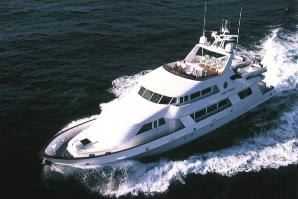
Two of the various composite vessels on which I've done significant design work are the 160' MY Evviva and the 100' MY Lady Dianne. They have both been best-of-show award winners at Monaco - very high quality yachts. You can see the Lady Dianne under way here.
With the Evviva, cost was not an issue - in other words there was no budget. A dream customer you might think... but he was definitely not an easy one to please! Evviva's structure was designed for minimum weight, but without going to the extreme of carbon fiber - which was at that time in relatively limited use. We therefore used a cored hull, vinyl ester resins and predominately Kevlar bi-axial laminates. There was also liberal use of uni-directional laminates of various types in order to maximize the section modulus of the framing. Cores were air-bagged to the outer skin in order to reduce the weight of core-bond used. We used some CF but only for stiffness locally, as well as to build the passerelle.
Pre-pregs (cloth laminates pre-impregnated with resin) were not at that time readily available outside the aircraft industry, however for some small parts we did use resin infusion technology. Today, pre-pregs are much more available and resin infusion techniques are becoming more and more common. Both are still relatively expensive, but they are very effective at weight control - since the amount of resin used is precise.
An additional assignment on the Evviva - and possibly the most challenging one - was that there be no secondary laminates anywhere on the exterior. Secondary lams were only allowed on the interior and where necessary to join deck and hull, etc. Therefore all the various 'outages' for hull fittings, plumbing, hatches, joints, etc. became 'bosses' on the mould, so all of them had to be planned in advance. This was no small feat considering that construction was more or less concurrent with the design work being done.
The requirement for there to be no secondary lams was carried to extremes. For example, each deck and its adjacent house sides were made as one single piece, with the interior decks as a drop-in while the house structure was still upside down in the mould. Once house and deck were fully assembled, each successive assembly was turned upright and craned onto the hull in one piece - no small task at 160'...!
On other vessels our construction strategy has of course been rather different, and has always adapted to the customer's preferences. In most cases, we find that form follows budget... so the majority of other composite yachts are much less extreme!
However, given the will and the means to do so, there are much more exotic technologies available and weight savings can be dramatic.
Fiberglass vs. Aluminum & Steel...
Since we can work equally well with metal, composite or wood structure, and since we find that there are distinct advantages to each material, we do not offer any prejudice - except possibly with regard to ferro cement which does have merit but definitely not within a high labor cost venue...!
Composites are an absolutely excellent engineering material and offer a considerable range of choices with regard to economy, strength, lightness, ruggedness, construction methods, etc. Since there are literally hundreds of fabric choices and a number of different resin systems, a strict comparison between a highly variable composite structure and an entirely homogeneous structure such as metal is not so simple!
It is perhaps less difficult to make a comparison between steel and composite construction. Under around 150 feet, steel will nearly always be heavier. Even that is subject to debate, since above that size one can still make use of high strength fabrics to effect a lighter structure than steel could possibly achieve - but at a far greater cost.
Many writers have made comparisons between aluminum and 'fiberglass' construction, however I find this to be very problematic. Here is why...
On the basis of cost, weight and overall strength, for a composite structure we must first ask, "What's the available budget..? Will it be a cored structure, or a single skin laminate..? What resin system and what cloth will be specified..?"
It is not at all difficult to design a fiberglass structure to be as strong as or stronger than an aluminum structure - and to also be as light - however since we ordinarily must work within a given budget there will always be definite limits on what will be possible with either type of structure. We also have to ask, "What do we mean by strength..?" Are we talking about impact strength, or stiffness, or fatigue strength, or tensile strength, or yield strength..? We then should consider questions such as insulation, fire resistance, acoustic performance, corrosion vs. boat-pox, long term maintenance, eventual re-sale...
It is obvious that each of the above limitations, questions or considerations will reveal a different winner in the contest. Thus, the question of whether to favor composite or metal construction can really only be answered on a case by case basis after fully considering the owner's requirements and preferences, the available budget, and the intended use of the boat.
Can we say that one or the other choice is better...? Not really. We can only say whether the choices made properly address the wishes of the owner. Of course if the original request and owner's preference leans strongly in favor of composites - so be it and there is no need to question that choice. At that point it simply becomes a matter of appropriate design, and the resulting yacht must meet the same structural standards regardless of the choice of materials.
In our work we design very conservatively to the ABS or the ISO rules for each material type. With metal, our approach is to specify the simplest structure that will do the job. That turns out to be the most friendly for everyone involved - from ease of construction to simple long term maintenance.
Similarly with composites, except that far more variation becomes possible with regard to cost, construction technique, choice of materials, etc. Each specific fabric and resin combination having its peculiar advantages. For example, if it is within the budget to make use of resin infusion techniques, pre-pregs, or high strength fabrics, then weight can be held to an absolute minimum.
Building Efficiently...
Once the basic design has been created, there is still much that the design office can do to augment the construction process, i.e. to make it faster, more efficient, more accurate, and ultimately to save money.
For metal, we advocate NC cutting for the entire structure. It is very accurate and the NC cut parts are quick to assemble. For composites, we advocate 5-axis router cutting to create the moulds for hull and superstructure. This dramatically shortens the amount of time the builders' shop floor is occupied. In other words, because it is possible to completely eliminate lofting and the mould making is out-sourced, the builder's in-shop overhead costs are reduced.
Designing For The Long Term...
Metal and composites are both highly suited to the construction of sailing yachts as well as LRC types and expeditionary motor yachts. These vessel types have actually become our specialty, i.e. ocean worthy voyaging yachts intended for long term ownership.
Our work with metal boats has primarily been to elevate that concept from the usual perception that metal boats are only for back yard builders - to that of metal being a viable choice for professional boat builders and for long term yacht ownership.
From my side, the design work is not nearly as great a challenge as finding the right builder. In the case of metal boats and if the build venue is within North America, qualified metal boat builders can indeed be difficult to find.
In the case of composite construction, they are everywhere...! Still, one must choose wisely to be certain the builder is not only capable of building the structure itself, but also able to install the equipment correctly and to complete the interior to the desired level of finish.
As always, I am pleased to discuss new design projects in whatever materials are preferred - and without introducing a bias to the equation. For a snapshot of our approach to creating a new design please see our Introduction and Custom Design web pages, or please feel free to inquire for more information.
Other Articles on Boat Structure
Metal Boats for Blue Water | Aluminum vs Steel | Steel Boats | Aluminum for Boats
Metal Boat Framing | Metal Boat Building Methods | Metal Boat Welding Sequence | Designing Metal Boat Structure
Composites for Boats | The Evolution of a Wooden Sailing Type
Please see the AVAILABLE BOAT PLANS web page.
Home | Intro | Our Design Process | Stock Design Info | Motor Yacht Designs | Sailing Yacht Designs | Prototype Designs
Plans List | Articles | Our CAD Design Stream | Maxsurf | SITE MAP..! | Site Search | Design Team | Contact Us