Messing about in boats since 1975. Online Since 1997.
Home | Intro | Our Design Process | Stock Design Info | Motor Yacht Designs | Sailing Yacht Designs | Prototype Designs
Plans List | Articles | Our CAD Design Stream | Maxsurf | SITE MAP..! | Site Search | Design Team | Contact Us
Please see the AVAILABLE BOAT PLANS web page
35' Aluminum Power Catamaran
"Twee Schoenen"
Exterior Profile | Interior Profile & Arrangement
Hull Model Perspective Above | Hull Model Perspective Aft
Copyright 2003 - 2011 Michael KastenGeneral Concept
The name "Twee Schoenen" is Dutch for "Two Shoes" which captures both the general look of the boat (Dutch) and the twin-hull type (Two Shoes). Aesthetically and functionally the boat would be very much at home on a Dutch canal...
The 35 foot aluminum "Twee Schoenen 35" is a displacement power catamaran, having a "tunnel-hull" and modest beam. This design was developed in order to provide a stable platform capable of high displacement speeds, and also capable of long range at lower speeds. Design waterline length is 32.8 feet. Moulded beam is 14 feet. Displacement is intended to be 24,000 lb. light, and 28,000 lb loaded. Hull depth is 2.6 feet from the Reference WL.
As is usual for a power catamaran, twin engines are specified, providing redundancy of get-home power and shallow draft for cruising in thin water. Twin hulls also allow the boat to be beached and still remain upright at low tide.
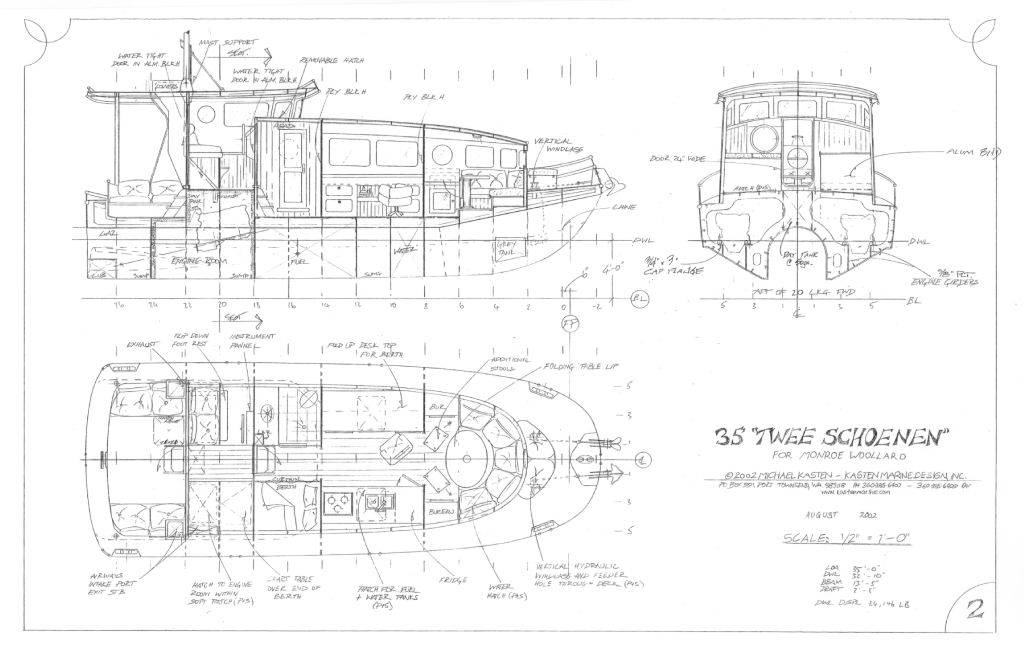
As originally planned, starting right forward the interior begins with a large dinette table surrounded by a wrap-around seat. Aft of that is a large desk to port and a galley to starb'd. Aft to port is a head compartment, and to starb'd is a double berth, enclosed for privacy.
Within the pilot house is a chart desk to starb'd and a helm to port. Access to the engine space is provided via two hatches, one below the pilot seat, and the other below the chart desk.
As originally designed, aft of the pilot house there is a cockpit with seating all around and a secure coaming.
The long forward cabin has a downward sloping curve in order to maximize the headroom in the galley / dinette area, while still allowing the maximum view ahead from within the pilot house. On review of older power vessels from the 20's through the 60's there are numerous examples of similar roof lines.
In order to avoid the usual "flat" and rather dull sheer line often found on power craft, a pronounced sheer line was used. This allows a substantial bulwark forward for protection of the cabin, and for security while walking around the side and forward decks.
Just forward of the cabin is a forward facing seat which hides the two anchor winches and provides storage for lines and other gear. A small shore boat is stowed above the pilot house, lifted in place by the mast and boom.
Hull Design Notes
The owner wanted a vessel with an asymmetric tunnel hull. The original request was for a trailerable vessel for use in Hawaii. This imposed a limit on overall beam of around 14 feet. The original request also included the capability to travel between the US mainland and Hawaii, thereby requiring a large fuel capacity, and reasonable efficiency at low speed for long range travel - strongly favoring the use of propellers rather then jet-drive.
The hull form that was chosen is based on similar types that are used in a variety of configurations for sport fishing, as landing craft / small ferries, and as rescue boats. In order to develop the design we followed in the tradition established for these types of craft in England and in South Africa.
The overall approach with these hull types is to take a typical "mono-hull" hull type, cut it in half lengthwise, move the two halves apart, plate the inner face using flat panels, and provide a radius at the top in order to create the tunnel. This is a practical approach for the sake of ease of construction. The benefits with this kind of hull are to help eliminate wave pounding, to carve turns, and to eliminate potential wake interference between the hulls.
This hull type is suited to sizes from around 35 feet and larger. In order to achieve the speed potential of this type of vessel, light weight, low superstructures, and high power are essential. For maximum "lift" a greater beam would provide a substantial benefit, as would fitting foils in between the hulls.
Construction is in all aluminum alloy for the best combination of lightness and strength. With a total re-design of the structure, GRP construction would also be possible.
Photo Courtesy of Monroe Woollard
Powering Options...
Several powering options were considered for the Twee Schoenen, including the use of passive near-surface hydrofoils to span between the hulls in order to achieve greater lift and higher speed. Due to the compact size of the vessel and relatively heavy waterplane loading, it was determined that the foils would probably not provide the upper range of high speeds expected, even though foils might still offer a benefit in terms of lift.
The engines chosen were twin Steyr 230hp diesels with ZF 220 down-angle gears. Made in Austria, the Steyr engine is very compact, has an excellent warranty for commercial use, produces high power for its size, and is not too heavy. It was elected not to use hydrofoils, though it is possible they could provide added lift and consequently provide improved top speed.
Chartering / Commercial Options...
After numerous tweaks and owner-specified additions during the design process, including a completely revised interior configuration, the design was approved by Transport Canada for use as a passenger carrying vessel in Canada. The new layout is shown in the following images...
Chartering Layout Profile | Chartering Layout Plan View
In the Commercial Layout, the galley is aft to starb'd, opposite the head. This opens the whole forward area for seating, or for possible other uses...
For example, the forward area could be made quickly convertible for over-night use by a smaller group, or as a research lab for extended on-site monitoring, or as a dive shop, or as a light cargo area... all of which illustrate the flexibility of the Commercial Layout having the galley and head aft.
On eco-tours, the forward area provides seating for twelve. Kayaks can be carried on deck. Via the ladder on the bow there is easy access for divers or directly onto the beach for exploring the islands. Since she will safely sit upright on the beach with the propellers clear of the hard, areas with extreme tides offer additional intrigue...
As-built, the Twee Schoenen is Canadian flagged, approved for passenger carrying by the Canadian Coast Guard and Transport Canada, and is operated out of Campbell River, British Columbia. As of mid-2009, the Twee Schoenen is being offered for sale. For details, please inquire.
Design Info...
If designed strictly for speed, the essential ingredients will always be light weight, limited superstructure, adequate water-plane area, sufficient overall length, and high power. With a tunnel hull, there is also the excellent option to use hydrofoils fitted in-between the hulls. While not presently fitted, they could be very easily added, and would provide quite a lot of additional lift for better performance at speed.
For example, if the design were made larger, say to 40 feet or more on deck, and the individual hulls made slightly wider, there would be a much larger water-plane, resulting in a dramatically reduced load per unit of water-plane area. This would translate into much greater dynamic lift and a much higher actual planing speed. Prototype designs that illustrate this potential can be found on our Power Prototypes web page and range in size from 50' to 120'. All have excellent potential for long range voyaging, or for shorter range at speed.
For more information about these vessels, please inquire.
Please see the AVAILABLE BOAT PLANS web page.
Home | Intro | Our Design Process | Stock Design Info | Motor Yacht Designs | Sailing Yacht Designs | Prototype Designs
Plans List | Articles | Our CAD Design Stream | Maxsurf | SITE MAP..! | Site Search | Design Team | Contact Us