Messing about in boats since 1975. Online Since 1997.
Home | Intro | Our Design Process | Stock Design Info | Motor Yacht Designs | Sailing Yacht Designs | Prototype Designs
Plans List | Articles | Our CAD Design Stream | Maxsurf | SITE MAP..! | Site Search | Design Team | Contact Us
Please see the AVAILABLE BOAT PLANS web page
Nomadic LAND Craft..!
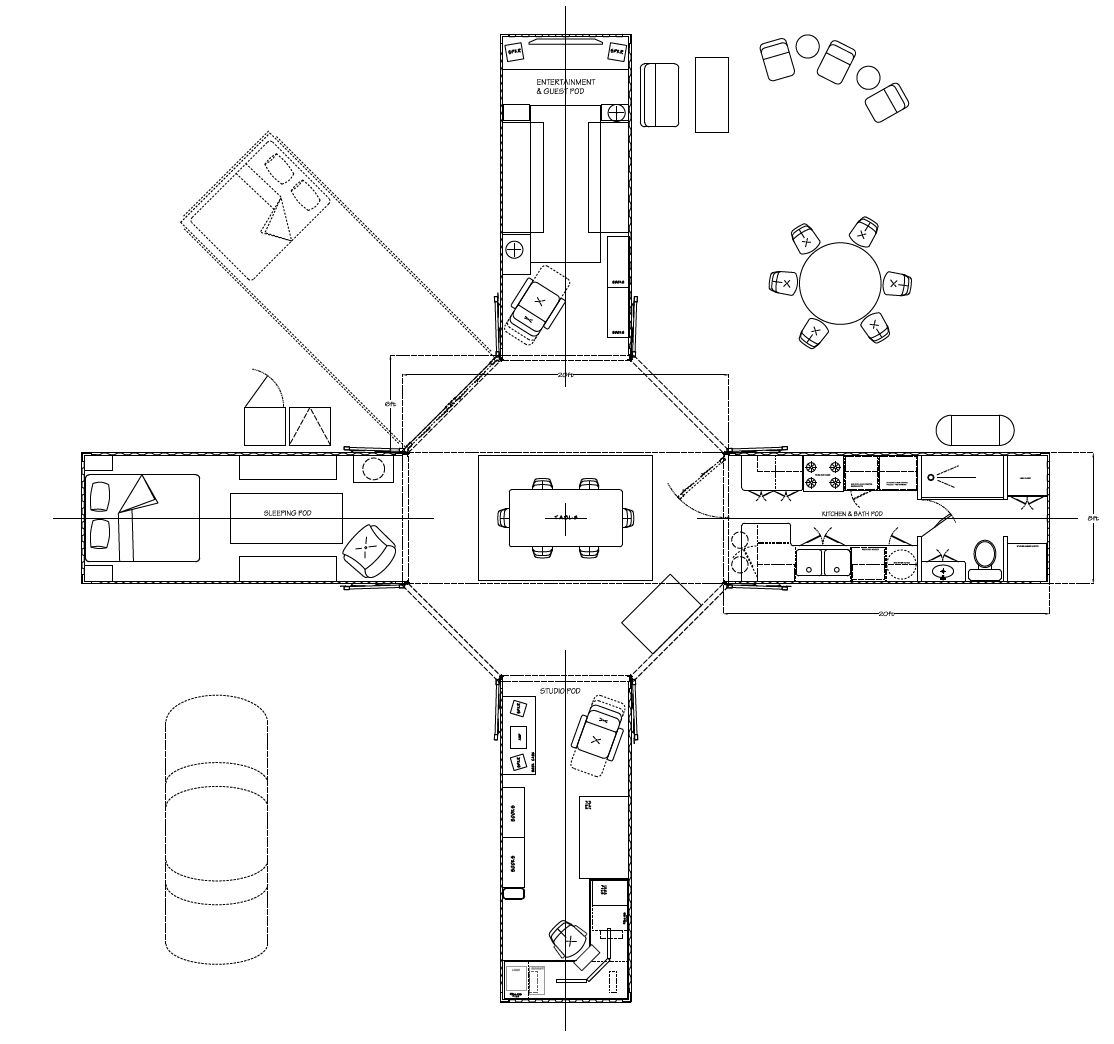
Modular 20' Container Home Concept
Click for Larger Image
Click HERE for a larger PDF drawing.
Copyright 2012 - 2014 Michael Kasten
Updated 10 January 2014
Sustaining the Nomadic Life
As has been described in greater detail at my Nomadic Watercraft page, Nomadic Peoples are defined as being those who move from one place to another rather than settling permanently in one location, usually for the purpose of hunting, herding, or to offer skills in trade. In this case, in order to preserve the essential nomadic characteristics of mobility and independence I have explored a somewhat more modern version... a land-based container home.
Essential Characteristics
The core function of any nomadic land craft is first to provide shelter. In addition to that, it should also also provide several essential characteristics:
- Simplicity for the sake of ease of construction and economy of ownership
- Ruggedness and strength in keeping with a simple structure
- Quality for the sake of safety, freedom from maintenance, and a long lasting structure
- Economy for the sake of maximum independence from the banking system, compound interest, and endless payments
- Portability for the sake of remaining independent of the requirements of local building codes
- Mobility in order to be easily moved from one place to another without too much fuss and bother
- A sense of the familiar and the feeling of being 'at home'
In order to address the latter characteristic, rather than viewing such a structure merely as a roof over one's head, it should be viewed as one's habitat. If it has been successfully designed, you will feel very much 'at home' while living there. In other words, a place where you feel at ease and that will always invoke good feelings. You will want to live there because you like being there.
The Shipping Container as a Dwelling
My main interest in exploring the Quad Container Home concept shown above is to acknowledge that shipping containers are inexpensive, simple, strong and easily transported, thus immediately satisfying several of the above essential characteristics.
I wanted to end up with the as-built structure of the containers intact so that one could close the doors, fold up the gazebo and deck, put the whole thing on a flat bed or on a ship and be off to another location. Since such a structure is 'temporary' and portable, it will not ordinarily fall under the purview of one's local building codes - even in the US... Since it does not have wheels, it also will not fall under the transportation / road / vehicle rules.
This goes a long way toward keeping the government and the banking system out of your pocket...!
Location
I have assumed that the container array would be parked at a site of at least one acre in size that had an RV hookup (electricity, well and septic). Most rural locales allows this, and do not require a building permit to place a portable facility on site (at least the last time I looked, which admittedly was a WHILE ago…).
It is possible to buy an already ‘improved’ lot with some or all of those amenities already present. But since the containers are portable, you could also rent / lease the space for the container array where there is already an RV hookup. If / when that spot were to become untenable, you can simply move the whole shebang to another suitable spot.
It is certain to be cheaper to just buy an old airstream or similar. But trailers are much smaller, their license needs to be paid up, and the tires and chassis maintained or you can’t really claim them to be portable. However in the example shown above, since the kitchen / head container / pod is the most complex and expensive unit to build, certainly an older airstream or the like would make an excellent kitchen / head module for the container array, eliminating that complexity.
Alternately, the airstream could be used as an intermediate step while you build the gazebo and the other ‘pods’.
Appearance
The exterior is intended to look like an orderly array of containers, painted white or nearly so if in the desert, or painted a pleasant flat deep red-brown-rust color if in a cooler location.
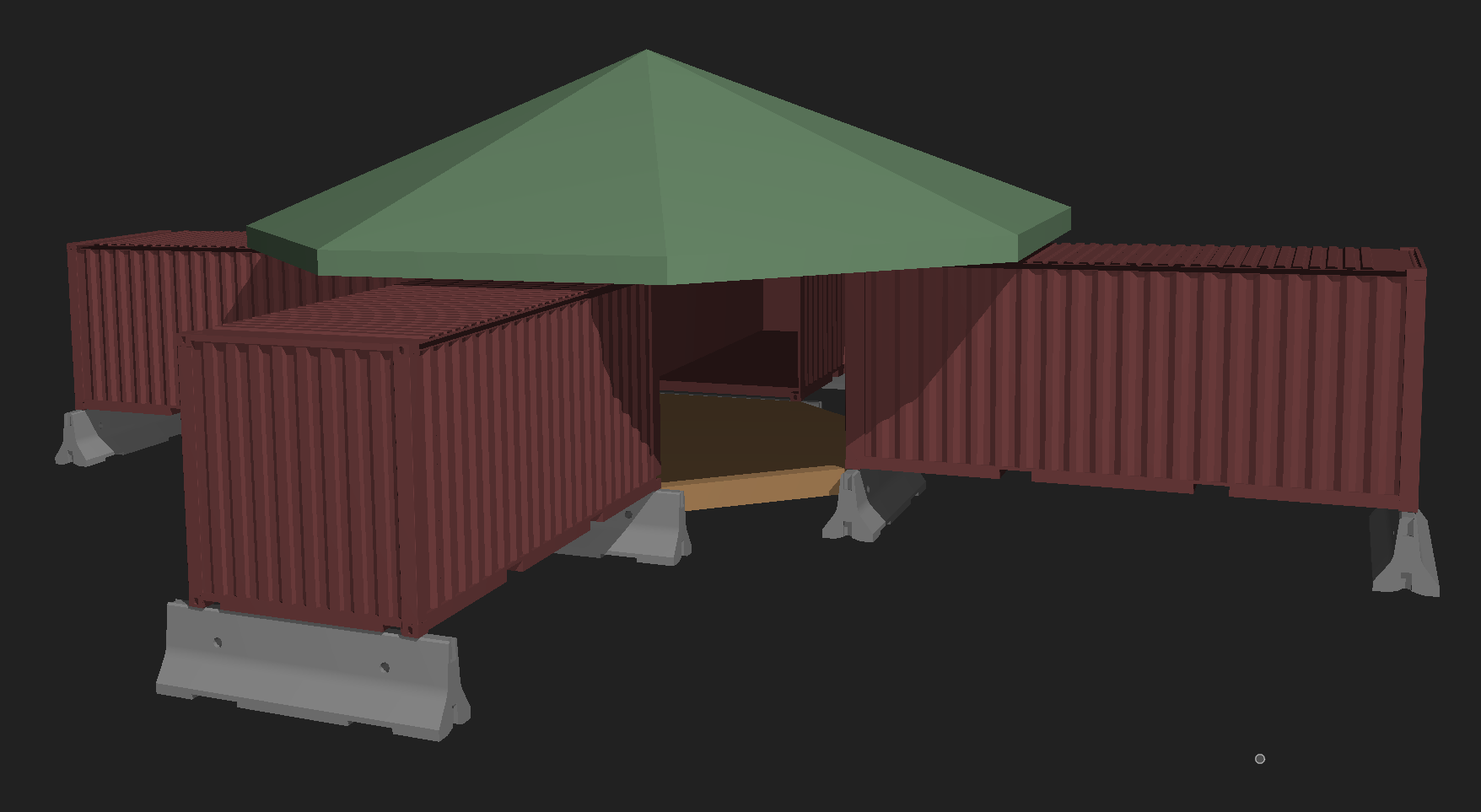
The containers are to rest on heavy duty concrete traffic separators - the ones you see along the freeway. They are quite portable and in all likelihood inexpensive. One of those is to be located at each end of each container.
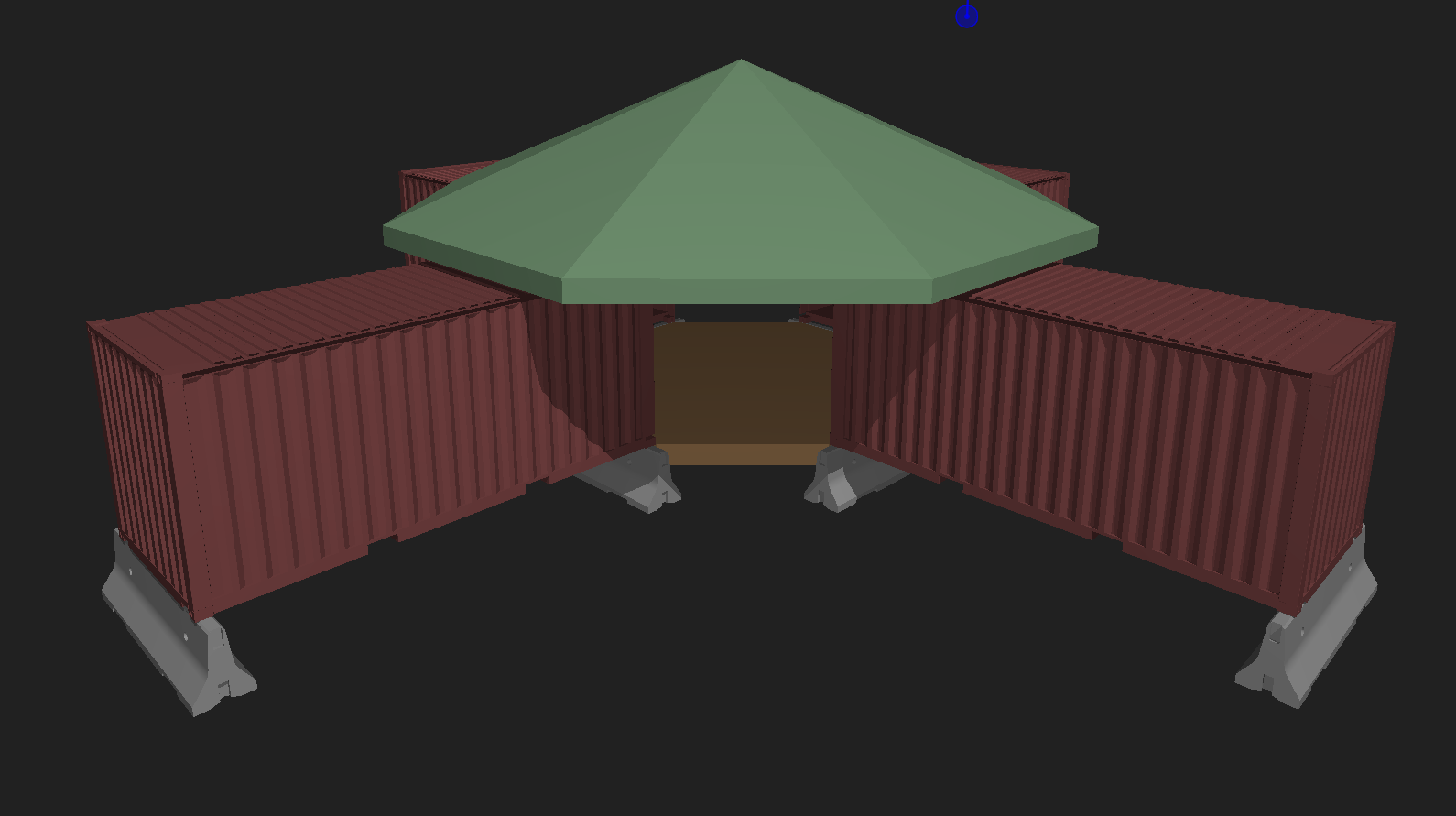
The Gazebo is a primary feature of the "look" of the whole affair. As its base, the Gazebo has an independent free standing deck at the height of the container floors. Stairs would lead up to each of the gazebo’s open facets.
In most counties that have implemented the US Uniform Building Code, a deck structure that is 30 inches or less off the ground also is not regulated and does not require a permit. If not seeking code approval for the Gazebo, it would have an awning / tent-like roof. Being ‘temporary’ such an awning is not usually regulated by rural building codes.
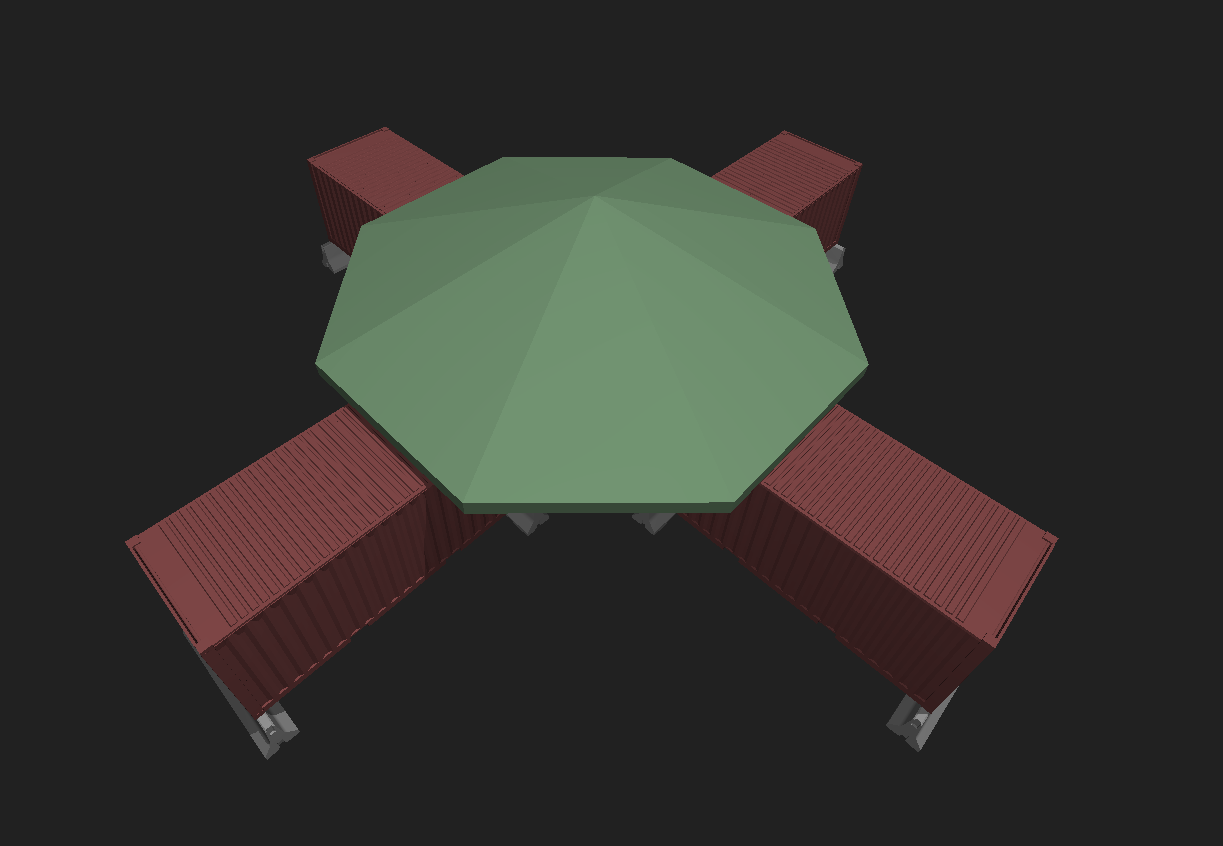
If built per code, the Gazebo deck could be higher off the ground, and would have an octagonal, insulated, fixed metal roof with a low to medium pitch, extending a few feet beyond the deck and ending just above the height of the container tops at the eaves, and color coordinated with the containers.
Click Image for Larger View
Other Views:
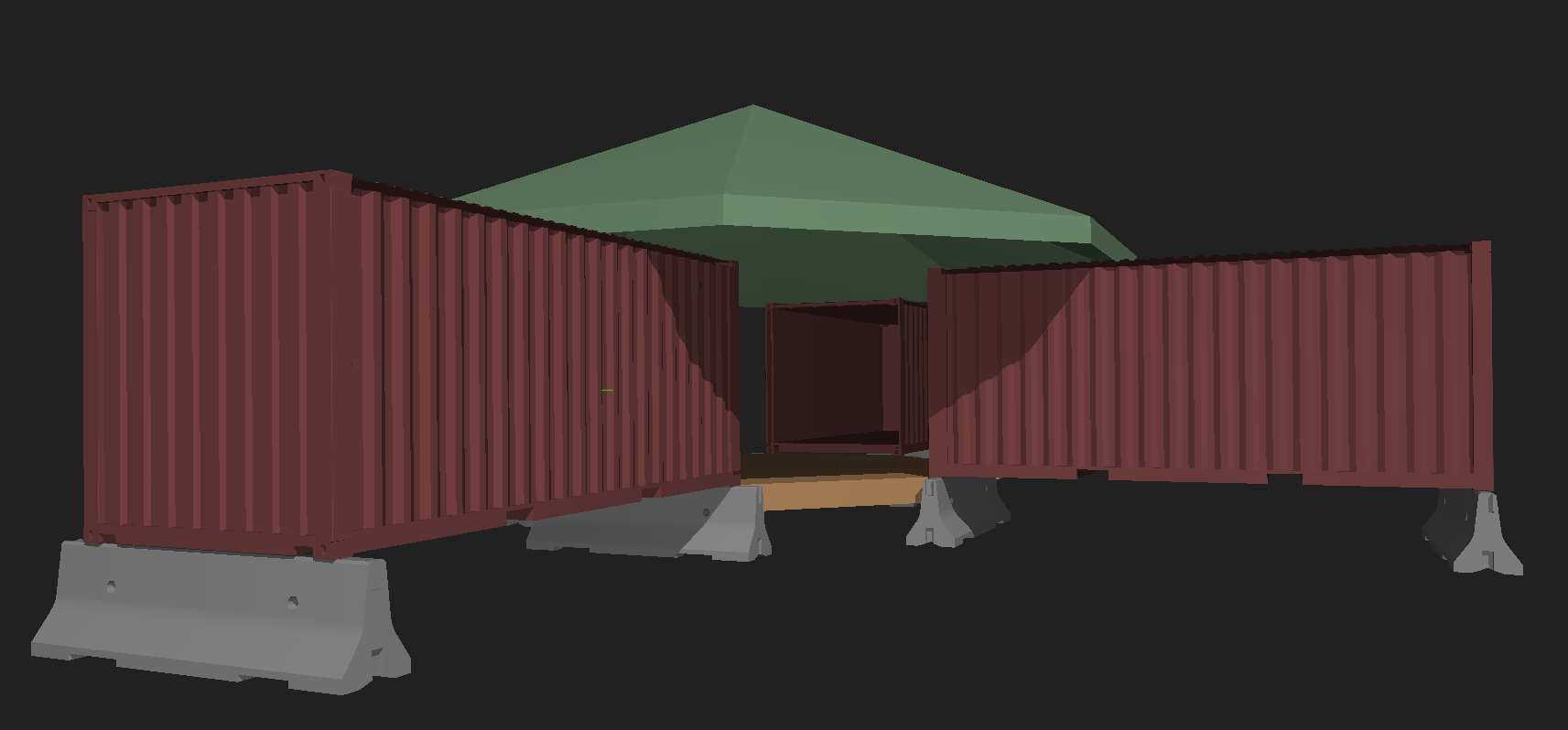
Eye Level Perspective | Top Perspective | Entry PerspectiveStructure
Containers are designed to function more or less as a large "box-beam" which is usually supported only at its ends. Since it is not structurally friendly to cut into the "web" of a beam beyond the middle third of its height, and since the container sides form the web of a beam, the windows in the sides should ideally be varying sizes of round ports that will ideally be limited to 1/3 of the height of the container. Given a standard container's side wall height of 8 feet, this means the window ports should be no larger than 2' - 8" in diameter.
This means a series of round “porthole-like” windows aligned on the neutral axis of the structure, i.e. half the height of the sides. This preserves the integrity of the entire container’s “box-beam” design and it is rather easy to accomplish in steel. This would be very cool looking, with window locations according to the requirements of the interior layout.
But actually you could make a round port up to 4 feet in diameter provided that the window opening were encircled by a 1/4" by 4" or wider flange of steel flat bar welded to the container sidewalls. This would recover the integrity of the “beam” lost to the opening. Large ports of this type could be placed as close as three feet in between or from either end. The end wall of the container is not restricted in the same way, but I would still limit a window there to 4 feet in diameter.
The objective in retaining the containers’ structural integrity is so that the container can be quickly and easily moved by the usual means: truck, ship, etc. and would be secure in transit.
The Setting
From the above, we can visualize the "look" of the array of containers... Round ports of varying sizes as windows placed as needed for the interior, with all of the containers nuzzled up to a roofed Gazebo having big sliding doors over the entirety of each open facet. With strategic landscaping, this could be pretty nice.
One of the hurdles for extreme climates is that, while the containers can be insulated well, the whole collection will have quite a lot of surface area for the amount of volume contained. The location would therefore ideally be in a fairly mild climate...If in the tropics, then at at a mild elevation, etc.
That said, it would be quite easy to isolate the unused parts of the living space so they do not need to be heated or cooled full time. The majority of the living space does not need to be heated or cooled at night. Ditto for the sleeping pod during the day...
A larger view of the Quad Container Home interior and exterior layout can be found HERE.
Variations on a Theme...
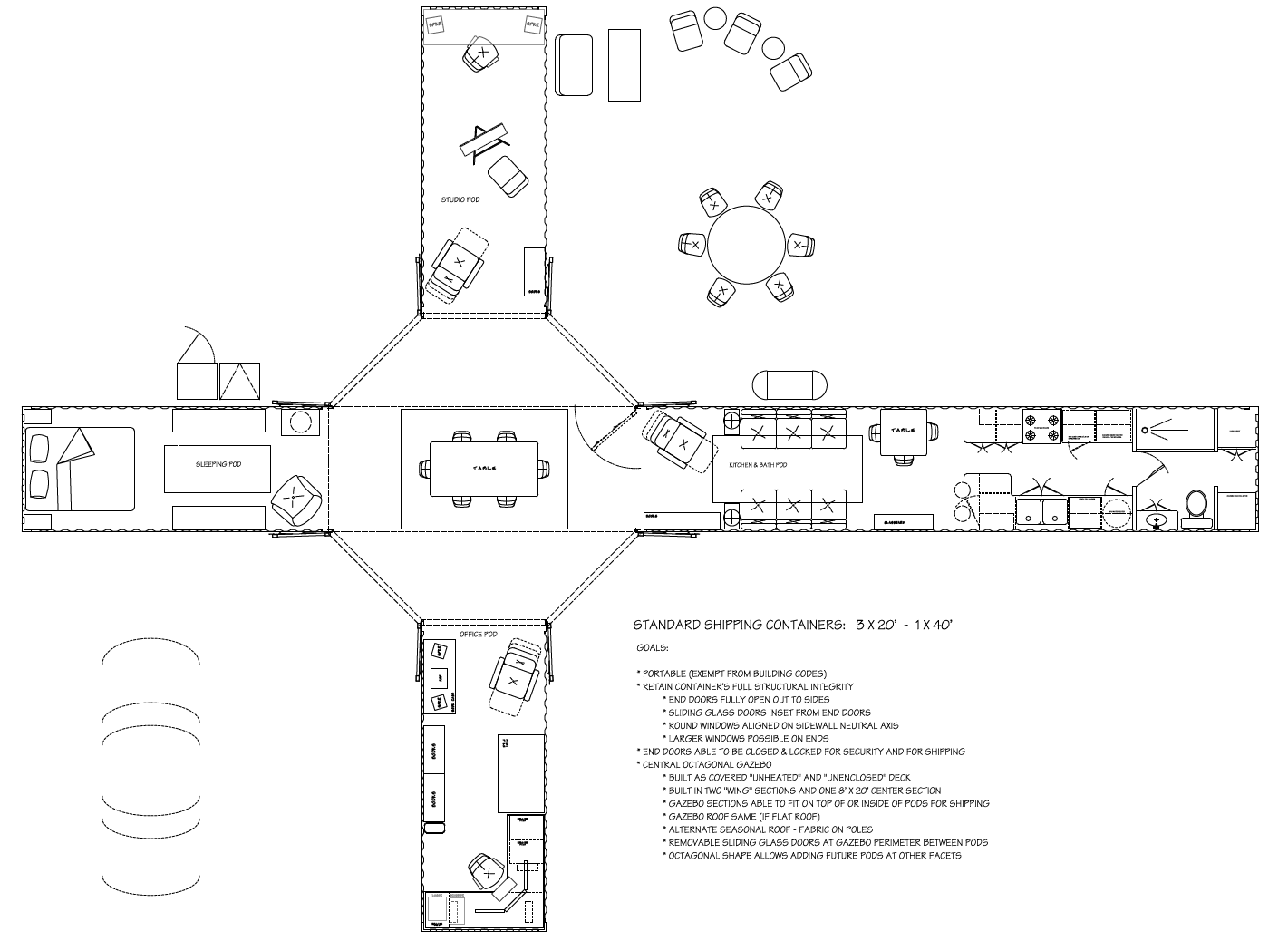
Below is a second concept which makes use of one 40' shipping container, plus three 20' containers. More or less it is the same, except that the living room is included in the "kitchen pod" and a "studio pod" has been added. With a couple of Futon couches in the living room, the "kitchen / living room" pod could easily be transported by itself to another site and used independently.
Larger Modular Container Home Concept
Click Image for Larger View
Or Click HERE for a Larger PDFAlternative Container Concepts...!
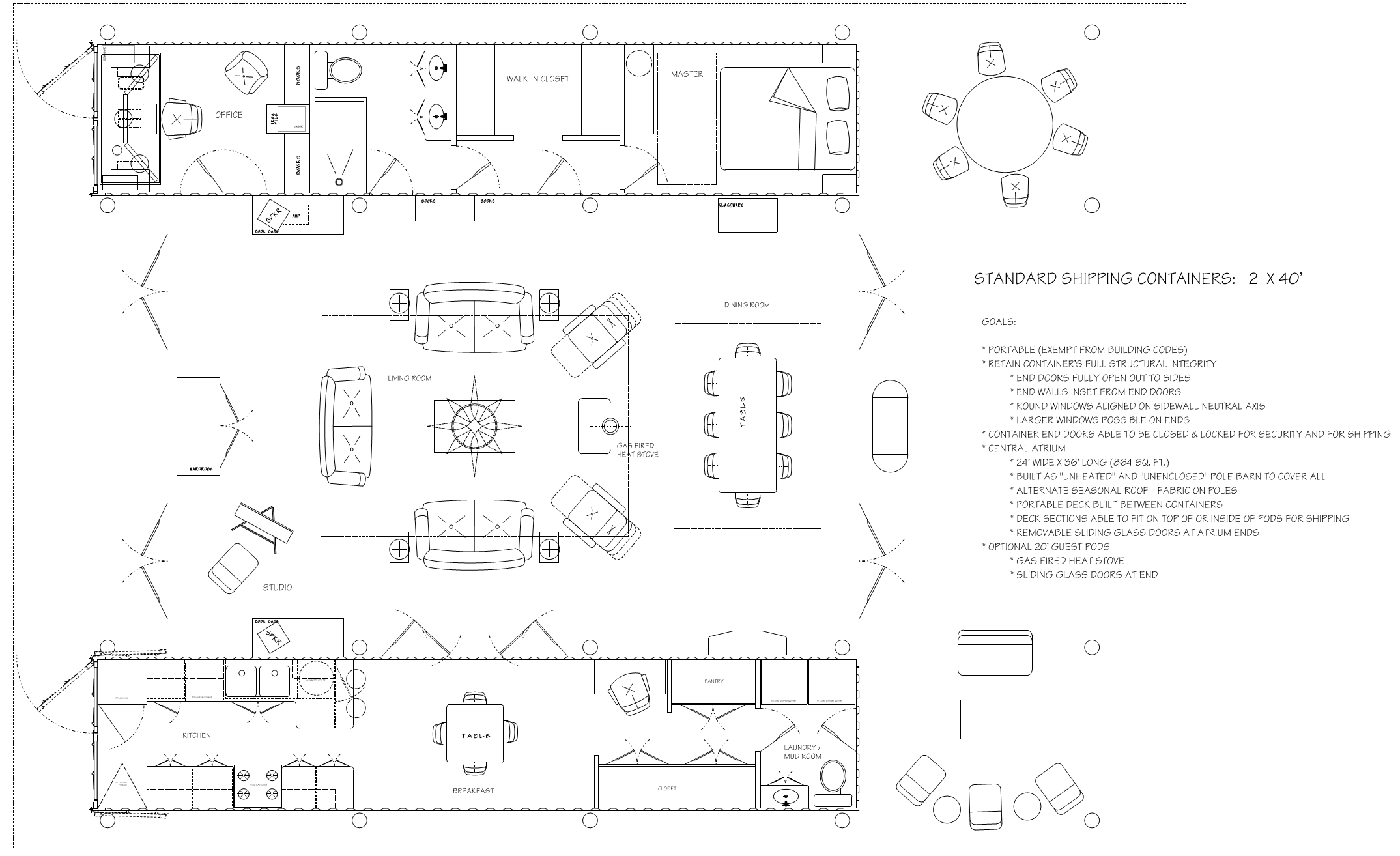
Below is quite a different type of container home plan that is somewhat more 'permanent' in nature. Here we have made use of a pair of 40' x 8' standard containers that flanking a large central courtyard. The structure of the central courtyard is that of a pole barn with clerestory windows just below the eaves, and above the inside edges of the two containers.
As with a typical pole barn, the structure is exceedingly simple and inexpensive. Just inboard of the containers is a row of poles which support a heavy beam across their tops, parallel to the inboard edge of the containers. Spanning the overhead of the courtyard are trusses. This allows a completely open and flexible layout for the courtyard.
The courtyard could easily and inexpensively be arranged with a rammed earth floor, or a slab with tile or wood flooring as an upgrade. The central pole barn structure is enclosed at the ends of the living space by glass walls below the height of the ceiling. Above the ceiling, the gables would ideally have wood or metal siding. Using a stoutly built series of "W" trusses on 24" centers, there would be plenty of storage space above the courtyard. With "barn" style doors in each gable, access would be simple and would not impose on the courtyard layout.
Outboard of the courtyard, to each side we have arranged a "lean-to" shed roof over each of the 40'containers. Each shed roof will have its high point just below the clerestory windows of the central pole barn structure; will slope downward at a shallow pitch over each of the containers; and will have a generous overhang at the eave. In this way the containers are protected from rain, snow and sun. In the image below, the pole barn roof outline is shown as a dotted line surrounding the interior and extending beyond the containers and courtyard to the right in order to cover the large back yard patio.
Placing the poles of these "lean-to" wings just outboard of the containers allows the shed roof structures to be entirely independent of the containers. Since the plumbing for the bathroom / kitchen / laundry is entirely within the containers, there is no "dwelling structure" needed on-site - only the pole barn, water, septic, and electricity. These factors allow the containers to be brought on-site and installed after the pole barn is built, and later removed leaving the pole barn fully intact.
A Boatbuilding Shop..?
Why would this particular structure be of interest to boat builders...? Certainly it is a benefit to have a shelter while building one's own boat. With the pole barn container home concept, the central courtyard need not be used for 'living space' and instead could be used as a boat building shop..!
As shown, the width of the central pole barn is 22 feet between poles (24 feet between containers) and the length of the roof is 60 feet. The pole barn roof could easily be extended in order to cover a boat of greater length.
When the boat is completed, the end walls can be enclosed and the central part converted into living space as shown below. The glass end walls are intended to be built as a modular array that is easy to assemble / disassemble so that they can be loaded into the containers along with the courtyard furniture. Thus, if it were desired to move to another site, there would be nothing left behind except for the pole barn and whatever flooring you may have installed.
Larger Modular Container Home Concept
Click Image for Larger View
Or Click HERE for a Large PDF
Choices...
I have selected the above examples primarily on the basis of their simplicity and their consequent economy of ownership. Naturally the word 'economy' means different things to different people, however in this context I am referring to a structure that will be affordable and easy to take care of. In that sense, the above designs are structures that I would personally consider owning and living within.
Simple does not imply 'crude' in any way. Nor does it imply that "style" should supersede function... Yet the creation of a certain kind of lifestyle very much *is* its function." Such lifestyle implying that the structure be easy to afford, easy to keep, comfortable, safe, and friendly. In other words, a fine and simple home.
If attention has been paid to the essential characteristics outlined above, we will end up with a strong, safe, unique habitat that does not require brokers, banks, or government meddling.
Wot to do,
An how to do it,
An if so,
Wy..?
- Krazy Kat, 1930's
Why..?
This is the essential question... In order to answer that question we must begin by re-stating our original goal:
"To achieve a certain degree of autonomy - a self-imposed order and sovereignty - wherein there lies potential for a true wealth of being."
To the question, "Why?" we must answer, "Why not...?"
How?
This becomes the next question. In other words, how shall we create our own unique and autonomous habitat...? It starts with imagination... Given that, if an existing design is not found that will satisfy our unique requirements, a new design can easily be created.
If you would like to discuss these concepts further, please inquire.
Please see the AVAILABLE BOAT PLANS web page.
Home | Intro | Our Design Process | Stock Design Info | Motor Yacht Designs | Sailing Yacht Designs | Prototype Designs
Plans List | Articles | Our CAD Design Stream | Maxsurf | SITE MAP..! | Site Search | Design Team | Contact Us