Messing about in boats since 1975. Online Since 1997.
Home | Intro | Our Design Process | Stock Design Info | Motor Yacht Designs | Sailing Yacht Designs | Prototype Designs
Plans List | Articles | Our CAD Design Stream | Maxsurf | SITE MAP..! | Site Search | Design Team | Contact Us
Please see the AVAILABLE BOAT PLANS web page
The 49' Trawler Yacht
"Monsoon"
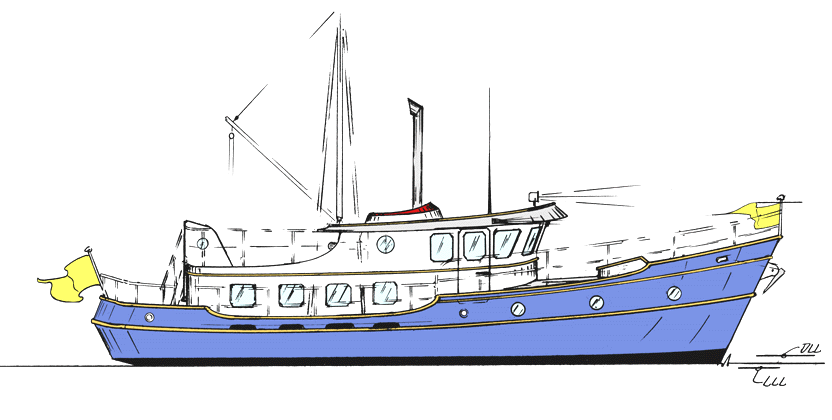
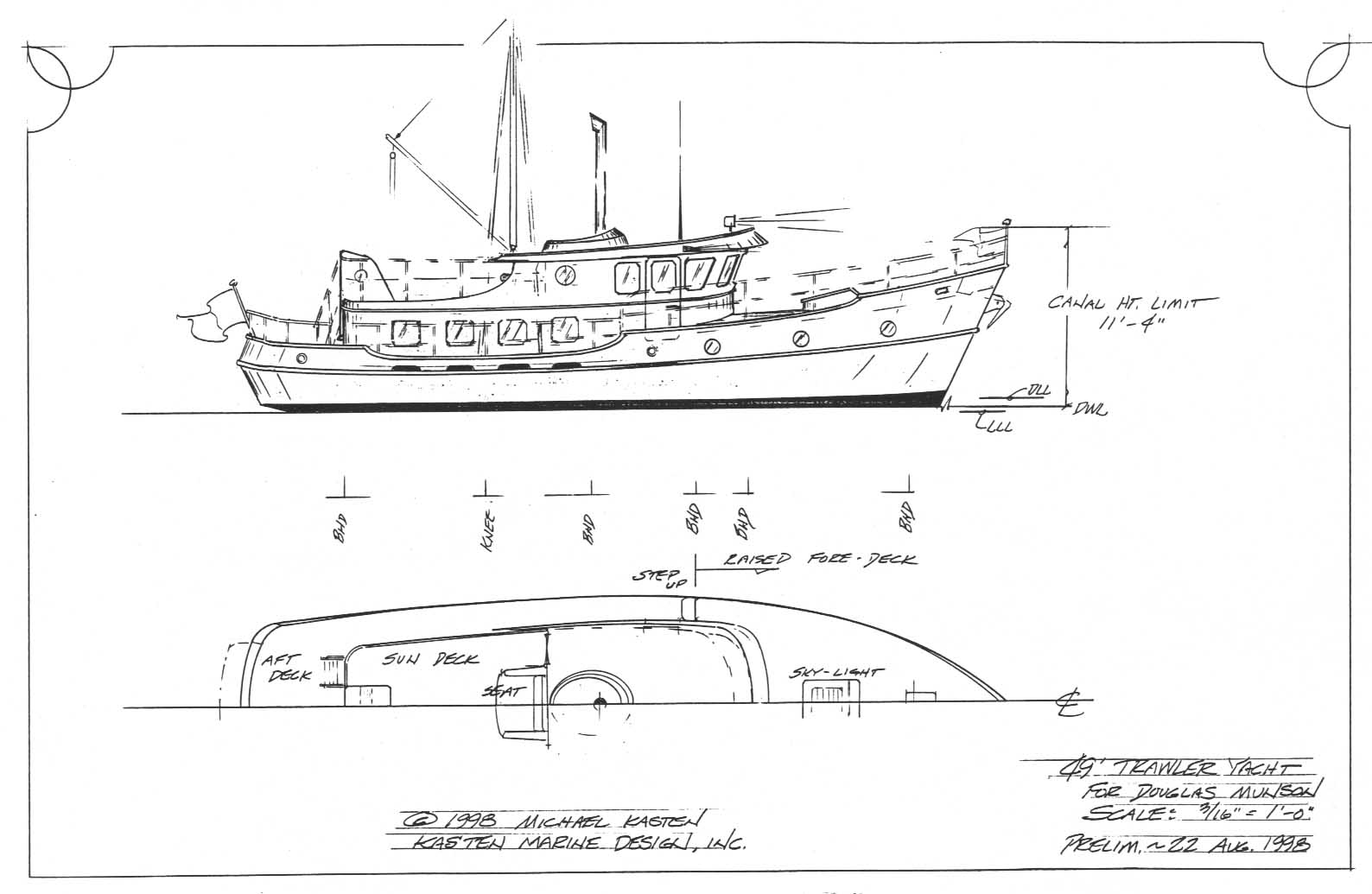
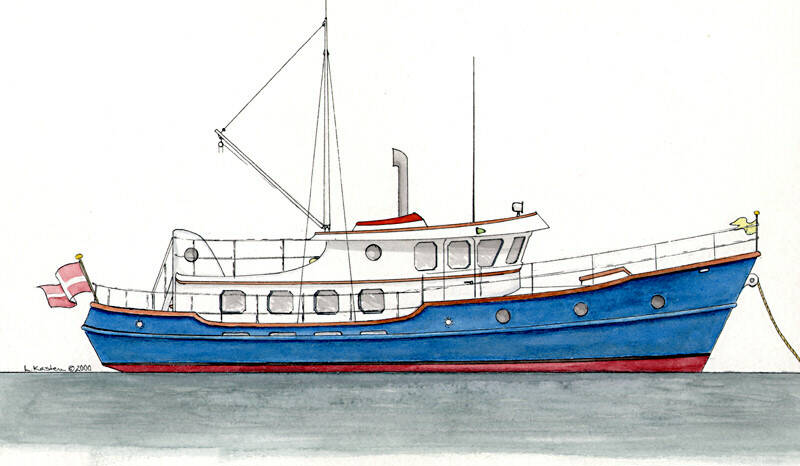
49' Monsoon Study Drawing | 49' Monsoon Watercolor Image
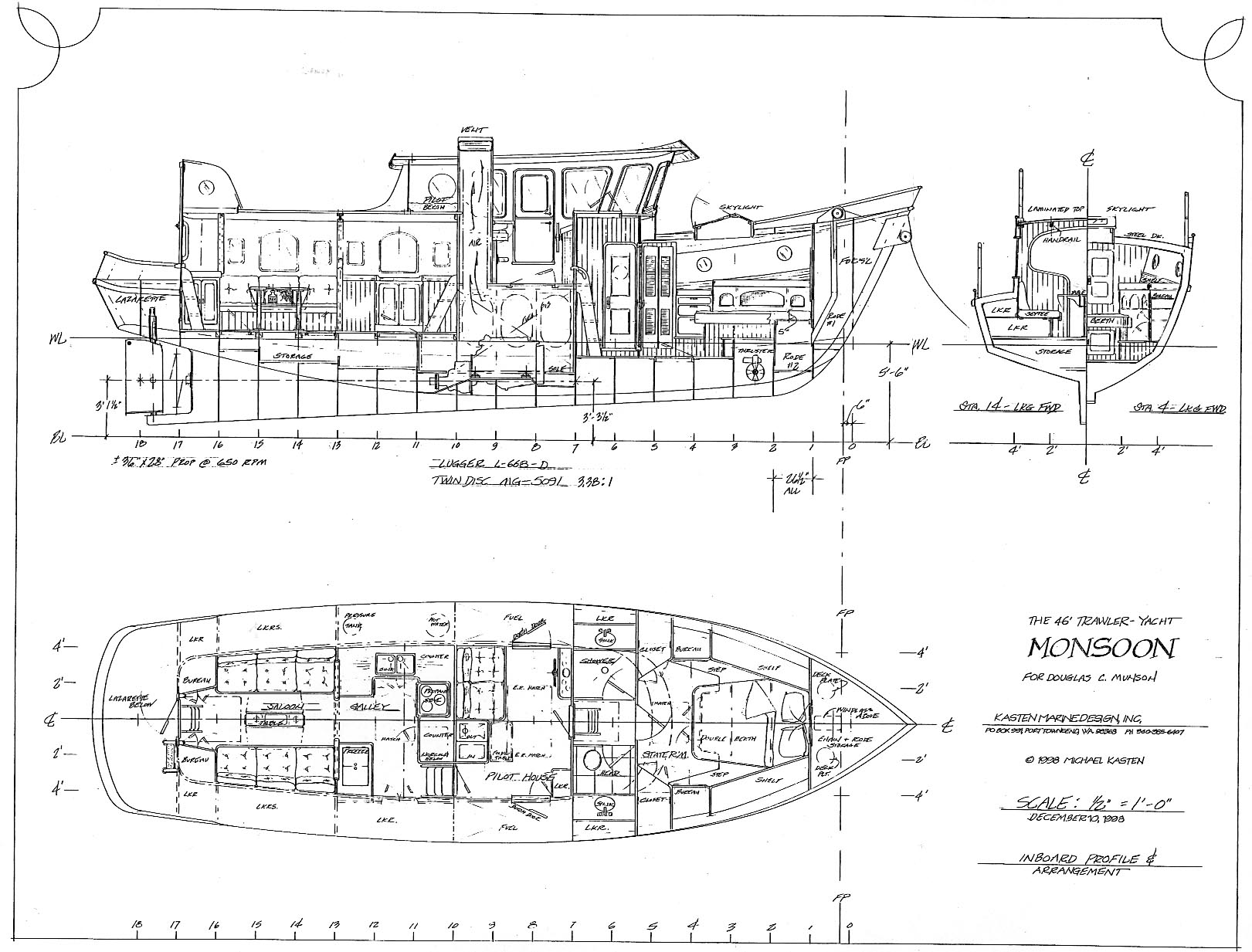
46' Monsoon Outboard Profile | 46' Monsoon Interior P & ACopyright 2002 - 2011 Michael Kasten
General Concept
Monsoon was designed for a couple with occasional guests for coastal cruising in US and European waters. The concept was to create a comfortable family trawler yacht with a 'midship wheel house, generous forward stateroom, and aft saloon & galley. Above drawing shows the original study drawing we created for the 49' Monsoon.
In order to squeeze the interior requirements into the least possible size, a slightly shorter version was developed at 46 feet LOA. In my view, the three extra feet in the 49 footer provide a vast improvement both aesthetically and functionally - and at little if any difference in cost. The longer waterline allows faster running for the same horsepower, therefore a slightly longer range; a bit of added room in each compartment; and a considerably more graceful appearance. There being no practical, nor even any rational advantage to making the vessel shorter, we have elected to discontinue the 46' version of the Monsoon design in favor of the 49' version.
Particulars of the Monsoon 49 are: 49' LOA x 41' 3" DWL x 13' - 6" Beam x 4' - 11" Loaded Draft. With a design displacement of 43,250# the 49' Monsoon is of relatively light weight for her length. Displacement will vary from around 39,000# light, to a full load capacity of 52,000# with tanks full, ready for a voyage.
Though the layout of the 46' version is shown in the above links, the layout of the 49' version is identical - except that the 49' version has just a bit more space dedicated to each compartment. In either case the hull, deck, and house structures are steel, with cold moulded wood pilot house top. The wood house top is more or less standard on our steel vessels under around 50 or so feet LOA. Primarily this is to save weight and to simplify construction. It also has the advantage of keeping the hull open during fabricating and painting - a big plus for the builder... All aluminum construction is also equally possible, in which case the house top would be metal.
In metal vessels, we make use of integral tanks throughout, which saves weight, saves space, increases tank capacity, allows better access to the hull, easier maintenance, and makes for simpler, easier construction.
Accommodations
The layout makes use of a forward cabin extending from just forward of the 'midships pilot house to the bow. The fore cabin top extends the full width of the ship. This provides the greatest amount of interior space, the largest open deck area, the greatest forward freeboard and the most reserve stability.
Within the forward cabin is the owner's stateroom with a generous queen berth. To starb'd is a head, and to port a shower.
Aft of the owner's cabin / head / shower is a weather tight companionway and a ladder leading up to the pilot house, located at the same level as the exterior side decks.
To starb'd and aft in the pilot house is a weather tight companionway that leads aft and down a ladder to the aft cabin. At the base of the ladder is a short passage leading to the galley.
The galley extends across the full width of the vessel. Within the galley forward is a long counter that houses a refrigerator and the stove. The galley counter wraps around to port and aft. A double stainless deep sink is located to port. In the starb'd part of the galley is a deep freeze.
A structural bulkhead right aft of the galley separates the galley from the saloon. The bulkhead is arranged for maximum strength as well as the maximum open area between galley and saloon. Passage aft is on center.
The saloon has a settee to port and to starb'd with a table located between them, securely fixed to the cabin sole. The table contains storage for wine and spirits, and has a folding leaf on both sides to allow easy passage fore and aft.
The settees are intended to function as pilot berths during passages, and as guest sleeping quarters at other times. Lee cloths are provided for secure sleeping at sea. A curtain is arranged to provide privacy between the galley and the saloon. Aft of the settee berths are a pair of bureaus for general storage. Between the two bureaus is the companionway ladder leading up and aft to the after deck through a water tight scuttle.
Layout On Deck
Substantial bulwarks and toe rails surround all the exterior decks. The aft deck has sufficient room for a pair of folding chairs and a small folding table to be placed there for casual seating. A 36" high railing extends around the after deck and along the side decks, with an opening for boarding both port and starb'd.
To starb'd of the scuttle leading forward into the aft house is a ladder leading upward to the aft house top. The aft house top accommodates simple seating and an on-deck table. A 36" high railing extends around the perimeter of the house top. Under way, a skiff is stowed on top of the house. An A-Frame mast supports paravane poles on either side.
Forward of the pilot house is a large foredeck which is clear except for the two sky-lights, the windlass / anchor arrangement, and the cleats, bitts and dorades.
Propulsion
The specified engine is a Lugger or John Deere 6 cylinder naturally aspirated diesel of approximately 115 hp continuous at 2,200 rpm. The gear is a Twin Disc having a 3:1 reduction and a 28 inch 3 blade fixed propeller. This combination was chosen for the sake of ruggedness, extreme simplicity, and for the sake of economy in building. The engine space is very adequate, and enough extra room has been allowed for the optional placement of a generator. Sufficient fuel is provided for a Bermuda / Azores crossing from the US to Europe, giving a range of 2,000 NM at an S/L of 1.2. An additional pair of long range saddle tanks are also possible, giving a full 3,000 NM range for the longer passage from the US west coast to Hawaii.
Hull Form
The hull is modeled after the Pacific Northwest commercial fishing vessels but with a much finer overall form. A single chine shape has been chosen for ease of construction in steel, and for better roll attenuation. A fine entry combined with a long graceful run aft provide a very easily driven hull. Prismatic has been optimized for the anticipated Speed to Length range during coastal ocean and inshore cruising.
The steel rudder is heavy duty and is well supported. The rudder is a balanced design for minimal stress on the steering gear. A NACA 0012 series foil shape is used for low drag and maximum turning angle without stalling. An end plate is used on the rudder bottom for greater steering efficiency, and a hole is provided for withdrawal of the propeller shaft.
Further Development
This is quite a versatile design, which improves dramatically as the vessel gets longer. As a further development of this design we have explored a version of the Monsoon at 60 feet, which offers a larger saloon / dining cabin aft, and more spacious accommodations forward. A smaller version of the Monsoon 46 has been developed as the 40' Coaster, which has been built by professional and amateur builders.
For more information on this design our other trawler yacht designs, please inquire.
Please see the AVAILABLE BOAT PLANS web page.
Home | Intro | Our Design Process | Stock Design Info | Motor Yacht Designs | Sailing Yacht Designs | Prototype Designs
Plans List | Articles | Our CAD Design Stream | Maxsurf | SITE MAP..! | Site Search | Design Team | Contact Us