Messing about in boats since 1975. Online Since 1997.
Home | Intro | Our Design Process | Stock Design Info | Motor Yacht Designs | Sailing Yacht Designs | Prototype Designs
Plans List | Articles | Our CAD Design Stream | Maxsurf | SITE MAP..! | Site Search | Design Team | Contact Us
Please see the AVAILABLE BOAT PLANS web page
A 100' to 120' Cargo / Charter 'Skipjack'
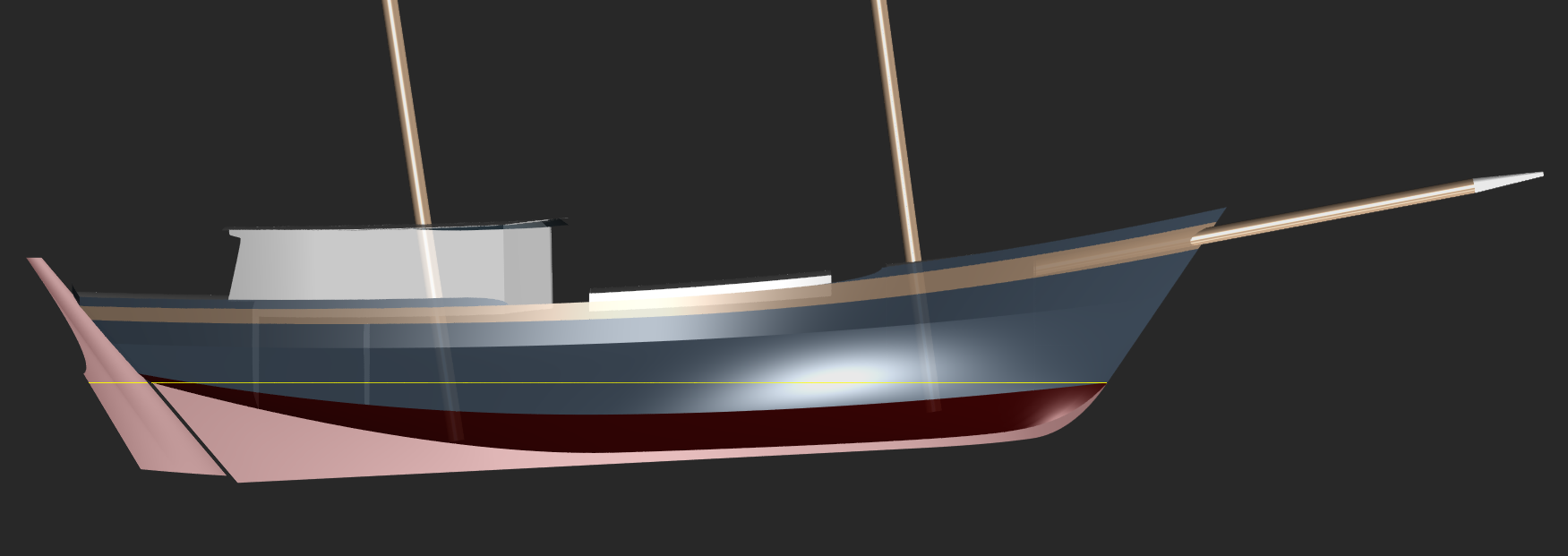
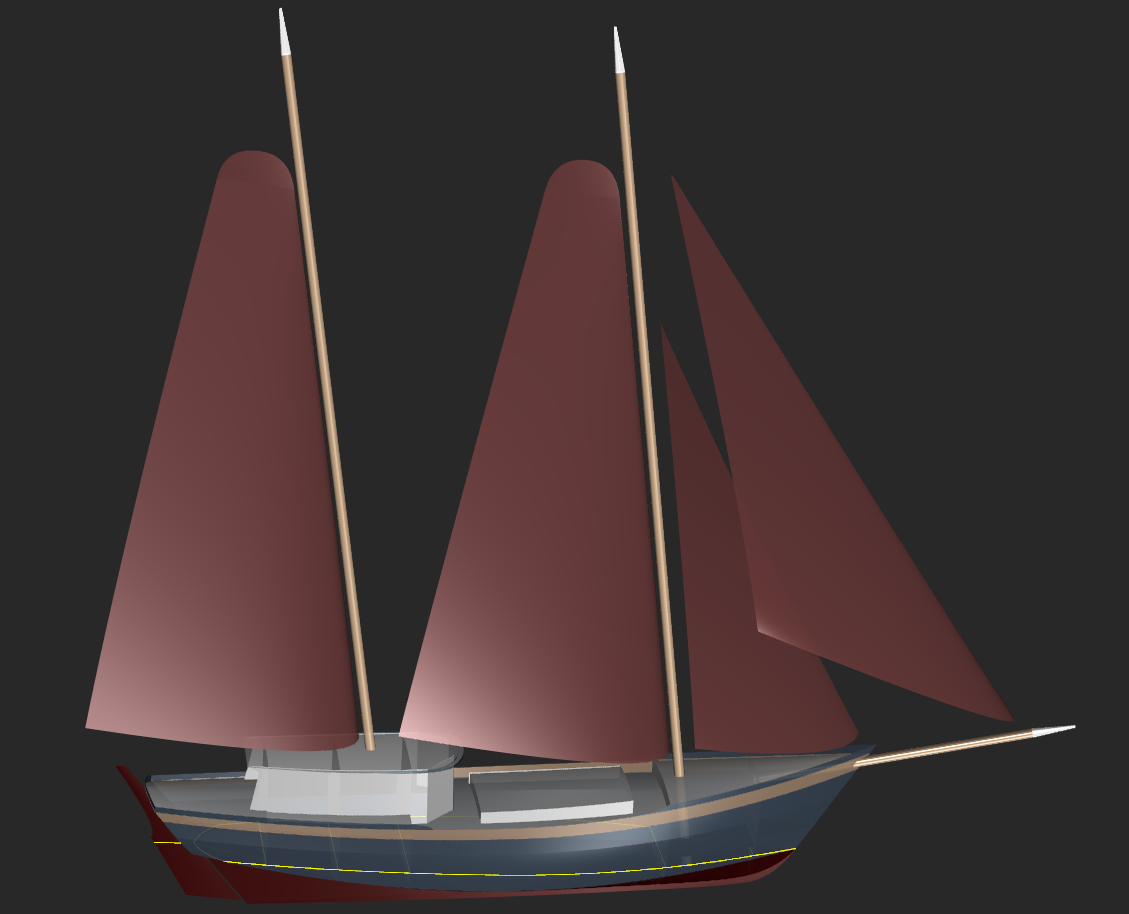
100' Aft View | 100' Side View | 100' Sailing View
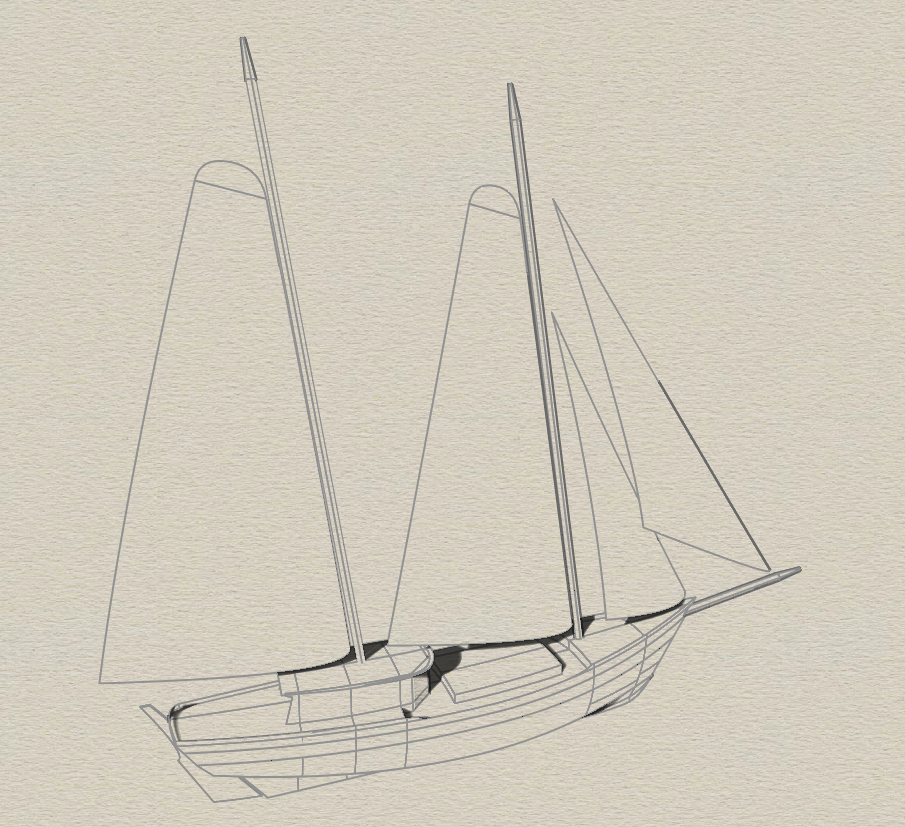
120' Side View | 120' Sailing View | 120' Artistic RenderingCopyright 2008 - 2016 Michael Kasten
General Concept
Based on a request for a classic shoal draft charter yacht of around 100 feet on deck (approximately 31 meters) with an easy to handle rig (no gaffs or tops'ls), I developed the 100' Bermuda Skipjack prototype. Then, based on another inquiry regarding the possibility of designing a 100' cargo-yacht, I developed the prototype shown above. This "Cargo Skipjack" makes use of the same hull form, but adds a cargo hold in place of the original cabins and adds a pilot house aft. As a cargo-yacht, the idea was to employ a more modest sail rig and a motor-vessel sized engine in order to take advantage of the synergy offered by motor-sailing.
Given the single chine shape inherited from the original Skipjack types, this design will be ideal for steel construction, though aluminum is equally possible. The Skipjack is perhaps the ultimate in terms of being an aesthetically refined traditional sailing vessel which has always had a single chine hull shape. No one argues with the shape, since these vessels have never been otherwise.
My original question was, "Could the original flat, wide, low freeboard Skipjack hull form actually be made suitable for the open ocean..?"
Well, not if taken too literally. In order to make this work, I adapted the hull to a new shape for its new ocean-going purpose, but without violating the aesthetic character of the original Skipjack types. My goal in so doing was to create a charter-worthy cargo-yacht that could be sailed with confidence on the oceans of the world; that preserved the original aesthetic character of the Skipjack type; and that could be very simply built and sailed.
The first concepts in this design series were my 51' to 70' Skipjack prototypes. Taking those concepts a few steps further led first to my 100' Bermuda Skipjack prototype, and in this case has led us to create a prototype design for a pair of competent cargo-yachts with the same hull form, one at 100' and one at 120' on deck length.
100' Skipjack - Click for Larger ImageSeaworthiness
In order to be a good cargo-yacht suited to the open ocean, the original Skipjack hull form was made much less flat and less wide for its overall length; the hull has been made deeper; and the topsides were given more freeboard. This latter trick was accomplished without aesthetic penalty by raising the deck to the height of the rather substantial bulwarks of the original types, and then placing a bulwark and toe rail above that.
Per the rigorous requirements of the EU-RCD, specifically the STIX criterion as outlined in ISO-12217, as long as the CG can be kept low, the adaptation of the Skipjack shown here has proven to score well within Category A, i.e. all ocean.
This is of course a much larger vessel than the STIX criterion is intended to address (maximum length of 78'), therefore we have additionally verified compliance with the MCA criteria for open ocean sailing under the Red Ensign LY3 code. In addition to that we have verified that the 120' Cargo Skipjack also complies with the relatively difficult USCG criteria for carrying passengers under sail. Both of these criteria are for carrying passengers under sail, and are much more rigorous than any of the regulatory requirements for carrying cargo.
Hull Form
Given that this design still has somewhat more beam than would a typical yacht, the initial stability is excellent, providing for stiff sailing without excessive depth of keel. The long straight keel, with slight 'drag' over its full length, provides for the ultimate in tracking at sea, while not offering too much keel below. This combination is the very best at being able to avoid broaching or being tripped by a sea. With this keel configuration, a centerboard would be ideal in order to provide more 'bite' to windward. But as a "motor-sailor" there is really no need to do so.
Alternately, if the keel were shaped differently the ballast could be lowered further. This would not necessarily make the keel deeper overall, it would just become level on the bottom, but still raked downward in the forward third. In other words, starting aft, the keel would remain at the full depth of the rudder heel for approximately 2/3 of the keel length, and then would slope upward to the depth of the stem forward. With that configuration, it would not be at all necessary to use a centerboard, vastly simplifying the whole thing, but still able to sail in the same depth of water.
The overall benefit of the Skipjack shape is its refined traditional aesthetics, combined with an economically built and easily driven hull form. Inevitably comes the question then... 'Isn't a rounded hull faster..?'
We answer this question the same way every time: A single chine shape has very slightly more wetted surface, therefore more sail area is indicated making it the equal of a rounded hull. In section, the single chine shape has just a bit more 'shoulder' below the waterline which allows the boat to carry that extra sail area without penalty in terms of heel. At speed, in particular when sailing fast down wind, the chine shape is actually faster due to being able to develop greater dynamic lift.
The single chine shape has other advantages... primarily that of being quite simple to build in metal, therefore requiring considerably less labor. In terms of speed per dollar, since one can afford to make a single chine vessel longer than one could afford to do with a rounded or multi-chine hull form, there are substantial performance gains to be had.
The 100' Cargo Skipjack
Particulars of the 100' Cargo Skipjack are:
- Length on Deck - 100'
- Beam on Deck - 28.5'
- WL Length - 85'
- Draft - just under 9' at the rudder heel
- Displacement at DWL - 168 Long Tons
The 100’ Skipjack has a preliminary carrying capacity of around 24 long tons. Maximum load for this size amounts to around 14% of the light ship displacement. At 3.9 long tons per inch of immersion, the max load implies a total immersion of 6 inches.
The 120' Cargo Skipjack
Particulars of the 120' Cargo Skipjack are:
- Length on Deck - 120'
- Beam on Deck - 33.3'
- WL Length - 100.4'
- Draft - just under 10.5' at the rudder heel
- Displacement at DWL - 276 Long Tons
The 120’ Skipjack has a preliminary carrying capacity of around 44 long tons. Maximum load amounts to around 16% of the light ship displacement. The 120’ Skipjack has an average capacity of 5.5 long tons per inch of immersion. Thus the cargo capacity of 44 tons assumes 8 inches of immersion at maximum loading. The 120’ Skipjack, when light, has a Displacement to Length ratio of 276. When loaded the D/L is 306, therefore still a medium displacement vessel even when loaded.
120' Cargo Skipjack - Click for Larger ImageSailing Rig
For the rig, in order to make good use of modern materials, the spars will ideally be fabricated using welded aluminum pipe. Alternately, at this size steel pipe masts can be very workable. The sail materials will be Dacron, and a performance oriented sail cut should be used.
As a cargo yacht, the schooner rig keeps the masts clear of the hold nicely. It could just as easily be a gaff rig, but what I’ve shown is quite a bit simpler. The rig must be kept rather low-aspect for this adventure, but it need not be shy on sail area. A modified Bugeye or modified Bermuda rig will be ideal. Aesthetically this seems to provide just the right dose of tradition, while also providing excellent performance in an easily handled rig.
I have referred to these as ‘motor-sailing’ vessels, however even though they’re intended to have a fully capable engine with all the usual motor vessel systems and fuel capacity, they are not lacking in the sailing department at all. For example, the Sail Area of the 120’ Skipjack is intended to be between 9,000 and 10,000 square feet. At 10k sq. ft. of sail, in the half load condition, the Sail Area to Displacement ratio is 22 (within an expected range of 15 to 22), and the Sail Area to Wetted Surface ratio is 3.3 (within an expected range of 2.0 to 2.5). With that, the speed potential is around 14 to 14.5 knots, so the sailing department is not lacking in any way.
Those sail area ratios are quite high, but they are calculated in the half load condition, therefore when fully loaded, though the ratios will be slightly more modest, they will still be well within the upper end of the expected range. In other words, the fully loaded sailing performance should be quite brisk. As well, the sailing will be quite stiff, at only 9 degrees of heel in 15 knots of wind directly abeam on the sails (half load condition). When deeply loaded, the CG would be lower and the heel would be less.
Typical heel for a vessel of this size is expected to be on the order of around 8 to 13 degrees, with the norm being around 10 degrees, so the design is at the stiff end of the spectrum, even without a deep keel.
Layout Options
At 120’ on deck length, the Skipjack model is able to have a cargo hatch of 25’ length by around 20’ width. The hold that I have modeled is roughly 42.5’ in length, 11 feet in height and roughly 30’ width. The hold would take four 20’ containers below, two on each side of the centerboard trunk.
Since the cargo hold must be amidships for the best balance, I have modeled a deck house aft having 7 feet of interior headroom with a bridge right forward. There is room for four cabins of 3 meters square each aft of the bridge, or two cabins and a large galley or lounge. I’ve allowed for an engine room aft of the cargo hold, with tanks on each side. Additional tanks are below the cargo hold sole. Aft of the engine room, below the deck house, that space could possibly used for the galley and a workshop, or whatever is required. Forward of the cargo hold, there is room for two crew cabins with a crew galley, mess, and ship’s laundry.
This is not a “luxury charter” layout, although certainly the cargo hold could be transformed into four or more ultra deluxe suites for charters if that were to be the preferred use. The main thing with charters is to have enough room for ample crew to pamper the guests…! As imagined, this design would achieve that requirement nicely.
Summary
This is just how the working sailors of yore would have adapted such a vessel to its new purpose, i.e. that of a safe, easily built ocean sailing craft. Whether it is an "exact" replica of a fat old oyster boat is a completely silly question. But given the proper attention to detail, no-one would even notice...!
Fast cruising, windward ability, seaworthiness, simplicity of construction, ruggedness, and a reasonable cost to build and maintain... these have been the primary goals of the design. At least in my view, those goals have been superbly met.
For more information, please inquire.
120' Cargo Skipjack - Click for Larger Image
Please see the AVAILABLE BOAT PLANS web page.
Home | Intro | Our Design Process | Stock Design Info | Motor Yacht Designs | Sailing Yacht Designs | Prototype Designs
Plans List | Articles | Our CAD Design Stream | Maxsurf | SITE MAP..! | Site Search | Design Team | Contact Us